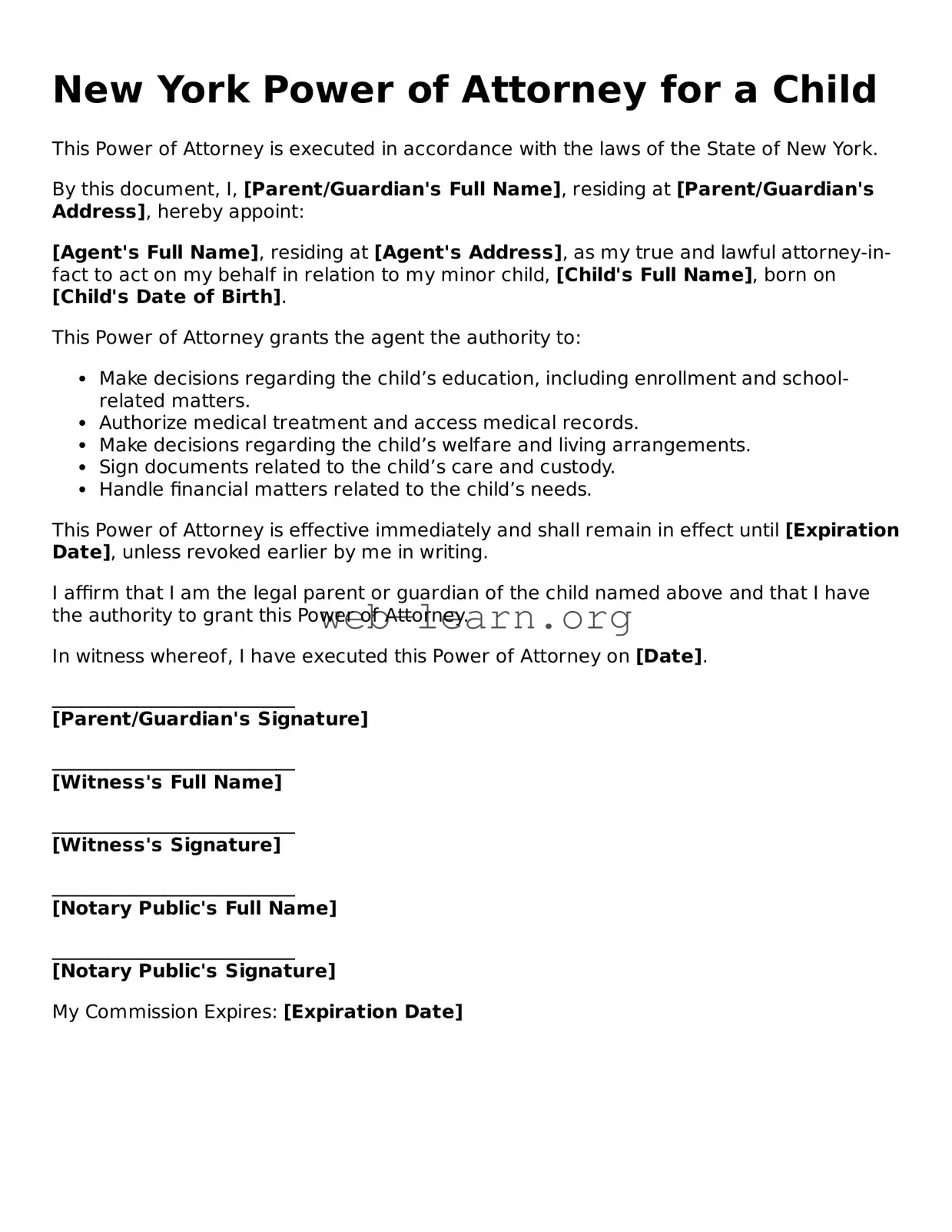
The New York Power of Attorney for a Child form serves as a crucial legal document for parents or guardians who need to delegate specific authority regarding the care and welfare of their child. This form allows a designated individual, often a relative or trusted friend, to make decisions related to the child's education, healthcare, and general well-being. By completing this document, parents can ensure that their child’s needs are met in their absence, whether for short-term situations like travel or longer-term circumstances. The form outlines the scope of authority granted, which can include enrolling the child in school, consenting to medical treatment, and handling day-to-day responsibilities. Additionally, it is important to understand that this power can be limited to a specific time frame or certain activities, providing flexibility based on individual circumstances. Proper execution of the form requires signatures from both the parent and the agent, and it is advisable to have the document notarized to enhance its validity. Understanding the nuances of this form can empower parents to make informed decisions that safeguard their child's interests when they cannot be present.
New York Power of Attorney for a Child
This Power of Attorney is executed in accordance with the laws of the State of New York.
By this document, I, [Parent/Guardian's Full Name], residing at [Parent/Guardian's Address], hereby appoint:
[Agent's Full Name], residing at [Agent's Address], as my true and lawful attorney-in-fact to act on my behalf in relation to my minor child, [Child's Full Name], born on [Child's Date of Birth].
This Power of Attorney grants the agent the authority to:
This Power of Attorney is effective immediately and shall remain in effect until [Expiration Date], unless revoked earlier by me in writing.
I affirm that I am the legal parent or guardian of the child named above and that I have the authority to grant this Power of Attorney.
In witness whereof, I have executed this Power of Attorney on [Date].
__________________________
[Parent/Guardian's Signature]
__________________________
[Witness's Full Name]
__________________________
[Witness's Signature]
__________________________
[Notary Public's Full Name]
__________________________
[Notary Public's Signature]
My Commission Expires: [Expiration Date]
| Fact Name | Description |
|---|---|
| Purpose | The New York Power of Attorney for a Child form allows a parent or guardian to designate another adult to make decisions for their child, especially in situations where the parent is unavailable. |
| Governing Law | This form is governed by New York State law, specifically under the New York General Obligations Law § 5-1501 et seq. |
| Duration | The authority granted through this form typically lasts until the child turns 18 or until the parent revokes it. |
| Revocation | Parents can revoke the Power of Attorney at any time by providing a written notice to the designated agent and any relevant parties. |
| Agent Qualifications | The designated agent must be at least 18 years old and capable of making decisions in the best interest of the child. |
| Limitations | The Power of Attorney does not allow the agent to make decisions regarding the child's education or medical care unless specifically stated. |
| Signature Requirements | The form must be signed by the parent or guardian in the presence of a notary public to be considered valid. |
Filling out the New York Power of Attorney for a Child form is a straightforward process. Once you complete the form, you'll be ready to give someone the authority to make decisions on behalf of your child when you are not available.
A Power of Attorney for a Child is a legal document that allows a parent or guardian to grant another adult the authority to make decisions on behalf of their child. This can include decisions related to education, healthcare, and other important matters. It is particularly useful when a parent is unable to care for their child temporarily, such as during travel or medical emergencies.
In New York, the agent can be any responsible adult, such as a relative, family friend, or neighbor. It is essential to choose someone trustworthy and reliable, as they will have significant responsibilities regarding the child's well-being. The agent must also be at least 18 years old and capable of understanding the duties involved.
The agent can make a variety of decisions, including:
However, the Power of Attorney can be tailored to limit or specify the scope of authority granted to the agent, depending on the parent's wishes.
The Power of Attorney for a Child remains effective until the specified expiration date, if one is included in the document. If no expiration date is mentioned, the authority typically lasts until the child turns 18 years old. Parents can revoke the Power of Attorney at any time by providing written notice to the agent.
Yes, in New York, the Power of Attorney for a Child must be signed in the presence of a notary public to be legally valid. This requirement helps ensure that the document is authentic and that the parent or guardian fully understands the implications of granting authority to another individual.
Filling out the New York Power of Attorney for a Child form can be straightforward, but mistakes are common. One frequent error occurs when individuals fail to provide complete information. Every section of the form is important. Omitting details can lead to delays or even invalidate the document.
Another mistake is not signing the form in the correct places. Each person involved must sign where indicated. If a signature is missing, the form may not be recognized by authorities. It's essential to double-check that all required signatures are present before submitting the form.
People often overlook the need for a notary public. In New York, the Power of Attorney for a Child must be notarized to be legally binding. Neglecting this step can render the document ineffective. It is wise to arrange for notarization as soon as the form is completed.
Some individuals mistakenly assume that the form is only necessary for long-term arrangements. However, it is also useful for short-term situations, such as travel or temporary guardianship. Not understanding the flexibility of the Power of Attorney can lead to missed opportunities for proper care of the child.
Finally, failing to keep copies of the completed form can be a significant oversight. It is crucial to retain copies for personal records and to provide them to relevant parties. This ensures that everyone involved has access to the necessary information when needed.
When preparing to use the New York Power of Attorney for a Child form, it’s essential to consider other related documents that may be necessary. These documents help ensure that all aspects of child care and legal authority are covered. Here are some commonly used forms:
Having these documents in place alongside the Power of Attorney for a Child form can help streamline communication and decision-making. It ensures that caregivers are prepared to handle various situations that may arise while caring for a child.
The Power of Attorney for a Child form is an essential document that allows a designated person to make decisions on behalf of a child. It shares similarities with several other legal documents. Here’s a look at eight documents that have comparable functions or purposes:
Understanding these documents can help ensure that the best interests of a child are always prioritized. Each serves a unique purpose but shares the common goal of providing support and protection for minors.
When filling out the New York Power of Attorney for a Child form, it is essential to approach the process with care and attention to detail. Below is a list of things you should and shouldn't do to ensure that the form is completed correctly and effectively.
By following these guidelines, you can help ensure that the Power of Attorney for a Child form is filled out correctly, providing peace of mind for both you and the child involved.
Understanding the New York Power of Attorney for a Child form is essential for parents and guardians. However, several misconceptions can lead to confusion. Below is a list of eight common misunderstandings regarding this important legal document.
Clearing up these misconceptions can help ensure that parents and guardians use the Power of Attorney for a Child form correctly and effectively. It is important to understand the rights and responsibilities that come with this document.
Filling out the New York Power of Attorney for a Child form is an important step for parents or guardians. Here are some key takeaways to consider:
Using the form properly can help ensure that a child's needs are met in the absence of a parent or guardian.
Does a Power of Attorney Need to Be Notarized in Arizona - It is a proactive step in planning for a child's care and well-being.
How to Get Power of Attorney in Florida - The form ensures that a trusted individual can manage a child's affairs during a parent's absence.