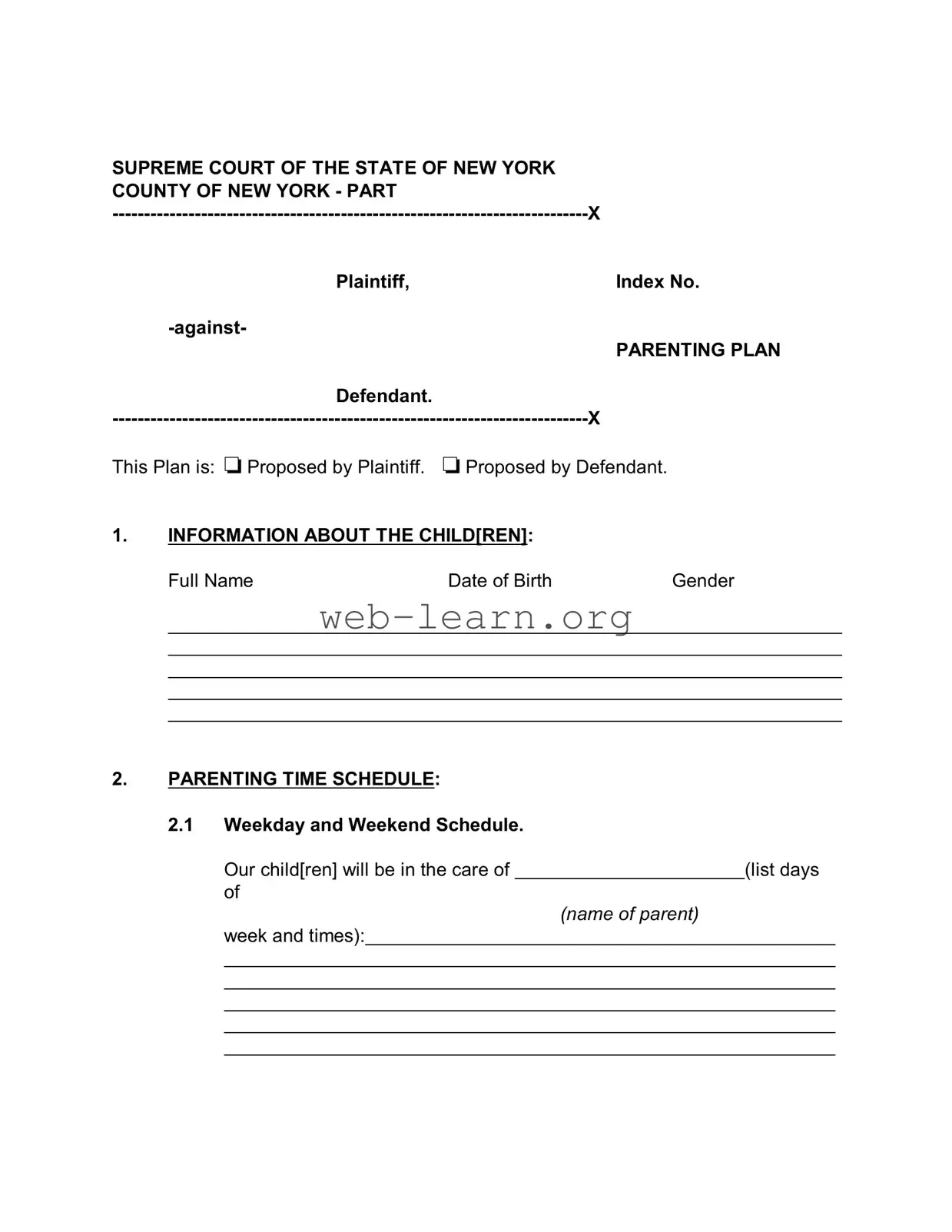
The New York Parenting Plan form serves as a crucial tool for parents navigating the complexities of co-parenting arrangements. This document facilitates a structured approach to determining how parenting responsibilities and time with children will be divided between parents. It begins by gathering essential information about the child or children involved, including their names, dates of birth, and genders. The form then outlines the parenting time schedule, which details the specific days and times each parent will care for the children during weekdays, weekends, and summer months. Additionally, it addresses how holidays will be shared, ensuring that both parents have the opportunity to spend meaningful time with their children during significant occasions. The form includes provisions for special considerations, such as adjustments to the schedule during holidays or school breaks, and emphasizes the importance of maintaining a consistent routine for the children. By clearly delineating these aspects, the New York Parenting Plan form aims to promote cooperation and communication between parents while prioritizing the well-being of the children involved.
SUPREME COURT OF THE STATE OF NEW YORK
COUNTY OF NEW YORK - PART
X |
|
Plaintiff, |
Index No. |
PARENTING PLAN
Defendant.
This Plan is: Proposed by Plaintiff. Proposed by Defendant.
1.INFORMATION ABOUT THE CHILD[REN]:
Full Name |
Date of Birth |
Gender |
|
|
|
|
|
|
|
|
|
|
|
|
|
|
|
2.PARENTING TIME SCHEDULE:
2.1Weekday and Weekend Schedule.
Our child[ren] will be in the care of |
|
(list days |
||
of |
(name of parent) |
|||
week and times): |
||||
|
|
|||
|
|
|
|
|
|
|
|
|
|
|
|
|
|
|
|
|
|
|
|
|
|
|
|
|

Our child[ren] will be in the care of |
|
(list |
days
(other parent’s name)
of week and times):
2.2Summer Schedule.
Choose One:
The schedule described above in Section 2.1 will continue throughout the summer except that
OR
The schedule for time with our child[ren] will be different during the summer than it is in the winter (describe below):
Our child[ren] will be in the care of |
|
(list |
(name of parent)
days of the week and times):
AND
Our child[ren] will be in care of |
|
(list days |
(other parent’s name)
of the week and times):
PARENTING PLAN REV 6/13 |
page 2. |
2.3Holiday Schedule.
The following holiday schedule will take priority over the regular weekday, weekend, and summer schedules discussed above. If a holiday is not specified as even, odd or every year with one parent, then our child[ren] will remain with the parent they are normally scheduled to be with.
Check One or Both:
When parents are using an alternating weekend plan and the holiday schedule would result in one parent having the child[ren] for three weekends in a row, the alternating weekend pattern will restart, so neither parent will go without having the child[ren] for more than two weekends in a row.
If a parent has our child[ren] on a weekend with an unspecified holiday or
Fill in the blanks below with the parent’s name to indicate where the child[ren] will be for the holidays. Provide beginning and ending times.
Holidays |
Even Years |
|
Odd Years Every Year |
Beginning/Ending Times |
|||||
Mother’s Day |
|
|
|
|
|
|
|
|
|
Father’s Day |
|
|
|
|
|
|
|
|
|
Thanksgiving |
|
|
|
|
|
|
|
For Thanksgiving, |
|
Christmas Eve |
|
|
|
|
|
|
|
Christmas Eve, |
|
|
|
|
|
|
|
|
Christmas, New |
||
Christmas |
|
|
|
|
|
|
|
Year’s Eve, and |
|
|
|
|
|
|
|
|
New Year’s, PROVIDE |
||
New Year’s Eve |
|
|
|
|
|
|
|
ADDITIONAL DETAILS |
|
|
|
|
|
|
|
|
BELOW in SECTIONS |
||
New Year’s |
|
|
|
|
|
|
|
2.4 and 2.5 |
|
|
|
|
|
|
|
|
|
|
|
Martin Luther |
|
|
|
|
|
|
|
|
|
King Day |
|
|
|
|
|
|
|
|
|
President’s Day |
|
|
|
|
|
|
|
|
|
PARENTING PLAN REV 6/13 |
page 3. |

Easter
Memorial Day
Fourth of July
Labor Day
Halloween
Veteran’s Day
Other:
2.4Thanksgiving. Details for sharing time with the child[ren] during this holiday are:
2.5Winter Break (Christmas, New Year’s, and School Vacation).
Choose One:
Our child[ren] will be in the care of each parent according to the schedule described in Section 2.1.
OR
Our child[ren] will spend half of Winter Break with each parent on a schedule that is consistent with the alternating holidays described above.
OR
Other: Details for sharing time with the child[ren] during Christmas Eve, Christmas Day, New Year’s Eve and New Year’s Day and school vacation are:
PARENTING PLAN REV 6/13 |
page 4. |

2.6Spring Break.
Choose One:
Our child[ren] will be in the care of each parent according to the schedule described in Section 2.1.
OR
Our child[ren] will alternate spending spring break with each parent (indicate which parent).
With
With
OR
Our child[ren] will spend half of spring break with each parent (provide details):
2.7Child[ren]’s Birthdays. Choose One:
Our child[ren] will be in the care of each parent according to the schedule described in Sections 2.1 and 2.2.
OR
Our child[ren]’s birthdays will be planned so that both parents participate in the birthday celebration.
OR
PARENTING PLAN REV 6/13 |
page 5. |

Our child[ren] will celebrate birthdays according to the following plan (indicate which parent has the child[ren], and any other important details.:
2.8Other Holiday and Vacations. Details for sharing time with the child[ren] during other holidays or vacation are:
2.9Number of Overnights.
Our schedule for sharing time with our child[ren] results in our child[ren]
spending |
|
|
overnights in the home of |
|
(name of |
|||
one parent) and |
|
|
overnights in the home of |
|
|
|
||
(name of other parent). |
|
|
||||||
2.10Primary Residence (Optional).
We agree that our child[ren] shall primarily reside with (name of one parent).
We agree that neither residence shall be considered the “primary” residence.”
2.11Alternate Care (Optional).
We choose not to specify arrangements for alternate care.
Our arrangements for alternate care are:
PARENTING PLAN REV 6/13 |
page 6. |

2.12Temporary Changes to the Schedule.
Any schedule for sharing time with our child[ren] may be changed as long as both parents agree to the changes ahead of time in writing OR
verbally (choose one).
Activities scheduled during the other parent’s time must be coordinated with the other parent.
Makeup and Missed Parenting Time: Only substantial medical reasons will be considered sufficient for postponement of parenting time. If a child is ill and unable to spend time with a parent, a makeup parenting time will be scheduled. If a parent fails to have the child[ren] during their scheduled parenting time for any other reason, there will be no makeup of parenting time unless the parties agree otherwise in writing.
2.13Permanent Changes to the Schedule.
We understand that, once the judge signs the final judgment in our case and approves this Parenting Plan, any changes that we do not agree on can be made only by applying to the court and proving that there has been a “change in circumstance.”
Before applying to the court, we understand that we can agree to try to resolve our dispute through mediation or other means.
3.
3.1
Each parent will make
3.2.Major Decisions.
PARENTING PLAN REV 6/13 |
page 7. |

Major decisions include, but are not limited to, decisions about our child[ren]’s education,
Choose One: |
|
|
(parent’s name) shall have sole |
OR
Both parents will share in the responsibility for making major decisions about our child[ren]. This arrangement is known by the courts as Joint Custody.
AND |
(Choose One). |
||
|
|
|
(Parent’s name) shall always consult with the |
other parent prior to making major decisions. |
|||
|
|
|
(Parent’s name) shall have the option to consult |
with the other parent prior to making major decisions.
OR
Other - - Describe how major decisions will be handled; including dividing the responsibility for major decisions between the parents according to each parent’s strengths/weaknesses:
4.INFORMATION SHARING:
Unless there is court order stating otherwise:
Both parents are entitled to important information regarding our child[ren]
PARENTING PLAN REV 6/13 |
page 8. |

including but not limited to, our child[ren]’s current address and telephone number, education, medical, governmental agency, psychological and law enforcement records.
Information about our child[ren]’s progress in school and any school activity is equally available to both parents. Both parents are encouraged to consult with school staff concerning our child[ren]’s welfare and education.
Both parents will immediately notify each other regarding any emergency circumstances or substantial changes in the health of our child[ren].
Both parents will provide each other with contact numbers and addresses and will notify each other of any change in that information within 72 hours of such a change. If either parent takes our child[ren] from their usual place of residence, they will provide the other parent with an emergency contact phone number.
5.RELOCATION OF A PARENT:
5.1Neither parent shall relocate outside his/her immediate vicinity without the prior permission of the other parent or an order of the court.
5.2Other:
6.
Choose One:
Both parents and child[ren] shall have the right to communicate by telephone, in writing or by
OR
PARENTING PLAN REV 6/13 |
page 9. |

Procedures for telephone, written or
7.EXCHANGE OF OUR CHILD[REN]:
7.1 Choose One:
Both parents will share equally in the responsibility of exchanging our child[ren] from one parent to the other while parents continue to reside in the same locale.
OR
Procedures for exchanging our child[ren] (provide details):
7.2Both parents shall have the child[ren] ready on time with sufficient clothing packed and ready at the
All clothing that accompanied our child[ren] shall be returned to the other parent.
8.MUTUAL RESPECT:
Parents will not say things or knowingly allow others to say things in the presence of our child[ren] that would take away our child[ren]’s love and respect for the other parent.
9.OTHER TERMS:
Add any other items regarding the child[ren] you would like to include in your
PARENTING PLAN REV 6/13 |
page 10. |
| Fact Name | Details |
|---|---|
| Governing Law | The New York Parenting Plan form is governed by New York Domestic Relations Law. |
| Purpose | This form helps parents outline a parenting plan for their child(ren) after separation or divorce. |
| Child Information | It requires full names, dates of birth, and genders of the child(ren) involved. |
| Parenting Time Schedule | Parents must provide detailed schedules for weekdays, weekends, and holidays. |
| Holiday Prioritization | The holiday schedule takes precedence over regular schedules to ensure fair time-sharing. |
| Summer Schedule | Parents can choose to maintain the regular schedule or create a different one for summer months. |
| Child's Birthdays | Parents can decide whether to share birthday celebrations or follow the regular parenting schedule. |
Once you have gathered the necessary information, follow these steps to fill out the New York Parenting Plan form accurately. Ensure that all details are correct, as this plan will guide the arrangements for your child(ren).
What is the purpose of the New York Parenting Plan form?
The New York Parenting Plan form is designed to outline the parenting arrangements for children following a separation or divorce. It helps both parents agree on important aspects of their children's lives, including custody, visitation schedules, and holiday plans. This form serves as a guideline to ensure that the children's best interests are prioritized and that both parents are on the same page regarding their responsibilities.
Who should fill out the Parenting Plan form?
Both parents should collaborate to fill out the Parenting Plan form. It can be proposed by either the plaintiff or the defendant in a court case. Open communication is essential to create a plan that works for everyone involved, particularly the children. Each parent should contribute their preferences and considerations to ensure that the plan reflects their joint decisions.
What information is required about the child(ren)?
The form requires basic information about the child or children, including:
This information helps clarify who the parenting plan pertains to and is necessary for legal documentation.
How is the parenting time schedule structured?
The parenting time schedule is divided into sections for weekdays, weekends, summer, and holidays. Parents will specify:
This structured approach ensures clarity and helps prevent misunderstandings regarding time spent with the children.
What should be included in the holiday schedule?
The holiday schedule should outline how parenting time will be divided during specific holidays. Parents need to indicate:
Including these details is crucial for maintaining consistency and ensuring that both parents are aware of their responsibilities during holiday periods.
What happens if parents cannot agree on the Parenting Plan?
If parents cannot agree on the Parenting Plan, they may need to seek mediation or legal assistance. Courts can also become involved to help determine the best arrangement for the children. It is essential to prioritize the children's well-being and reach a resolution that serves their best interests.
Filling out the New York Parenting Plan form can be a daunting task, and many make mistakes that could impact their custody arrangements. One common error is failing to provide complete information about the child or children. This includes not listing full names, dates of birth, and gender. Incomplete information can lead to confusion and delays in processing the plan.
Another mistake is neglecting to clearly outline the parenting time schedule. Parents often forget to specify the days and times each parent will care for the children. This lack of detail can result in misunderstandings and disputes later on. It’s crucial to be as specific as possible to avoid any ambiguity.
Some parents mistakenly choose the wrong summer schedule option. It’s essential to carefully consider whether the summer schedule will remain the same as the regular schedule or if it will differ. Choosing the wrong option can complicate summer arrangements and lead to conflicts.
Additionally, many overlook the holiday schedule. Parents frequently forget to indicate how holidays will be shared, which can lead to disagreements during important family occasions. Filling out this section accurately ensures that both parents are on the same page regarding holiday plans.
Another common error is failing to provide specific details for sharing time during holidays. For example, parents often skip providing beginning and ending times for each holiday, leaving the schedule open to interpretation. This can create tension and confusion during the holiday season.
Some individuals also neglect to indicate their preferences for special occasions, such as their child’s birthday. It’s vital to communicate how birthdays will be celebrated to ensure both parents can participate. Ignoring this aspect can lead to feelings of exclusion and resentment.
Moreover, parents sometimes forget to review the entire form before submission. Missing out on reviewing can lead to overlooked errors or incomplete sections. A thorough review can catch mistakes that may have been missed during the initial filling out of the form.
Lastly, many parents do not seek legal advice when completing the Parenting Plan form. Consulting with a legal professional can provide clarity and guidance, ensuring that the plan is comprehensive and meets all legal requirements. This oversight can have significant consequences down the line.
Being aware of these common mistakes can help parents create a more effective and clear Parenting Plan. Taking the time to fill out the form correctly is crucial for the well-being of the children involved.
The New York Parenting Plan form is an essential document for parents navigating custody arrangements. Alongside this form, several other documents are commonly used to provide a comprehensive understanding of parenting responsibilities and rights. Below is a list of these documents, each with a brief description.
These documents work together with the Parenting Plan to create a clear framework for co-parenting. They help ensure that both parents understand their roles and responsibilities, ultimately benefiting the child(ren) involved.
The New York Parenting Plan form shares similarities with several other documents that outline parenting arrangements and custody agreements. Below is a list of eight such documents, detailing how each is comparable.
When filling out the New York Parenting Plan form, it is essential to approach the task with care. Here are some key points to consider:
Understanding the New York Parenting Plan form can be challenging, especially with the various assumptions people often make about it. Here are nine common misconceptions that deserve clarification:
By dispelling these misconceptions, parents can better navigate the complexities of the New York Parenting Plan form and work towards a cooperative co-parenting relationship.
Filling out the New York Parenting Plan form is a crucial step for parents navigating custody arrangements. Here are some key takeaways to keep in mind:
By keeping these points in mind, parents can create a comprehensive and effective parenting plan that serves the best interests of their child(ren).