In the bustling landscape of New York's business environment, having a solid foundation is essential for any limited liability company (LLC). One of the key documents that serve this purpose is the New York Operating Agreement form. This form outlines the internal workings of the LLC, detailing the rights and responsibilities of its members. It covers crucial aspects such as ownership percentages, profit distribution, and management structure, ensuring that all members are on the same page. Additionally, the agreement addresses how decisions will be made, how disputes will be resolved, and what happens if a member decides to leave the company. By establishing these guidelines, the Operating Agreement not only protects the interests of the members but also provides clarity and stability for the business as it grows and evolves. Understanding the nuances of this document is vital for anyone looking to establish a successful LLC in New York.
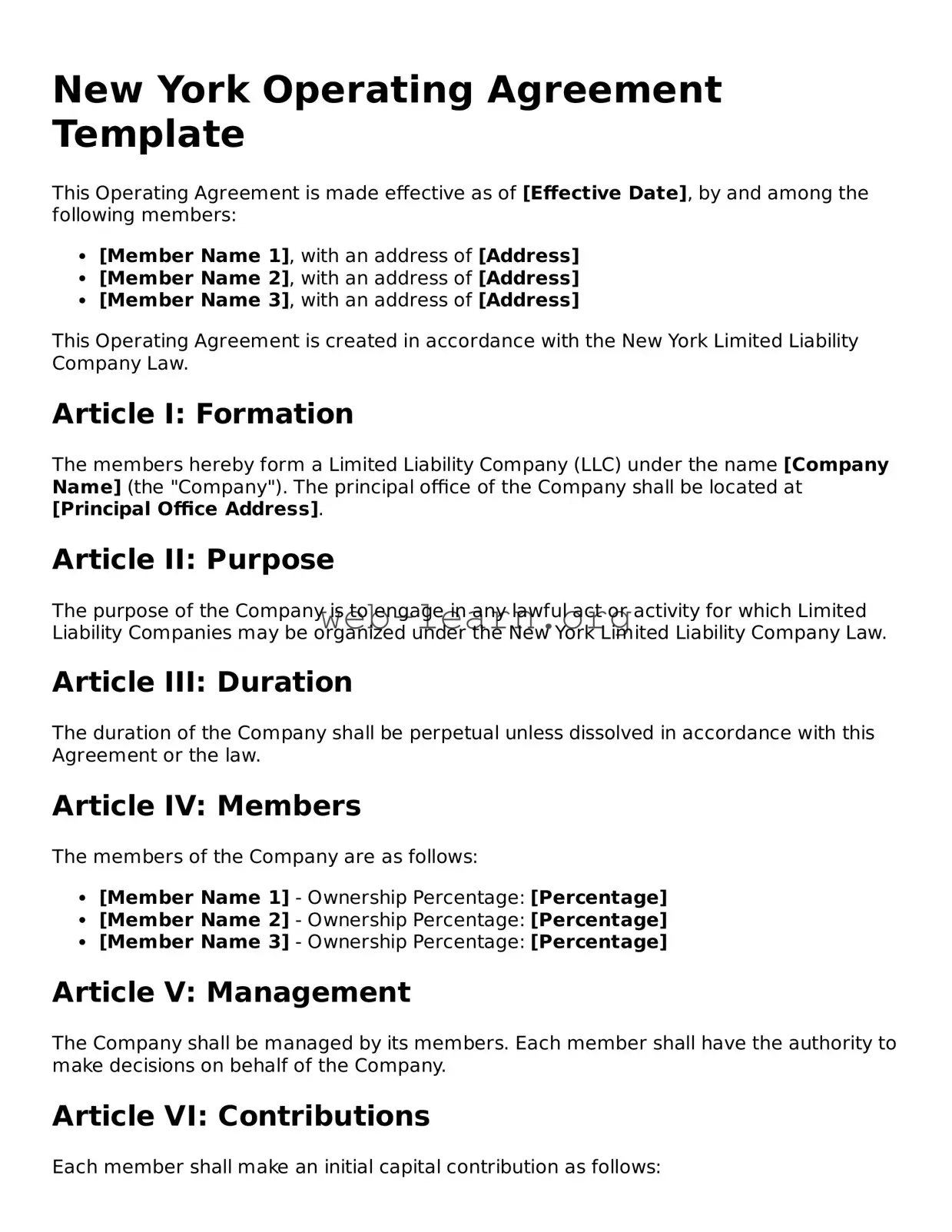
New York Operating Agreement Template
This Operating Agreement is made effective as of [Effective Date], by and among the following members:
This Operating Agreement is created in accordance with the New York Limited Liability Company Law.
Article I: Formation
The members hereby form a Limited Liability Company (LLC) under the name [Company Name] (the "Company"). The principal office of the Company shall be located at [Principal Office Address].
Article II: Purpose
The purpose of the Company is to engage in any lawful act or activity for which Limited Liability Companies may be organized under the New York Limited Liability Company Law.
Article III: Duration
The duration of the Company shall be perpetual unless dissolved in accordance with this Agreement or the law.
Article IV: Members
The members of the Company are as follows:
Article V: Management
The Company shall be managed by its members. Each member shall have the authority to make decisions on behalf of the Company.
Article VI: Contributions
Each member shall make an initial capital contribution as follows:
Article VII: Distributions
Distributions shall be made to the members in proportion to their respective ownership percentages.
Article VIII: Indemnification
The Company shall indemnify any member or manager against any loss or liability incurred in connection with the Company, to the fullest extent permitted by law.
Article IX: Amendments
This Operating Agreement may be amended only by a written agreement signed by all members.
Article X: Governing Law
This Agreement shall be governed by and construed in accordance with the laws of the State of New York.
IN WITNESS WHEREOF, the members have executed this Operating Agreement as of the date first above written.
______________________________
[Member Name 1]
______________________________
[Member Name 2]
______________________________
[Member Name 3]
| Fact Name | Details |
|---|---|
| Purpose | The New York Operating Agreement outlines the management structure and operating procedures for a limited liability company (LLC). |
| Governing Law | This agreement is governed by the New York Limited Liability Company Law. |
| Member Rights | It specifies the rights and responsibilities of each member, including profit distribution and decision-making processes. |
| Flexibility | Members can customize the agreement to suit their specific needs, as long as it complies with state laws. |
| Not Mandatory | While not required by law, having an Operating Agreement is highly recommended to prevent disputes and clarify expectations. |
Completing the New York Operating Agreement form is an essential step for organizing a limited liability company (LLC). This document outlines the management structure and operational guidelines for the LLC. Follow the steps below to ensure that the form is filled out correctly.
Once the form is completed, it should be reviewed for accuracy. After ensuring that all information is correct, the next step is to keep a copy for your records and distribute copies to all members. This will help maintain transparency and accountability within the LLC.
What is a New York Operating Agreement?
A New York Operating Agreement is a legal document that outlines the management structure and operating procedures of a Limited Liability Company (LLC) in New York. It serves as an internal guideline for the members of the LLC, detailing their rights, responsibilities, and obligations. While not required by law, having an Operating Agreement is highly recommended as it helps prevent misunderstandings and disputes among members.
Why is an Operating Agreement important?
An Operating Agreement is crucial for several reasons:
Who should draft the Operating Agreement?
The Operating Agreement can be drafted by any member of the LLC, but it is advisable to consult with a lawyer to ensure that it meets all legal requirements and adequately reflects the members' intentions. A well-drafted agreement will address specific needs and concerns unique to your business and its members.
Can the Operating Agreement be changed?
Yes, the Operating Agreement can be amended. Changes may be necessary as the business grows or as members' circumstances change. To amend the agreement, members typically need to follow the procedures outlined within the existing Operating Agreement. This may involve a vote or written consent from all members, depending on what is specified in the document.
When individuals or groups decide to form a limited liability company (LLC) in New York, they must complete an Operating Agreement. This document outlines the management structure and operational procedures of the LLC. However, many people make common mistakes when filling out this form, which can lead to confusion or even legal issues down the line.
One frequent error is failing to clearly define the roles and responsibilities of each member. It’s essential to specify who will manage the company and what authority each member holds. Without this clarity, disagreements may arise, leading to operational inefficiencies. Members might assume different roles, which can create conflicts and hinder decision-making.
Another common mistake is neglecting to include provisions for profit and loss distribution. Members should explicitly state how profits and losses will be allocated among them. If this is left vague or unspecified, it could result in disputes later on, especially when the business starts generating income.
Some individuals overlook the importance of including a buy-sell agreement. This provision outlines the process for a member who wishes to leave the LLC or sell their interest. Without such an agreement, the remaining members may find themselves in a difficult position if a member decides to exit unexpectedly.
Additionally, many people fail to address what happens in the event of a member's death or incapacity. It’s crucial to have a plan in place for how the LLC will continue to operate under these circumstances. A lack of foresight in this area can lead to chaos and uncertainty for the remaining members.
Another mistake involves not updating the Operating Agreement as the business evolves. As the company grows or changes, it’s important to revisit and revise the agreement to reflect new circumstances. Failing to do so can result in outdated provisions that no longer serve the best interests of the members.
Some individuals also make the mistake of not having the agreement signed by all members. An unsigned agreement may not hold up in legal disputes, which undermines its effectiveness. Every member should review and sign the document to ensure that everyone is on the same page.
Lastly, individuals sometimes neglect to consult with a legal professional when drafting the Operating Agreement. While it may seem like a straightforward task, having an expert review the document can help identify potential issues and ensure compliance with New York laws. This step can save time and resources in the long run.
When forming a limited liability company (LLC) in New York, the Operating Agreement is a crucial document. However, it is often accompanied by several other forms and documents that help establish the legal and operational framework of the business. Below is a list of common documents that are typically used alongside the New York Operating Agreement.
These documents work together to ensure that an LLC operates smoothly and in compliance with state laws. While the Operating Agreement lays out the rules for internal governance, the other documents help define the structure and responsibilities within the company. Understanding each of these forms is vital for anyone looking to establish a successful LLC in New York.
The Operating Agreement is a key document for limited liability companies (LLCs). It outlines the management structure and operating procedures. Several other documents serve similar purposes in different contexts. Below is a list of documents that share similarities with an Operating Agreement:
When filling out the New York Operating Agreement form, it's essential to approach the task with care. This document outlines the structure and rules of your limited liability company (LLC), so getting it right is crucial. Here are six important dos and don'ts to consider:
By following these guidelines, you can help ensure that your New York Operating Agreement is both effective and compliant with state regulations.
Operating agreements are essential documents for limited liability companies (LLCs) in New York. However, several misconceptions surround their use and purpose. Understanding these misconceptions can help business owners navigate the complexities of forming and operating an LLC.
Many believe that a single-member LLC does not require an operating agreement. However, having one is still advisable. It outlines the owner's rights and responsibilities, providing clarity and protection in case of future disputes.
Some people think that operating agreements must be filed with the state and are therefore public records. In reality, operating agreements are internal documents. They do not need to be filed with the New York Department of State, keeping them confidential.
While there are recommended elements to include, there is no mandated template for an operating agreement in New York. Each LLC can tailor its agreement to suit its unique needs, allowing for flexibility in governance.
Some believe that amendments to the operating agreement can only occur under specific circumstances. In fact, members can amend the agreement at any time, as long as they follow the procedures outlined within the document itself.
This misconception suggests that only larger companies need an operating agreement. In truth, all LLCs, regardless of size, benefit from having one. It helps establish clear operational guidelines and protects members' interests.
Some may think that simply adhering to state law makes an operating agreement unnecessary. However, state laws provide a default framework that may not align with the specific needs of an LLC. An operating agreement allows members to customize their governance structure and operational procedures.
Filling out and using the New York Operating Agreement form is an important step for any business entity. Here are some key takeaways to keep in mind:
How to Write an Operating Agreement - The Operating Agreement can establish the rules for financial contributions to the LLC.
How to Write an Operating Agreement - The Operating Agreement can specify the duration of the LLC’s existence.