In the dynamic landscape of employment law, the New York Non-compete Agreement form plays a pivotal role in defining the boundaries of professional relationships. This document, often utilized by employers to protect their business interests, outlines the conditions under which an employee agrees not to engage in similar work or start a competing business within a specified timeframe and geographic area after leaving their job. Key elements of the form include the duration of the restriction, the geographic scope, and the specific activities that are prohibited. Additionally, the agreement must be reasonable in terms of its limitations to be enforceable under New York law. Employers are tasked with ensuring that their non-compete agreements are not overly broad, as overly restrictive terms can lead to legal challenges and potential invalidation. Conversely, employees must understand their rights and the implications of signing such agreements, as they can significantly impact future employment opportunities. Thus, the New York Non-compete Agreement form serves not only as a protective measure for businesses but also as a critical document that shapes the career trajectories of countless individuals.
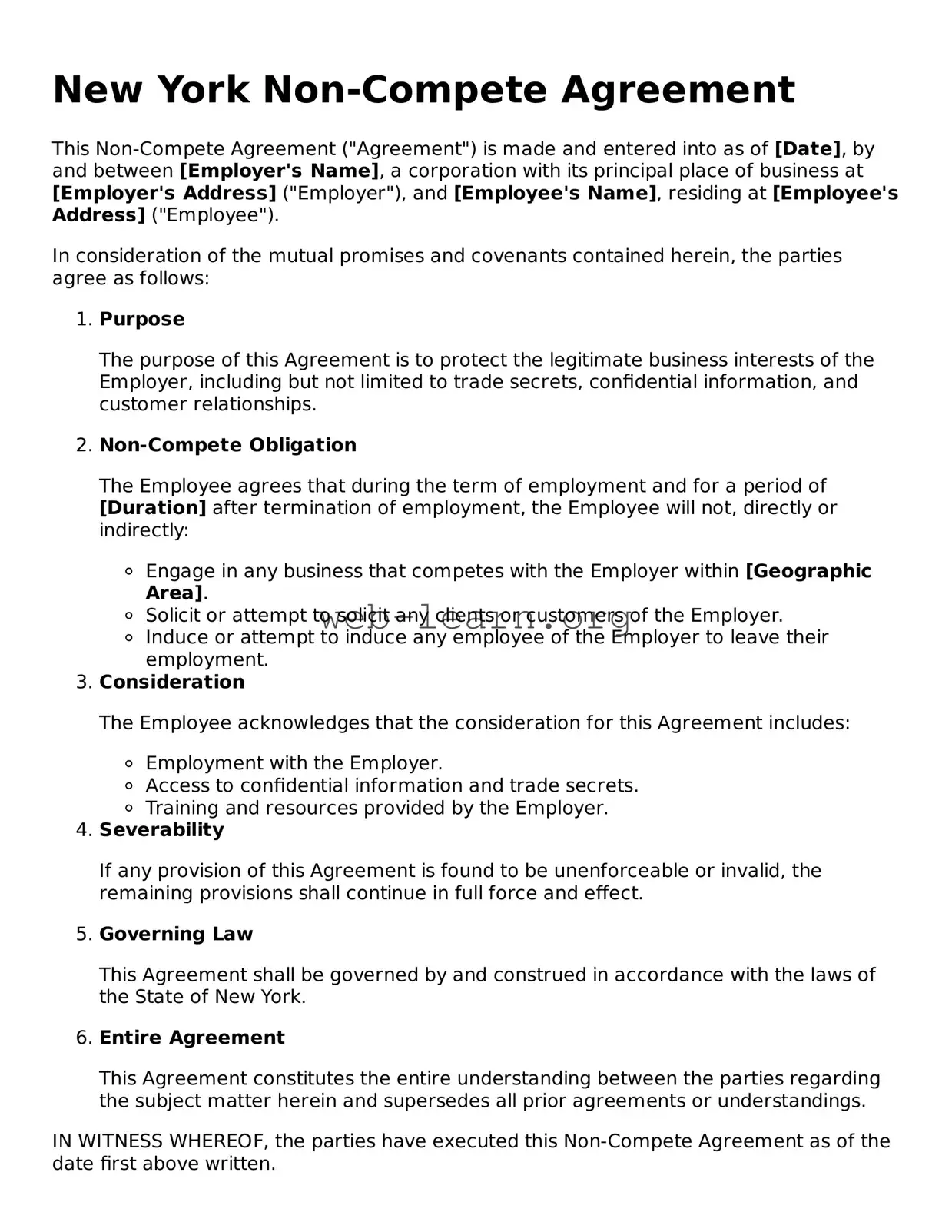
New York Non-Compete Agreement
This Non-Compete Agreement ("Agreement") is made and entered into as of [Date], by and between [Employer's Name], a corporation with its principal place of business at [Employer's Address] ("Employer"), and [Employee's Name], residing at [Employee's Address] ("Employee").
In consideration of the mutual promises and covenants contained herein, the parties agree as follows:
The purpose of this Agreement is to protect the legitimate business interests of the Employer, including but not limited to trade secrets, confidential information, and customer relationships.
The Employee agrees that during the term of employment and for a period of [Duration] after termination of employment, the Employee will not, directly or indirectly:
The Employee acknowledges that the consideration for this Agreement includes:
If any provision of this Agreement is found to be unenforceable or invalid, the remaining provisions shall continue in full force and effect.
This Agreement shall be governed by and construed in accordance with the laws of the State of New York.
This Agreement constitutes the entire understanding between the parties regarding the subject matter herein and supersedes all prior agreements or understandings.
IN WITNESS WHEREOF, the parties have executed this Non-Compete Agreement as of the date first above written.
Employer: _______________________________
Employee: _______________________________
Date: _______________________________
| Fact Name | Description |
|---|---|
| Definition | A non-compete agreement is a contract that restricts an employee from working for competitors or starting a competing business for a specified period after leaving the company. |
| Governing Law | New York law governs non-compete agreements, primarily under common law principles. |
| Enforceability | In New York, non-compete agreements are enforceable if they are reasonable in duration, geographic scope, and necessary to protect legitimate business interests. |
| Duration | Typically, non-compete agreements in New York are valid for a duration of up to one year, although longer periods may be justified in certain circumstances. |
| Geographic Scope | The geographic area covered by a non-compete must be limited to where the employer operates and where the employee had significant contact. |
| Consideration | For a non-compete agreement to be valid, there must be consideration, such as a job offer, training, or access to proprietary information. |
| Judicial Scrutiny | Courts in New York closely scrutinize non-compete agreements, often striking down those deemed overly restrictive or not serving a legitimate business purpose. |
| Alternatives | Employers may consider using non-solicitation agreements or confidentiality agreements as alternatives to non-compete clauses, as they are generally easier to enforce. |
After obtaining the New York Non-compete Agreement form, you will need to fill it out accurately to ensure it meets your needs. Follow the steps below to complete the form correctly.
Once completed, review the form for accuracy and clarity before finalizing it. Ensure that all parties retain a copy for their records.
What is a Non-compete Agreement in New York?
A Non-compete Agreement is a legal contract between an employer and an employee. It restricts the employee from working for competitors or starting a similar business within a certain timeframe and geographic area after leaving the company. In New York, these agreements must be reasonable in scope and duration to be enforceable.
Are Non-compete Agreements enforceable in New York?
Yes, Non-compete Agreements can be enforceable in New York, but they must meet specific criteria. The agreement must protect legitimate business interests, such as trade secrets or customer relationships. Additionally, the restrictions imposed should not be overly broad or harsh, making it difficult for the employee to find work.
What factors determine the enforceability of a Non-compete Agreement?
Several factors influence whether a Non-compete Agreement is enforceable in New York:
Can an employee negotiate a Non-compete Agreement?
Yes, employees can negotiate the terms of a Non-compete Agreement. It’s advisable to discuss any concerns or desired changes with the employer before signing. Adjustments can include shortening the duration, limiting the geographic area, or clarifying the scope of restricted activities.
What should I do if I believe my Non-compete Agreement is unfair?
If you think your Non-compete Agreement is unreasonable or unfair, consider consulting with an employment attorney. They can help assess the agreement's terms and your specific situation. If necessary, they may assist you in negotiating changes or challenging the agreement's enforceability.
What are the consequences of violating a Non-compete Agreement?
Violating a Non-compete Agreement can lead to legal consequences. Employers may seek damages, which could include lost profits or other financial losses resulting from the violation. In some cases, they may also pursue an injunction to prevent the employee from working for a competitor. Understanding the potential risks is crucial before making any decisions that could breach the agreement.
Filling out the New York Non-compete Agreement form can be a complex task, and many individuals make common mistakes that can lead to misunderstandings or even legal issues down the line. One frequent error occurs when individuals fail to clearly define the scope of the non-compete. This includes not specifying the geographic area and the duration of the agreement. Without these details, the agreement may be deemed unenforceable.
Another mistake is not considering the reasonableness of the restrictions imposed by the non-compete. Courts in New York often evaluate whether the terms are too broad or overly restrictive. If the agreement prevents an individual from working in their field for an extended period or across a large area, it may not hold up in court.
Some individuals neglect to seek legal advice before signing the agreement. Understanding one’s rights and obligations is crucial. A legal professional can provide insights into how the agreement may affect future employment opportunities and can help clarify any ambiguous language.
Additionally, people often overlook the importance of including consideration in the agreement. In legal terms, consideration refers to something of value exchanged between parties. If an employee does not receive adequate compensation or benefits in exchange for agreeing to the non-compete, the agreement may be unenforceable.
Inaccurate information is another common mistake. Individuals sometimes provide incorrect personal details, such as their name or address, which can create complications if enforcement of the agreement becomes necessary. Ensuring that all information is accurate and up-to-date is vital.
Some individuals fail to read the entire agreement before signing. Skimming through the document can lead to missing crucial terms or conditions that may have significant implications. It is essential to understand every clause and how it may impact future employment.
Another error involves not considering the specific industry or job role. Non-compete agreements should be tailored to reflect the nature of the work and the level of competition. A generic agreement may not adequately protect the interests of the employer or may unfairly restrict the employee.
People sometimes assume that a non-compete agreement is standard and therefore does not require negotiation. However, terms can often be modified. Engaging in discussions about the agreement can lead to a more balanced and fair contract.
Lastly, individuals may not keep a copy of the signed agreement for their records. Having a personal copy is important for future reference, especially if disputes arise regarding the terms of the agreement. Documenting the agreement can help clarify what was agreed upon.
In summary, avoiding these common mistakes can lead to a more effective and enforceable New York Non-compete Agreement. Careful consideration, thorough understanding, and attention to detail are essential when navigating this legal document.
When entering into a Non-compete Agreement in New York, several other documents may accompany it to ensure clarity and legal protection for both parties involved. Understanding these forms can help you navigate your contractual obligations more effectively.
Each of these documents plays a vital role in shaping the relationship between employer and employee. It's essential to review them carefully to understand your rights and obligations fully. Taking the time to ensure all forms are in order can prevent potential disputes down the line.
When filling out a Non-compete Agreement form in New York, it’s important to be mindful of certain practices that can help ensure clarity and legality. Here’s a list of dos and don’ts to guide you through the process.
Non-compete agreements can often be misunderstood, especially in a bustling business hub like New York. Here are four common misconceptions about these agreements that you should be aware of:
Understanding these misconceptions can help both employees and employers navigate the complexities of non-compete agreements more effectively.
When filling out and using the New York Non-compete Agreement form, there are several important points to consider. Here are some key takeaways:
Are Non Competes Enforceable in Louisiana - Non-compete Agreements can vary widely in their terms and conditions.
Georgia Non-compete Law - Employees should be aware that breaching a Non-compete Agreement may lead to legal consequences.