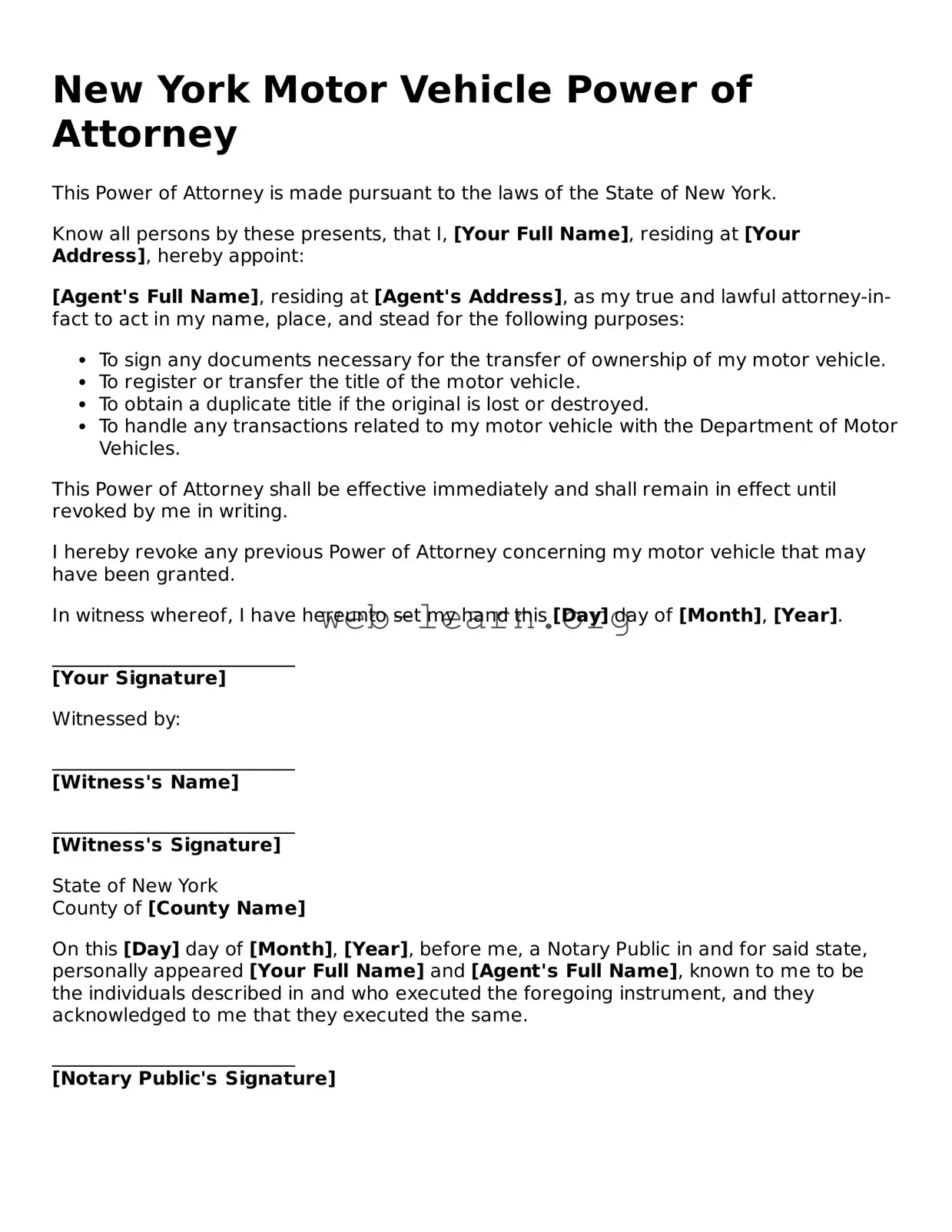
The New York Motor Vehicle Power of Attorney form serves as a crucial tool for vehicle owners who wish to delegate specific authority to another person regarding their motor vehicle transactions. This form allows an individual, known as the principal, to appoint an agent to handle tasks such as transferring ownership, registering a vehicle, or obtaining necessary documents from the Department of Motor Vehicles (DMV). By using this form, the principal can ensure that their interests are protected while enabling the agent to act on their behalf. It is important to note that the form must be completed accurately, including the names and signatures of both the principal and the agent, to be legally valid. Additionally, the scope of authority granted can be tailored to fit the principal's needs, whether for a single transaction or ongoing responsibilities. Understanding the nuances of this form can help vehicle owners navigate the often complex world of motor vehicle regulations with greater ease.
New York Motor Vehicle Power of Attorney
This Power of Attorney is made pursuant to the laws of the State of New York.
Know all persons by these presents, that I, [Your Full Name], residing at [Your Address], hereby appoint:
[Agent's Full Name], residing at [Agent's Address], as my true and lawful attorney-in-fact to act in my name, place, and stead for the following purposes:
This Power of Attorney shall be effective immediately and shall remain in effect until revoked by me in writing.
I hereby revoke any previous Power of Attorney concerning my motor vehicle that may have been granted.
In witness whereof, I have hereunto set my hand this [Day] day of [Month], [Year].
__________________________
[Your Signature]
Witnessed by:
__________________________
[Witness's Name]
__________________________
[Witness's Signature]
State of New York
County of [County Name]
On this [Day] day of [Month], [Year], before me, a Notary Public in and for said state, personally appeared [Your Full Name] and [Agent's Full Name], known to me to be the individuals described in and who executed the foregoing instrument, and they acknowledged to me that they executed the same.
__________________________
[Notary Public's Signature]
| Fact Name | Description |
|---|---|
| Purpose | The New York Motor Vehicle Power of Attorney form allows an individual to authorize another person to act on their behalf regarding motor vehicle transactions. |
| Governing Law | This form is governed by the New York State Vehicle and Traffic Law. |
| Principal | The person granting authority is known as the principal. |
| Agent | The individual receiving authority to act is referred to as the agent. |
| Notarization Requirement | The form must be signed in the presence of a notary public to be valid. |
| Specific Transactions | The agent can handle specific transactions, such as title transfers and registration renewals. |
| Duration | The authority granted can be limited to a specific time frame or until revoked. |
| Revocation | The principal has the right to revoke the power of attorney at any time, provided it is done in writing. |
| Use Cases | This form is commonly used when the principal is unable to attend a DMV appointment in person. |
Filling out the New York Motor Vehicle Power of Attorney form is a straightforward process. Once completed, this form allows you to designate someone to act on your behalf regarding your vehicle matters. Follow these steps carefully to ensure accuracy.
After completing these steps, you will be ready to submit the form to the appropriate authorities or provide it to the designated person. Ensure that you keep a copy for your records.
The New York Motor Vehicle Power of Attorney form is a legal document that allows an individual (the principal) to designate another person (the agent) to act on their behalf regarding motor vehicle transactions. This can include tasks like transferring ownership, registering a vehicle, or handling title issues.
Any competent adult can be designated as an agent. This often includes family members, friends, or trusted associates. It is important to choose someone who you trust to handle your motor vehicle matters responsibly.
Your agent can perform a variety of tasks related to your motor vehicle, including:
Yes, the New York Motor Vehicle Power of Attorney form must be notarized. This step ensures that the document is legally binding and that the identity of the principal is verified.
The form must follow the format provided by the New York DMV. You can obtain the official form from their website or at any DMV office. It is crucial to use the correct version to ensure that it is accepted for your intended purposes.
The Power of Attorney remains valid until you revoke it, or until the specific tasks outlined in the document are completed. You can revoke the Power of Attorney at any time by providing written notice to your agent.
This form is specific to New York State. If you have a vehicle registered in another state, you will need to check that state’s requirements for a Power of Attorney, as they may differ.
If you lose the form, you can fill out a new one. It is advisable to inform your agent and any relevant parties, such as the DMV, about the loss to prevent unauthorized actions.
Yes, you can appoint multiple agents, but it is essential to specify whether they must act together or if they can act independently. Clear instructions will help avoid confusion and ensure that your wishes are followed.
If you need help, consider reaching out to a legal professional or a local DMV office. They can provide guidance on how to complete the form correctly and answer any specific questions you may have.
Filling out the New York Motor Vehicle Power of Attorney form can be straightforward, but many people make common mistakes that can lead to delays or complications. One frequent error is not providing complete information. Each section of the form must be filled out accurately. Omitting details such as the vehicle identification number (VIN) or the correct name of the person being authorized can invalidate the document.
Another common mistake is using incorrect signatures. The person granting the power of attorney must sign the form, and if this signature does not match the name as it appears on the title or registration, it could cause issues. It's essential to ensure that the signatures are consistent throughout the document.
Some individuals forget to date the form. A missing date can raise questions about when the power of attorney was granted. This is crucial for establishing the timeline of authority, especially if disputes arise later. Always double-check that the date is included and accurate.
Many people also fail to have the form notarized when required. In New York, notarization is necessary for the form to be legally binding. Skipping this step can render the document ineffective. Make sure to find a notary public and have them witness the signing of the form.
Another mistake is not understanding the scope of authority being granted. The form allows you to specify what powers are being given. Be clear about whether the authority is limited to specific transactions or if it is broader. Ambiguities can lead to misunderstandings and misuse of the power granted.
Additionally, some individuals neglect to keep copies of the completed form. After filling it out and submitting it, retaining a copy for personal records is wise. This can be helpful if questions arise in the future about the authority granted or if you need to reference the document later.
Lastly, failing to review the form before submission is a significant oversight. Errors can easily be overlooked in the rush to complete the paperwork. Taking the time to carefully review the form can prevent mistakes that might complicate the process. A thorough check can save time and ensure that everything is in order.
The New York Motor Vehicle Power of Attorney form allows an individual to designate another person to act on their behalf regarding motor vehicle matters. This document is often accompanied by several other forms and documents to ensure all legal requirements are met. Below is a list of commonly used forms that complement the Power of Attorney in vehicle transactions.
Having these documents ready can streamline the process of managing motor vehicle transactions in New York. Each form serves a specific purpose and helps ensure compliance with state laws, making the transfer or registration of a vehicle smoother and more efficient.
The Motor Vehicle Power of Attorney form allows individuals to designate someone else to handle specific tasks related to their vehicle. This form is not unique; several other documents serve similar purposes in different contexts. Below are six documents that share similarities with the Motor Vehicle Power of Attorney form:
When filling out the New York Motor Vehicle Power of Attorney form, there are important steps to follow. Here’s a handy list of what to do and what to avoid.
Following these guidelines will help ensure that your Power of Attorney form is completed correctly and efficiently.
Many people have misunderstandings about the New York Motor Vehicle Power of Attorney (POA) form. These misconceptions can lead to confusion and potentially costly mistakes. Here is a list of ten common misconceptions about this important legal document:
Understanding these misconceptions can help individuals navigate the process of creating and using a Motor Vehicle Power of Attorney more effectively. Proper knowledge empowers vehicle owners to make informed decisions about their legal rights and responsibilities.
Filling out the New York Motor Vehicle Power of Attorney form can seem daunting, but it doesn’t have to be. Here are some key takeaways to keep in mind:
By following these steps, you can confidently navigate the process of using the New York Motor Vehicle Power of Attorney form.
Arkansas Dept of Motor Vehicles - The Motor Vehicle Power of Attorney simplifies the process of managing vehicle transactions without your direct involvement.
Oregon Dmv Poa - The Motor Vehicle Power of Attorney is often required by motor vehicle departments.
Idaho Dmv Power of Attorney - Having this form can provide clarity in situations where multiple parties are involved.
Ga Limited Power of Attorney - A Motor Vehicle Power of Attorney can help simplify complex vehicle transactions.