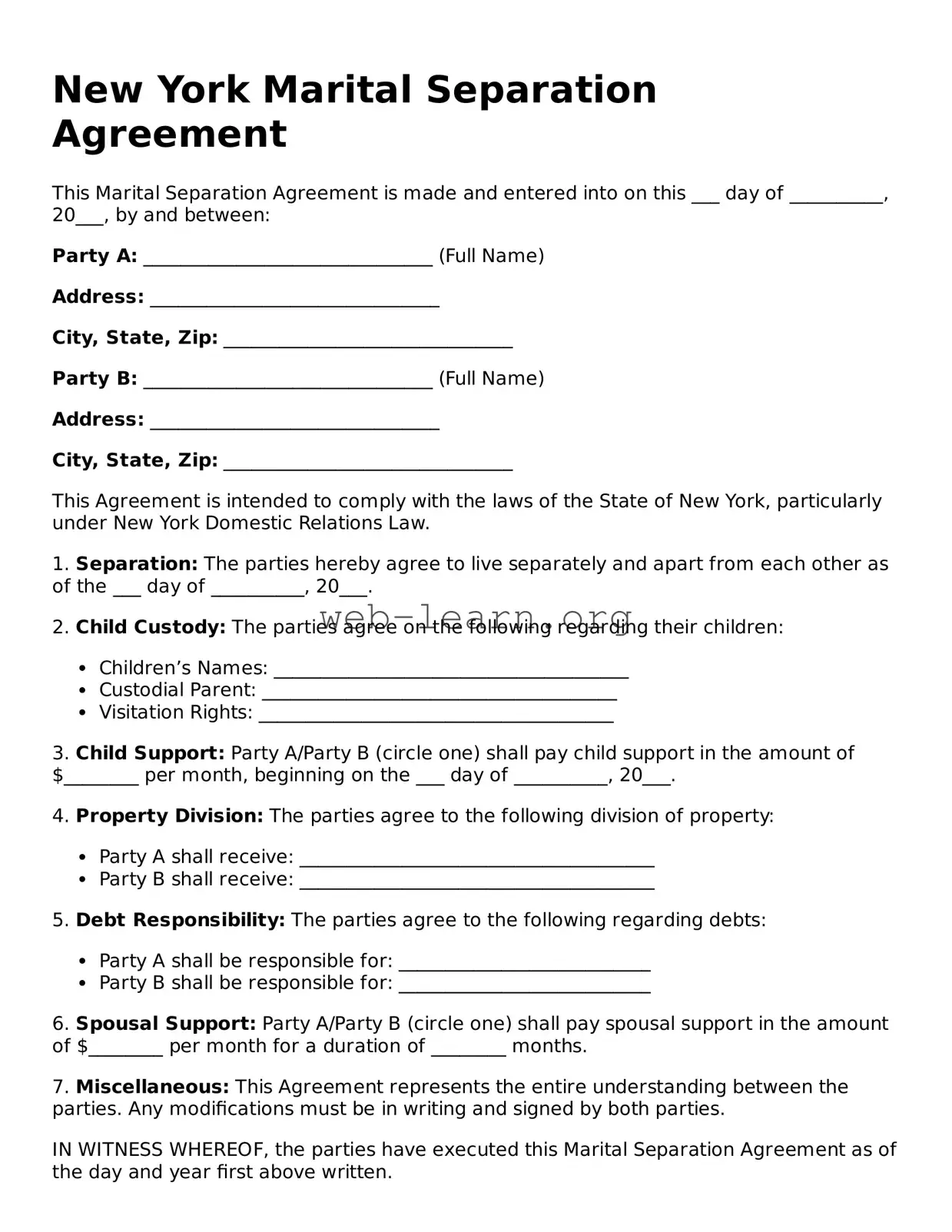
The New York Marital Separation Agreement form serves as a crucial document for couples who decide to live apart but wish to outline their rights and responsibilities during the separation period. This agreement covers a variety of important aspects, including the division of assets and debts, child custody arrangements, and spousal support obligations. By clearly delineating these elements, the form aims to minimize conflict and provide a structured approach to separation. Couples can address living arrangements, visitation schedules, and financial responsibilities, ensuring that both parties have a mutual understanding of their obligations. This document not only facilitates a smoother transition during a challenging time but also lays the groundwork for future legal proceedings, should the couple decide to pursue divorce. Understanding the nuances of this agreement can empower individuals to make informed decisions about their future and protect their interests.
New York Marital Separation Agreement
This Marital Separation Agreement is made and entered into on this ___ day of __________, 20___, by and between:
Party A: _______________________________ (Full Name)
Address: _______________________________
City, State, Zip: _______________________________
Party B: _______________________________ (Full Name)
Address: _______________________________
City, State, Zip: _______________________________
This Agreement is intended to comply with the laws of the State of New York, particularly under New York Domestic Relations Law.
1. Separation: The parties hereby agree to live separately and apart from each other as of the ___ day of __________, 20___.
2. Child Custody: The parties agree on the following regarding their children:
3. Child Support: Party A/Party B (circle one) shall pay child support in the amount of $________ per month, beginning on the ___ day of __________, 20___.
4. Property Division: The parties agree to the following division of property:
5. Debt Responsibility: The parties agree to the following regarding debts:
6. Spousal Support: Party A/Party B (circle one) shall pay spousal support in the amount of $________ per month for a duration of ________ months.
7. Miscellaneous: This Agreement represents the entire understanding between the parties. Any modifications must be in writing and signed by both parties.
IN WITNESS WHEREOF, the parties have executed this Marital Separation Agreement as of the day and year first above written.
Party A Signature: _______________________________ Date: ________________
Party B Signature: _______________________________ Date: ________________
Witness Signature: _______________________________ Date: ________________
| Fact Name | Details |
|---|---|
| Definition | A New York Marital Separation Agreement is a legal document that outlines the terms of a couple's separation. |
| Governing Law | This agreement is governed by New York State Domestic Relations Law. |
| Purpose | The agreement addresses issues such as property division, child custody, and support obligations. |
| Mutual Consent | Both parties must voluntarily agree to the terms outlined in the agreement. |
| Not a Divorce | A separation agreement does not dissolve the marriage; it only provides a framework for living separately. |
| Enforceability | Once signed, the agreement can be enforced in court, provided it meets legal requirements. |
Completing the New York Marital Separation Agreement form requires careful attention to detail. Once the form is filled out, it will serve as a legally binding document that outlines the terms of separation between spouses. The following steps will guide you through the process of filling out the form accurately.
After filling out the form, it is advisable to keep copies for both parties and file the original with the appropriate court, as required by New York law. This ensures that the agreement is recognized and enforceable in the future.
What is a New York Marital Separation Agreement?
A New York Marital Separation Agreement is a legal document that outlines the terms and conditions under which a couple agrees to live separately while remaining legally married. This agreement typically covers various aspects of the separation, including division of property, child custody, child support, and spousal support.
Why should I create a Marital Separation Agreement?
Creating a Marital Separation Agreement can provide clarity and structure during a challenging time. It helps to set expectations and responsibilities for both parties, which can reduce conflict and misunderstandings. Additionally, having a written agreement can be beneficial if either party decides to pursue divorce in the future.
What should be included in a Marital Separation Agreement?
A comprehensive Marital Separation Agreement should include:
Do both parties need to sign the agreement?
Yes, both spouses must sign the Marital Separation Agreement for it to be legally binding. It is also advisable to have the signatures notarized to add an extra layer of authenticity. This ensures that both parties have agreed to the terms voluntarily.
Can a Marital Separation Agreement be modified?
Yes, a Marital Separation Agreement can be modified if both parties agree to the changes. It is important to document any modifications in writing and have both parties sign the revised agreement. This helps to maintain clarity and ensures that both parties are on the same page.
Is a Marital Separation Agreement the same as a divorce?
No, a Marital Separation Agreement is not the same as a divorce. While it allows couples to live separately and outlines their responsibilities during that time, it does not legally terminate the marriage. Couples may choose to remain separated for a period before deciding whether to proceed with a divorce.
Completing the New York Marital Separation Agreement form can be a daunting task for many individuals. It is essential to approach this process with care to avoid potential pitfalls. One common mistake is failing to provide accurate personal information. It is crucial to ensure that names, addresses, and other identifying details are correct. Inaccuracies can lead to delays or complications in the agreement's acceptance.
Another frequent error is neglecting to address all relevant assets and debts. Individuals often overlook certain properties or financial obligations, which can create disputes later on. A comprehensive list of all marital assets and debts should be included to ensure that both parties have a clear understanding of their financial situation.
People sometimes rush through the section outlining child custody and support arrangements. This aspect of the agreement requires careful consideration. It is vital to detail the custody arrangements, visitation schedules, and financial responsibilities for the children's upbringing. Inadequate attention to these details can lead to misunderstandings and conflicts in the future.
Additionally, some individuals may fail to seek legal advice before finalizing their agreement. While it is possible to complete the form independently, consulting with a legal professional can provide valuable insights. An attorney can help clarify rights and obligations, ensuring that the agreement is fair and enforceable.
Lastly, many people forget to sign and date the agreement properly. A lack of signatures can render the document invalid. Both parties must review the agreement thoroughly and sign it in the appropriate places. This step is essential to ensure that the agreement is legally binding and recognized by the court.
A New York Marital Separation Agreement is an important document for couples who decide to live apart while addressing various aspects of their relationship. Along with this agreement, there are several other forms and documents that may be necessary to ensure a smooth separation process. Here is a list of commonly used documents:
Each of these documents plays a vital role in ensuring that the separation process is clear and manageable for both parties. Having the right paperwork can help avoid potential disputes and misunderstandings in the future.
When filling out the New York Marital Separation Agreement form, it’s essential to approach the process with care. Here are some helpful tips on what to do and what to avoid:
Understanding the New York Marital Separation Agreement form can be challenging. Several misconceptions often arise, leading to confusion for those considering separation. Here are six common misconceptions:
Many people believe that a marital separation agreement is equivalent to a divorce. In reality, a separation agreement is a legal document outlining the terms of a couple's separation, while a divorce legally ends the marriage.
Some think that a marital separation agreement holds no legal weight. However, when properly executed, it is enforceable in court, meaning both parties are expected to adhere to its terms.
There is a misconception that a separation agreement automatically includes child custody arrangements. While it can address custody, parents must explicitly outline these terms within the agreement.
Some individuals assume that only attorneys can draft a marital separation agreement. While legal advice is beneficial, couples can create their own agreements as long as they meet legal requirements.
Many believe that entering into a separation agreement means they cannot reconcile. This is not true; couples can choose to reunite or modify the agreement at any time.
There is a common belief that only couples with significant assets need a separation agreement. In reality, any couple considering separation can benefit from outlining their rights and responsibilities, regardless of financial status.
Being informed about these misconceptions can help individuals navigate the complexities of marital separation more effectively.
When filling out and using the New York Marital Separation Agreement form, consider the following key takeaways:
How to Legally Separate in Colorado - Each spouse should review the agreement carefully to ensure it meets their needs and expectations.
Legal Separation in Alabama - It can help reduce emotional stress by providing a clear structure for the separation process.
Arizona Legal Separation - A Marital Separation Agreement can help couples navigate the complexities of separation with confidence.
How Long Do You Have to Be Separated Before Divorce in Arkansas - A Marital Separation Agreement can provide a framework for future negotiations.