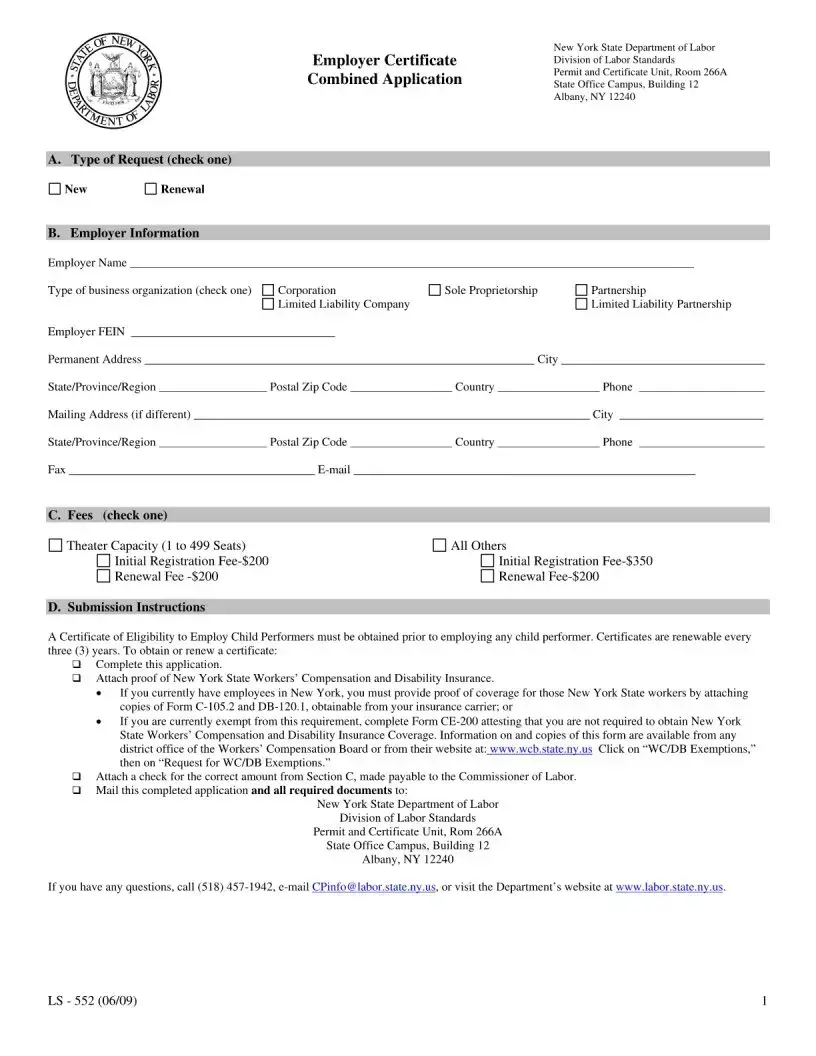
The New York LS 552 form is a critical document designed for employers seeking to hire child performers in the state. It serves as a combined application for a Certificate of Eligibility to Employ Child Performers, which is mandatory prior to the employment of any child in the entertainment industry. This form requires the employer to provide essential information, including the type of business organization, contact details, and relevant fees associated with the application process. Employers must also submit proof of New York State Workers’ Compensation and Disability Insurance, alongside other necessary documentation. The LS 552 outlines specific responsibilities for employers, such as establishing a trust account for the child performer’s earnings and ensuring that the child maintains satisfactory academic performance. Additionally, it mandates that all employed child performers possess valid employment permits. Understanding the requirements and obligations detailed in this form is vital for compliance with state laws, ensuring the protection of child performers while facilitating their employment in various entertainment sectors.
| Fact Name | Description |
|---|---|
| Form Purpose | The New York LS 552 form is used to apply for a Certificate of Eligibility to Employ Child Performers. |
| Governing Law | This form is governed by New York State Labor Laws, specifically those pertaining to the employment of minors. |
| Type of Request | Applicants can select either a new request or a renewal of an existing certificate. |
| Employer Information | Employers must provide their name, business type, FEIN, and contact information on the form. |
| Fees | The initial registration fee is $200 for theater capacity of 1 to 499 seats and $350 for all others; renewal fees are $200. |
| Submission Instructions | Completed forms must be mailed with proof of Workers’ Compensation and Disability Insurance to the Department of Labor. |
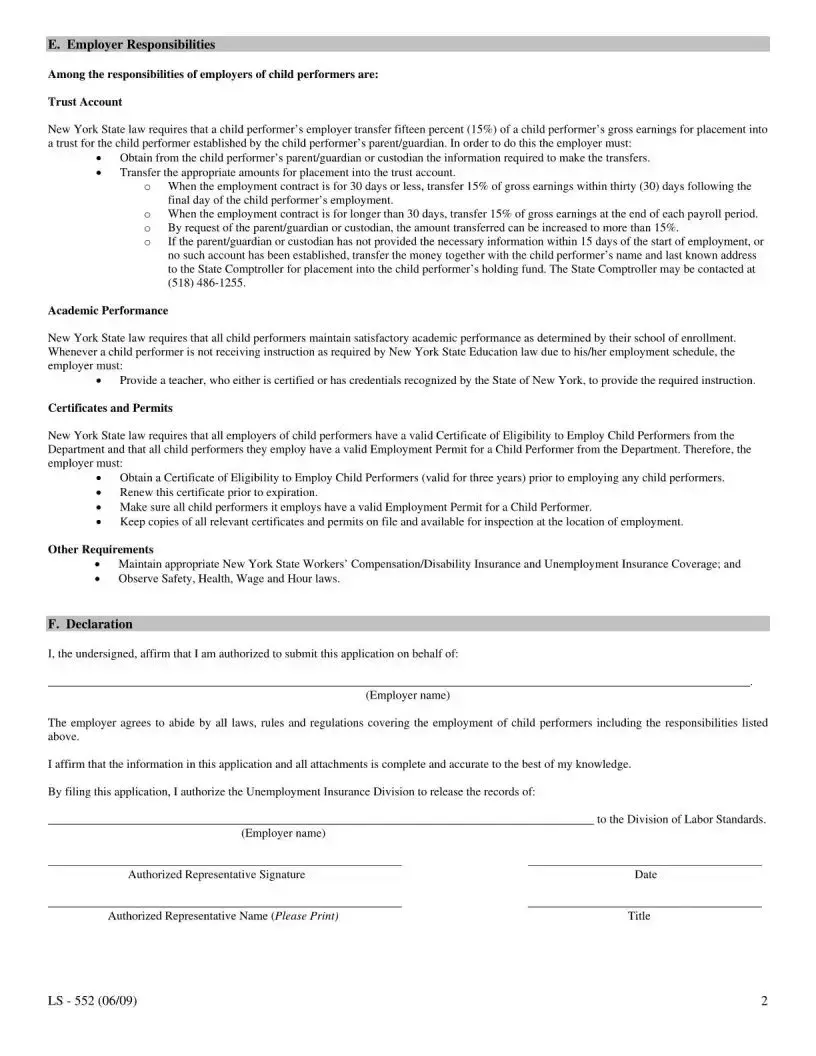
| Trust Account Requirement | Employers must transfer 15% of a child performer’s gross earnings to a trust account established by the child's guardian. |
| Academic Performance | Child performers must maintain satisfactory academic performance as determined by their school of enrollment. |
| Validity Period | The Certificate of Eligibility is valid for three years and must be renewed before expiration. |
Completing the New York LS 552 form is an important step for employers looking to hire child performers. This application helps ensure compliance with state regulations regarding the employment of minors in the entertainment industry. After filling out the form, it will need to be submitted along with required documentation to the New York State Department of Labor.
The New York LS 552 form is used to apply for a Certificate of Eligibility to Employ Child Performers. This certificate is required by employers before they can legally hire child performers in the state of New York. The certificate is valid for three years and must be renewed before its expiration.
The LS 552 form requires various details, including:
There are different fees based on the type of registration:
Employers have several key responsibilities:
To submit the LS 552 form, complete the application and attach the required documents, including proof of New York State Workers’ Compensation and Disability Insurance. Send the completed application along with a check for the appropriate fee to:
New York State Department of Labor
Division of Labor Standards
Permit and Certificate Unit, Room 266A
State Office Campus, Building 12
Albany, NY 12240
For further assistance, contact the Department at (518) 457-1942 or via email at [email protected].
Filling out the New York LS 552 form can be a straightforward process, but many individuals make common mistakes that can delay their application or result in rejection. One frequent error is failing to check the correct type of request. Applicants must indicate whether they are applying for a new certificate or a renewal. Not making this selection can lead to confusion and unnecessary delays.
Another mistake involves incomplete employer information. It is crucial to provide the employer's name, type of business organization, and Federal Employer Identification Number (FEIN). Omitting any of this information can result in processing issues. Additionally, applicants often forget to include both permanent and mailing addresses. This oversight can complicate communication with the Department of Labor.
Many applicants also struggle with the fees section. The form requires individuals to check the appropriate fee based on the theater capacity or the type of registration. Misunderstanding the fee structure can lead to submitting the wrong amount, which will delay the processing of the application.
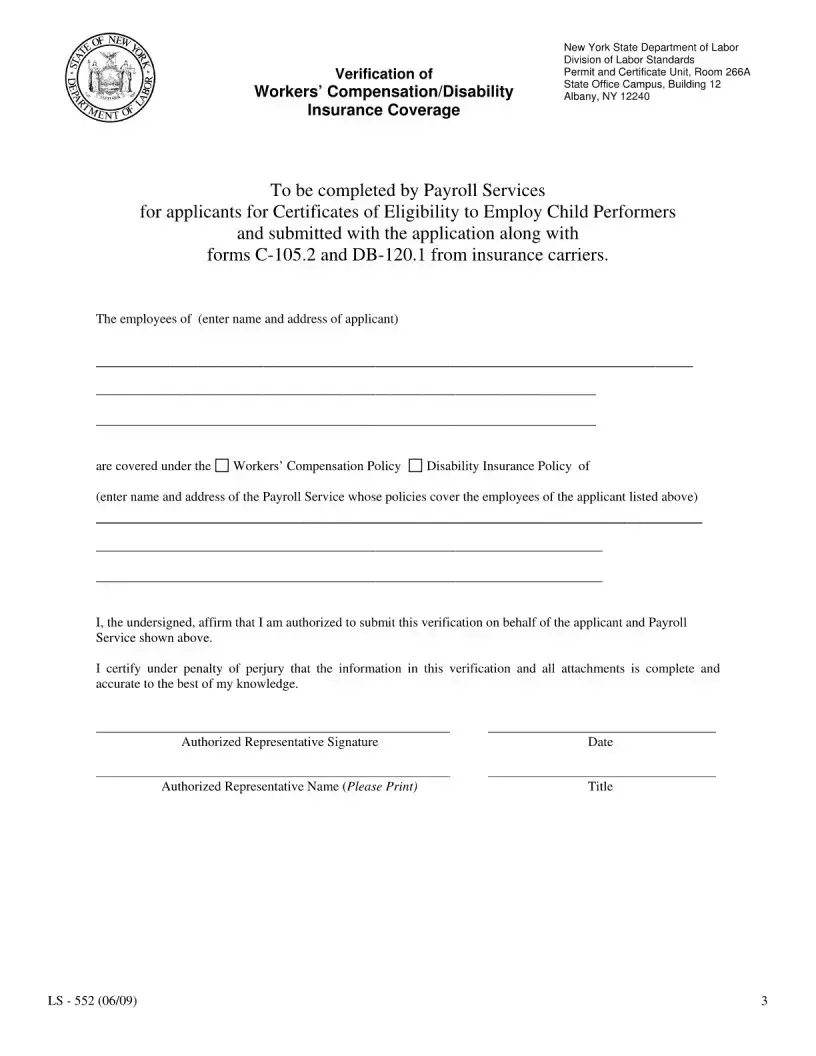
Proof of New York State Workers' Compensation and Disability Insurance is another critical component. Applicants sometimes neglect to attach the necessary documentation, such as Form C-105.2 and DB-120.1. Failing to provide this proof can result in automatic denial of the application.
Some individuals may not be aware of the exemption process. If an employer is exempt from obtaining Workers' Compensation and Disability Insurance, they must complete Form CE-200. Not doing so can lead to complications, especially if the employer believes they are exempt but fails to provide the required documentation.
Another common error is not including the payment check with the application. It is important to make the check payable to the Commissioner of Labor and to ensure that the correct fee is attached. Missing this step can result in the application being returned, causing unnecessary delays.
In terms of responsibilities, employers often overlook the requirement to maintain a trust account for child performers. New York law mandates that 15% of a child performer's gross earnings be transferred into a trust. Not fulfilling this obligation can lead to legal issues down the line.
Academic performance requirements can also be misunderstood. Employers must ensure that child performers are receiving proper educational instruction, especially if their work schedule interferes with their schooling. Failing to provide a certified teacher can lead to violations of state law.
Lastly, applicants sometimes forget to sign and date the declaration section of the form. This affirmation is essential, as it confirms that the information provided is accurate and complete. Without a signature, the application may be considered invalid, resulting in further delays.
The New York Ls 552 form is an essential document for employers seeking to hire child performers. However, it is often accompanied by several other forms and documents that ensure compliance with state regulations. Below is a list of these important documents, each serving a unique purpose in the employment process.
These forms and documents collectively help create a safe and compliant environment for child performers in New York. Employers should ensure they have all necessary paperwork in order to avoid legal complications and provide a supportive framework for young talent.
The New York Ls 552 form is essential for employers wishing to hire child performers. It is similar to several other important documents in terms of purpose and requirements. Below is a list of four documents that share similarities with the Ls 552 form:
When filling out the New York LS 552 form, it’s important to follow specific guidelines to ensure your application is processed smoothly. Here are four things you should and shouldn't do:
Many believe that only new employers need to complete the LS 552 form. However, this form is also required for renewing existing certificates every three years. Employers must stay compliant regardless of their prior status.
Submitting the form does not guarantee instant approval. The Department of Labor reviews each application, and it may take time to process. Employers should plan accordingly and submit their applications well in advance of hiring child performers.
While the employer plays a significant role, the child's parent or guardian must also provide necessary information for the trust account. Both parties share responsibility to ensure compliance with the law.
This is incorrect. Each child performer must obtain a valid Employment Permit for a Child Performer from the Department. Employers must ensure that all child performers possess this permit before employment begins.
In fact, employers must attach proof of New York State Workers’ Compensation and Disability Insurance when submitting the LS 552 form. This is a critical step in the application process.
This is a significant oversight. Employers must ensure that child performers maintain satisfactory academic performance. If employment affects their education, the employer is responsible for providing a certified teacher for required instruction.
Filling out the New York Ls 552 form requires careful attention to detail. Here are key takeaways to ensure compliance and smooth processing:
Following these guidelines will help facilitate the application process and ensure adherence to New York State laws regarding the employment of child performers.