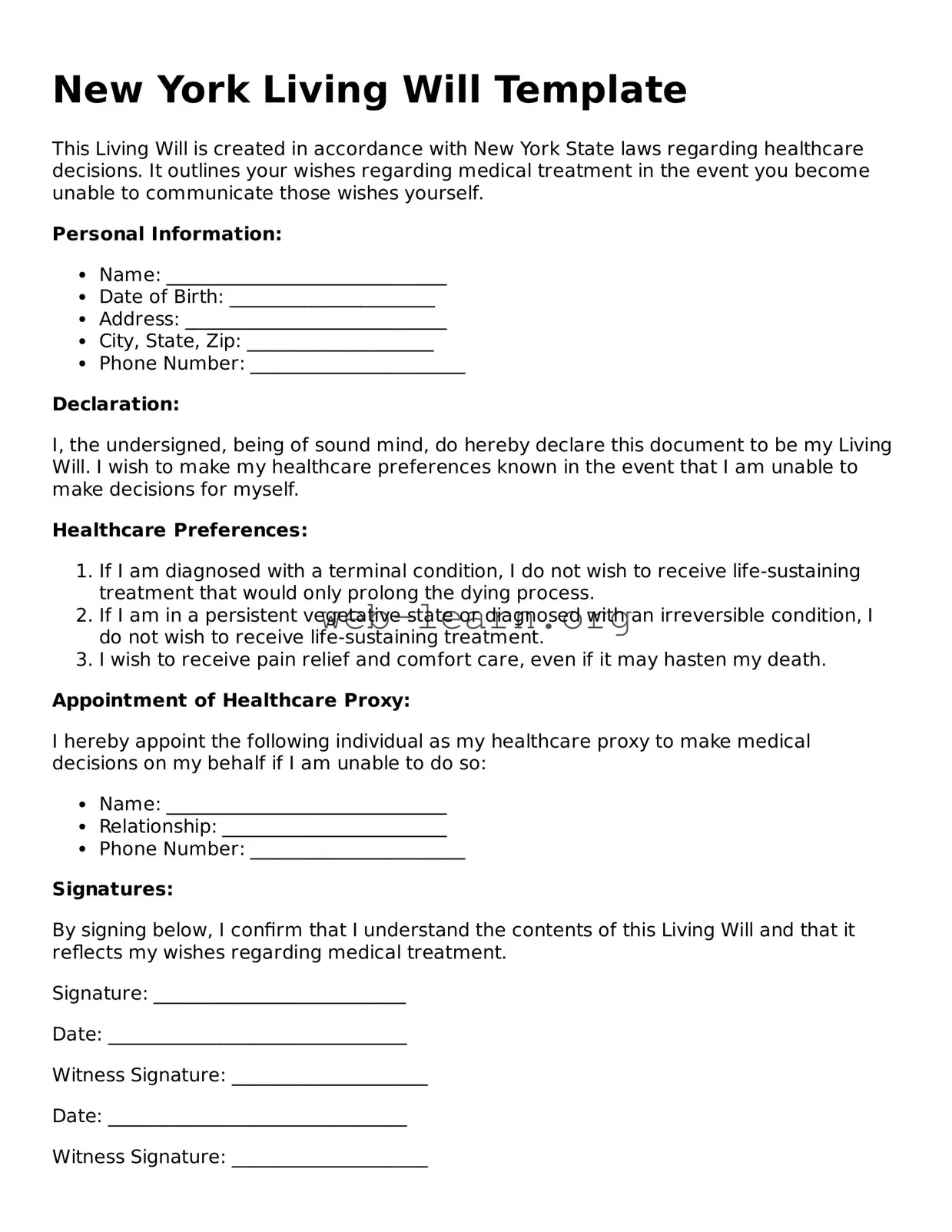
The New York Living Will form serves as a crucial document for individuals wishing to outline their preferences regarding medical treatment in the event they become unable to communicate their wishes. This form allows individuals to specify their desires concerning life-sustaining treatment, such as resuscitation efforts and artificial nutrition and hydration. By completing a Living Will, a person can ensure that their healthcare providers and loved ones are aware of their values and choices, providing clarity during difficult times. It is important to note that this document does not appoint a healthcare proxy; rather, it focuses solely on medical treatment preferences. The Living Will should be signed and dated in the presence of witnesses to ensure its validity. Understanding the implications of this form can empower individuals to take control of their healthcare decisions, offering peace of mind that their wishes will be respected if they cannot advocate for themselves.
New York Living Will Template
This Living Will is created in accordance with New York State laws regarding healthcare decisions. It outlines your wishes regarding medical treatment in the event you become unable to communicate those wishes yourself.
Personal Information:
Declaration:
I, the undersigned, being of sound mind, do hereby declare this document to be my Living Will. I wish to make my healthcare preferences known in the event that I am unable to make decisions for myself.
Healthcare Preferences:
Appointment of Healthcare Proxy:
I hereby appoint the following individual as my healthcare proxy to make medical decisions on my behalf if I am unable to do so:
Signatures:
By signing below, I confirm that I understand the contents of this Living Will and that it reflects my wishes regarding medical treatment.
Signature: ___________________________
Date: ________________________________
Witness Signature: _____________________
Date: ________________________________
Witness Signature: _____________________
Date: ________________________________
| Fact Name | Description |
|---|---|
| Purpose | A New York Living Will outlines a person's healthcare preferences in case they become unable to communicate their wishes. |
| Governing Laws | The New York Living Will is governed by the New York Public Health Law, specifically Article 29-CC. |
| Requirements | The form must be signed by the individual and witnessed by at least two adults who are not related or beneficiaries. |
| Revocation | A Living Will can be revoked at any time by the individual, either verbally or in writing. |
| Healthcare Proxy | A Living Will can be used alongside a Healthcare Proxy, which designates someone to make decisions on behalf of the individual. |
Completing the New York Living Will form is a vital step in ensuring your healthcare wishes are respected. By following these steps, you can effectively communicate your preferences regarding medical treatment in the event that you cannot speak for yourself.
Once you have filled out and signed the form, it is crucial to ensure that it is accessible to those who may need it. Keeping copies in a safe but easily reachable location can help facilitate your wishes when necessary.
A Living Will is a legal document that outlines your preferences for medical treatment in the event that you become unable to communicate your wishes. This document specifically addresses situations where you may be terminally ill or in a persistent vegetative state. By creating a Living Will, you ensure that your healthcare providers and loved ones understand your desires regarding life-sustaining treatments.
While anyone can benefit from having a Living Will, it is especially important for individuals who are aging, have chronic illnesses, or are facing surgeries that carry significant risks. Having a Living Will in place can provide peace of mind for both you and your family, knowing that your healthcare choices will be respected even if you cannot voice them yourself.
Creating a Living Will in New York can be straightforward. You can either draft the document yourself or use a template that complies with New York state laws. It is crucial to ensure that the document is signed and dated in the presence of at least one witness who is not a relative or someone who would benefit from your estate. Additionally, you may want to discuss your wishes with your family and healthcare providers to ensure everyone is on the same page.
Yes, you can change or revoke your Living Will at any time, as long as you are mentally competent. To make changes, simply create a new Living Will that clearly states your updated preferences. Be sure to destroy any previous versions to avoid confusion. Inform your healthcare providers and family members about the changes to ensure they have the most current information.
If you do not have a Living Will, healthcare providers will typically follow standard medical procedures and may make decisions based on what they believe is in your best interest. This can lead to situations where treatments you would not want could be administered. Without a Living Will, your family may also face difficult decisions about your care, which can lead to disagreements and stress during an already challenging time.
No, a Living Will and a Health Care Proxy are not the same, though they are related. A Living Will specifies your treatment preferences, while a Health Care Proxy designates someone to make healthcare decisions on your behalf if you are unable to do so. It is often advisable to have both documents in place to ensure that your wishes are honored and that someone is available to advocate for you when needed.
Creating a Living Will is an important step in ensuring that your healthcare wishes are honored. However, many individuals make mistakes when filling out the New York Living Will form. One common error is failing to clearly articulate their preferences regarding medical treatment. It is crucial to specify which treatments you do or do not want, as vague statements can lead to confusion among healthcare providers and loved ones.
Another frequent mistake is neglecting to update the document. Life circumstances change, and so do personal beliefs and preferences regarding medical care. Regularly reviewing and updating your Living Will ensures that it accurately reflects your current wishes. This is particularly important after significant life events such as marriage, divorce, or the diagnosis of a serious illness.
Many people also overlook the importance of having witnesses. In New York, the Living Will must be signed in the presence of at least two witnesses who are not related to you and who will not benefit from your estate. Failing to include valid witnesses can invalidate the document, leaving your healthcare decisions open to interpretation.
Another mistake is not discussing the Living Will with family members or healthcare proxies. Open communication can prevent misunderstandings and ensure that your loved ones are aware of your wishes. When family members are informed, they can advocate for your preferences more effectively, especially in stressful situations.
Additionally, individuals sometimes forget to sign and date the document. A Living Will that is not properly signed may not be recognized by healthcare providers. It is essential to ensure that your signature is present, and the date is clear to avoid any complications when the document is needed.
Lastly, some people assume that a Living Will is a one-time task. In reality, it should be part of an ongoing conversation about your healthcare preferences. Regular discussions with your healthcare providers and loved ones can help ensure that everyone is on the same page, reducing the likelihood of disputes or confusion in the future.
A New York Living Will is a crucial document that outlines an individual's preferences regarding medical treatment in the event of incapacitation. However, several other forms and documents can complement this legal instrument to ensure comprehensive health care planning. Below is a list of these essential documents, each serving a unique purpose in the realm of health care and end-of-life decisions.
Incorporating these documents alongside your New York Living Will can significantly enhance your ability to communicate your health care preferences and ensure that your wishes are respected. By taking the time to prepare these forms, you provide clarity and direction for your loved ones and health care providers during challenging times.
When filling out the New York Living Will form, there are important guidelines to follow. Here’s a list of things you should and shouldn't do:
When discussing the New York Living Will form, several misconceptions often arise. Understanding these can help individuals make informed decisions about their healthcare preferences. Here are five common misconceptions:
This is not accurate. A Living Will outlines your wishes regarding medical treatment in specific situations, particularly at the end of life. In contrast, a DNR order specifically instructs medical personnel not to perform CPR if your heart stops or if you stop breathing.
This misconception is false. Individuals have the right to modify or revoke their Living Will at any time, as long as they are mentally competent to do so. Regularly reviewing your wishes is encouraged.
This is misleading. While Living Wills are often associated with terminal conditions, they can also address situations where individuals are unable to communicate their wishes, regardless of the underlying health issue.
This is not entirely true. While healthcare providers are generally expected to honor a Living Will, there may be circumstances where they cannot comply due to institutional policies or legal constraints. It is important to discuss your wishes with your healthcare team.
This misconception overlooks the fact that anyone over the age of 18 can benefit from having a Living Will. Accidents and unexpected health issues can happen at any age, making it wise for all adults to consider their healthcare preferences.
Filling out and using the New York Living Will form is an important step in planning for future medical care. Here are some key takeaways to consider:
By taking these steps, you can ensure that your medical wishes are respected and understood in the event of an emergency.
Arkansas Medical Power of Attorney - A Living Will can be a way to express your beliefs about life and death.
Living Will Free Forms - A Living Will is a straightforward way to express your healthcare goals.
Living Will Vs Health Care Directive - Creating a Living Will is an act of compassion, showing consideration for those who may care for you.
Living Will Indiana - It is important to ensure that your Living Will is accessible to your healthcare providers and family members.