Creating a Last Will and Testament is a crucial step in ensuring that your wishes are honored after your passing. In New York, this legal document serves as a roadmap for distributing your assets, appointing guardians for minor children, and designating an executor to manage your estate. The form typically requires you to clearly identify yourself, outline your intentions regarding your property, and specify who will inherit what. Additionally, it includes important provisions for revoking any previous wills and may require witnesses to validate the document. Understanding the nuances of the New York Last Will and Testament form is essential, as it helps to avoid potential disputes among heirs and ensures that your legacy is carried out according to your desires. Whether you are drafting your will for the first time or revisiting an existing one, grasping the key components of this form can provide peace of mind and clarity for both you and your loved ones.
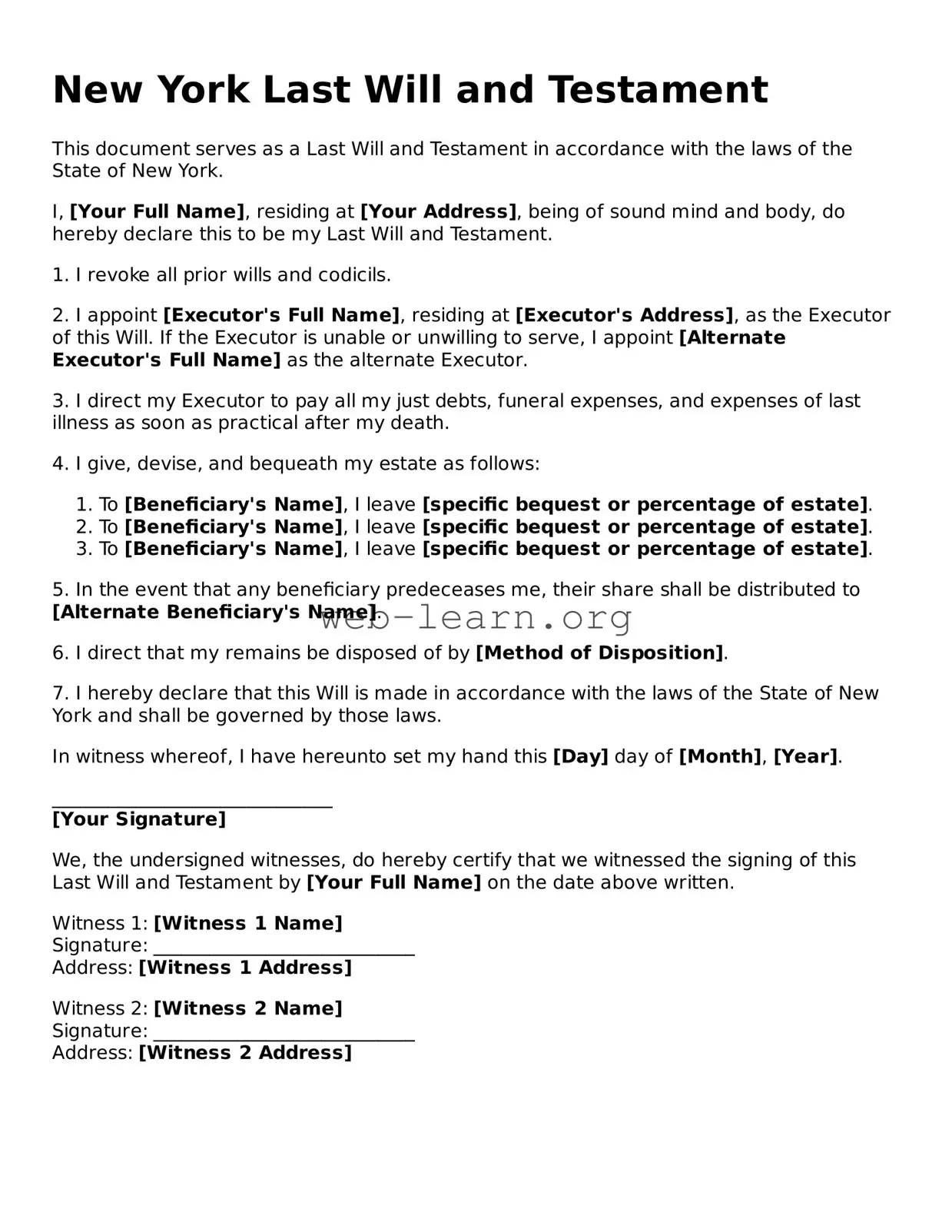
New York Last Will and Testament
This document serves as a Last Will and Testament in accordance with the laws of the State of New York.
I, [Your Full Name], residing at [Your Address], being of sound mind and body, do hereby declare this to be my Last Will and Testament.
1. I revoke all prior wills and codicils.
2. I appoint [Executor's Full Name], residing at [Executor's Address], as the Executor of this Will. If the Executor is unable or unwilling to serve, I appoint [Alternate Executor's Full Name] as the alternate Executor.
3. I direct my Executor to pay all my just debts, funeral expenses, and expenses of last illness as soon as practical after my death.
4. I give, devise, and bequeath my estate as follows:
5. In the event that any beneficiary predeceases me, their share shall be distributed to [Alternate Beneficiary's Name].
6. I direct that my remains be disposed of by [Method of Disposition].
7. I hereby declare that this Will is made in accordance with the laws of the State of New York and shall be governed by those laws.
In witness whereof, I have hereunto set my hand this [Day] day of [Month], [Year].
______________________________
[Your Signature]
We, the undersigned witnesses, do hereby certify that we witnessed the signing of this Last Will and Testament by [Your Full Name] on the date above written.
Witness 1: [Witness 1 Name]
Signature: ____________________________
Address: [Witness 1 Address]
Witness 2: [Witness 2 Name]
Signature: ____________________________
Address: [Witness 2 Address]
| Fact Name | Description |
|---|---|
| Definition | A Last Will and Testament is a legal document that outlines how a person's assets will be distributed after their death. |
| Governing Law | The New York Last Will and Testament is governed by the New York Estates, Powers and Trusts Law (EPTL). |
| Requirements | In New York, a will must be in writing, signed by the testator, and witnessed by at least two individuals. |
| Revocation | A will can be revoked by the testator at any time, either by creating a new will or by physically destroying the old one. |
| Executor Appointment | The testator can appoint an executor in the will to manage the estate and ensure the wishes are carried out. |
| Witness Eligibility | Witnesses must be at least 18 years old and should not be beneficiaries of the will to avoid potential conflicts. |
| Holographic Wills | New York does not recognize holographic wills, which are wills written entirely in the testator's handwriting without witnesses. |
| Probate Process | After the testator's death, the will must go through the probate process in New York to validate its authenticity. |
Filling out a Last Will and Testament form is an important step in ensuring that your wishes are honored after you pass away. Once you have completed the form, it will need to be signed and witnessed according to New York state laws. This ensures that your will is valid and can be executed as intended.
What is a Last Will and Testament?
A Last Will and Testament is a legal document that outlines how a person’s assets and affairs should be handled after their death. It specifies who will inherit property, appoints guardians for minor children, and can designate an executor to manage the estate.
Who can create a Last Will and Testament in New York?
In New York, any individual who is at least 18 years old and of sound mind can create a Last Will and Testament. It is essential that the person understands the nature of their actions and the consequences of the will.
What are the requirements for a valid will in New York?
To be valid, a Last Will and Testament in New York must meet the following criteria:
Can I change my Last Will and Testament after it is created?
Yes, you can change your will at any time while you are still alive. This can be done by creating a new will or by adding a codicil, which is an amendment to the existing will. Remember, any changes must also comply with the legal requirements for a valid will.
What happens if I die without a will in New York?
If you die without a will, your estate will be distributed according to New York’s intestacy laws. This means your assets will be divided among your heirs, which may not align with your wishes. Having a will ensures your preferences are honored.
Can I write my own Last Will and Testament?
Yes, you can write your own will, known as a holographic will. However, it is advisable to consult with a legal professional to ensure it meets all legal requirements and accurately reflects your intentions.
What is an executor, and how do I choose one?
An executor is the person responsible for managing your estate after your death. This includes paying debts, distributing assets, and ensuring your wishes are followed. Choose someone trustworthy, organized, and willing to take on this responsibility.
Can I include funeral arrangements in my will?
Yes, you can include instructions for your funeral arrangements in your will. However, it is essential to communicate these wishes to your family and loved ones, as the will may not be read until after the funeral.
How can I ensure my will is not contested?
To minimize the chances of your will being contested, consider the following steps:
Is it necessary to notarize a will in New York?
Notarization is not required for a will to be valid in New York. However, having your will notarized can help simplify the probate process and may reduce the likelihood of disputes.
Creating a Last Will and Testament is an important step in ensuring that your wishes are honored after you pass away. However, many people make common mistakes when filling out this form, which can lead to complications down the line. One frequent error is failing to properly identify the beneficiaries. It is crucial to provide full names and, if possible, their relationship to you. Simply using nicknames or vague descriptions can create confusion and disputes among family members.
Another mistake often seen is neglecting to sign the will in the presence of witnesses. In New York, the law requires that you sign your will in front of at least two witnesses who are not beneficiaries. Without proper signatures, the document may be deemed invalid. It's essential to ensure that all parties understand their role in this process to avoid any future challenges.
Additionally, many individuals overlook the importance of updating their will. Life changes such as marriage, divorce, or the birth of a child can significantly impact your wishes. Failing to revise your will to reflect these changes can lead to unintended consequences, such as excluding loved ones or unintentionally including someone you no longer wish to benefit.
Another common oversight is not including a residuary clause. This clause specifies what happens to any remaining assets not explicitly mentioned in the will. Without it, any assets not accounted for could be distributed according to state law rather than your personal wishes, which may not align with your intentions.
Some people also forget to consider the appointment of an executor. This person will be responsible for carrying out your wishes as outlined in the will. Choosing someone who understands your desires and can manage the responsibilities effectively is vital. Not naming an executor can lead to delays and disputes among family members regarding who should take charge.
Finally, many individuals fail to store their will in a safe yet accessible location. A will that cannot be found after your passing is as good as nonexistent. It’s advisable to keep it in a secure place, such as a safe deposit box or with a trusted family member, and to inform your executor of its location. Taking these steps can help ensure that your wishes are honored and that your loved ones are spared unnecessary stress during a difficult time.
When creating a New York Last Will and Testament, there are several other important documents that may be used in conjunction with it. Each of these documents serves a unique purpose and can help ensure that your wishes are carried out effectively. Below is a list of some commonly associated forms.
Incorporating these documents along with your Last Will and Testament can provide clarity and ensure that your preferences are respected. Each document plays a vital role in planning for the future and protecting your interests.
When filling out the New York Last Will and Testament form, it’s important to approach the task with care. Here are some things you should and shouldn’t do to ensure your will is valid and reflects your wishes.
Following these guidelines will help ensure that your Last Will and Testament is effective and honored. Take your time and double-check your work to make sure everything is in order.
When it comes to creating a Last Will and Testament in New York, many people hold misconceptions that can lead to confusion or mistakes. Here are six common misconceptions:
Understanding these misconceptions can help ensure that your Last Will and Testament accurately reflects your wishes and protects your loved ones.
When filling out and using the New York Last Will and Testament form, keep these key takeaways in mind:
Connecticut Will - You can include specific bequests for personal items in your will.
Will Template Georgia - May specify how to handle debts owed to the deceased at the time of death.
Last Will and Testament Template Louisiana - Provides a record of the individual’s wishes for future reference.
Does an Attorney Have to Prepare a Will - Can be updated as life circumstances change, such as marriage or divorce.