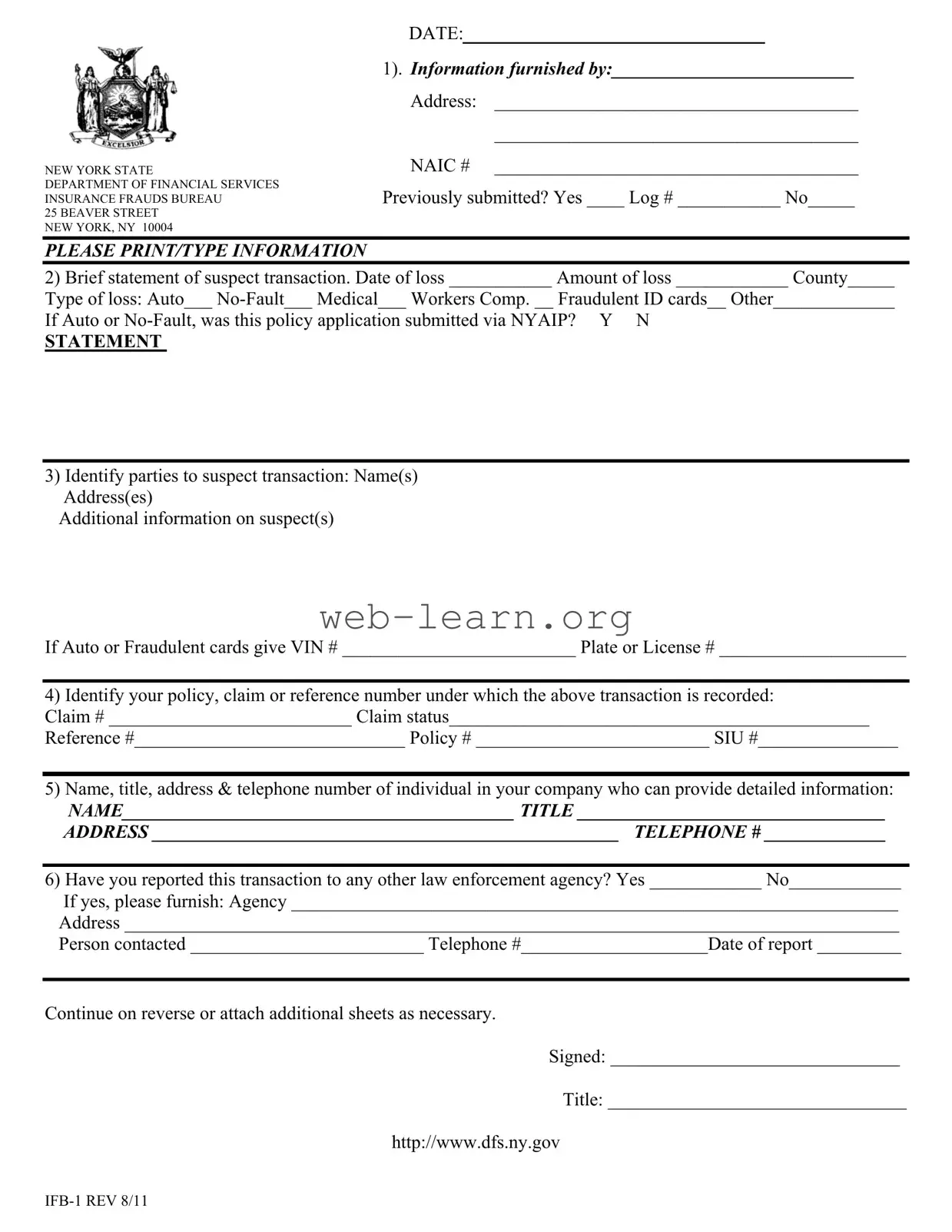
The New York Ifb 1 form is a crucial document utilized by the New York State Department of Financial Services' Insurance Frauds Bureau. This form serves as a means for individuals and organizations to report suspected fraudulent transactions related to insurance claims. It captures essential information, including the details of the suspect transaction, such as the date and amount of loss, as well as the type of loss involved—be it auto, no-fault, medical, or workers' compensation. The form also requires the identification of the parties involved in the transaction, along with any relevant vehicle identification numbers (VIN) or license plate information when applicable. Additionally, the Ifb 1 form prompts the reporter to provide their policy, claim, or reference numbers associated with the transaction, ensuring that all relevant details are linked for effective investigation. A designated individual within the reporting company must be identified, providing their contact information for follow-up inquiries. Furthermore, the form inquires whether the transaction has been reported to any other law enforcement agency, facilitating a coordinated approach to tackling insurance fraud. By gathering this comprehensive information, the Ifb 1 form plays a vital role in helping authorities combat fraudulent activities and protect the integrity of the insurance system.
NEW YORK STATE
DEPARTMENT OF FINANCIAL SERVICES INSURANCE FRAUDS BUREAU
25 BEAVER STREET
NEW YORK, NY 10004
DATE:
1). Information furnished by:__________________________
Address: _______________________________________
_______________________________________
NAIC # _______________________________________
Previously submitted? Yes ____ Log # ___________ No_____
PLEASE PRINT/TYPE INFORMATION
2)Brief statement of suspect transaction. Date of loss ___________ Amount of loss ____________ County_____
Type of loss: Auto___
If Auto or
STATEMENT
3)Identify parties to suspect transaction: Name(s) Address(es)
Additional information on suspect(s)
If Auto or Fraudulent cards give VIN # _________________________ Plate or License # ____________________
4) Identify your policy, claim or reference number under which the above transaction is recorded:
Claim # __________________________ Claim status_____________________________________________
Reference #_____________________________ Policy # _________________________ SIU #_______________
5)Name, title, address & telephone number of individual in your company who can provide detailed information:
NAME__________________________________________ TITLE _________________________________
ADDRESS __________________________________________________ TELEPHONE # _____________
6)Have you reported this transaction to any other law enforcement agency? Yes ____________ No____________
If yes, please furnish: Agency _________________________________________________________________
Address ___________________________________________________________________________________
Person contacted _________________________ Telephone #____________________Date of report _________
Continue on reverse or attach additional sheets as necessary.
Signed: _______________________________
Title: ________________________________
http://www.dfs.ny.gov
| Fact Name | Fact Description |
|---|---|
| Governing Authority | The New York Ifb 1 form is governed by the New York State Department of Financial Services. |
| Purpose | This form is used to report suspected insurance fraud in New York. |
| Submission Date | The form requires the date of submission, which is critical for record-keeping. |
| Information Requirements | Reporters must provide detailed information about the suspect transaction, including the date and amount of loss. |
| Types of Loss | Various types of loss can be reported, including auto, no-fault, medical, and workers' compensation. |
| Contact Information | The form requires contact details of a representative who can provide further information regarding the report. |
| Law Enforcement Notification | Reporters must indicate if the transaction has been reported to any other law enforcement agency. |
| Revisions | The current version of the form is IFB-1, revised in August 2011. |
Completing the New York IFB 1 form is a straightforward process that requires specific information about a suspected fraudulent transaction. Once filled out, this form will be submitted to the New York State Department of Financial Services Insurance Frauds Bureau for further investigation.
What is the purpose of the New York IFB 1 form?
The New York IFB 1 form is designed for reporting suspected insurance fraud to the Insurance Frauds Bureau of the New York State Department of Financial Services. This form helps individuals and companies document and report fraudulent activities related to various types of insurance, including auto, medical, and workers' compensation claims. By submitting this form, you contribute to the prevention of fraud and help maintain the integrity of the insurance system.
Who should fill out the IFB 1 form?
The form should be completed by individuals or representatives of companies who suspect fraudulent activity related to an insurance transaction. This could include insurance agents, claims adjusters, or anyone who has knowledge of suspicious activities involving insurance claims. It is important that the person filling out the form provides accurate and detailed information to assist in the investigation.
What information is required on the IFB 1 form?
The IFB 1 form requires several key pieces of information:
Providing complete and accurate details will enhance the effectiveness of the investigation.
How do I submit the IFB 1 form?
After filling out the IFB 1 form, it should be submitted directly to the Insurance Frauds Bureau. This can typically be done via mail or, in some cases, electronically. Ensure that you keep a copy of the completed form for your records. If you have any questions about the submission process, you may contact the Bureau directly for guidance.
What happens after I submit the IFB 1 form?
Once the IFB 1 form is submitted, the Insurance Frauds Bureau will review the information provided. They may conduct an investigation based on the details you reported. You may be contacted for further information or clarification. It is essential to cooperate with any follow-up inquiries to assist in the investigation. The Bureau aims to address fraud efficiently and effectively, ensuring that appropriate actions are taken.
Completing the New York IFB-1 form requires careful attention to detail. One common mistake is failing to provide complete information in the section asking for personal details. Individuals often leave the fields for their name, address, or NAIC number blank or incomplete. This can lead to delays in processing the report, as the Insurance Frauds Bureau needs accurate information to follow up.
Another frequent error is not clearly stating the nature of the suspect transaction. When filling out the brief statement section, some submitters provide vague descriptions or omit crucial details. It's essential to be as specific as possible regarding the type of loss and the circumstances surrounding the incident. A well-detailed statement can significantly aid in the investigation.
People also tend to overlook the importance of identifying all parties involved in the transaction. Incomplete or inaccurate information about suspects can hinder the investigation process. Ensure that all names and addresses are provided clearly, and if applicable, include additional information that could be relevant to the case.
Additionally, many individuals fail to include their policy, claim, or reference numbers. This oversight can lead to confusion and delays, as the Bureau relies on these identifiers to track the related transactions. Always double-check that these numbers are entered correctly and are up to date.
Moreover, some applicants neglect to provide contact information for the individual within their organization who can offer further details. This omission can cause frustration for investigators who may need to reach out for clarification. Make sure to include a name, title, address, and phone number for prompt communication.
Lastly, failing to disclose whether the transaction has been reported to other law enforcement agencies is a critical mistake. If the answer is yes, it's vital to provide the agency's name and contact details. This information helps avoid duplication of efforts and ensures that all relevant parties are informed. Each of these mistakes can complicate the process, so reviewing the form thoroughly before submission is essential.
The New York IFB 1 form is a crucial document used for reporting suspected insurance fraud. However, it is often accompanied by other forms and documents that provide additional context or information regarding the suspected fraudulent activity. Below is a list of related forms that may be required or beneficial when submitting the IFB 1 form.
In summary, while the New York IFB 1 form serves as a primary tool for reporting insurance fraud, the inclusion of these additional documents can enhance the clarity and comprehensiveness of the report. Each form plays a distinct role in providing a fuller picture of the situation at hand, ultimately aiding in the investigation process.
The New York Ifb 1 form is used to report suspected insurance fraud. It shares similarities with several other documents in the realm of insurance and fraud reporting. Here’s a look at seven documents that are similar to the Ifb 1 form:
When filling out the New York IFB 1 form, it is essential to follow specific guidelines to ensure accuracy and compliance. Here are six important dos and don’ts to consider:
By adhering to these guidelines, individuals can help facilitate a smoother reporting process and contribute to effective investigations of insurance fraud.
The New York IFB 1 form is a crucial document for reporting suspected insurance fraud. However, several misconceptions surround it. Here are ten common misunderstandings:
Understanding these misconceptions can help ensure that suspected fraud is reported accurately and effectively. Timely and correct reporting is essential for addressing insurance fraud in New York.
When filling out and using the New York IFB 1 form, consider the following key takeaways:
Completing the form thoroughly and accurately can significantly aid in the investigation of insurance fraud cases.