
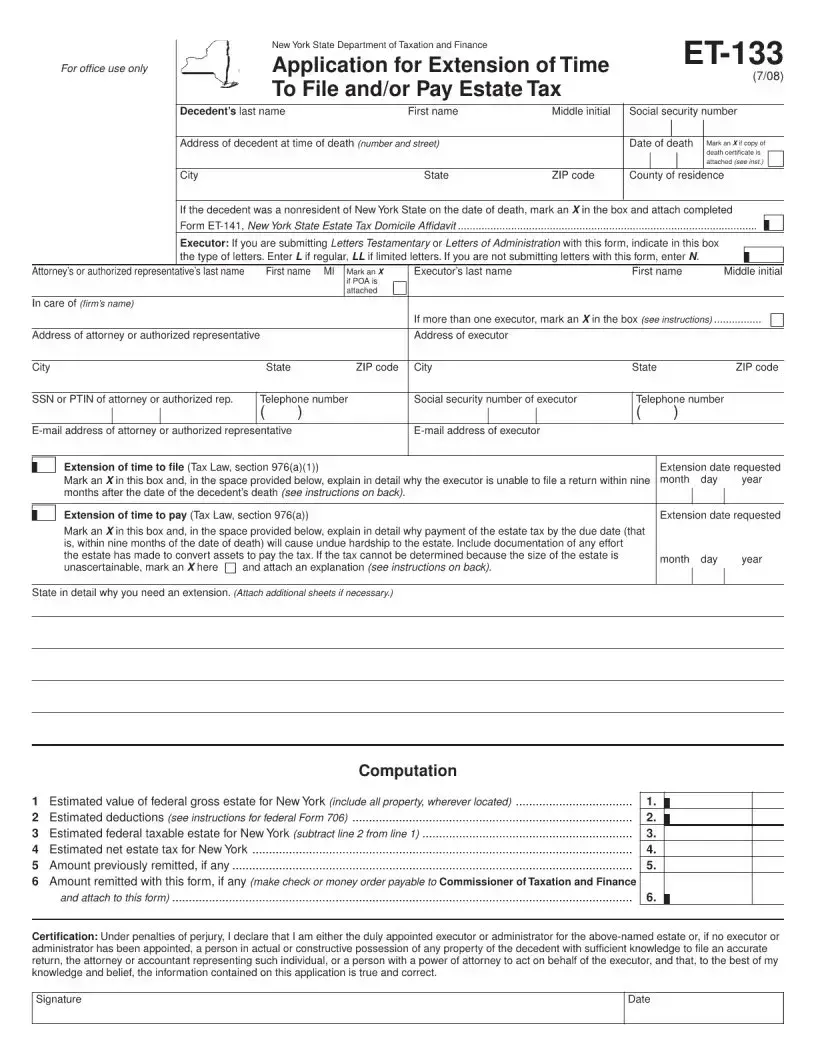
The New York ET-133 form serves as a crucial document for executors managing the estate of a deceased individual. This application allows for an extension of time to file or pay estate tax, addressing the potential complexities that can arise during the estate settlement process. Executors must provide essential information, including the decedent's name, social security number, and address at the time of death. Additionally, the form requires details about the executor, such as their name and contact information, as well as any authorized representatives involved. If the decedent was a nonresident, the executor must attach Form ET-141, the New York State Estate Tax Domicile Affidavit. The ET-133 also includes sections where the executor can explain their reasons for needing an extension, whether for filing or payment, and it emphasizes the importance of documentation to support these requests. The form must be submitted within nine months of the decedent's death to avoid penalties, and it is essential that executors follow the filing instructions carefully to ensure compliance with New York State tax laws.
| Fact Name | Details |
|---|---|
| Form Purpose | The ET-133 form is used to apply for an extension of time to file or pay estate tax in New York State. |
| Governing Law | This form is governed by New York Tax Law, section 976. |
| Filing Deadline | The form must be filed within nine months after the date of the decedent's death. |
| Who Can File | The executor, administrator, or authorized representative may file the ET-133 form. |
| Required Attachments | A copy of the death certificate and any Letters Testamentary or Letters of Administration may need to be attached. |
| Extension for Filing | Marking the appropriate box allows the executor to request an extension for filing the estate tax return. |
| Extension for Payment | The form allows for a request to extend the time for paying the estate tax, citing undue hardship if applicable. |
| Mailing Address | Completed forms should be mailed to NYS Estate Tax, Processing Center, PO Box 15167, Albany NY 12212-5167. |
| Private Delivery Services | Private delivery services may be used, but only designated services will establish the filing date. |
Completing the New York ET-133 form is an important step in managing estate tax responsibilities. After you fill out this form, it will be submitted to the New York State Department of Taxation and Finance. They will review your application and notify you of their decision regarding your request for an extension of time to file or pay estate tax.
After completing the form, ensure all necessary documents are attached. Mail the ET-133 form and any required payment to the specified address. Be mindful of the nine-month deadline following the decedent's death to avoid penalties.
The New York ET-133 form is an application for an extension of time to file and/or pay estate tax. Executors of a decedent's estate use this form to request additional time beyond the standard nine months after the date of death to either file the estate tax return or make the required payment.
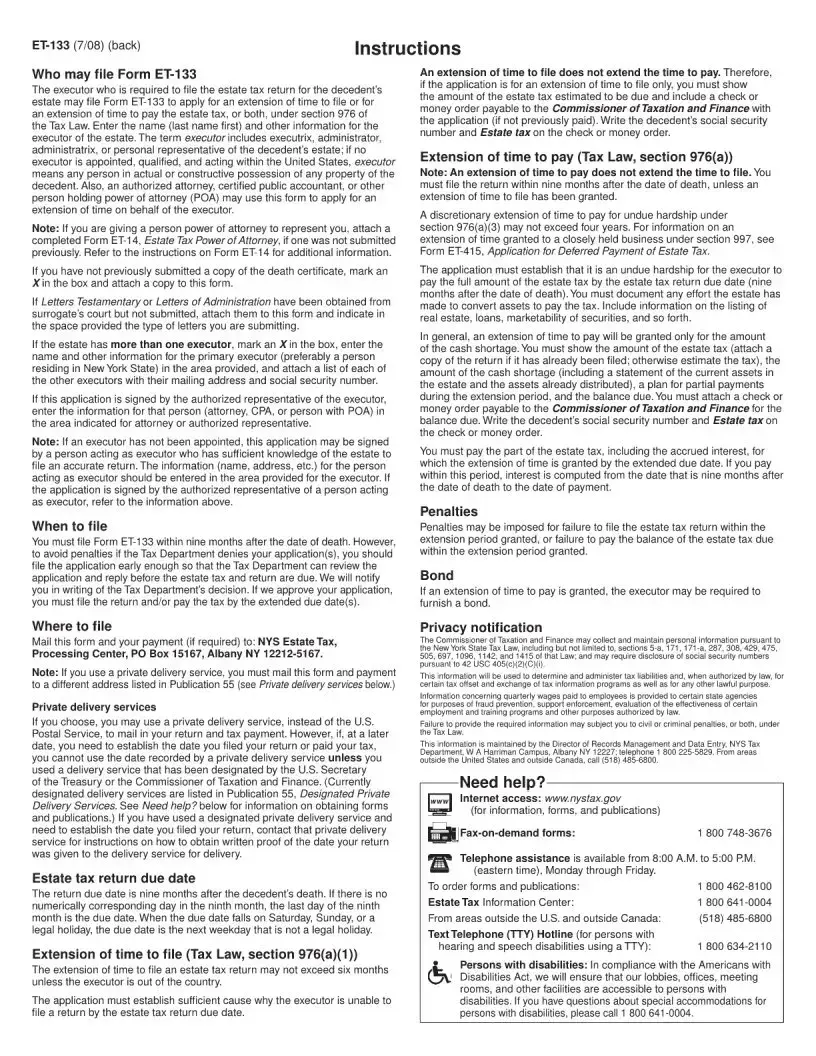
The executor or administrator of the estate is eligible to file the ET-133 form. If no executor has been appointed, any person in possession of the decedent's property can file. Additionally, an authorized attorney or accountant can file on behalf of the executor.
You must file the ET-133 form within nine months of the decedent's death. It is advisable to submit your application early to allow time for the Tax Department to review it before the estate tax and return are due.
The form requires the decedent's name, social security number, address at the time of death, date of death, and details about the executor. You must also explain why you need an extension, either for filing or payment, and provide any necessary documentation to support your request.
If the Tax Department denies your application, you will need to file the estate tax return and pay any taxes due by the original deadline to avoid penalties. The Tax Department will notify you in writing regarding their decision.
Mail the completed form and any required payment to the NYS Estate Tax Processing Center at PO Box 15167, Albany, NY 12212-5167. If using a private delivery service, refer to Publication 55 for the correct address.
Yes, you can use a private delivery service. However, ensure that the service is designated by the U.S. Secretary of the Treasury or the Commissioner of Taxation and Finance. Only then can you establish the date of filing based on the service's records.
When requesting an extension for payment, you must explain why paying the estate tax by the due date would cause undue hardship. Include documentation showing any efforts made to convert estate assets to pay the tax.
If you need to provide additional documentation or explanations, attach these on separate sheets. Ensure that all attachments are clearly labeled and referenced in your application to avoid confusion.
Filling out the New York ET-133 form can be a daunting task, and many individuals make mistakes that can delay processing or lead to complications. One common error is failing to attach the necessary documentation. For instance, if the decedent's death certificate is not included when required, it can result in the rejection of the application. Always check to ensure that all required documents are attached before submitting the form.
Another frequent mistake involves incorrect identification of the executor. The form requires the executor's name, social security number, and contact information. If this information is incomplete or inaccurate, it can create confusion and delay the processing of the application. Double-checking the details provided can save time and prevent unnecessary follow-up requests.
Many applicants also overlook the importance of providing a clear explanation for the requested extension. The form asks for specific reasons why the executor cannot file or pay the estate tax on time. Vague or insufficient explanations may lead to denial of the extension request. It is crucial to provide detailed information and any supporting documentation that demonstrates the need for an extension.
Lastly, failing to file the ET-133 form within the nine-month deadline is a significant mistake. This deadline is crucial to avoid penalties and interest on unpaid taxes. Applicants should mark their calendars and ensure that they submit the form as early as possible to allow for any potential issues. Being proactive can help manage the estate tax process more smoothly.
The New York ET-133 form is an essential document for executors seeking an extension of time to file or pay estate taxes. Alongside this form, several other documents may be required to ensure compliance with state regulations. Below is a list of commonly used forms and documents that often accompany the ET-133.
Each of these documents plays a critical role in the estate tax process, facilitating accurate reporting and compliance with New York State laws. Properly preparing and submitting these forms can help prevent delays and potential penalties associated with estate tax obligations.
The New York ET-133 form is an important document for those managing the estate of a deceased individual. It serves as a request for an extension of time to file or pay estate taxes. There are several other documents that share similarities with the ET-133 form, each serving specific purposes in the realm of estate management and tax obligations. Below is a list of ten documents that are similar to the New York ET-133 form, along with explanations of how they relate to it.
Understanding these documents can help you navigate the complexities of estate management and ensure compliance with tax regulations. Each form plays a role in managing the financial and legal responsibilities that arise after a person's death, making it crucial to be aware of them.
When filling out the New York ET-133 form, there are several important dos and don'ts to keep in mind. Following these guidelines will help ensure that your application is processed smoothly.
Understanding the New York ET-133 form can be challenging, especially with various misconceptions surrounding it. Here are six common misunderstandings about this form, along with clarifications to help you navigate the process more effectively.
Many people believe that the ET-133 form is solely for requesting an extension to file the estate tax return. In reality, it can also be used to request an extension for paying the estate tax, or for both filing and payment extensions.
While having a court-appointed executor is common, it's not a strict requirement. If no executor has been appointed, anyone in actual or constructive possession of the decedent's property can file the form.
Although the ET-133 form must be filed within nine months of the decedent's death, it doesn't need to be submitted right away. Executors should ensure they have all necessary documentation before filing.
Some believe that only one reason can be provided for needing an extension. However, you can explain multiple reasons for both filing and payment extensions, as long as you provide sufficient detail.
Submitting the ET-133 form does not automatically grant an extension. The New York State Tax Department will review the application and notify you of their decision. It's essential to file early to allow time for their response.
Even if you have submitted a death certificate for other purposes, you must attach a copy to the ET-133 form if you haven't submitted it with this specific application. This requirement ensures that all necessary documentation is on file.
Here are some key takeaways about filling out and using the New York ET-133 form: