In New York, the Durable Power of Attorney form serves as a vital tool for individuals looking to manage their financial and legal affairs, especially in times of incapacity. This document allows you to appoint someone you trust—often referred to as your agent or attorney-in-fact—to make decisions on your behalf. The form is designed to remain effective even if you become unable to make decisions for yourself due to illness or injury. It covers a range of powers, from handling bank transactions and real estate matters to managing investments and filing taxes. Importantly, you can customize the powers granted to your agent, ensuring they align with your specific needs and preferences. By using this form, you not only gain peace of mind but also ensure that your affairs are managed according to your wishes, even when you can’t actively participate in the decision-making process.
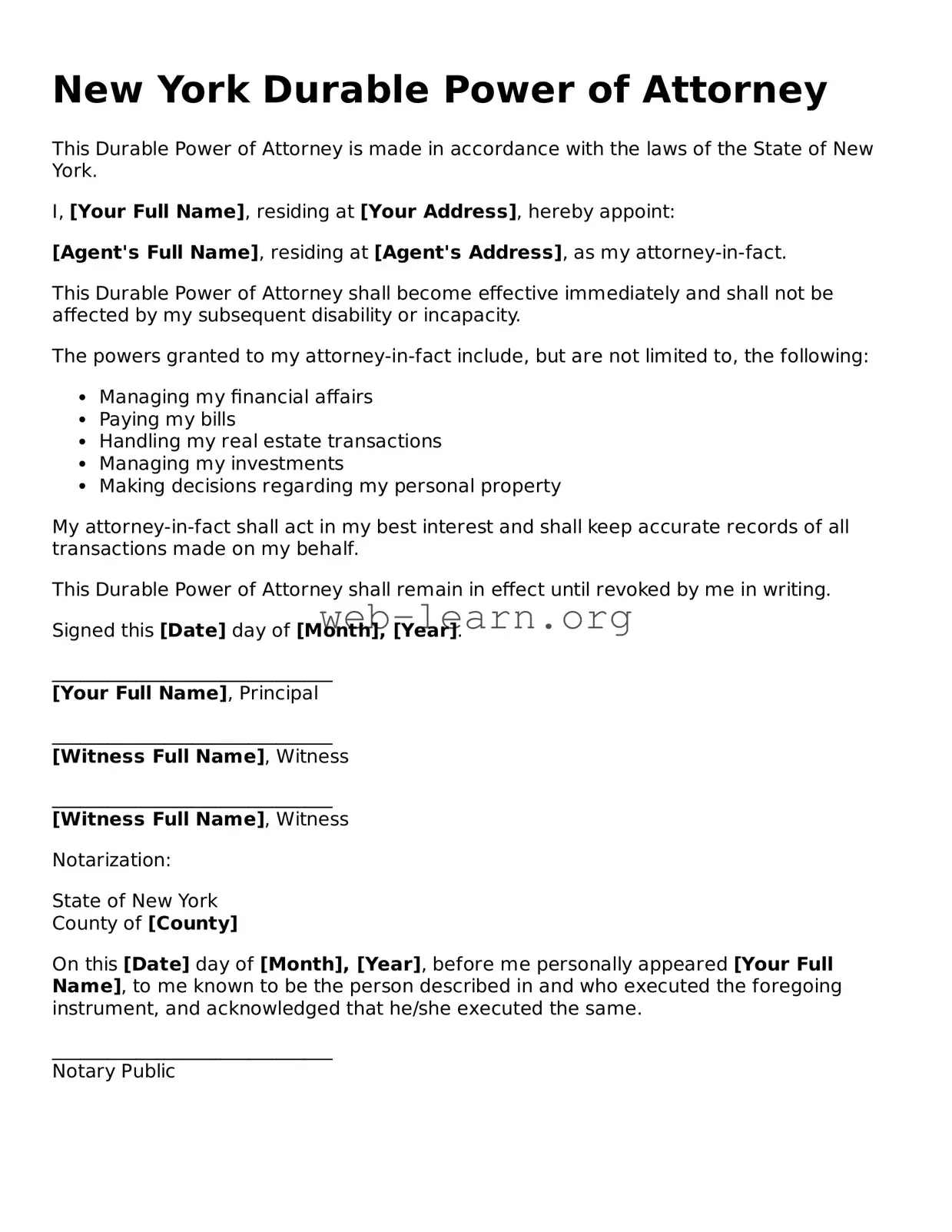
New York Durable Power of Attorney
This Durable Power of Attorney is made in accordance with the laws of the State of New York.
I, [Your Full Name], residing at [Your Address], hereby appoint:
[Agent's Full Name], residing at [Agent's Address], as my attorney-in-fact.
This Durable Power of Attorney shall become effective immediately and shall not be affected by my subsequent disability or incapacity.
The powers granted to my attorney-in-fact include, but are not limited to, the following:
My attorney-in-fact shall act in my best interest and shall keep accurate records of all transactions made on my behalf.
This Durable Power of Attorney shall remain in effect until revoked by me in writing.
Signed this [Date] day of [Month], [Year].
______________________________
[Your Full Name], Principal
______________________________
[Witness Full Name], Witness
______________________________
[Witness Full Name], Witness
Notarization:
State of New York
County of [County]
On this [Date] day of [Month], [Year], before me personally appeared [Your Full Name], to me known to be the person described in and who executed the foregoing instrument, and acknowledged that he/she executed the same.
______________________________
Notary Public
| Fact Name | Description |
|---|---|
| Definition | A Durable Power of Attorney allows you to appoint someone to make financial decisions on your behalf, even if you become incapacitated. |
| Governing Law | The New York Durable Power of Attorney is governed by New York General Obligations Law, Article 5, Title 15. |
| Durability | This form remains effective even if you become mentally incapacitated, ensuring your financial matters are managed. |
| Agent Authority | The appointed agent can handle various financial tasks, including managing bank accounts, paying bills, and making investments. |
| Revocation | You can revoke the Durable Power of Attorney at any time, as long as you are mentally competent. |
| Witness Requirements | The form must be signed in the presence of two witnesses or a notary public to be valid. |
Filling out the New York Durable Power of Attorney form is a straightforward process that allows you to designate someone to act on your behalf in financial matters. Once completed, this document will provide the designated agent with the authority to make decisions regarding your finances, ensuring that your interests are managed according to your wishes.
A Durable Power of Attorney is a legal document that allows you to appoint someone to manage your financial and legal affairs if you become unable to do so yourself. Unlike a regular Power of Attorney, a DPOA remains effective even if you become incapacitated.
You can appoint anyone you trust as your agent, as long as they are at least 18 years old and mentally competent. This could be a family member, a friend, or a professional, such as an attorney or financial advisor.
You can grant a wide range of powers, including:
It's important to specify the powers you want to grant clearly in the document.
To create a DPOA, you must fill out the New York State Durable Power of Attorney form. This form must be signed by you and notarized. It's advisable to consult with a legal professional to ensure that the document meets all requirements.
Yes, you can revoke a Durable Power of Attorney at any time as long as you are mentally competent. To do this, you should create a written revocation document and notify your agent and any institutions that may have relied on the DPOA.
If you become incapacitated without a DPOA in place, your loved ones may need to go through a court process to obtain guardianship. This can be time-consuming and costly, making it crucial to have a DPOA in place.
Yes, New York State has a specific form for the Durable Power of Attorney. Using the official form ensures that your document meets all legal requirements and is recognized by financial institutions and other entities.
Absolutely. You can specify which powers your agent has and which they do not. This can help you maintain control over your affairs and ensure that your wishes are respected.
After completing your DPOA, keep the original document in a safe place. Provide copies to your agent, financial institutions, and any relevant parties. It’s also wise to review the document periodically to ensure it still reflects your wishes.
Filling out the New York Durable Power of Attorney form can be a straightforward process, but many individuals make common mistakes that can lead to complications. One frequent error is not selecting the right agent. The agent should be someone trustworthy and capable of handling financial matters. Choosing someone who is not reliable can result in mismanagement of assets.
Another mistake is failing to specify the powers granted. The form allows for broad or limited powers. If the powers are not clearly defined, the agent may not be able to act effectively on behalf of the principal. Clarity is essential to ensure the agent understands their authority.
Some people overlook the need for signatures. Both the principal and the agent must sign the document. Without these signatures, the form is not valid. Additionally, witnesses are often required, and their absence can invalidate the document.
Inadequate dating of the form is another common issue. It is crucial to date the document when it is signed. This date establishes when the powers take effect and can prevent disputes about the timing of authority.
Moreover, many individuals neglect to update the form after significant life changes, such as marriage, divorce, or the death of a previously appointed agent. Keeping the document current ensures that it reflects the principal's wishes and circumstances.
People also frequently misunderstand the implications of the Durable Power of Attorney. They may believe that it gives the agent unlimited power. In reality, the form can be tailored to restrict certain actions, and it is important to communicate these limits clearly.
Another mistake is not considering the potential for abuse. Without proper safeguards, an agent could misuse their authority. Adding checks, such as requiring co-signatures for large transactions, can help mitigate this risk.
Some individuals fail to provide copies of the completed form to relevant parties, including the agent and financial institutions. Having copies readily available can facilitate smoother transactions and ensure that everyone is aware of the agent's authority.
Lastly, people sometimes forget to review the document periodically. Regular reviews can help ensure that the Durable Power of Attorney remains aligned with the principal's intentions and needs as circumstances change over time.
A Durable Power of Attorney (DPOA) is a crucial document that allows an individual to appoint someone else to make financial and legal decisions on their behalf. However, several other forms and documents often complement the DPOA to ensure comprehensive planning and protection of your interests. Below is a list of these important documents.
Having these documents in place, along with your Durable Power of Attorney, creates a robust framework for managing your affairs and protecting your wishes. It is always advisable to consult with a professional to ensure these documents are prepared correctly and reflect your intentions accurately.
When filling out the New York Durable Power of Attorney form, it’s important to get it right. Here’s a list of things you should and shouldn’t do to ensure the process goes smoothly.
Following these guidelines will help you complete the Durable Power of Attorney form correctly. It's a crucial document, so attention to detail is key.
When it comes to the New York Durable Power of Attorney (DPOA) form, several misconceptions can lead to confusion. Here are four common misunderstandings:
This is not entirely true. While many people use a DPOA for financial decisions, it can also cover health care decisions if specified. It's important to clearly outline the powers granted in the document.
In reality, a DPOA can be effective immediately upon signing, unless the document specifies otherwise. This means the agent can act on behalf of the principal right away.
This is incorrect. The principal retains the right to revoke the DPOA at any time, as long as they are mentally competent. Revocation must be done in writing.
This is a significant misconception. Each state has its own laws and requirements for DPOA forms. It is crucial to use the form specific to New York to ensure compliance with state regulations.
Filling out and using a New York Durable Power of Attorney form is an important step in ensuring that your financial and legal affairs are managed according to your wishes in the event that you become incapacitated. Here are some key takeaways to consider:
Taking the time to understand and properly execute a Durable Power of Attorney can provide peace of mind for you and your loved ones. It ensures that your financial matters will be handled according to your preferences, even when you are unable to communicate them yourself.
What Does Dpoa Mean - Some individuals choose to have co-agents for added oversight.
Power of Attorney Connecticut - This form can help ensure your healthcare preferences are followed if you cannot speak.
Power of Attorney Arizona - This form is essential for anyone who wants to prepare for the unexpected in their personal or financial life.