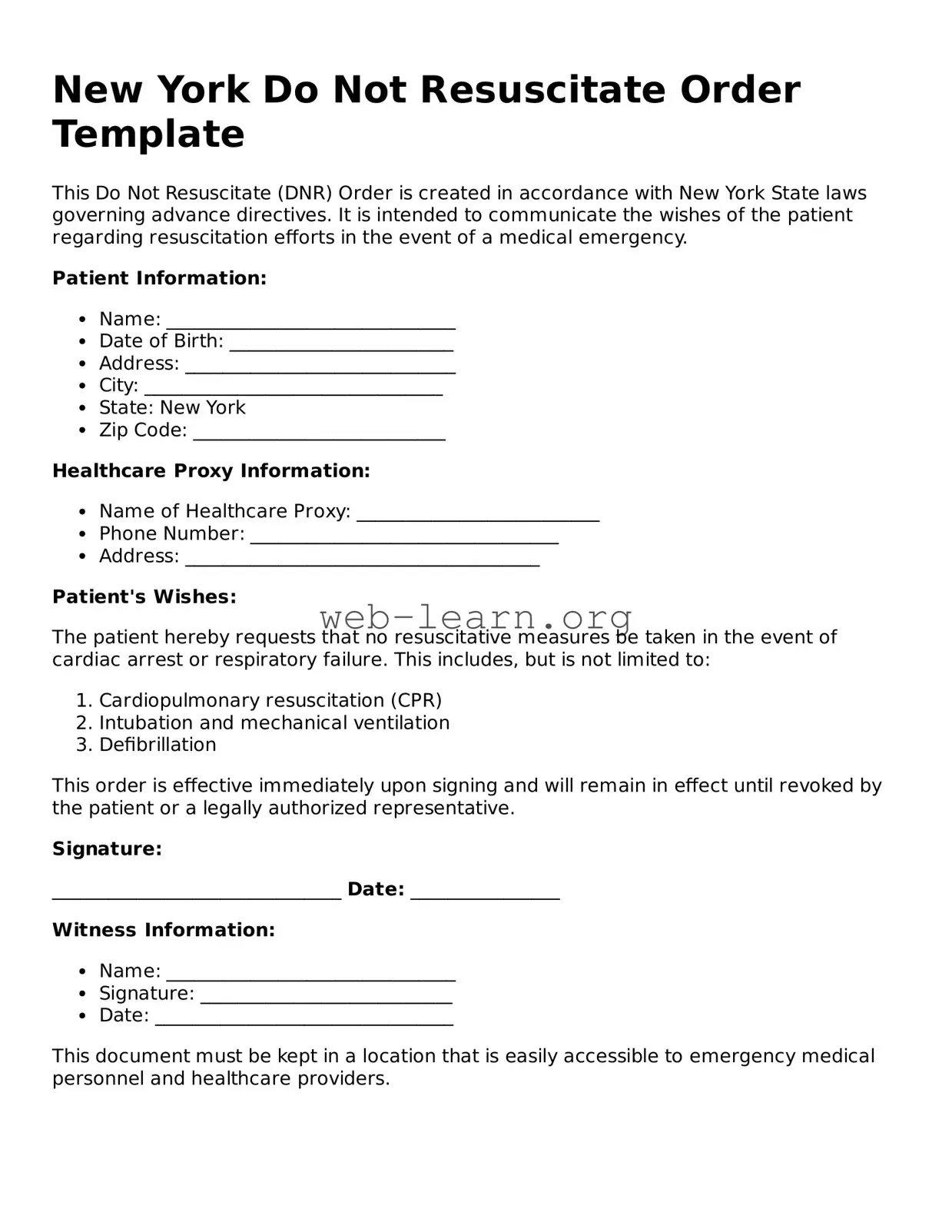
The New York Do Not Resuscitate Order (DNR) form serves as a crucial document for individuals who wish to express their preferences regarding medical interventions in the event of a cardiac arrest or respiratory failure. This form allows patients to communicate their desire not to receive cardiopulmonary resuscitation (CPR) or other life-sustaining treatments. It is essential for ensuring that healthcare providers understand and respect the patient's wishes. The DNR form must be completed and signed by a physician, and it should be readily available in medical settings to guide emergency response teams. In addition, the form requires the patient or their legal representative to acknowledge their understanding of the implications of the order. Understanding the DNR form and its components can help individuals make informed decisions about their end-of-life care, providing peace of mind for both patients and their families.
New York Do Not Resuscitate Order Template
This Do Not Resuscitate (DNR) Order is created in accordance with New York State laws governing advance directives. It is intended to communicate the wishes of the patient regarding resuscitation efforts in the event of a medical emergency.
Patient Information:
Healthcare Proxy Information:
Patient's Wishes:
The patient hereby requests that no resuscitative measures be taken in the event of cardiac arrest or respiratory failure. This includes, but is not limited to:
This order is effective immediately upon signing and will remain in effect until revoked by the patient or a legally authorized representative.
Signature:
_______________________________ Date: ________________
Witness Information:
This document must be kept in a location that is easily accessible to emergency medical personnel and healthcare providers.
| Fact Name | Description |
|---|---|
| Purpose | The New York Do Not Resuscitate (DNR) Order form allows individuals to refuse resuscitation efforts in the event of cardiac or respiratory arrest. |
| Governing Law | This form is governed by New York Public Health Law, specifically Article 29-B. |
| Eligibility | Any adult who is capable of making health care decisions can complete a DNR Order, or it can be completed by a legally authorized representative. |
| Form Accessibility | The DNR Order form is available online and must be printed, signed, and kept accessible to emergency medical personnel. |
Filling out the New York Do Not Resuscitate Order form is a straightforward process that requires careful attention to detail. After completing the form, it is essential to ensure that it is signed and dated appropriately. This document will guide healthcare providers in understanding your wishes regarding resuscitation in emergency situations.
A Do Not Resuscitate Order is a legal document that allows a person to refuse resuscitation efforts in the event of a cardiac or respiratory arrest. In New York, this order is intended to respect the wishes of individuals who may not want aggressive life-saving measures taken if they are in a terminal condition or experiencing irreversible decline.
In New York, a DNR Order can be requested by an individual who is capable of making their own medical decisions. If the individual is unable to make decisions, a legally authorized representative, such as a family member or healthcare proxy, may request the order on their behalf.
The DNR Order must be completed using the official form provided by the New York State Department of Health. This form requires the signature of the patient or their authorized representative, as well as the signature of a physician. It is important to ensure that all sections of the form are filled out accurately to avoid any confusion during an emergency.
The DNR Order should be kept in a place that is easily accessible to emergency medical personnel. It is advisable to keep a copy in the patient’s medical records, at home, and to provide copies to family members. Some individuals choose to wear a medical alert bracelet or necklace that indicates their DNR status.
Yes, a DNR Order can be revoked at any time. The individual or their representative can verbally communicate their wish to revoke the order, or they can destroy the original document. It is essential to inform healthcare providers of any changes to ensure that the patient’s current wishes are respected.
If a DNR Order is not followed, it may lead to unwanted resuscitation efforts that go against the wishes of the patient. Healthcare providers are legally obligated to adhere to the DNR Order once it has been properly documented and signed. If there are concerns about compliance, it is crucial to discuss them with the healthcare team to ensure that everyone is on the same page.
To ensure that your DNR Order is honored, communicate your wishes clearly with your healthcare providers and family members. Make sure they are aware of your DNR status and have copies of the order. Regularly review the order and discuss it with your healthcare team, especially if your health status changes.
Filling out a New York Do Not Resuscitate (DNR) Order form can be a daunting task, and it’s crucial to get it right. Many people make common mistakes that can lead to confusion or unintended consequences. Here are ten mistakes to avoid when completing this important document.
First, one of the most frequent errors is failing to sign the form. A DNR Order is not valid without the signature of the patient or their legal representative. Make sure to check that all necessary signatures are in place before submitting the form.
Secondly, not dating the form can create issues. A DNR Order should always include the date it was completed. This helps healthcare providers understand the timeline of your wishes and ensures that the order is current.
Another common mistake is not providing enough information about the patient. The form should clearly identify the patient’s full name, date of birth, and any other identifying details. This prevents any mix-ups with other patients and ensures that your wishes are respected.
Some people overlook the importance of discussing their DNR wishes with family members. Failing to communicate your decision can lead to confusion and conflict during a medical emergency. Having an open conversation can help everyone understand your choices and respect them.
Additionally, neglecting to review the form for errors can be a significant oversight. Simple mistakes, such as misspellings or incorrect information, can undermine the validity of the document. Always double-check your work before finalizing the form.
Another mistake is using outdated versions of the form. Make sure you are using the most current DNR Order form available in New York. Laws and regulations can change, and using an outdated form may lead to complications.
Some individuals mistakenly think that a DNR Order is only necessary for terminal illnesses. In reality, anyone can choose to have a DNR Order in place, regardless of their health status. Understanding that this is a personal choice is essential.
People also often forget to provide copies of the DNR Order to relevant parties. After completing the form, it’s vital to share copies with your healthcare provider, family members, and anyone else involved in your care. This ensures that your wishes are known and can be honored.
Another pitfall is not updating the DNR Order when circumstances change. Life events, such as a change in health status or a change in your wishes, may necessitate a revision of the document. Regularly reviewing your DNR Order can help keep it aligned with your current preferences.
Lastly, some individuals mistakenly assume that a DNR Order is only for hospital settings. It’s important to understand that a DNR applies in various healthcare settings, including at home or in a nursing facility. Be clear about where you want your DNR wishes to be honored.
By avoiding these common mistakes, you can ensure that your DNR Order accurately reflects your wishes and is respected by healthcare providers. Taking the time to fill out this form correctly can provide peace of mind for you and your loved ones.
A New York Do Not Resuscitate (DNR) Order form is an important document for individuals who wish to communicate their preferences regarding resuscitation efforts in medical emergencies. Along with the DNR form, several other documents may be used to ensure that a person's healthcare wishes are respected. Below is a list of some common forms and documents associated with a DNR order.
These documents work together to create a comprehensive plan for an individual's healthcare preferences. It is important for individuals to discuss their wishes with family members and healthcare providers to ensure that everyone understands their intentions.
When filling out the New York Do Not Resuscitate Order form, there are important dos and don'ts to keep in mind. Here’s a straightforward list to help you navigate the process.
These steps will help ensure that your wishes are clearly communicated and respected. Taking the time to fill out this form correctly is essential for your peace of mind and the clarity of your healthcare decisions.
Understanding the New York Do Not Resuscitate (DNR) Order form is essential for individuals and families making critical healthcare decisions. However, several misconceptions often arise, leading to confusion. Below is a list of common misunderstandings regarding the DNR Order form in New York.
Understanding these misconceptions can empower individuals and families to make informed decisions regarding end-of-life care and ensure that their wishes are respected in critical situations.
The New York Do Not Resuscitate Order (DNR) form is an important document that outlines a person's wishes regarding resuscitation efforts in the event of a medical emergency. Here are key takeaways regarding its use and completion:
Dnr Hospital - Family members can play a key role in supporting a loved one's decision regarding a DNR order.
Illinois Do Not Resuscitate Law - Emergency responders are trained to look for DNR orders in situations where resuscitation may be needed.