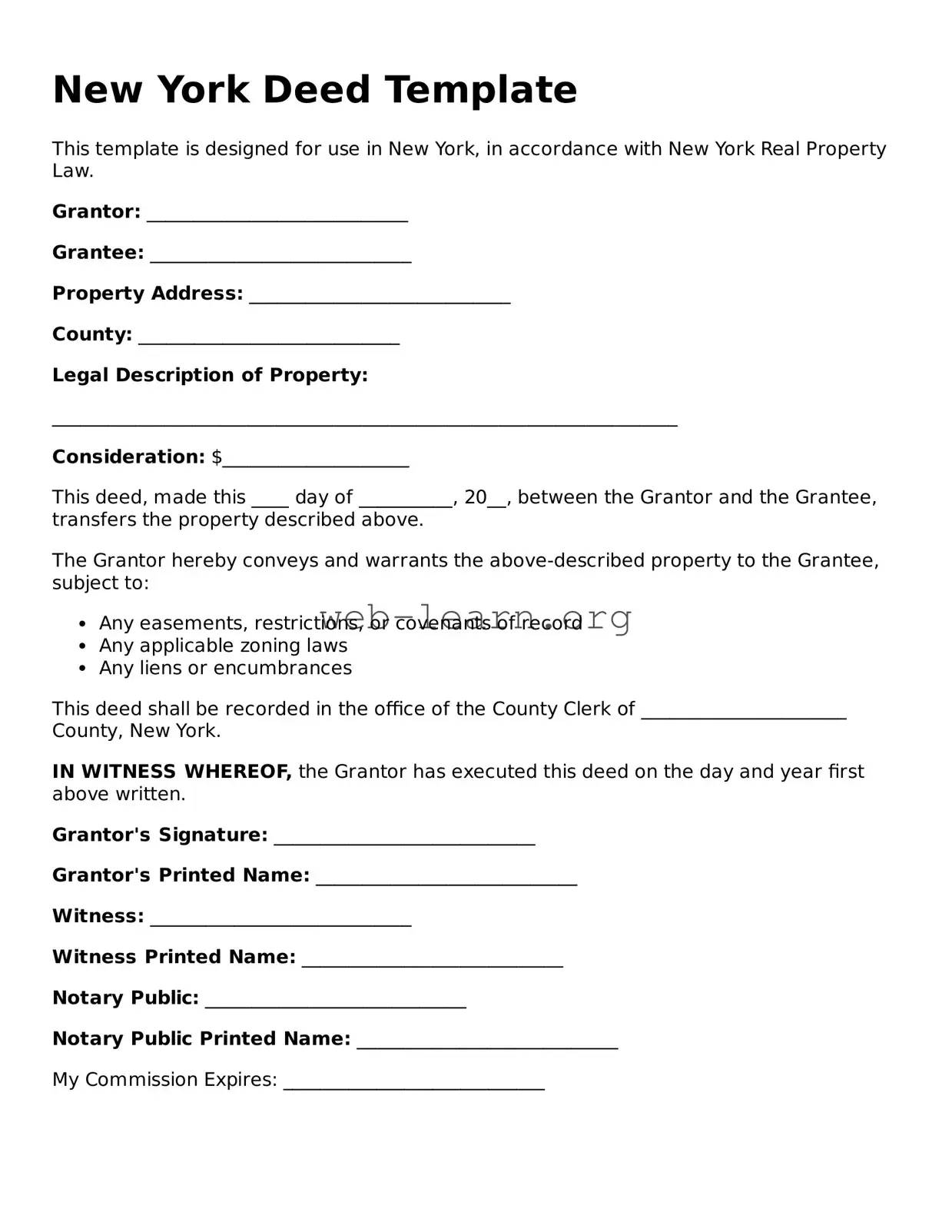
When it comes to real estate transactions in New York, understanding the New York Deed form is essential for both buyers and sellers. This document serves as a legal instrument that facilitates the transfer of property ownership from one party to another. Typically, it includes critical information such as the names of the grantor (the seller) and the grantee (the buyer), a detailed description of the property, and any relevant terms or conditions attached to the transfer. Additionally, the form must be signed and notarized to ensure its validity. Depending on the type of deed—be it a warranty deed, quitclaim deed, or another variant—specific rights and protections may be offered to the grantee. Understanding these nuances can help parties navigate the complexities of property transactions in New York, ensuring a smoother process and minimizing potential disputes down the line.
New York Deed Template
This template is designed for use in New York, in accordance with New York Real Property Law.
Grantor: ____________________________
Grantee: ____________________________
Property Address: ____________________________
County: ____________________________
Legal Description of Property:
___________________________________________________________________
Consideration: $____________________
This deed, made this ____ day of __________, 20__, between the Grantor and the Grantee, transfers the property described above.
The Grantor hereby conveys and warrants the above-described property to the Grantee, subject to:
This deed shall be recorded in the office of the County Clerk of ______________________ County, New York.
IN WITNESS WHEREOF, the Grantor has executed this deed on the day and year first above written.
Grantor's Signature: ____________________________
Grantor's Printed Name: ____________________________
Witness: ____________________________
Witness Printed Name: ____________________________
Notary Public: ____________________________
Notary Public Printed Name: ____________________________
My Commission Expires: ____________________________
| Fact Name | Description |
|---|---|
| Governing Law | The New York Deed form is governed by the New York Real Property Law. |
| Types of Deeds | New York recognizes various types of deeds, including warranty deeds, quitclaim deeds, and bargain and sale deeds. |
| Required Signatures | All parties involved in the transfer of property must sign the deed for it to be valid. |
| Notarization | The signatures on the New York Deed must be notarized to ensure authenticity. |
| Recording Requirement | To protect the interests of the new owner, the deed must be recorded in the county clerk's office where the property is located. |
| Transfer Tax | New York imposes a real estate transfer tax on the transfer of property, which must be paid at the time of recording. |
| Legal Description | A precise legal description of the property must be included in the deed to clearly identify the parcel being transferred. |
| Revocation | Once executed and recorded, a deed cannot be revoked without the consent of all parties involved. |
After obtaining the New York Deed form, it is important to fill it out accurately to ensure proper transfer of property. Once completed, the form will need to be signed and filed with the appropriate county office.
A New York Deed form is a legal document used to transfer ownership of real property in New York State. This form outlines the details of the transaction, including the names of the parties involved, a description of the property, and the terms of the transfer. There are various types of deeds, such as warranty deeds and quitclaim deeds, each serving different purposes.
Essential information on a New York Deed form includes:
You can obtain a New York Deed form through various sources. Many legal websites offer downloadable templates. Additionally, local county clerk offices may provide forms or guidance on how to complete them. It is advisable to ensure that the form complies with New York State laws.
While it is not legally required to have a lawyer to complete a New York Deed form, consulting with one can be beneficial. A lawyer can help ensure that the deed is filled out correctly and that all legal requirements are met. This can prevent potential issues in the future regarding property ownership.
After completing the New York Deed form, it must be signed by the grantor and notarized. The next step is to file the deed with the county clerk's office where the property is located. This filing officially records the transfer of ownership. It is important to keep a copy of the recorded deed for your records.
Yes, there are typically fees associated with filing a New York Deed form. These fees can vary by county. It is advisable to check with the local county clerk’s office for specific amounts. Additionally, there may be transfer taxes applicable to the transaction, which should also be considered.
Filling out a New York Deed form can seem straightforward, but many individuals make common mistakes that can lead to complications down the road. Understanding these pitfalls can help ensure a smoother process when transferring property ownership.
One frequent error involves incorrect names. When completing the deed, it’s crucial to ensure that the names of all parties involved are spelled correctly and match their legal identification. A minor typo can create significant issues during the transfer, potentially delaying the process or even invalidating the deed.
Another mistake often seen is the failure to include all necessary parties. If multiple owners are involved in the property, all names must be listed on the deed. Omitting a co-owner can lead to disputes later on, especially if that person has not consented to the transfer.
People also sometimes overlook the description of the property. The deed must contain a clear and accurate description of the property being transferred. This description should include details such as the address and any relevant boundaries. A vague or incorrect description can cause confusion and legal issues regarding ownership.
In addition, some individuals neglect to include the date of the transfer. While it may seem like a minor detail, the date is essential for establishing the timeline of ownership. Without it, determining the rights of the parties involved can become complicated, especially in disputes over property claims.
Another common oversight is the failure to sign the deed correctly. All parties involved must sign the document, and their signatures should be notarized. A missing signature or an improperly notarized document can render the deed invalid, requiring additional steps to correct the issue.
People often forget to consider tax implications when filling out a deed form. Depending on the nature of the transfer, there may be tax consequences that need to be addressed. Consulting with a tax professional can help clarify any obligations and prevent unexpected financial burdens.
Lastly, many individuals underestimate the importance of recording the deed after it has been completed. Failing to file the deed with the appropriate county office can lead to problems with proving ownership in the future. Recording the deed protects the new owner’s rights and ensures that the transfer is officially recognized.
By being aware of these common mistakes, individuals can navigate the process of filling out a New York Deed form with greater confidence and accuracy. Taking the time to double-check each detail can save significant time and trouble later on.
The New York Deed form is a crucial document in the process of transferring property ownership. Along with this form, several other documents are commonly utilized to ensure a smooth transaction. Each of these documents serves a specific purpose in the real estate process.
These documents work together with the New York Deed form to facilitate a clear and legally sound property transaction. Understanding each document's role can help both buyers and sellers navigate the complexities of real estate transactions more effectively.
When filling out the New York Deed form, it is essential to follow specific guidelines to ensure accuracy and compliance. Below is a list of things to do and avoid during this process.
Things You Should Do:
Things You Shouldn't Do:
Understanding the New York Deed form can be tricky, and there are several misconceptions that people often have. Here’s a look at ten common misunderstandings, along with clarifications to help you navigate this important document.
Many people believe that all deeds serve the same purpose. In reality, there are various types of deeds, such as warranty deeds and quitclaim deeds, each with different implications for ownership and liability.
Some think that recording a deed is optional. However, in New York, it is crucial to record the deed to protect your ownership rights and provide public notice of the transaction.
It’s a common belief that deeds don’t require notarization. In New York, a deed must be signed and notarized to be legally binding.
People often assume that only the seller’s signature is required. However, both parties typically need to sign the deed for it to be valid.
While the primary purpose of a deed is to transfer property, it can also be used to clarify ownership interests or to add or remove names from a title.
Many believe that a signed deed is set in stone. However, it is possible to amend or modify a deed under certain circumstances, provided both parties agree.
Some think that deeds are only relevant for homes. In fact, any real estate transaction, including commercial properties and land sales, requires a deed.
Many individuals overlook the potential tax consequences when transferring property. In New York, certain transfers may incur transfer taxes, so it’s essential to be aware of these obligations.
People often believe that a recorded deed is immune to challenges. However, there are instances where a deed can be contested in court, especially if there are issues like fraud or duress.
Lastly, some assume that once a deed is executed, it lasts forever. While deeds do convey ownership, they can be revoked or altered through legal processes, depending on the situation.
By clearing up these misconceptions, you can better understand the importance of the New York Deed form and ensure that your property transactions go smoothly.
When filling out and using the New York Deed form, there are several important considerations to keep in mind. Here are some key takeaways:
Alabama Deed Transfer Form - In some cases, a Deed can be used to transfer property as part of a divorce settlement.
How to Get a Deed for a House - May involve specific language to meet legal standards.