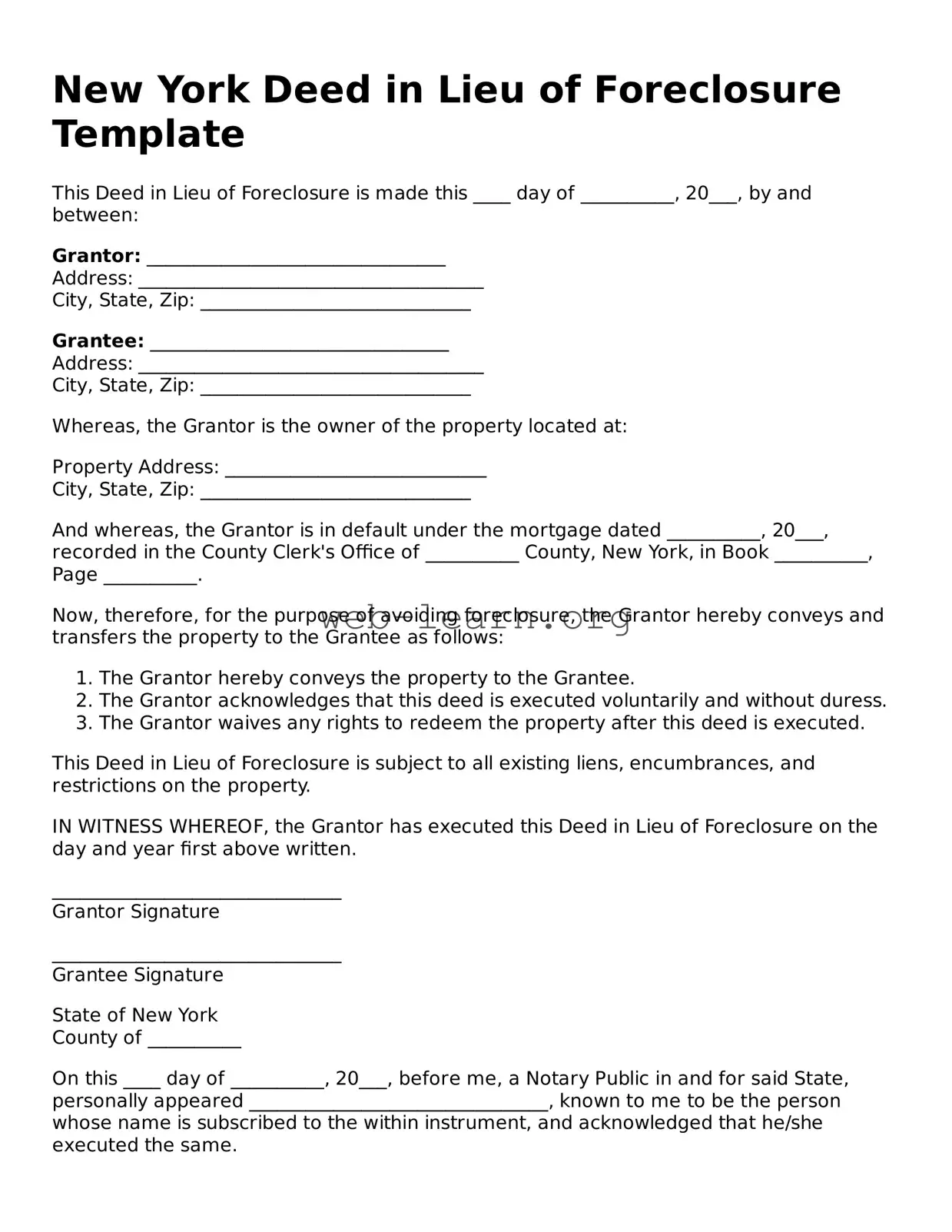
The New York Deed in Lieu of Foreclosure form serves as a significant tool for homeowners facing financial difficulties and potential foreclosure. This legal document allows property owners to voluntarily transfer their property back to the lender in exchange for the cancellation of their mortgage debt. By opting for a deed in lieu of foreclosure, homeowners can often avoid the lengthy and stressful foreclosure process, which can have lasting impacts on their credit. The form typically requires the homeowner to provide essential information, including the property address, the names of all parties involved, and a clear statement of the intent to transfer ownership. In addition, the lender may need to review the homeowner's financial situation to ensure that this option is appropriate. Overall, the Deed in Lieu of Foreclosure form offers a more amicable resolution for both parties, allowing homeowners to regain control of their financial future while providing lenders with a more efficient way to recover their losses.
New York Deed in Lieu of Foreclosure Template
This Deed in Lieu of Foreclosure is made this ____ day of __________, 20___, by and between:
Grantor: ________________________________
Address: _____________________________________
City, State, Zip: _____________________________
Grantee: ________________________________
Address: _____________________________________
City, State, Zip: _____________________________
Whereas, the Grantor is the owner of the property located at:
Property Address: ____________________________
City, State, Zip: _____________________________
And whereas, the Grantor is in default under the mortgage dated __________, 20___, recorded in the County Clerk's Office of __________ County, New York, in Book __________, Page __________.
Now, therefore, for the purpose of avoiding foreclosure, the Grantor hereby conveys and transfers the property to the Grantee as follows:
This Deed in Lieu of Foreclosure is subject to all existing liens, encumbrances, and restrictions on the property.
IN WITNESS WHEREOF, the Grantor has executed this Deed in Lieu of Foreclosure on the day and year first above written.
_______________________________
Grantor Signature
_______________________________
Grantee Signature
State of New York
County of __________
On this ____ day of __________, 20___, before me, a Notary Public in and for said State, personally appeared ________________________________, known to me to be the person whose name is subscribed to the within instrument, and acknowledged that he/she executed the same.
_______________________________
Notary Public
| Fact Name | Description |
|---|---|
| Definition | A deed in lieu of foreclosure is a legal document where a borrower voluntarily transfers ownership of their property to the lender to avoid foreclosure proceedings. |
| Governing Law | The deed in lieu of foreclosure is governed by New York Real Property Actions and Proceedings Law (RPAPL) and general contract law. |
| Eligibility | Homeowners facing financial hardship may qualify for a deed in lieu of foreclosure, but they must demonstrate an inability to maintain mortgage payments. |
| Benefits | This process can help homeowners avoid the lengthy and costly foreclosure process, and it may have less impact on their credit score. |
| Risks | Homeowners may still be liable for any deficiency if the property sells for less than the mortgage balance, unless otherwise negotiated. |
| Process | The homeowner must negotiate with the lender, complete the necessary paperwork, and ensure that all liens on the property are addressed. |
| Alternatives | Other options include loan modification, short sale, or filing for bankruptcy, each with its own implications and processes. |
After completing the New York Deed in Lieu of Foreclosure form, the next steps typically involve submitting the document to the appropriate parties. This may include the lender and any relevant county office. It is important to keep copies of all documents for personal records.
A Deed in Lieu of Foreclosure is a legal document that allows a homeowner to voluntarily transfer their property to the lender to avoid foreclosure. This process can help the homeowner avoid the negative consequences of a foreclosure on their credit report.
In this arrangement, the homeowner agrees to hand over the property to the lender. In return, the lender typically agrees to forgive the remaining mortgage debt. This can be a quicker and less costly option than going through the formal foreclosure process.
Yes, there are some potential downsides. The lender may require the homeowner to be behind on payments, which could damage credit. Additionally, not all lenders accept a Deed in Lieu of Foreclosure, and some may impose strict eligibility requirements.
The process typically involves the following steps:
Some lenders may offer relocation assistance or cash incentives to encourage homeowners to choose a Deed in Lieu of Foreclosure. However, this varies by lender and is not guaranteed.
In most cases, a Deed in Lieu of Foreclosure only addresses the primary mortgage. Homeowners may still be responsible for other liens, such as property taxes or second mortgages, unless specifically negotiated with the lender.
Consulting with a financial advisor or a housing counselor can provide valuable insights. They can help evaluate your situation and discuss the potential benefits and risks associated with a Deed in Lieu of Foreclosure.
Filling out the New York Deed in Lieu of Foreclosure form can be a daunting task, and many people make common mistakes that can complicate the process. One frequent error is failing to provide accurate property information. It is essential to include the correct address and legal description of the property. Inaccurate details can lead to delays and potential legal issues down the line.
Another mistake often seen is neglecting to obtain the necessary signatures. Both the borrower and the lender must sign the document for it to be valid. Missing a signature can render the deed ineffective, leaving the borrower still responsible for the mortgage. Always double-check that all required parties have signed before submitting the form.
People sometimes overlook the importance of reviewing the terms of the deed. It is crucial to understand the implications of transferring ownership back to the lender. Some may not realize that this action could affect their credit score or other financial obligations. Taking the time to read and comprehend the terms can prevent unpleasant surprises later.
Additionally, individuals often forget to consult with a legal advisor or real estate professional. Seeking expert guidance can clarify the process and ensure that all legal requirements are met. Many mistakes stem from a lack of understanding, and professional advice can provide valuable insights.
Lastly, failing to keep copies of the completed form is a common oversight. After submitting the deed, it is wise to retain a copy for personal records. This documentation can be crucial if any disputes arise in the future. Always ensure that you have a complete record of your transactions.
A Deed in Lieu of Foreclosure is a legal document that allows a borrower to transfer ownership of their property to the lender to avoid foreclosure. This process often involves several other forms and documents that facilitate the transaction and protect the interests of both parties. Below are five commonly associated documents.
Each of these documents plays a crucial role in the deed in lieu of foreclosure process. They help clarify the terms of the transaction, protect the interests of both the borrower and the lender, and ensure compliance with applicable laws. Understanding these documents can aid in navigating the complexities of real estate transactions effectively.
When completing the New York Deed in Lieu of Foreclosure form, it is essential to approach the process with care. Here are five important dos and don’ts to keep in mind:
Taking these steps can help ensure that your Deed in Lieu of Foreclosure form is filled out correctly and submitted on time. Your attention to detail will pay off in the long run.
Understanding the New York Deed in Lieu of Foreclosure can be challenging. Misconceptions often arise, leading to confusion for homeowners facing financial difficulties. Here are ten common misconceptions explained clearly.
A deed in lieu of foreclosure does not automatically eliminate all mortgage obligations. While it can help relieve the homeowner from the property, there may still be remaining debts or tax implications.
A deed in lieu of foreclosure is not the same as a foreclosure. In a foreclosure, the lender takes possession of the property through legal action. In contrast, a deed in lieu is a voluntary transfer of property to the lender.
Homeowners often believe that a deed in lieu guarantees a waiver of any deficiency judgment. However, this is not always the case. It's crucial to negotiate this aspect with the lender.
Many think that only properties in severe disrepair can be transferred through a deed in lieu. In reality, properties of various conditions may qualify, depending on the lender's policies.
While both options can impact credit scores, a deed in lieu may be viewed more favorably by some lenders than a foreclosure. The extent of the impact varies based on individual credit histories.
Many homeowners expect the deed in lieu process to be swift. However, it can take time, as lenders typically require thorough documentation and may take weeks or months to approve the transfer.
Not all lenders have the same policies regarding deeds in lieu. Some may not offer this option at all, so it's important to check with the specific lender involved.
A common belief is that a deed in lieu absolves homeowners of all future liabilities. However, there may still be tax implications or other financial responsibilities that need to be addressed.
While the form may appear straightforward, completing a deed in lieu involves various legal and financial considerations. It is advisable to seek professional guidance to ensure all aspects are correctly handled.
Some believe that only homeowners who owe more than their property is worth can pursue a deed in lieu. However, homeowners with equity may also consider this option depending on their circumstances.
Being informed about these misconceptions can empower homeowners to make better decisions regarding their financial futures. Seeking professional advice is always a prudent step in navigating such complex matters.
When considering a Deed in Lieu of Foreclosure in New York, it is important to understand the following key points:
What Does an Arizona Homeowner Lose When Choosing to Use Deed in Lieu of Foreclosure? - In some cases, the lender may forgive a portion of the mortgage debt as part of the agreement.
Foreclosure Georgia - This process may be less costly than foreclosure for lenders.
California Voluntary Property Surrender Document - This agreement can potentially save time and money for all parties involved.