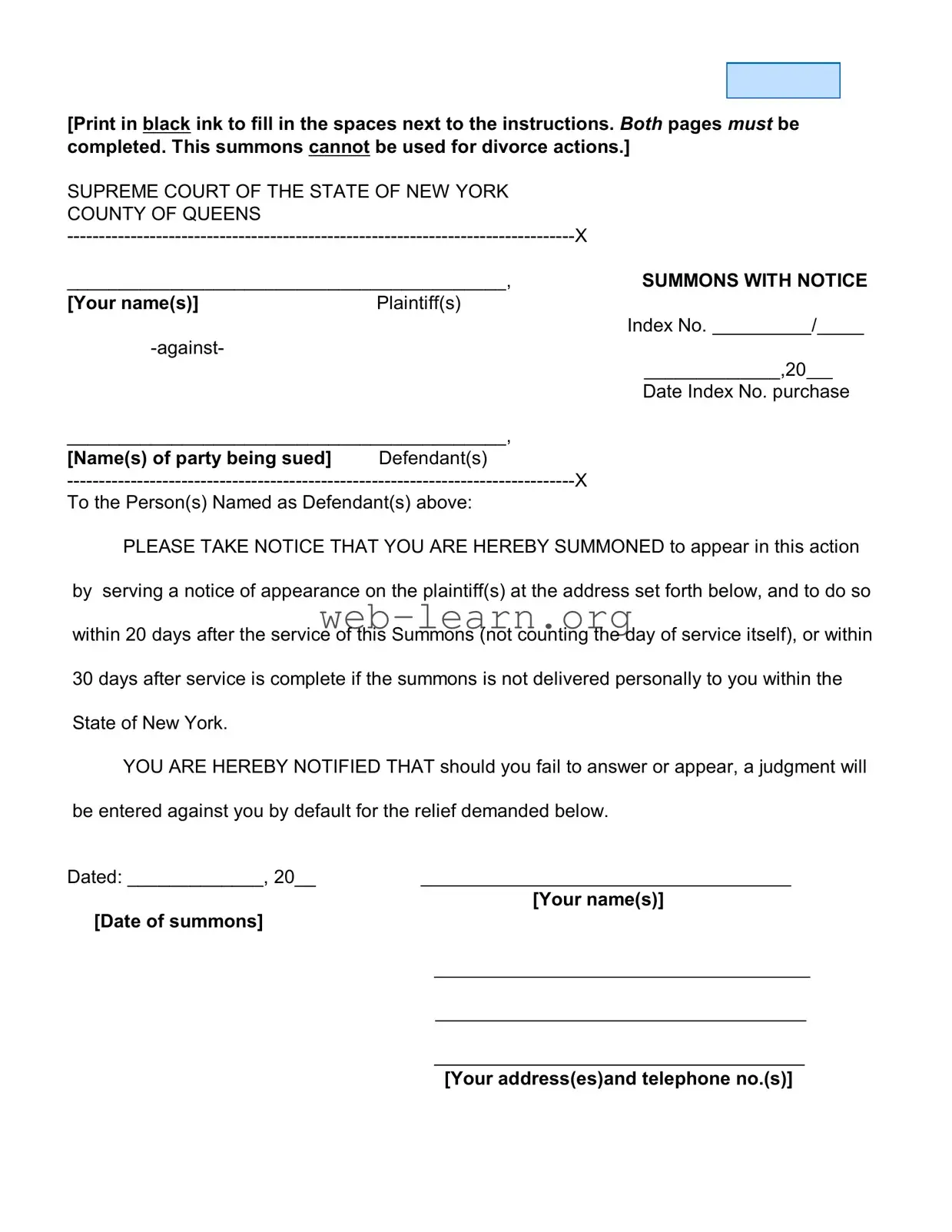
When navigating the legal system in New York, understanding the New York Court Summons form is essential for both plaintiffs and defendants. This form serves as a formal notification to the defendant that a legal action has been initiated against them, and it outlines important details regarding the case. The summons must be filled out in black ink, and both pages require completion to ensure proper filing. Notably, this form is not applicable for divorce actions. It includes vital information such as the names of the parties involved, the index number, and the nature of the action being taken, whether it’s for breach of contract or negligence. Additionally, the summons informs the defendant of their obligation to respond within a specified timeframe—20 days if served in person, or 30 days if not. Failure to respond can result in a default judgment against the defendant, highlighting the importance of timely action. Furthermore, the form designates the venue for the trial, typically based on the residence of either the plaintiff or the defendant, thereby establishing jurisdiction. Understanding these components can help individuals navigate the complexities of their legal situation more effectively.

[Print in black ink to fill in the spaces next to the instructions. Both pages must be completed. This summons cannot be used for divorce actions.]
SUPREME COURT OF THE STATE OF NEW YORK
COUNTY OF QUEENS
X |
|
|
|
|
||
__________________________________________, |
SUMMONS WITH NOTICE |
|||||
[Your name(s)] |
Plaintiff(s) |
Index No. |
/ |
|
|
|
|
|
|
||||
|
|
|
|
|
|
|
_____________,20
Date Index No. purchase
__________________________________________,
[Name(s) of party being sued] Defendant(s)
To the Person(s) Named as Defendant(s) above:
PLEASE TAKE NOTICE THAT YOU ARE HEREBY SUMMONED to appear in this action
by serving a notice of appearance on the plaintiff(s) at the address set forth below, and to do so within 20 days after the service of this Summons (not counting the day of service itself), or within 30 days after service is complete if the summons is not delivered personally to you within the State of New York.
YOU ARE HEREBY NOTIFIED THAT should you fail to answer or appear, a judgment will be entered against you by default for the relief demanded below.
Dated: _____________, 20__
[Your name(s)]
[Date of summons]
[Your address(es)and telephone no.(s)]

Defendant(s) ____________________________________________________________
[Address(es) of party being sued]
Notice: The nature of this action is [briefly describe the nature of your case against the defendant(s), such as, breach of contract, negligence]:
The relief sought is [briefly describe the kind of relief you are asking for, such as, money damages of $25,000]
Should defendant(s) fail to appear herein, judgment will be entered by default for the sum of [amount of money demanded], with interest form the date of [date from which interest on the amount demanded is
claimed] and the costs of this action.
Venue:
Plaintiff(s) designate Queens County as the place of trial. The basis of this designation is [check box that applies]:
Plaintiff(s) residence in Queens County
Defendant(s) residence in Queens County
Other [See CPLR Article 5]:
| Fact Name | Details |
|---|---|
| Form Purpose | The New York Court Summons form is used to notify a defendant of a legal action against them, requiring their appearance in court. |
| Completion Requirements | Both pages of the summons must be filled out completely, and it should be printed in black ink. |
| Exclusions | This summons cannot be used for divorce actions; it is specifically designed for other types of civil cases. |
| Response Time | Defendants have 20 days to respond after receiving the summons, or 30 days if not served personally within New York State. |
| Default Judgment | If a defendant fails to respond, a default judgment may be entered against them, granting the relief sought by the plaintiff. |
| Filing Location | The form is filed in the Supreme Court of the State of New York, specifically in Queens County for this instance. |
| Governing Law | The use and procedure of this summons are governed by the New York Civil Practice Law and Rules (CPLR), particularly Article 5. |
| Venue Designation | Queens County is designated as the trial location based on the residence of either the plaintiff or defendant, or other specified reasons. |
Once you have gathered all the necessary information, you can begin filling out the New York Court Summons form. This form is essential for initiating a legal action and must be completed carefully. After filling out the form, you will need to serve it to the defendant(s) and follow the required procedures for your case.
What is a New York Court Summons form?
The New York Court Summons form is a legal document that notifies a defendant that a lawsuit has been filed against them. It outlines the basic details of the case, including the names of the parties involved, the nature of the action, and the relief sought by the plaintiff.
Who can use this form?
This form can be used by individuals or entities filing a lawsuit in the Supreme Court of New York, specifically in Queens County. However, it cannot be used for divorce actions.
What information do I need to fill out?
You must provide:
How do I serve the summons to the defendant?
You can serve the summons by delivering it personally to the defendant or by mailing it to their last known address. If the summons is not delivered personally, the defendant has 30 days to respond. If it is delivered personally, they have 20 days.
What happens if the defendant does not respond?
If the defendant fails to respond or appear in court within the specified time frame, a judgment may be entered against them by default. This means you could receive the relief you sought without further court proceedings.
What is meant by 'venue' in the summons?
Venue refers to the location where the lawsuit is filed and tried. In this case, you are designating Queens County as the venue. This designation is based on factors such as the residence of the plaintiff or defendant.
Can I modify the summons once it is filed?
Once the summons is filed, it cannot be modified. If you need to change any information, you will have to file a new summons. It is important to ensure all details are accurate before submission.
Filling out the New York Court Summons form requires careful attention to detail. One common mistake is using blue or colored ink instead of black ink. The instructions clearly state that black ink should be used to ensure clarity and legibility. Using the wrong ink color can lead to issues in processing the form.
Another frequent error is failing to complete both pages of the summons. Many individuals overlook the requirement to fill out all necessary sections, which can result in delays or rejections. It is essential to ensure that every part of the form is completed before submission.
Many people also neglect to include their current address and telephone number on the form. This information is crucial for communication purposes. Without it, the court may have difficulty reaching the plaintiff for any necessary updates or notifications regarding the case.
Another mistake involves improperly identifying the defendant(s). It is important to provide the full legal names of the parties being sued. Incomplete or incorrect names can lead to confusion and may affect the court's ability to serve the summons effectively.
Some individuals fail to provide a clear description of the nature of the action. This section should briefly explain the basis of the lawsuit, such as breach of contract or negligence. A vague description may leave the court unsure about the specifics of the case.
Additionally, people often forget to specify the relief sought in the case. This section should detail the type of compensation or remedy being requested. Omitting this information can hinder the court's understanding of what the plaintiff is seeking.
Another common oversight is neglecting to indicate the amount of money demanded in the relief section. It is essential to include this figure, as it directly impacts the judgment if the defendant fails to respond.
Some individuals also overlook the date from which interest is claimed. This date is important for calculating any financial awards. Failing to specify this date can lead to complications in the resolution of the case.
Finally, many people forget to check the appropriate venue box that applies to their case. This selection is vital for determining the proper jurisdiction for the trial. Ensuring that the correct box is checked can prevent unnecessary legal complications down the line.
When initiating a legal action in New York, several forms and documents accompany the New York Court Summons. Each of these documents plays a crucial role in ensuring the process runs smoothly and adheres to legal requirements. Below is a list of commonly used documents along with brief descriptions of their purposes.
Understanding these documents is essential for anyone involved in a legal action. Each form serves a distinct purpose and contributes to the overall process of resolving disputes in court. Properly completing and filing these documents can significantly impact the outcome of a case.
The New York Court Summons form shares similarities with several other legal documents. Each document serves a specific purpose in the legal process and often includes similar elements such as notification, instructions for response, and consequences for non-compliance. Below is a list of ten documents that are comparable to the New York Court Summons form:
When filling out the New York Court Summons form, certain practices can facilitate a smoother process. Below are four recommendations to consider, along with common pitfalls to avoid.
Understanding the New York Court Summons form is essential for anyone involved in a legal matter. However, several misconceptions can lead to confusion. Here are seven common misconceptions:
Being informed about these misconceptions can help ensure that you navigate the legal process more effectively. If you have questions, seeking guidance from a knowledgeable source can be beneficial.
When filling out and using the New York Court Summons form, it is important to follow specific guidelines to ensure compliance and effectiveness. Below are key takeaways to keep in mind: