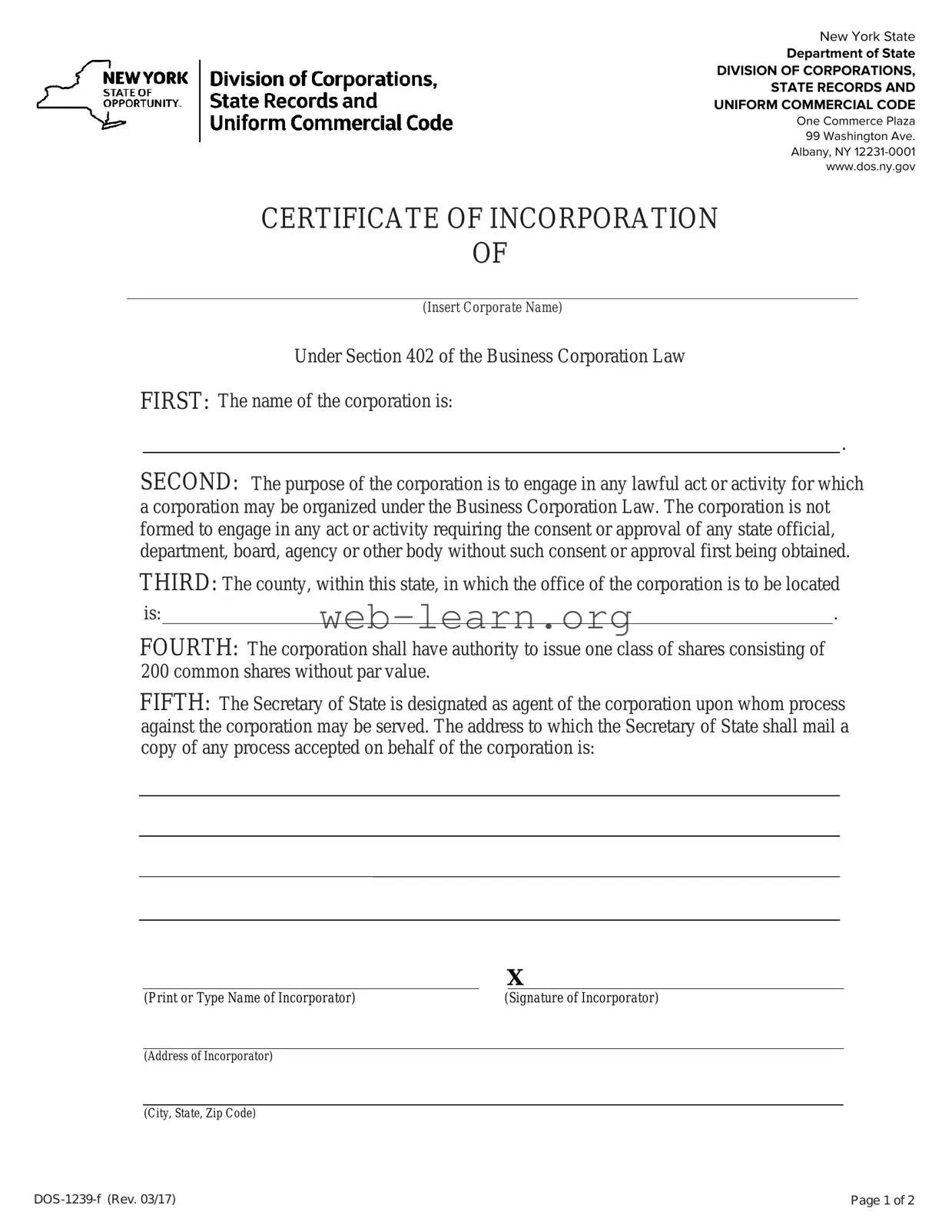
When embarking on the journey of establishing a corporation in New York, one of the first and most crucial steps is the completion of the New York Certificate of Incorporation. This official document serves as the foundation for your business, encapsulating essential details that define its existence. At its core, the certificate requires the corporation's name, which must be unique and compliant with state regulations. Additionally, it outlines the purpose of the corporation, allowing for flexibility in lawful activities under the Business Corporation Law. The form also specifies the location of the corporation's office within New York, ensuring a clear jurisdiction for legal matters. Notably, the certificate grants the authority to issue a specified number of shares, providing a framework for ownership and investment. Furthermore, it designates the Secretary of State as the official agent for service of process, streamlining legal communications. While the form is readily available through the New York State Department of State, it is important to remember that it does not encompass all possible provisions under the law. As such, consulting with an attorney is highly recommended to ensure that all legal bases are covered. The filing fee for this certificate is $125, and it must be submitted by a natural person, not another corporation. Understanding these key aspects will help pave the way for a successful incorporation process.
New York State
Department of State
DIVISION OF CORPORATIONS,
STATE RECORDS AND
UNIFORM COMMERCIAL CODE
One Commerce Plaza
99 Washington Ave.
Albany, NY
www.dos.ny.gov
CERTIFICATE OF INCORPORATION
OF
(Insert Corporate Name)
Under Section 402 of the Business Corporation Law
FIRST: The name of the corporation is:
.
SECOND: The purpose of the corporation is to engage in any lawful act or activity for which a corporation may be organized under the Business Corporation Law. The corporation is not formed to engage in any act or activity requiring the consent or approval of any state official, department, board, agency or other body without such consent or approval first being obtained.
THIRD: The county, within this state, in which the office of the corporation is to be located
is: |
|
. |
FOURTH: The corporation shall have authority to issue one class of shares consisting of 200 common shares without par value.
FIFTH: The Secretary of State is designated as agent of the corporation upon whom process against the corporation may be served. The address to which the Secretary of State shall mail a copy of any process accepted on behalf of the corporation is:
|
X |
|
(Print or Type Name of Incorporator) |
|
(Signature of Incorporator) |
(Address of Incorporator)
(City, State, Zip Code)
Page 1 of 2 |

CERTIFICATE OF INCORPORATION
OF
(Insert Corporate Name)
Under Section 402 of the Business Corporation Law
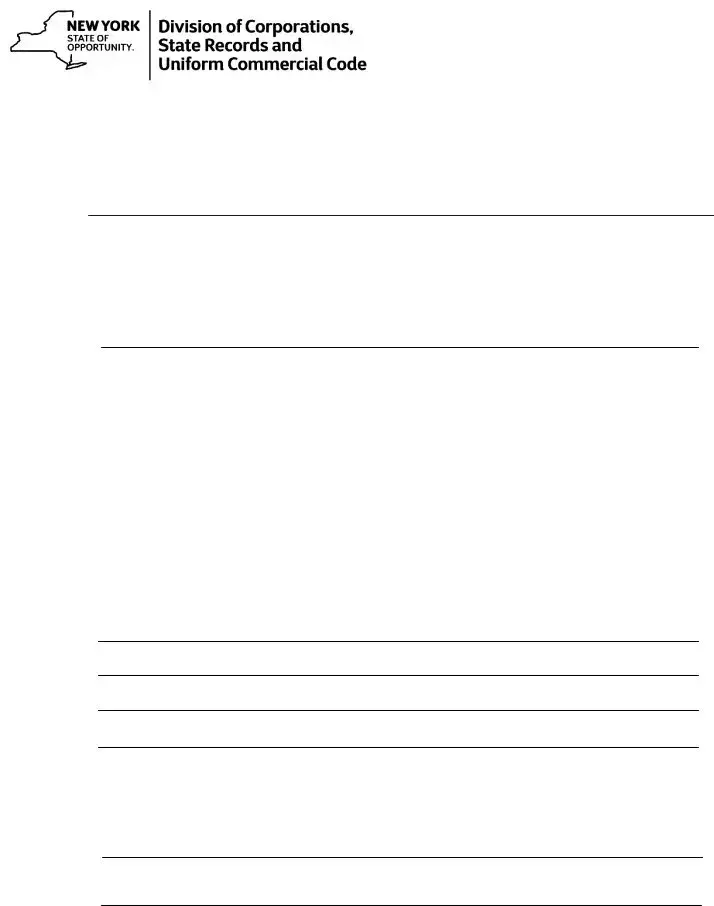
Filer’s Name and Mailing Address:
Name:
Company, if Applicable:
Mailing Address:
City, State and Zip Code:
Notes:
1.This form was prepared by the New York State Department of State for filing a certificate of incorporation for a business corporation. It does not contain all optional provisions under the law. You are not required to use this form. You may draft your own form or use forms available at legal stationery stores.
2.The Department of State recommends that legal documents be prepared under the guidance of an attorney.
3.The fee for filing a certificate of incorporation is $125. Checks should be made payable to the Department of State.
4.The incorporator must be a natural person, not a corporation or other business entity.
5.The filer may not be the corporation being formed.
For DOS use only
Page 2 of 2 |
| Fact Name | Description |
|---|---|
| Governing Law | The New York Certificate of Incorporation is governed by Section 402 of the Business Corporation Law. |
| Purpose of the Corporation | The corporation can engage in any lawful act or activity permitted under the Business Corporation Law. |
| Location Requirement | The certificate must specify the county in New York where the corporation's office will be located. |
| Share Authority | The corporation is authorized to issue one class of shares, totaling 200 common shares without par value. |
| Agent for Service | The Secretary of State is designated as the agent upon whom legal process against the corporation may be served. |
| Filing Fee | A fee of $125 is required for filing the certificate of incorporation, payable to the Department of State. |
| Incorporator Requirement | The incorporator must be a natural person, not a corporation or any other business entity. |
| Filer Restrictions | The filer of the certificate cannot be the corporation that is being formed. |
Filling out the New York Certificate of Incorporation form is a crucial step in establishing your corporation. Once you complete the form, you will need to submit it along with the required filing fee to the New York State Department of State. This will initiate the official formation of your corporation.
What is the purpose of the New York Certificate of Incorporation?
The New York Certificate of Incorporation is a legal document that establishes a corporation in the state of New York. It outlines essential information about the corporation, including its name, purpose, location, and share structure. By filing this certificate, you officially register your business and gain the legal status necessary to operate as a corporation.
What information is required to complete the form?
To complete the New York Certificate of Incorporation, you will need to provide the following details:
It is important to ensure that all information is accurate and complete to avoid delays in processing.
How much does it cost to file the Certificate of Incorporation?
The fee for filing a Certificate of Incorporation in New York is $125. Payment should be made via check, which must be payable to the Department of State. Keep in mind that this fee is non-refundable, so ensure that your application is complete before submission.
Can I draft my own Certificate of Incorporation?
Yes, you can draft your own Certificate of Incorporation. The form provided by the New York State Department of State is a standard template, but you are not obligated to use it. You may create your own document or purchase forms from legal stationery stores. However, it is recommended to seek guidance from an attorney to ensure that your document complies with all legal requirements.
Filling out the New York Certificate form can be straightforward, but many people make mistakes that can delay the process. One common error is leaving the corporate name blank. This is crucial, as the name must be clearly stated in the first section of the form. Without it, the application cannot proceed.
Another frequent mistake is failing to provide a valid purpose for the corporation. The form states that the corporation is to engage in any lawful activity. However, some individuals forget to include this information, which can lead to rejection. Ensure that the purpose aligns with the requirements of the Business Corporation Law.
People often overlook the requirement to specify the county where the corporation's office will be located. This information is essential and must be filled in accurately. Missing this detail can cause delays in processing the application.
Providing incorrect information about the shares can also lead to issues. The form specifies that the corporation should have one class of shares consisting of 200 common shares without par value. If this section is not completed correctly, it may result in complications during the approval process.
Another mistake is not designating the Secretary of State as the agent for service of process. This designation is mandatory, and without it, the form will not be accepted. Be sure to fill in the address where the Secretary of State should send any process accepted on behalf of the corporation.
Some individuals mistakenly think they can file the form on behalf of a corporation that is still being formed. The filer must be a natural person, not another corporation or business entity. This requirement is critical for the validity of the application.
Missing the signature of the incorporator is another common oversight. The form must be signed by the incorporator, and without this signature, the application will be incomplete. Double-check to ensure that all necessary signatures are included.
Additionally, the address of the incorporator must be clearly stated. Omitting this information can lead to confusion and delays in communication from the Department of State.
Lastly, people often forget to include the correct filing fee. The fee for submitting the certificate of incorporation is $125. Ensure that checks are made payable to the Department of State to avoid any processing issues.
By avoiding these mistakes, you can help ensure that your New York Certificate form is completed accurately and submitted without unnecessary delays. Always review the form carefully before submission.
When filing a New York Certificate of Incorporation, several other forms and documents may be necessary to ensure compliance with state regulations. Below is a list of commonly used documents that accompany the incorporation process. Each document plays a crucial role in establishing a business entity and maintaining legal compliance.
Each of these documents is essential for the successful establishment and operation of a corporation in New York. Proper preparation and submission of these forms can prevent delays and ensure that the business is compliant with all legal requirements.
The New York Certificate form shares similarities with several other legal documents used in business formation and governance. Each of these documents serves a specific purpose within the corporate framework. Here is a list of ten documents that are similar to the New York Certificate form:
When filling out the New York Certificate form, it's important to follow certain guidelines to ensure your application is processed smoothly. Here’s a list of what you should and shouldn’t do:
Misconceptions about the New York Certificate form can lead to confusion during the incorporation process. Below are nine common misconceptions and clarifications regarding the form.
Filling out the New York Certificate form is a crucial step in establishing a corporation. Here are some key takeaways to consider:
Completing the New York Certificate form accurately is vital for a smooth incorporation process. Take your time, and ensure that all information is correct before submission.