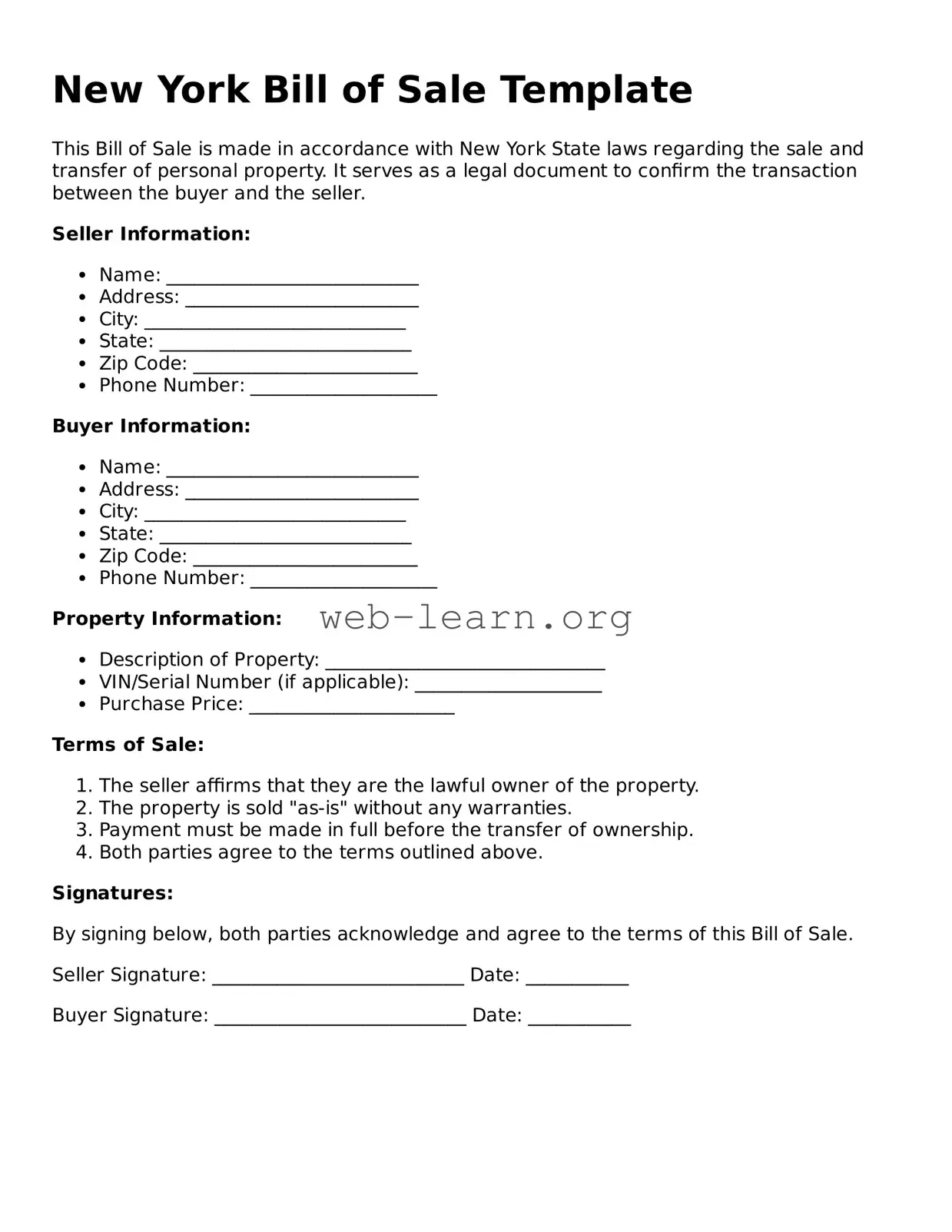
When it comes to transferring ownership of personal property in New York, a Bill of Sale is an essential document that provides a clear record of the transaction. This form is particularly important for items such as vehicles, boats, and valuable personal belongings, as it serves to protect both the buyer and the seller. The Bill of Sale outlines key details, including the names and addresses of both parties, a description of the item being sold, the sale price, and the date of the transaction. It may also include any warranties or conditions related to the sale. Having a properly executed Bill of Sale not only helps to establish legal ownership but also provides proof of the transaction should any disputes arise in the future. Understanding the components and significance of this form can make the process of buying or selling property smoother and more secure.
New York Bill of Sale Template
This Bill of Sale is made in accordance with New York State laws regarding the sale and transfer of personal property. It serves as a legal document to confirm the transaction between the buyer and the seller.
Seller Information:
Buyer Information:
Property Information:
Terms of Sale:
Signatures:
By signing below, both parties acknowledge and agree to the terms of this Bill of Sale.
Seller Signature: ___________________________ Date: ___________
Buyer Signature: ___________________________ Date: ___________
| Fact Name | Description |
|---|---|
| Purpose | The New York Bill of Sale form serves as a legal document to transfer ownership of personal property from one party to another. |
| Governing Law | The Bill of Sale is governed by New York State laws, particularly under the Uniform Commercial Code (UCC). |
| Types of Property | This form can be used for various types of personal property, including vehicles, equipment, and other tangible items. |
| Notarization | While notarization is not required for all transactions, it is recommended for added legal protection and verification. |
| Seller and Buyer Information | Both the seller and buyer must provide their full names, addresses, and signatures on the form. |
| Purchase Price | The form requires the purchase price to be clearly stated, ensuring transparency in the transaction. |
| As-Is Condition | Often, the Bill of Sale includes a clause stating that the item is sold "as-is," meaning the buyer accepts the item in its current condition. |
| Record Keeping | Both parties should retain a copy of the Bill of Sale for their records, as it serves as proof of the transaction. |
Completing the New York Bill of Sale form is a straightforward process. Once filled out, this document can serve as a record of the transaction between a buyer and a seller. It’s important to ensure all information is accurate to avoid any potential issues in the future.
A New York Bill of Sale is a legal document that serves as proof of the transfer of ownership of personal property from one party to another. It outlines the details of the transaction, including the buyer, seller, description of the item, and the sale price. This document is essential for both parties to protect their rights and ensure clarity in the sale.
A Bill of Sale is typically needed when you buy or sell personal property, such as vehicles, boats, or valuable items. It is particularly important for transactions involving significant value or when the item requires registration, like a car. Having a Bill of Sale can help avoid disputes and provide a clear record of the transaction.
The Bill of Sale should include:
While a Bill of Sale is not legally required for all transactions in New York, it is highly recommended. For certain items, especially vehicles and boats, a Bill of Sale may be necessary for registration or titling purposes. Always check specific regulations related to the type of property being sold.
Yes, you can create your own Bill of Sale. It is important to ensure that it includes all necessary information and is clear and concise. Templates are available online, but customizing it to fit your specific transaction is advisable. If you have any doubts, consulting a legal professional can provide additional assurance.
In New York, notarization is not typically required for a Bill of Sale. However, having the document notarized can add an extra layer of authenticity and can be beneficial in case of future disputes. It may also be required for certain types of transactions, so it is wise to verify the specific needs based on the item being sold.
If the item sold is defective, the terms outlined in the Bill of Sale will guide how to proceed. If the seller provided any warranties or guarantees, those should be honored. If no warranties were stated, the buyer may have limited recourse. It is crucial to be transparent about the condition of the item before the sale to avoid potential disputes.
It is advisable to keep a copy of the Bill of Sale for at least three to five years after the transaction. This period allows you to address any potential issues that may arise regarding ownership or defects. Both the buyer and seller should retain their copies for their records.
If you lose your Bill of Sale, it is recommended to contact the other party involved in the transaction to request a duplicate. If that is not possible, you may need to provide other documentation to prove ownership, such as receipts or registration documents. In some cases, creating a new Bill of Sale with the same details and having both parties sign it can help establish the transaction again.
When filling out the New York Bill of Sale form, individuals often encounter several common mistakes that can lead to complications down the line. One frequent error is failing to provide complete information about the buyer and seller. Both parties must include their full names, addresses, and contact information. Omitting any of these details can create confusion and may hinder the transaction.
Another mistake is neglecting to accurately describe the item being sold. The form should include a detailed description, including the make, model, year, and any identifying numbers, such as a Vehicle Identification Number (VIN) for vehicles. A vague description can lead to disputes regarding the item’s condition or ownership.
Many people also overlook the importance of the date. The Bill of Sale should clearly indicate the date of the transaction. Without this information, it can be difficult to establish a timeline, which may be necessary for legal purposes or future disputes.
Additionally, some individuals forget to include the purchase price. This figure is crucial for both parties, as it establishes the terms of the sale and can have implications for tax purposes. Leaving this blank can lead to misunderstandings or legal challenges.
Another common oversight involves signatures. Both the buyer and seller must sign the document for it to be valid. Failing to obtain the necessary signatures can render the Bill of Sale ineffective, leaving both parties unprotected.
People often make the mistake of not keeping a copy of the completed Bill of Sale. It is essential for both parties to retain a signed copy for their records. This document serves as proof of the transaction and can be important in case of future disputes.
Some individuals may not realize that the Bill of Sale needs to be notarized in certain situations. While not always required, notarization can add an extra layer of authenticity to the document, making it more difficult to contest in the future.
Another issue arises when individuals fail to check for any local or state-specific requirements. Each jurisdiction may have its own rules regarding the Bill of Sale, and overlooking these can lead to complications. Always verify that the form complies with local laws.
People sometimes confuse the Bill of Sale with other legal documents, such as a title transfer. While they may serve similar purposes, they are distinct documents. Understanding the differences is crucial to ensuring a smooth transaction.
Finally, some individuals rush through the process, leading to careless mistakes. Taking the time to carefully review each section of the form can prevent errors that might cause significant issues later. Attention to detail is key when completing the New York Bill of Sale form.
The New York Bill of Sale form is an essential document for transferring ownership of personal property. However, several other forms and documents may accompany it to ensure a smooth transaction and provide legal protection for both parties involved. Below is a list of commonly used documents that complement the Bill of Sale in New York.
Using these documents in conjunction with the New York Bill of Sale can help facilitate a clear and legally binding transaction. It is advisable to ensure that all necessary forms are completed accurately to protect the interests of both the buyer and the seller.
A Bill of Sale is an important document used to transfer ownership of personal property. Several other documents serve similar purposes in different contexts. Here’s a list of nine documents that share similarities with a Bill of Sale:
When filling out the New York Bill of Sale form, there are some important do's and don'ts to keep in mind. Following these guidelines can help ensure that your transaction goes smoothly.
By adhering to these guidelines, you can help ensure that your Bill of Sale is clear and legally sound.
The New York Bill of Sale form is often misunderstood. Here are eight common misconceptions about this important document:
Understanding these misconceptions can help individuals navigate the process of buying and selling more effectively. A Bill of Sale is a valuable tool that protects everyone involved in a transaction.
When filling out and using the New York Bill of Sale form, it is important to keep several key points in mind. These takeaways can help ensure that the process goes smoothly and that all necessary information is accurately captured.
By following these takeaways, you can ensure that your use of the New York Bill of Sale form is effective and legally sound.
Auto Bill of Sale Colorado - This form serves as proof of a transaction between a buyer and a seller.
Vehicle Bill of Sale Indiana - This document can provide a clear chain of ownership for future reference.
Online Bill of Sale - A Bill of Sale can be a simple yet effective way to document a transaction.