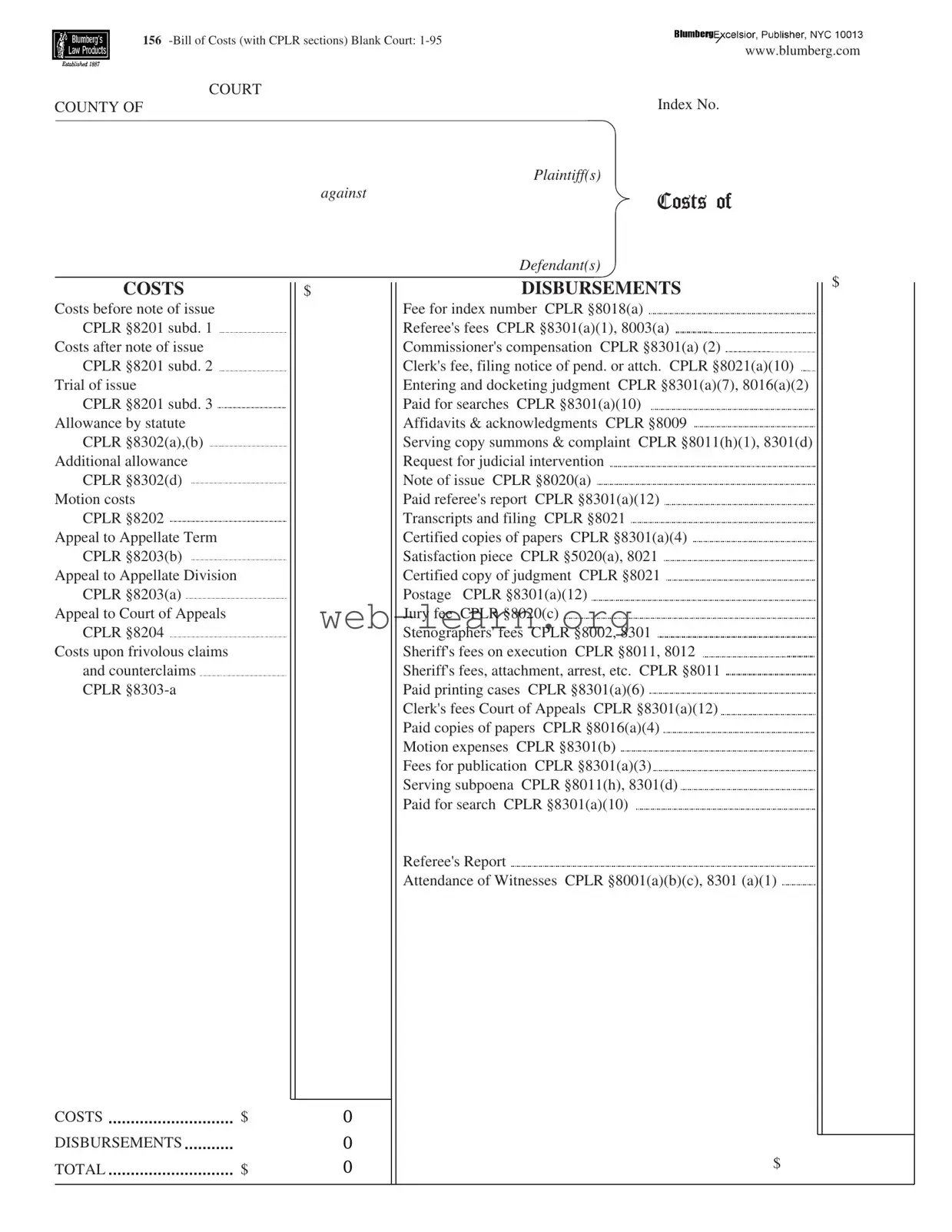
The New York Bill of Costs form is an essential document in the legal process, particularly for those involved in civil litigation. This form serves as a comprehensive record of the costs and disbursements incurred during a legal action, allowing parties to seek reimbursement for expenses associated with their case. It includes various categories of costs, such as those incurred before and after the note of issue, trial-related expenses, and allowances mandated by statute. The form also outlines specific costs for appeals to different courts, ensuring that all potential expenses are accounted for. In addition to costs, it details disbursements, which cover fees for services like filing, serving documents, and obtaining necessary transcripts. Completing this form accurately is crucial, as it forms the basis for the taxation of costs by the court. The Bill of Costs also requires an affirmation from the attorney, confirming that the listed expenses are reasonable and necessary for the case. Overall, understanding the components of the New York Bill of Costs form is vital for anyone navigating the complexities of the legal system in New York.
156
www.blumberg.com
|
COURT |
COUNTY OF |
Index No. |
Plaintiff(s)
against |
Costs of |
|
|
|
Defendant(s) |
COSTS
Costs before note of issue CPLR §8201 subd. 1
Costs after note of issue CPLR §8201 subd. 2
Trial of issue
CPLR §8201 subd. 3 Allowance by statute
CPLR §8302(a),(b) Additional allowance
CPLR §8302(d) Motion costs
CPLR §8202 Appeal to Appellate Term
CPLR §8203(b)
Appeal to Appellate Division CPLR §8203(a)
Appeal to Court of Appeals CPLR §8204
Costs upon frivolous claims and counterclaims CPLR
$
DISBURSEMENTS
Fee for index number CPLR §8018(a) Referee's fees CPLR §8301(a)(1), 8003(a) Commissioner's compensation CPLR §8301(a) (2)
Clerk's fee, filing notice of pend. or attch. CPLR §8021(a)(10) Entering and docketing judgment CPLR §8301(a)(7), 8016(a)(2) Paid for searches CPLR §8301(a)(10)
Affidavits & acknowledgments CPLR §8009
Serving copy summons & complaint CPLR §8011(h)(1), 8301(d) Request for judicial intervention
Note of issue CPLR §8020(a)
Paid referee's report CPLR §8301(a)(12) Transcripts and filing CPLR §8021 Certified copies of papers CPLR §8301(a)(4) Satisfaction piece CPLR §5020(a), 8021 Certified copy of judgment CPLR §8021 Postage CPLR §8301(a)(12)
Jury fee CPLR §8020(c) Stenographers' fees CPLR §8002, 8301 Sheriff's fees on execution CPLR §8011, 8012 Sheriff's fees, attachment, arrest, etc. CPLR §8011 Paid printing cases CPLR §8301(a)(6)
Clerk's fees Court of Appeals CPLR §8301(a)(12) Paid copies of papers CPLR §8016(a)(4)
Motion expenses CPLR §8301(b) Fees for publication CPLR §8301(a)(3) Serving subpoena CPLR §8011(h), 8301(d) Paid for search CPLR §8301(a)(10)
Referee's Report
Attendance of Witnesses CPLR §8001(a)(b)(c), 8301 (a)(1)
$
COSTS |
$ |
0 |
DISBURSEMENTS |
|
0 |
TOTAL |
$ |
0 |
$

State of New York, County of
ss.:
being duly sworn, deposes, and says; that deponent is not a party to the action, is over 18 years of age and resides at
That on
deponent served the within bill of costs and notice of taxation on
attorney(s) for
herein, at his/her office at
during his/her absence from said office. Strike out either (a) or (b).
(a) by then and there leaving a true copy of the same with
his/her clerk; partner; person having charge of said office.
(b)and said office being closed, by depositing a true copy of the same, enclosed in a sealed wrapper directed to said attorney(s), in the office letter drop or box.
Sworn to before me on
State of New York, County of |
ss.: |
being duly sworn, deposes and says; that deponent is not a party to the action, is over 18 years of age and resides at
That on
deponent served the within bill of costs and notice of taxation on
attorney(s) for at
the address designated by said attorney(s) for that purpose by depositing a true copy of same enclosed in a post paid properly addressed wrapper,
Sworn to before me on
Index No.
COURT
COUNTY OF
Plaintiff(s)
against
Defendant(s)
Bill of Costs
and Notice of |
Taxation |
|
|
|
|
Please Take Notice that the within is a true copy of the items of costs and disbursements in the within action
taxed *
and the same will be taxed *
by the clerk of
Court, at his/her office in the courthouse thereof on
atM.
of that
Yours, etc.
Attorney(s) for
To
Attorney(s) for
Service of the within bill of costs and notice of taxation is hereby admitted on
Attorney(s) for
ATTORNEY'S AFFIRMATION
STATE OF NEW YORK, COUNTY OF
ss.
The undersigned, an attorney admitted to practice in the courts of this state, affirms: that I am
the attorney(s) of record for the
in the above entitled action; that the foregoing disbursements have been or will be necessarily be made or incurred in this action and are reasonable in amount and that each of the persons named as witnessses attended as such witness on the trial, hearing or examination before trial herein the number of days set opposite their names; that each of said persons resided the number of miles set opposite their names, from the place of said trial, hearing or examination; and each of said persons, as such witness as aforesaid, necessarily traveled the number of miles to set opposite their names in traveling to, and the same distance in returning from, the same place of trial, hearing or examination; and that copies of documents or papers as charged herein were actually and necessarily obtained for use.
The undersigned affirms that the foregoing statements are true, under the penalties of perjury.
Dated:
The name signed must be printed beneath
* Check one (CPLR § 8402, 8403)
| Fact Name | Details |
|---|---|
| Purpose of the Bill | The Bill of Costs is used to outline the expenses incurred in a legal action, allowing for the recovery of certain costs by the prevailing party. |
| Governing Law | This form is governed by the New York Civil Practice Law and Rules (CPLR), specifically sections 8201, 8301, and 8302, among others. |
| Costs Before and After Note of Issue | Costs can be claimed before the note of issue under CPLR §8201 subd. 1, and after the note of issue under CPLR §8201 subd. 2. |
| Disbursements Included | The Bill of Costs includes various disbursements such as filing fees, referee fees, and costs for serving documents, as outlined in CPLR sections 8018, 8301, and others. |
| Notice of Taxation | Parties must serve a notice of taxation regarding the Bill of Costs, informing the opposing party of the costs being claimed and the date of taxation. |
Completing the New York Bill Costs form requires careful attention to detail. This document is essential for outlining the costs and disbursements incurred during a legal proceeding. Following the steps below will ensure that the form is filled out correctly and submitted in a timely manner.
Once the form is completed, it must be submitted to the appropriate court. Ensure that all necessary copies are made for your records and for service to the opposing party. Timely submission is crucial to avoid delays in the taxation process.
The New York Bill of Costs form is used to itemize and claim costs and disbursements incurred during a legal action. It provides a detailed breakdown of expenses that a party seeks to recover from the opposing party. These costs can include court fees, attorney fees, and other related expenses that arise during litigation.
Any party involved in a legal action, typically the prevailing party, can file a Bill of Costs. This includes both plaintiffs and defendants. The form must be completed and submitted to the court to formally request the recovery of costs associated with the case.
The Bill of Costs can include various types of expenses, such as:
Each item must be properly documented and justified to ensure that the court recognizes the costs as reasonable and necessary.
The Bill of Costs must be served on the opposing party's attorney. This can be done by either delivering a copy to the attorney's office or mailing it to the designated address. Proper service is crucial as it ensures that the opposing party is aware of the costs being claimed and can respond accordingly.
The Bill of Costs is taxed by the clerk of the court. This process involves reviewing the submitted costs to determine their validity and appropriateness. The clerk will then finalize the amount that can be recovered, which will be included in the judgment of the case.
Filling out the New York Bill Costs form can be a straightforward process, but several common mistakes can lead to complications. One frequent error is failing to include all necessary costs and disbursements. Many individuals overlook specific fees, such as those for serving documents or filing notices. Ensure that every applicable cost is accounted for to avoid delays in processing.
Another mistake is not providing accurate information regarding the attorney's details. It's essential to include the correct name and address of the attorney representing the party. Incorrect information can lead to miscommunication and potentially delay the taxation process.
Many people also struggle with the correct calculation of costs. Miscalculating the total amount due is a common issue. Double-check each line item and ensure that the totals reflect the actual expenses incurred. Inaccurate totals can lead to disputes and require additional revisions.
Omitting signatures is another significant mistake. The form requires signatures from both the attorney and the individual submitting the bill. Failing to provide these signatures can result in the form being rejected or delayed.
Some individuals neglect to serve the bill of costs properly. The form must be served to the opposing party's attorney according to the specified methods. Not adhering to these requirements can cause procedural issues and impact the outcome of the cost recovery process.
Another common oversight is not keeping copies of the submitted form. It is crucial to retain a copy for your records. This can serve as proof of submission and help clarify any future disputes regarding the costs.
Additionally, many people do not pay attention to the deadlines for submitting the bill of costs. Each case has specific timelines, and missing these deadlines can result in losing the right to claim certain costs. Always be aware of the timeline relevant to your case.
Lastly, individuals sometimes fail to provide adequate documentation to support their claims. Supporting documents, such as receipts and invoices, are necessary to substantiate the costs listed. Without these documents, the court may question the validity of the claims.
By being aware of these common mistakes, individuals can ensure that their New York Bill Costs form is completed accurately and efficiently, facilitating a smoother process in recovering costs.
The New York Bill of Costs form is a crucial document used in legal proceedings to outline the costs and disbursements incurred during a case. However, it is often accompanied by other important forms and documents that help to provide a complete picture of the financial aspects of the litigation. Below are five such documents commonly used alongside the Bill of Costs.
Understanding these accompanying documents can help ensure that all parties are prepared and informed throughout the litigation process. Each document plays a vital role in establishing the validity of the costs and ensuring that all legal requirements are met.
Bill of Particulars: Similar to the New York Bill Costs form, a Bill of Particulars provides detailed information about the claims made in a lawsuit. It outlines the specific facts and circumstances that support the claims, ensuring that all parties are clear on the issues at hand.
Statement of Claim: This document initiates a lawsuit and outlines the plaintiff's allegations against the defendant. Like the Bill Costs, it serves to inform the opposing party of the claims being made, although it focuses more on the legal basis for the action rather than the costs incurred.
Notice of Motion: A Notice of Motion is filed to request a court order. It is similar to the Bill Costs in that it requires formal submission to the court and must detail the specific relief sought, making it essential for moving a case forward.
Affidavit of Service: This document proves that legal papers were delivered to the opposing party. Like the Bill Costs, it is crucial for establishing that all parties have received the necessary documents, ensuring fairness in the legal process.
Proposed Order: A Proposed Order is submitted to the court for approval. Similar to the Bill Costs, it outlines specific requests and must be formatted correctly to comply with court requirements, making it an essential part of legal proceedings.
Notice of Appeal: This document is filed to initiate an appeal process. Like the Bill Costs, it must be submitted within a specific timeframe and includes details about the decision being challenged, ensuring that the appellate court has the necessary information to proceed.
Request for Judicial Intervention (RJI): An RJI is filed to request the court's involvement in a case. It shares similarities with the Bill Costs as it requires detailed information about the case and helps streamline the judicial process.
Settlement Agreement: This document outlines the terms agreed upon by both parties to resolve a dispute. While the Bill Costs focuses on expenses, a Settlement Agreement aims to finalize the terms of the resolution, often including costs as part of the settlement.
Stipulation of Discontinuance: This document formally ends a lawsuit. Similar to the Bill Costs, it must be filed with the court and requires agreement from both parties, ensuring that all procedural steps are followed.
Judgment Form: A Judgment Form is the final decision issued by the court. Like the Bill Costs, it summarizes the outcome of the case and may include details on costs awarded, reflecting the financial implications of the court's ruling.
When filling out the New York Bill Costs form, there are important dos and don'ts to keep in mind. Here’s a helpful list to guide you:
Following these guidelines will help ensure that your Bill of Costs is processed smoothly and efficiently.
This form is applicable to any party in a legal action, regardless of their size. Individuals and small businesses can also utilize it to recover costs incurred during litigation.
Costs can be claimed both before and after the note of issue, as indicated in CPLR §8201. This means you can start the process of recovering costs earlier in the litigation.
Costs must be specifically itemized and justified. The court will review the submitted Bill of Costs and determine which costs are reasonable and necessary.
While both terms relate to expenses incurred during litigation, disbursements refer to specific out-of-pocket expenses, such as filing fees or witness fees, as outlined in the form.
There are specific timeframes for submitting the Bill of Costs, typically after the conclusion of the trial or hearing. Failure to adhere to these timelines may result in forfeiture of the right to claim costs.
While attorneys typically handle the submission, individuals can also complete the form if they are representing themselves in a legal matter.
Supporting documentation is crucial. You must provide evidence for the costs and disbursements claimed, such as receipts or invoices, to substantiate your request.
Different courts may have variations in their requirements or processes for submitting a Bill of Costs. It is essential to check the specific rules for the court where your case is filed.
Only reasonable and necessary expenses directly related to the litigation can be claimed. Personal or unrelated expenses will not be reimbursed.
Winning does not guarantee recovery of all claimed costs. The court has discretion in awarding costs, and it may reduce or deny certain claims based on its evaluation.
When dealing with the New York Bill of Costs form, there are several important aspects to keep in mind. Understanding these key points can make the process smoother and more efficient.
By keeping these takeaways in mind, you can navigate the New York Bill of Costs form with greater confidence and clarity.