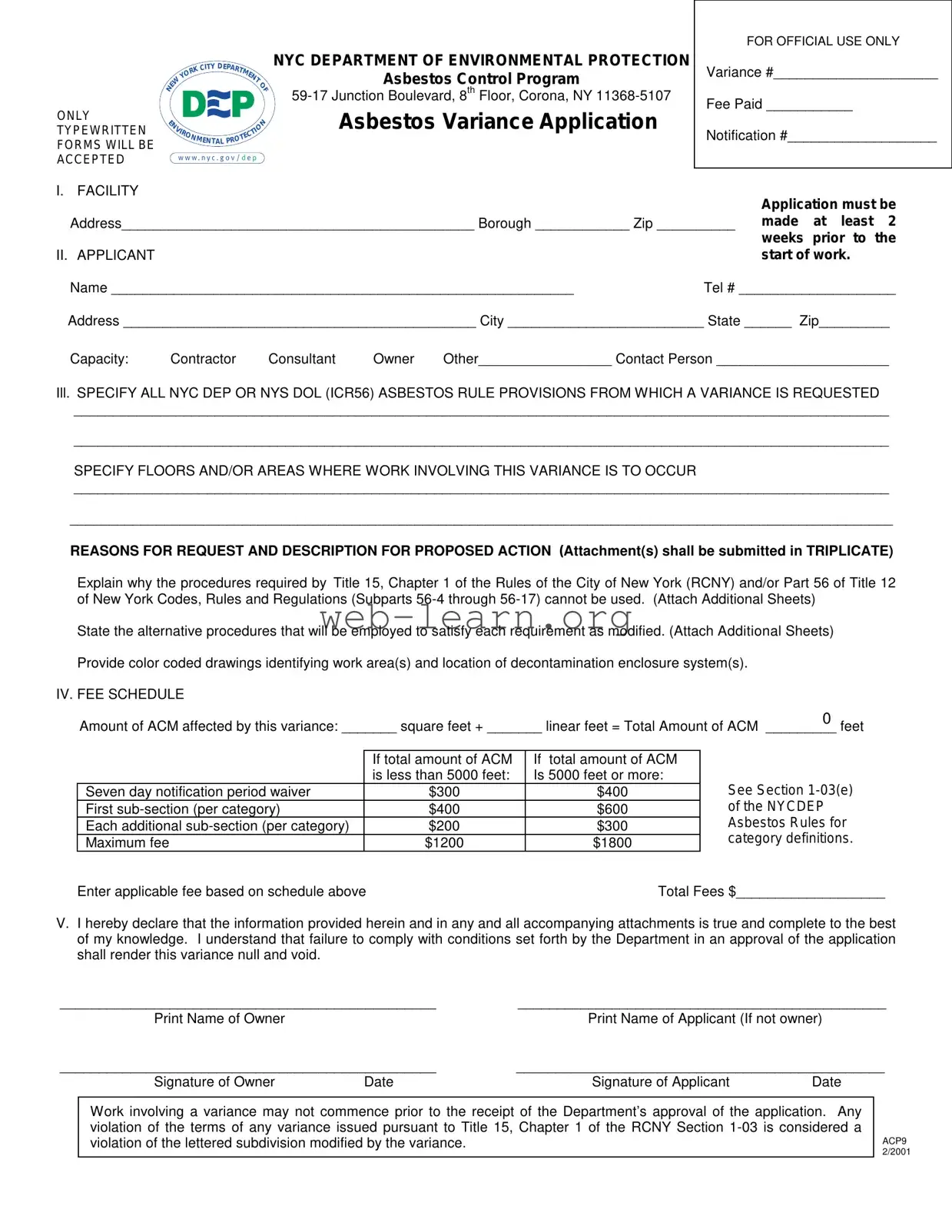
The New York ACP9 form is a crucial document for anyone involved in asbestos-related work in the city. This form serves as an Asbestos Variance Application, allowing contractors, consultants, and property owners to request exceptions to certain asbestos regulations set by the New York City Department of Environmental Protection (DEP). To ensure compliance and safety, applicants must submit this typewritten form at least two weeks before the planned work begins. The ACP9 requires detailed information about the facility where the work will take place, the applicant's contact details, and the specific asbestos regulations from which a variance is being sought. It also asks for a clear explanation of why standard procedures cannot be followed, as well as alternative methods that will be used to maintain safety standards. Additionally, the form outlines a fee schedule based on the amount of asbestos-containing material (ACM) affected by the variance. It is essential to complete the form accurately, as any misinformation can render the variance null and void. Overall, the ACP9 form plays a vital role in managing asbestos safely, ensuring that all necessary precautions are taken before any work commences.
ONLY TYPEWRITTEN FORMS WILL BE ACCEPTED
|
|
|
Y D |
EPA |
|
|
NYC DEPARTMENT OF ENVIRONMENTAL PROTECTION |
|
|
K |
CIT |
|
|
|
|
|
|
|
RT |
|
|
||
|
R |
|
|
M |
E |
Asbestos Control Program |
|
|
O |
|
|
|
|
||
|
W |
|
|
|
|
O |
|
|
Y |
|
|
|
|
N |
|
|
E |
|
|
|
|
T |
|
N |
|
|
|
|
F |
||
|
|
|
|
|
|
||
I |
|
|
|
|
|
|
|
T |
N |
Asbestos Variance Application |
|
N |
|
|
|
|
|
|
|
|
|
|
|
E |
|
|
|
|
|
|
|
|
|
|
|
V |
R |
|
|
|
|
|
|
IO |
|
|
|
|
|
|
|
|
|
C |
|
|
|||
|
|
O |
N |
|
|
|
E |
|
|
|
|
|
|
|
M |
|
T |
|
|
|
|
||
|
|
|
|
O |
|
|
|
|
|
||
|
|
|
|
|
ENTAL PR |
|
|
|
|
|
|
w w w . n y c . g o v / d e p
FOR OFFICIAL USE ONLY
Variance #_____________________
Fee Paid ___________
Notification #___________________
I. FACILITY
|
|
Application must be |
||
Address_____________________________________________ Borough ____________ Zip __________ |
made |
at least |
2 |
|
|
|
weeks |
prior to |
the |
II. APPLICANT |
|
start of work. |
|
|
Name ___________________________________________________________ |
Tel # ____________________ |
|||
Address _____________________________________________ City _________________________ State ______ Zip_________
Capacity: ¸Contractor ¸Consultant ¸Owner ¸Other_________________ Contact Person ______________________
Ill. SPECIFY ALL NYC DEP OR NYS DOL (ICR56) ASBESTOS RULE PROVISIONS FROM WHICH A VARIANCE IS REQUESTED
________________________________________________________________________________________________________
________________________________________________________________________________________________________
SPECIFY FLOORS AND/OR AREAS WHERE WORK INVOLVING THIS VARIANCE IS TO OCCUR
________________________________________________________________________________________________________
_________________________________________________________________________________________________________
REASONS FOR REQUEST AND DESCRIPTION FOR PROPOSED ACTION (ATTACHMENT(S) SHALL BE SUBMITTED IN TRIPLICATE)
Explain why the procedures required by Title 15, Chapter 1 of the Rules of the City of New York (RCNY) and/or Part 56 of Title 12 of New York Codes, Rules and Regulations (Subparts
State the alternative procedures that will be employed to satisfy each requirement as modified. (Attach ADDITIONAL Sheets)
Provide color coded drawings identifying work area(s) and location of decontamination enclosure system(s).
IV. FEE SCHEDULE
|
|
|
|
0 |
Amount of ACM affected by this variance: _______ square feet + _______ linear feet = Total Amount of ACM _________ feet |
||||
|
|
|
|
|
|
|
If total amount of ACM |
If total amount of ACM |
|
|
|
is less than 5000 feet: |
Is 5000 feet or more: |
See Section |
Seven day notification period waiver |
|
$300 |
$400 |
|
First |
|
$400 |
$600 |
of the NYCDEP |
Each additional |
|
$200 |
$300 |
Asbestos Rules for |
|
|
|
|
category definitions. |
Maximum fee |
|
$1200 |
$1800 |
|
|
|
|||
Enter applicable fee based on schedule above |
|
Total Fees $___________________ |
||
V.I hereby declare that the information provided herein and in any and all accompanying attachments is true and complete to the best of my knowledge. I understand that failure to comply with conditions set forth by the Department in an approval of the application shall render this variance null and void.
________________________________________________ |
_______________________________________________ |
||
Print Name of Owner |
|
Print Name of Applicant (If not owner) |
|
________________________________________________ |
_______________________________________________ |
||
Signature of Owner |
Date |
Signature of Applicant |
Date |
Work involving a variance may not commence prior to the receipt of the Department’s approval of the application. Any violation of the terms of any variance issued pursuant to Title 15, Chapter 1 of the RCNY Section
ACP9 2/2001
Click here if you wish to obtain a voter registration form. Government services are not conditioned on being registered to vote. A voter registration form can also be obtained at http://nyc. gov/html/misc/html/register. html, or by calling (212)
| Fact Name | Details |
|---|---|
| Form Purpose | The ACP9 form is used to apply for an asbestos variance in New York City. |
| Submission Deadline | Applications must be submitted at least two weeks before the work starts. |
| Governing Laws | The form is governed by Title 15, Chapter 1 of the Rules of the City of New York and Part 56 of Title 12 of New York Codes, Rules and Regulations. |
| Fee Structure | Fees range from $300 to $1800 depending on the amount of asbestos and type of variance requested. |
| Facility Information | Applicants must provide the facility's address and borough where the work will occur. |
| Applicant Details | Applicants must include their name, contact number, and address on the form. |
| Work Restrictions | Work cannot begin until the Department approves the variance application. |
| Compliance Statement | Applicants must declare that all information provided is accurate and complete. |
Filling out the New York ACP9 form requires careful attention to detail. Once completed, this form will be submitted to the New York City Department of Environmental Protection for review. Be sure to gather all necessary information and documents before starting, as this will streamline the process.
Once the form is filled out, it must be submitted to the Department of Environmental Protection at the address listed on the form. Remember that work involving a variance cannot begin until you receive approval from the Department.
What is the purpose of the New York ACP9 form?
The New York ACP9 form is used to apply for a variance from specific asbestos regulations set forth by the NYC Department of Environmental Protection (DEP). This form allows applicants to request permission to deviate from standard asbestos handling procedures under certain circumstances.
Who needs to fill out the ACP9 form?
Individuals or entities involved in construction, renovation, or demolition projects that may disturb asbestos-containing materials must complete this form. This includes contractors, consultants, and property owners. The application must be submitted at least two weeks before the planned start of work.
What information is required on the ACP9 form?
The form requires detailed information about the facility, the applicant, and the specific asbestos regulations from which a variance is being requested. Applicants must also provide reasons for the request, describe proposed actions, and include any relevant attachments.
What are the fees associated with the ACP9 form?
The fee structure depends on the amount of asbestos-containing material (ACM) affected by the variance. If the total ACM is less than 5,000 square feet, the fee is $300 for a seven-day notification period waiver. For amounts of 5,000 square feet or more, the fee is $400. Additional fees apply based on the number of sub-sections of the NYCDEP asbestos rules involved.
What happens if the application is not approved?
Work involving a variance may not commence until the Department approves the application. If the application is denied, the applicant must adhere to the standard asbestos handling procedures as outlined in the regulations.
What should I do if my application is approved?
Once the application is approved, the applicant must comply with all conditions set forth in the variance. Any violation of these terms will render the variance null and void, and work must cease until compliance is achieved.
How can I submit the ACP9 form?
The ACP9 form must be completed in a typewritten format and submitted to the NYC Department of Environmental Protection at the specified address: 59-17 Junction Boulevard, 8th Floor, Corona, NY 11368-5107. Ensure that all sections of the form are filled out accurately before submission.
Where can I find more information about asbestos regulations?
For additional details regarding asbestos regulations and the ACP9 form, visit the NYC DEP website at www.nyc.gov/dep. This site provides comprehensive information on the Asbestos Control Program and related guidelines.
Filling out the New York ACP9 form can be a straightforward process, but many applicants make common mistakes that can lead to delays or denials. One significant error is failing to submit the form in a typewritten format. The instructions clearly state that only typewritten forms will be accepted. Handwritten submissions are not permissible and will result in automatic rejection.
Another frequent mistake is not providing sufficient detail in the sections that specify the provisions from which a variance is requested. Applicants often leave these sections blank or provide vague descriptions. It is crucial to clearly outline the specific rules being waived and to explain why the standard procedures cannot be followed.
Inadequate documentation is another pitfall. The form requires attachments in triplicate, including detailed explanations and drawings. Some applicants neglect to include these necessary documents, which can lead to processing delays. Providing thorough and complete attachments is essential for a successful application.
Additionally, applicants sometimes miscalculate the amount of asbestos-containing material (ACM) affected by the variance. It is vital to accurately measure and report both square and linear feet. Mistakes in this calculation can lead to incorrect fee assessments and may affect the approval process.
Another mistake is submitting the application without ensuring that all required signatures are present. Both the owner and the applicant must sign the form, and missing signatures can halt the process. Double-checking for complete signatures before submission can save time and effort.
Moreover, some individuals fail to pay the correct fee based on the amount of ACM. The fee structure is tiered, depending on whether the total amount is less than or greater than 5,000 feet. Misunderstanding this structure can lead to underpayment or overpayment, complicating the application process.
Lastly, applicants often overlook the timeline for submission. The form must be submitted at least two weeks prior to the start of work. Last-minute submissions can lead to rushed applications and increased chances of errors. Planning ahead is essential to ensure compliance with this requirement.
By being aware of these common mistakes, applicants can improve their chances of successfully obtaining a variance through the New York ACP9 form. Attention to detail and thorough preparation are key components of a successful application process.
The New York ACP9 form is a critical document for those seeking a variance related to asbestos control. However, it is often accompanied by several other forms and documents that help facilitate the application process. Here’s a brief overview of some of these important documents.
These documents work together with the ACP9 form to ensure that asbestos-related work is conducted safely and in compliance with the law. Proper preparation and submission of these forms can significantly streamline the approval process and help mitigate risks associated with asbestos exposure.
The New York ACP9 form is a crucial document used in the Asbestos Control Program, specifically for requesting variances related to asbestos work. Several other documents share similarities with the ACP9 form in terms of purpose, structure, and the information required. Here are seven such documents:
Each of these documents plays a vital role in ensuring that asbestos-related work is conducted safely and in compliance with local and state regulations. Understanding their similarities can help streamline the process for those involved in asbestos management and abatement.
When filling out the New York ACP9 form, attention to detail is crucial. Here are five important dos and don’ts to keep in mind:
Understanding the New York ACP9 form is crucial for anyone involved in asbestos management. However, several misconceptions can lead to confusion. Here are four common misconceptions:
When filling out the New York ACP9 form, keep these key takeaways in mind:
Adhering to these guidelines will help streamline the application process and avoid unnecessary delays.