The New York 8104 form is an important document used by policyholders of New York Life Insurance Company and its affiliates. This form facilitates various requests related to life insurance policies, including changes to dividend options and tax withholding elections. When completing the 8104 form, policyholders must provide essential information such as their policy number, name, and contact details. They can select from multiple dividend options, including retaining the One Year Term Rider or applying dividends to premiums or loans. Additionally, the form addresses tax withholding requirements mandated by the Internal Revenue Service (IRS). Policyholders are required to indicate their preferences for federal and state income tax withholding, ensuring compliance with tax regulations. Completing the 8104 form accurately is crucial, as it can affect the policy's dividend distribution and tax implications. Understanding the various sections of this form can help policyholders make informed decisions regarding their life insurance policies.
Next >
Print...
New York Life Insurance Company |
NYLIFE Insurance Company of Arizona |
New York Life and Annuity Corporation |
(Not licensed in every state) |
(A Delaware Corporation) |
4343 North Scottsdale Rd, Suite 220 |
51 Madison Avenue, New York, NY 10010 |
Scottsdale, AZ 85251 |
www.newyorklife.com |
|
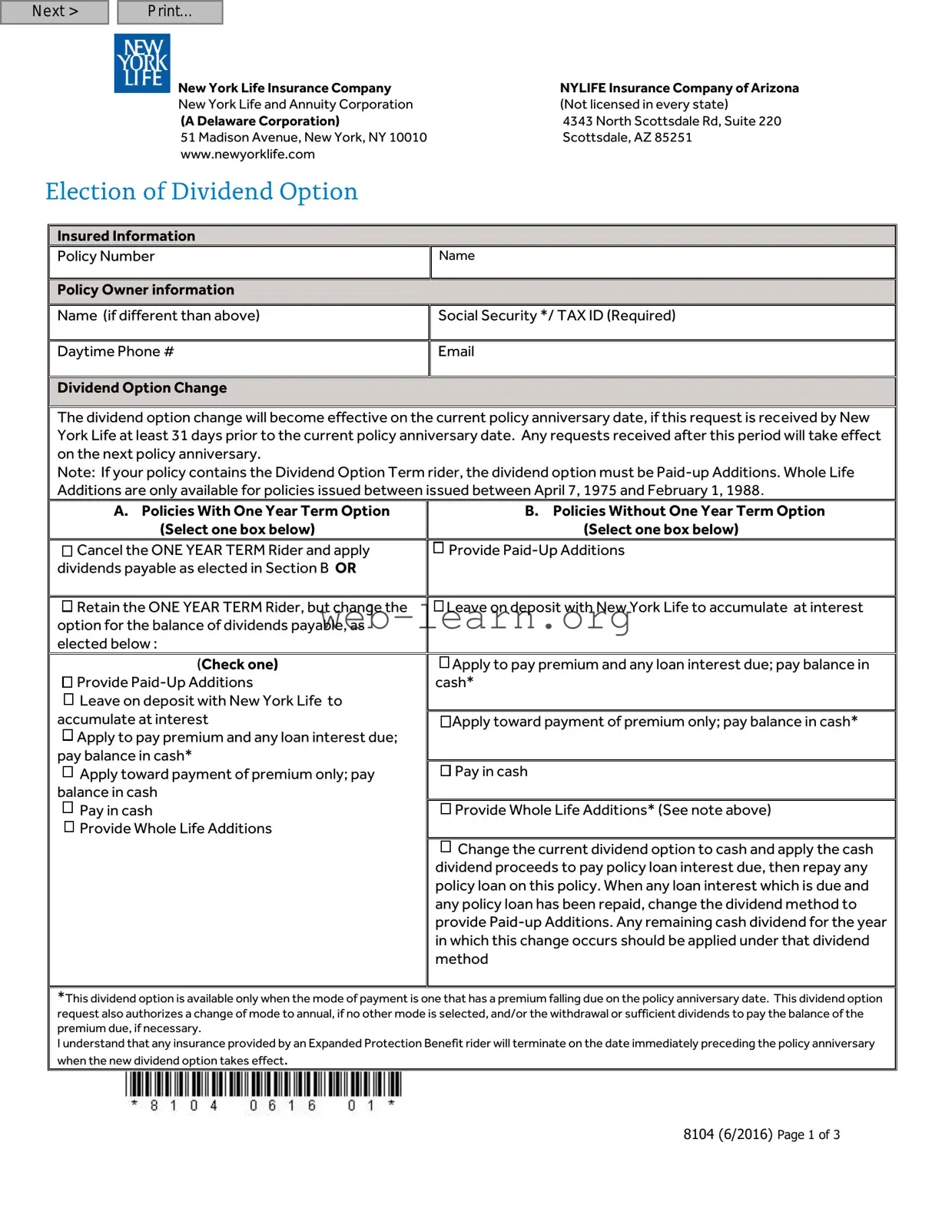
Insured Information
Policy Number |
Name |
|
|
Policy Owner information |
|
|
|
Name (if different than above) |
Social Security */ TAX ID (Required) |
|
|
Daytime Phone # |
|
|
|
Dividend Option Change
The dividend option change will become effective on the current policy anniversary date, if this request is received by New York Life at least 31 days prior to the current policy anniversary date. Any requests received after this period will take effect on the next policy anniversary.
Note: If your policy contains the Dividend Option Term rider, the dividend option must be
A.Policies With One Year Term Option (Select one box below)
Cancel the ONE YEAR TERM Rider and apply dividends payable as elected in Section B OR
Retain the ONE YEAR TERM Rider, but change the option for the balance of dividends payable, as elected below :
(Check one)
Provide
Leave on deposit with New York Life to accumulate at interest
Apply to pay premium and any loan interest due; pay balance in cash*
Apply toward payment of premium only; pay balance in cash
Pay in cash
Provide Whole Life Additions
B.Policies Without One Year Term Option (Select one box below)
Provide
Leave on deposit with New York Life to accumulate at interest
Apply to pay premium and any loan interest due; pay balance in cash*
Apply toward payment of premium only; pay balance in cash*
Pay in cash
Provide Whole Life Additions* (See note above)
Change the current dividend option to cash and apply the cash dividend proceeds to pay policy loan interest due, then repay any policy loan on this policy. When any loan interest which is due and any policy loan has been repaid, change the dividend method to provide
*This dividend option is available only when the mode of payment is one that has a premium falling due on the policy anniversary date. This dividend option request also authorizes a change of mode to annual, if no other mode is selected, and/or the withdrawal or sufficient dividends to pay the balance of the premium due, if necessary.
I understand that any insurance provided by an Expanded Protection Benefit rider will terminate on the date immediately preceding the policy anniversary when the new dividend option takes effect.
8104 (6/2016) Page 1 of 3
< Back
Next >
Print...
I wish to elect Added Value Advantage
Income Tax Withholding Section
IMPORTANT: The Internal Revenue Service (IRS) requires that you complete this section. See important tax information below before you make your withholding election. If your social security number (SSN) or taxpayer identification number (TIN) is not furnished, we are required by Federal law to withhold 10% of the taxable gain. Withholding election is not required for withdrawal from Dividend Deposits.
Are you a citizen of the United States (including a resident alien)? Yes |
No |
I elect to have the following withholding option applied to this payment and any future payment(s) under this policy (check only one box):
NO Federal or State Income taxes will be withheld |
ONLY Federal Income taxes withheld |
|
(This option may not be available for residents |
|
of certain states. See the State Income Tax |
|
Withholding section of this form) |
BOTH Federal and State Income taxes will be withheld
ONLY State income taxes withheld
If you elected any of the option above in which taxes will be withheld, you can specify the tax withholding percentage(%) of each withdrawal you would like to have applied to Federal and/or State income tax withholding. If a specific tax withholding amount is not indicated below, we will withhold 10% for federal tax purposes and the state’s minimum withholding (if applicable). Please fill in items (1) and (2) below.
(1)I would like to apply _____% of the taxable portion to Federal Withholding.
(2)I would like to apply _____% of the taxable portion to State Withholding.
If you elect to have Federal Income tax withheld, we are required to withhold at least 10% of the taxable portion of the distribution. If your state requires withholding, we will withhold the state’s minimum amount if you select an amount that is less than the minimum. Please see Important State Income Tax Withholding Information section.
Policyowner’s Signature (REQUIRED)
Under penalties of perjury, I (as owner named) certify: (1) my social security number or Tax ID number shown on this form is my correct taxpayer identification number, (2) I am not subject to back withholding because (a) I am exempt from backup withholding; or (b) I have not been notified by the IRS that I am subject to backup withholding as a result of a failure to report all interest or dividend income; or (c) the IRS has notified me that I am no longer subject to backup withholding, (3) I am a U.S. person (includes a U.S. resident alien), and (4) I am exempt from Foreign Account Compliance Act (FATCA) reporting.
Check this box if the IRS has notified you that you are subject to backup withholding.
If I am not a U.S. citizen, U.S. resident alien or other U.S. person, I am submitting the applicable Form W8 with this form to certify my foreign status and if applicable, claim treaty benefits.
The Internal Revenue Service does not require your consent to any provision of this document other than the certifications required to avoid backup withholding.
X
|
Policy Owner Signature |
Name (Printed) |
Date |
|
|
X |
|
|
|
|
|
|
|
|
|
Policy Owner Signature |
Name (Printed) |
Date |
|
|
RETURN FORM TO: |
|
|
|
|
New York Life |
|
|
|
|
P.O. Box 130539 |
|
|
|
|
Dallas, TX |
|
|
|
8104 (6/2016) Page 2 of 3

< Back |
|
Print... |
|
|
|
Important Tax Information
You should consider very carefully which box you check above. You should consult with your personal tax advisor, plan administrator, State income tax authority, or your local IRS office if you have any questions about income tax withholding. IRS publication 505 (Tax Withholding and Estimated Tax) and IRS forms
Federal Income Tax Withholding
A dividend withdrawal from your policy may result in a taxable gain reportable to the IRS on Form 1099. Federal income taxes must be withheld at a flat 10% rate from the taxable portion of your payment (as determined from our records), unless you elect not to have withholding apply by checking the appropriate box in the Income Tax Withholding Election section on this form.
Even if you elect not to have Federal income tax withheld, you are liable for payment of such tax on the taxable portion of your payment. There are penalties under the estimated tax payment rules if enough tax has not been paid through either estimated tax payments or withholding. If the taxable portion of a payment when added to the taxable portion of all other payments during the year is less than $200, Federal income tax is not required to be withheld.
State Income Tax Withholding
In addition to the Federal income tax withholding requirements, some states require withholding on policy gains when federal income tax is withheld. As of January 1, 2012, the following states require state income tax withholding when federal income tax withholding is in effect: Iowa, Kansas, Maryland, Massachusetts, Nebraska, Oklahoma, and Virginia. If you live in Arkansas, California, Delaware, Georgia, Maine, North Carolina, Oregon, or Vermont we are required to withhold state income tax if federal income tax withholding is in effect, unless you elect not to have state income tax withheld. If you live in Michigan, we are required to withhold state income tax from the taxable portion of your payments, unless you provide us with a properly completed Form MI
If you reside in any of the following states and request state tax withholding, you must also specify the percentage of state tax withholding that you choose to apply to the taxable portion of the withdrawal: Alabama, Colorado, Connecticut, District of Columbia, Idaho, Illinois, Indiana, Kentucky, Louisiana, Minnesota, Missouri, Montana, New Jersey, New Mexico, New York, North Dakota, Ohio, South Carolina, Utah, West Virginia, and Wisconsin. In these states, if a percentage is not specified, state tax will not be
withheld.
8104 (6/2016) Page 3 of 3
| Fact Name | Details |
|---|---|
| Form Title | New York 8104 Form |
| Governing Laws | New York Insurance Law |
| Purpose | This form is used to change the dividend option for life insurance policies. |
| Effective Date | The change becomes effective on the policy anniversary date if submitted at least 31 days prior. |
| Dividend Options | Options include Paid-Up Additions, cash payments, and leaving dividends to accumulate at interest. |
| Tax Withholding Requirement | Federal law mandates that 10% of taxable gains be withheld unless specified otherwise. |
| Signature Requirement | The policy owner's signature is required to certify the accuracy of the provided information. |
| State-Specific Withholding | Some states require state income tax withholding if federal withholding is applied. |
| Penalties for Early Withdrawal | A 10% penalty may apply for withdrawals before age 59½ unless exceptions are met. |
| Return Address | Completed forms should be sent to New York Life, P.O. Box 130539, Dallas, TX 75313-0539. |
Completing the New York 8104 form is an important step in managing your insurance policy. This form allows you to make specific changes related to your policy's dividend options and tax withholding preferences. After filling out the form, you will submit it to New York Life for processing. Below are the steps to guide you through the completion of the form.
What is the New York 8104 form?
The New York 8104 form is a document used by policyholders of New York Life Insurance Company to make changes to their dividend options associated with their life insurance policies. It allows policyholders to elect how they would like their dividends to be applied, whether to pay premiums, accumulate interest, or provide paid-up additions.
Who needs to fill out the New York 8104 form?
This form must be completed by the policy owner or the insured individual if they wish to change their dividend options. It is essential for those who have policies with dividend options and want to manage how their dividends are utilized.
What are the dividend options available on the New York 8104 form?
Policyholders can choose from several options, including:
When do changes made on the New York 8104 form take effect?
Changes to the dividend options will become effective on the current policy anniversary date if the request is received at least 31 days prior to that date. If the request is submitted after this period, the changes will take effect on the next policy anniversary.
What is the significance of tax withholding on the New York 8104 form?
The form includes a section for income tax withholding, as required by the IRS. If a policyholder does not provide their Social Security Number or Tax ID, the company must withhold 10% of the taxable gain. Policyholders can also elect to have federal and/or state taxes withheld from their dividend payments.
Are there penalties associated with early withdrawals?
Yes, if a policyholder withdraws funds from their policy before reaching the age of 59½, a 10% IRS penalty may apply unless certain exceptions, such as disability, are met. It's important for policyholders to understand these potential penalties when making withdrawal decisions.
What happens if I do not specify a withholding percentage?
If a policyholder does not specify a withholding percentage for federal or state taxes, the default rate of 10% for federal tax will be applied, along with the minimum withholding for the applicable state, if required.
Can I change my withholding election at any time?
Yes, policyholders can change their withholding election at any time. Any changes made will apply to future payments from the same policy.
Where should I send the completed New York 8104 form?
The completed form should be mailed to New York Life at the following address:
New York Life
P.O. Box 130539
Dallas, TX 75313-0539
Filling out the New York 8104 form can be straightforward, but mistakes can lead to delays or complications. One common error is not providing the Social Security number or Tax ID. This information is required and must be accurate. Without it, the form may be rejected, and processing will halt until the correct information is submitted.
Another frequent mistake involves the selection of dividend options. Applicants often fail to check a box or select an option that aligns with their intent. It is crucial to ensure that the chosen dividend option matches the policy type and the desired outcome. A lack of clarity here can lead to unintended consequences regarding how dividends are managed.
Many people also overlook the deadline for submitting changes to dividend options. If the request is not received at least 31 days before the policy anniversary, the change will not take effect until the following year. This timing is essential to avoid missing out on potential benefits.
Inaccurate or incomplete signatures are another common issue. The policy owner’s signature is mandatory, and missing or incorrect signatures can result in processing delays. Ensure that the name is printed clearly and matches the name on the policy.
Individuals sometimes fail to check the appropriate boxes regarding tax withholding. It is important to understand the implications of each option selected. Not doing so can lead to unexpected tax liabilities. Additionally, if no selection is made, the default withholding rate may not align with the individual's financial plans.
Some applicants neglect to consult with a tax advisor regarding the tax implications of their choices. This oversight can lead to misunderstandings about tax liabilities or penalties that could arise from certain selections. Seeking professional advice is a prudent step when completing the form.
Another mistake is not reviewing the state-specific requirements for tax withholding. Each state has different regulations, and failing to comply with these can lead to additional complications. It is essential to be aware of the specific rules that apply to the state of residence.
Lastly, individuals often forget to keep a copy of the completed form for their records. Retaining a copy can be beneficial for future reference and can help clarify any discrepancies that may arise later. Keeping organized records is an essential practice when dealing with financial documents.
When dealing with the New York 8104 form, there are several other documents and forms that may be relevant. These documents help clarify various aspects of your insurance policy and ensure compliance with tax regulations. Understanding these forms can streamline your process and help you make informed decisions.
Familiarizing yourself with these documents can make managing your insurance policy more efficient. Each form serves a specific purpose and can significantly impact your financial and tax situation. Always consider consulting with a tax advisor or financial planner if you have questions about how these forms relate to your personal circumstances.
When filling out the New York 8104 form, it’s important to follow certain guidelines to ensure accuracy and compliance. Here are some dos and don’ts to consider:
This form can be used by policyholders in various states, not just New York. It is applicable wherever New York Life operates.
Filing this form is often necessary for policy changes, especially regarding dividend options and tax withholding. It is important to follow the instructions carefully.
While it does focus on dividends, it also includes important tax withholding information. Understanding both aspects is crucial for managing your policy effectively.
You can change your dividend option, but you must submit the request at least 31 days before your policy anniversary for it to take effect on that date.
Not all policies qualify for the same options. For example, certain options are only available for policies issued within specific dates.
You have the ability to choose your tax withholding preferences on the form. However, if you do not specify, the default withholding rates will apply.
A signature is mandatory. It certifies that the information provided is accurate and acknowledges your understanding of the tax implications.
Withdrawals made before age 59½ may incur a 10% IRS penalty, unless specific exceptions apply. It is important to be aware of these potential penalties.
In fact, it is highly recommended to consult a tax advisor. They can provide guidance tailored to your individual situation and help you make informed decisions.
The 8104 form is relevant throughout the life of your policy. Changes in your financial situation or tax status may require you to revisit this form.