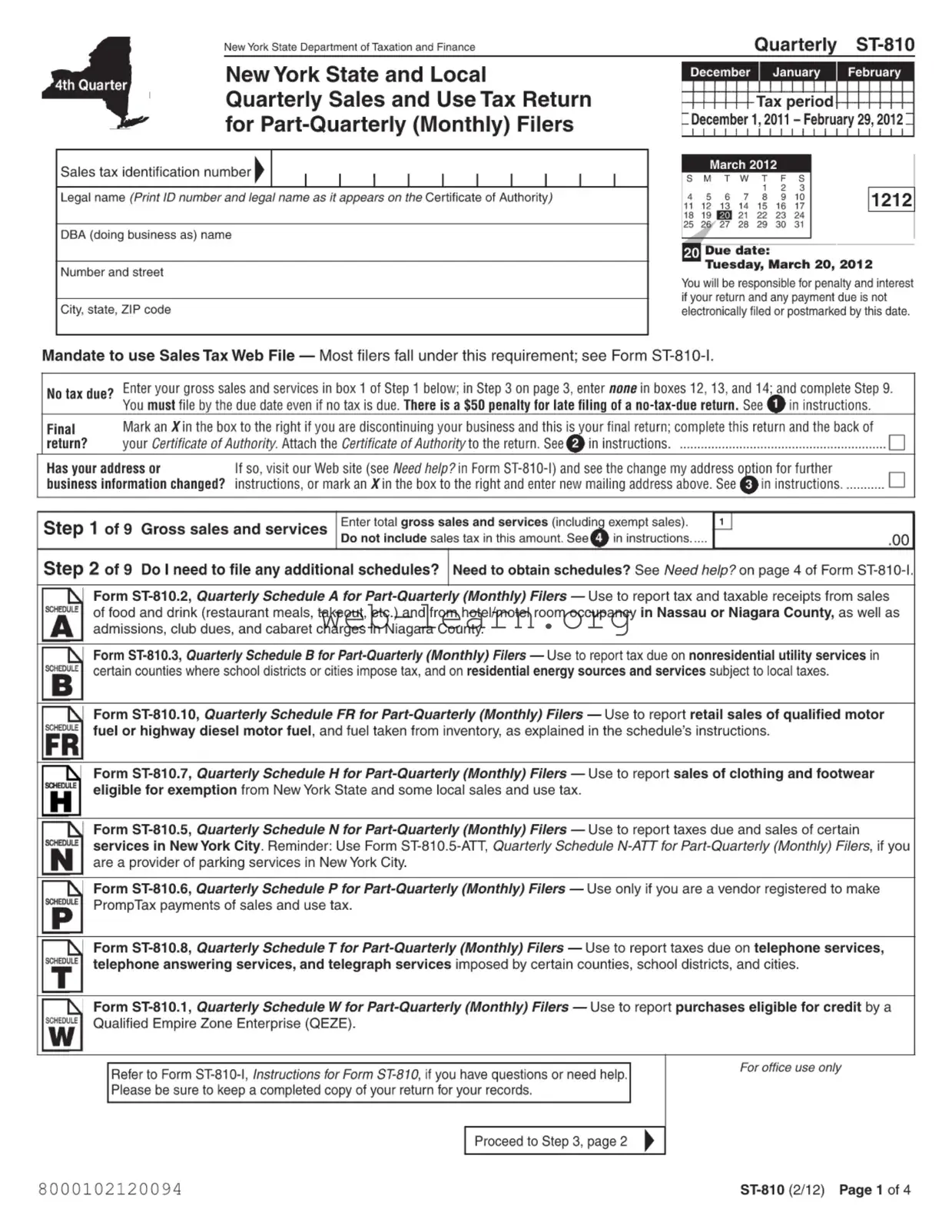
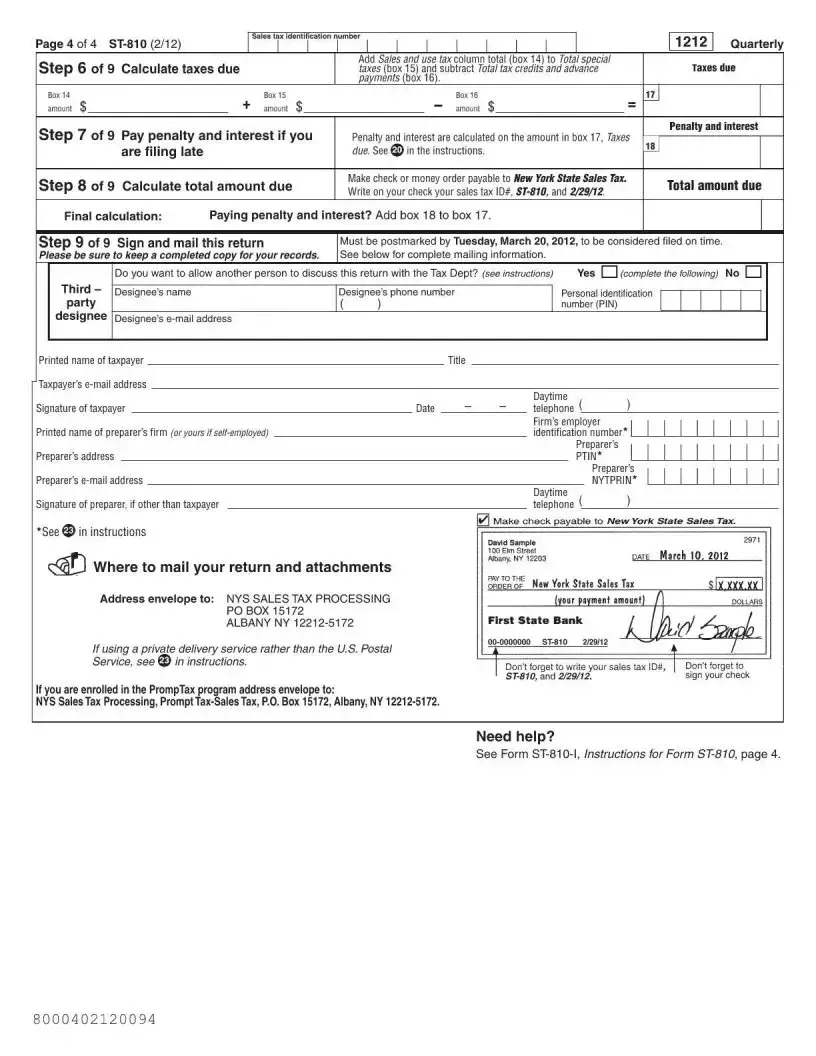
The New York ST-810 form is an essential document for businesses in New York State that need to report their sales and use tax on a quarterly basis. This form is specifically designed for part-quarterly filers, who are required to submit their tax information on a monthly schedule. It covers a three-month period, allowing businesses to report their gross sales, taxable purchases, and any applicable exemptions. The ST-810 requires businesses to provide their sales tax identification number, legal name, and address, ensuring that all information is accurately recorded. Timely submission is crucial; failure to file by the due date can result in penalties, even if no tax is due. The form also includes various schedules for reporting specific types of sales, such as food and drink or non-residential utility services. If a business is discontinuing operations, it must indicate this on the form and submit additional documentation. Keeping a completed copy for records is strongly advised, as it helps maintain accurate financial documentation.
| Fact Name | Details |
|---|---|
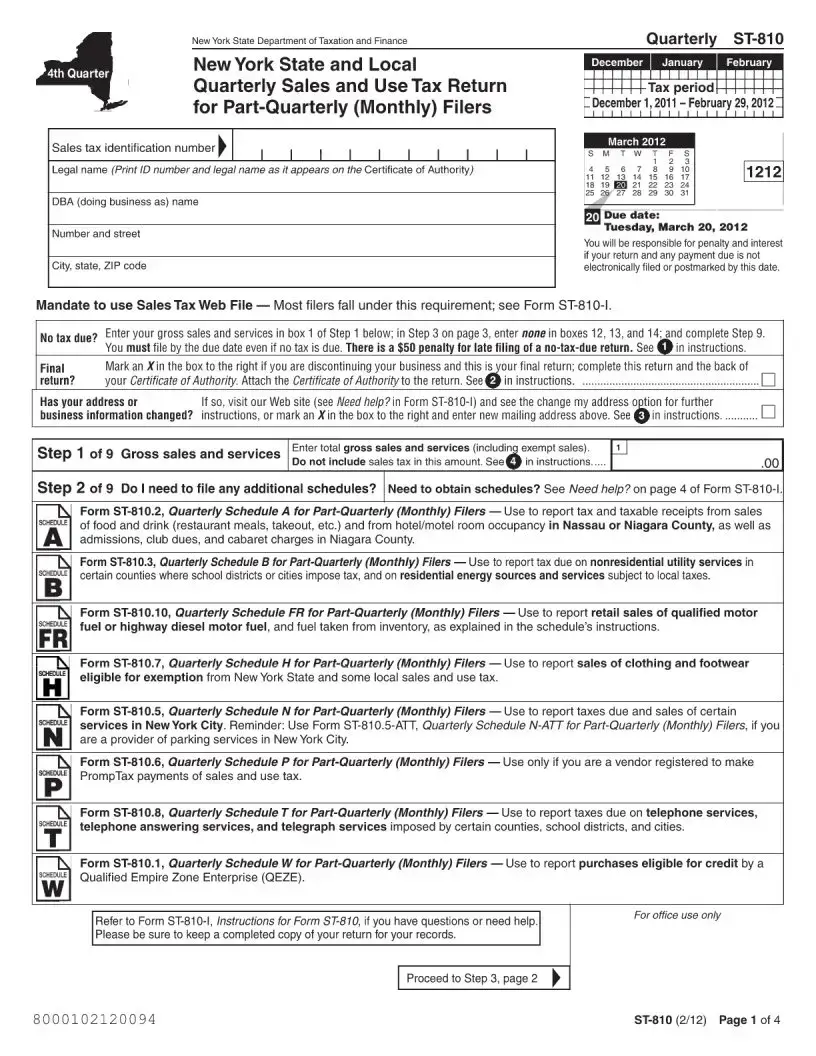
| Form Purpose | The New York ST-810 form is used for filing quarterly sales and use tax returns for businesses that file on a monthly basis. |
| Filing Frequency | This form is specifically designed for part-quarterly (monthly) filers, indicating that it is to be submitted every three months. |
| Due Date | The return is due on the 20th day of the month following the end of the tax period. For example, for the December quarter, it is due by March 20. |
| Penalty for Late Filing | A $50 penalty is imposed for late filing of a no-tax-due return, emphasizing the importance of timely submission. |
| Sales Tax Identification Number | Businesses must provide their sales tax identification number on the form, ensuring proper identification for tax purposes. |
| Changes in Business Information | If there are changes to the business address or information, these must be updated on the form to avoid processing issues. |
| Mandatory Electronic Filing | Most filers are required to use the Sales Tax Web File system for electronic submission, as indicated in the form's instructions. |
| Schedules for Additional Reporting | Additional schedules may be required depending on the nature of sales, such as Schedule A for food and drink or Schedule B for utility services. |
| Final Return Marking | Businesses discontinuing operations must mark the appropriate box and attach their Certificate of Authority with the final return. |
| Governing Law | The ST-810 form is governed by New York State Tax Law, specifically sections related to sales and use tax compliance. |
Completing the New York State ST-810 form is essential for reporting your sales and use tax. Following these steps carefully will help ensure that you fill out the form accurately and submit it on time. Make sure to keep a copy for your records once you have finished.
What is the New York ST-810 form?
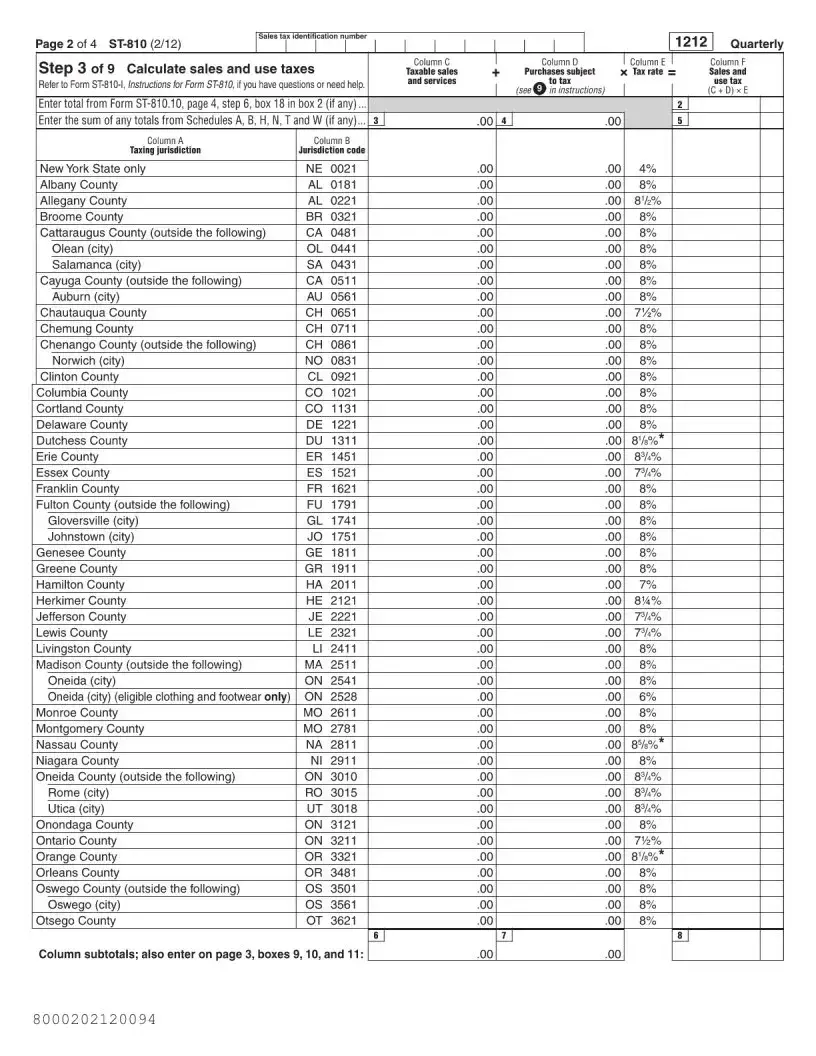
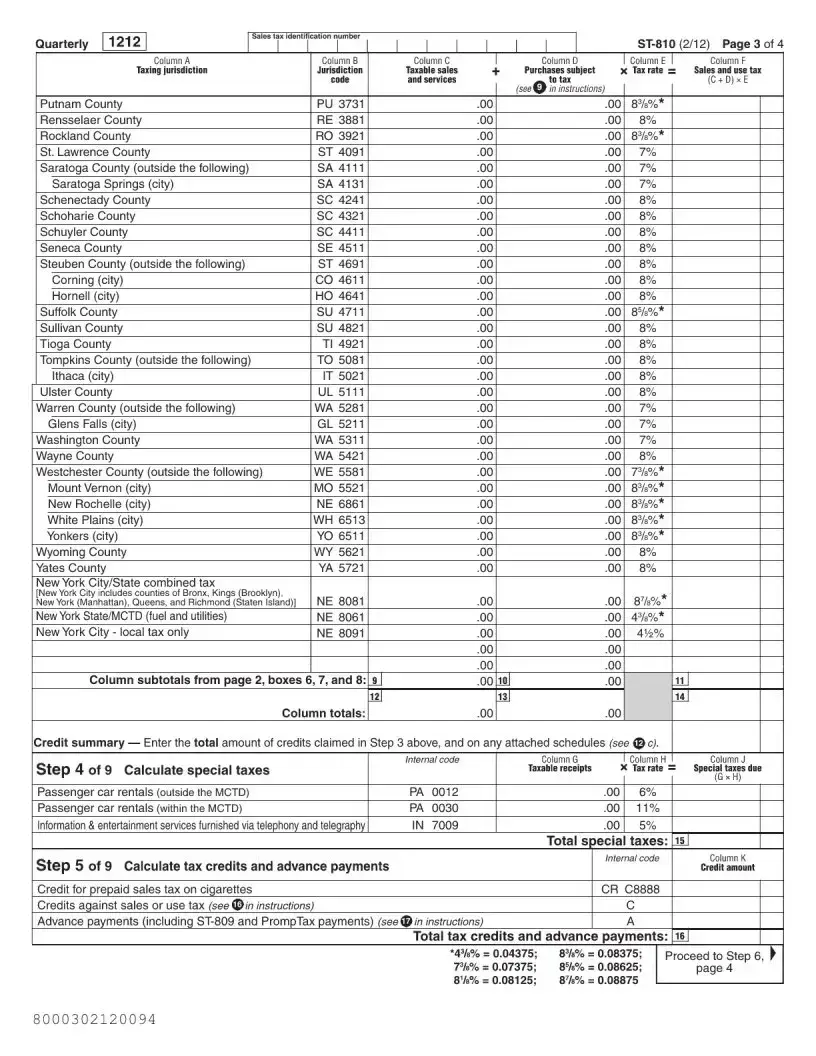
The New York ST-810 form is a quarterly sales and use tax return that businesses in New York State must file. It is specifically for part-quarterly (monthly) filers. This form reports the gross sales and services, as well as any sales tax collected during the quarter. The form is essential for maintaining compliance with state tax regulations.
When is the ST-810 form due?
The ST-810 form is due on the 20th day of the month following the end of the quarter. For example, if you are filing for the quarter that ends in February, your return is due by March 20. It's important to file on time to avoid penalties and interest. If you do not file by the due date, you may face a $50 penalty even if no tax is due.
What should I do if I have no tax due?
Even if you have no tax due, you must still file the ST-810 form by the due date. In the appropriate sections of the form, you will indicate that there is no tax due. Specifically, enter your gross sales and services in the designated box, and complete the necessary steps as outlined in the instructions. Failing to file can result in penalties.
What if my business information has changed?
If there has been a change in your business information, such as your address or legal name, you need to update this on your ST-810 form. You can mark the appropriate box on the form to indicate a change and provide the new information. For further assistance, refer to the change my address option on the New York State Department of Taxation and Finance website.
Filling out the New York ST-810 form can be straightforward, but many people make common mistakes that can lead to penalties or delays. One of the biggest errors is failing to provide the correct sales tax identification number. This number is crucial for identifying your business and ensuring that your tax return is processed accurately. Double-check that it matches what is on your Certificate of Authority.
Another frequent mistake is not marking the box for a final return when discontinuing a business. If you are closing your business, it is essential to indicate this on the form. Neglecting to do so may result in unnecessary follow-up from the tax department.
Many filers also forget to include their DBA (doing business as) name, which can lead to confusion. If your business operates under a name different from your legal name, ensure that it is clearly stated on the form. This helps in maintaining accurate records.
Some individuals mistakenly think they do not need to file if no tax is due. However, it is important to file even if there are no taxes owed. A $50 penalty applies for late filing of a no-tax-due return. This is a costly oversight that can be easily avoided by submitting the form on time.
Incorrectly reporting gross sales and services is another common issue. Ensure that you enter the total gross sales without including sales tax. This is a frequent error that can affect your overall tax calculations and lead to complications.
Many people overlook the requirement to attach any necessary schedules. Depending on your business activities, you may need to include additional forms such as Schedule A or Schedule B. Failing to do so can result in your return being deemed incomplete.
Another mistake is not updating your address or business information if it has changed. If you have moved or altered your business structure, make sure to reflect these changes on the form. This helps avoid issues with future correspondence from the tax department.
Some filers forget to keep a copy of their completed return for their records. This is a crucial step, as having a copy can be helpful for future reference or in case of an audit. Always retain a completed copy of your return.
Lastly, many individuals do not pay attention to the due date. The ST-810 form has a specific deadline, and missing it can lead to penalties. Mark your calendar and ensure that you file on or before the due date to avoid any issues.
The New York ST-810 form is a crucial document for businesses that report sales and use tax on a quarterly basis. Along with this form, several other documents are often required to ensure compliance with tax regulations. Below is a list of these additional forms and documents, along with brief descriptions of their purposes.
These forms are essential for accurately reporting sales and use tax obligations in New York State. Businesses should ensure they are familiar with each document's requirements to maintain compliance and avoid penalties.
When filling out the New York ST-810 form, it is essential to follow specific guidelines to ensure accuracy and compliance. Here is a list of things you should and should not do:
Misconceptions about the New York ST-810 Form
When filling out and using the New York ST-810 form, it's essential to keep several key points in mind. This form is crucial for reporting sales and use tax for businesses operating in New York State. Here are some important takeaways:
By keeping these points in mind, you can navigate the ST-810 form more effectively and ensure compliance with New York State tax regulations.