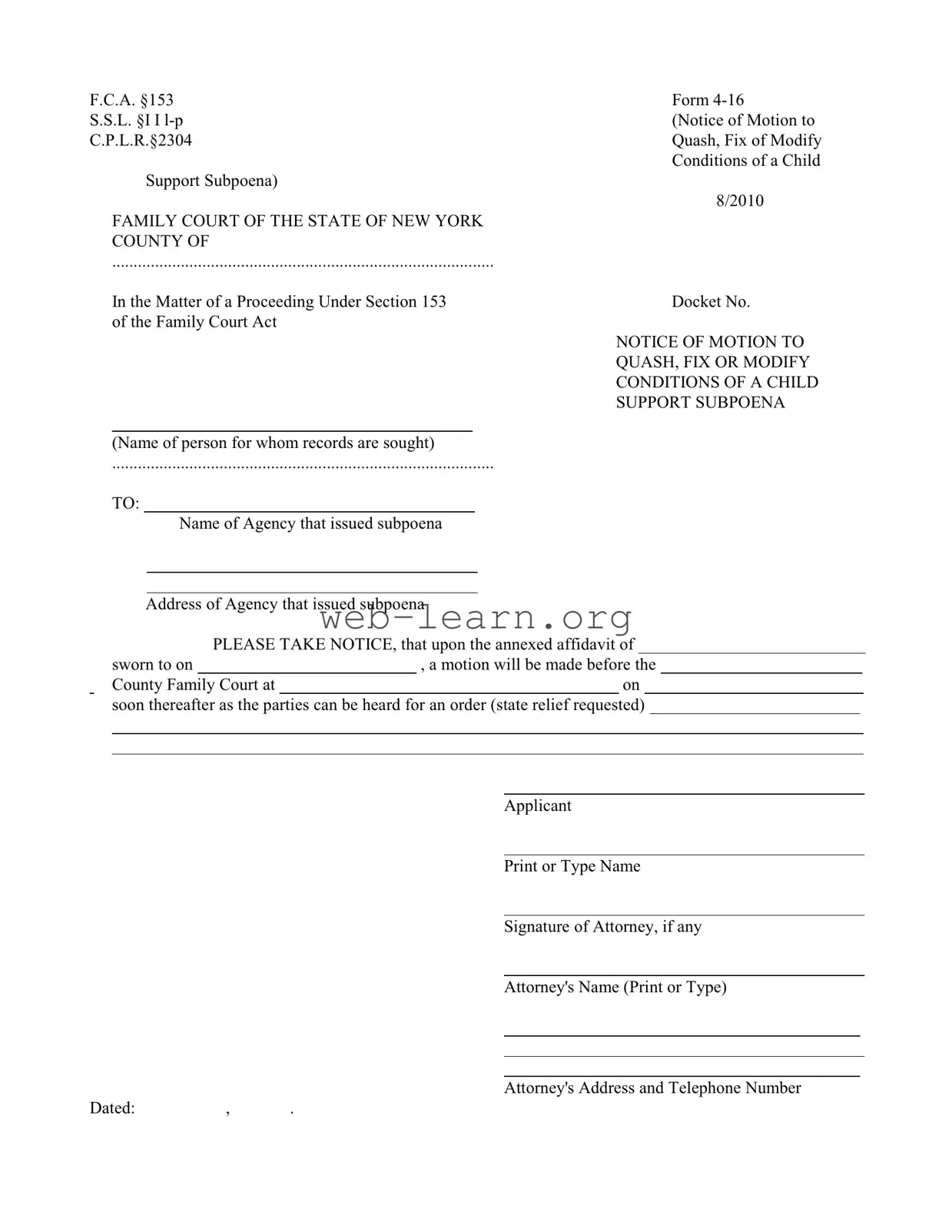
The New York 4-16 form serves a crucial role in family law proceedings, specifically regarding child support subpoenas. This form allows individuals to formally request the Family Court to quash, fix, or modify the conditions of a subpoena that demands records or information related to child support. It is utilized when a party believes that the subpoena is overly broad, irrelevant, or burdensome. The form requires the applicant to provide their name, the name of the agency that issued the subpoena, and the specific relief they are seeking. Additionally, the applicant must include an affidavit that outlines the reasons for their request, ensuring that the court understands the basis for the motion. This document not only streamlines the legal process but also safeguards the rights of those involved, ensuring that subpoenas are fair and just. Understanding how to properly fill out and submit the 4-16 form is essential for anyone navigating the complexities of child support cases in New York.
F.C.A. §153
S.S.L. §I I
C.P.L.R.§2304
Support Subpoena)
FAMILY COURT OF THE STATE OF NEW YORK COUNTY OF
.........................................................................................
In the Matter of a Proceeding Under Section 153 of the Family Court Act
Form
(Notice of Motion to Quash, Fix of Modify Conditions of a Child
8/2010
Docket No.
NOTICE OF MOTION TO
QUASH, FIX OR MODIFY
CONDITIONS OF A CHILD
SUPPORT SUBPOENA
(Name of person for whom records are sought)
.........................................................................................
TO:
Name of Agency that issued subpoena
Address of Agency that issued subpoena
PLEASE TAKE NOTICE, that upon the annexed affidavit of
sworn to on |
|
, a motion will be made before the |
|
|||
County Family Court at |
|
|
on |
|
||
soon thereafter as the parties can be heard for an order (state relief requested)
Applicant
Print or Type Name
Signature of Attorney, if any
Attorney's Name (Print or Type)
Attorney's Address and Telephone Number
Dated:,.
Form
.............................................................................Docket No.
In The M atter of a Proceeding Under Section 153 of the Family Court Act
AFFIDAVIT IN SUPPORT OF
M OTION TO QUASH, FIX OR
M ODIFY CONDITIONS OF A
CHILD SUPPORT SUBPOENA
(Name of person for whom records are sought)
............................................................................
STATE OF NEW YORK |
) |
|
:ss.: |
COUNTY OF |
) |
|
|
|
|
|
|
being duly sworn deposes and states: |
||
1 |
. Upon information and belief, a Family Court proceeding (has) (has not) been filed. (If filed, state Docket Number |
|||||||
|
|
|
.) |
|
|
|
|
|
2 |
.That a child support subpoena was served upon (specify individual or entity) |
|||||||
|
|
|
at |
|
|
|
(copy attached) |
|
3.That relief from the following directive(s) in said subpoena should be granted for the following reasons:
Applicant
Print or Type Name
Signature of Attorney, if any
Attorney's Name (Print or Type)
Attorney's Address and Telephone Number
Sworn to |
before me this |
|
|
|||
day of |
|
|
, |
|
|
. |
(Deputy) Clerk of the Court
Notary Public
| Fact Name | Details |
|---|---|
| Governing Law | The New York 4-16 form is governed by Family Court Act §153, Social Services Law §111-p, and Civil Practice Law and Rules §2304. |
| Purpose | This form is used to file a motion to quash, fix, or modify the conditions of a child support subpoena. |
| Filing Requirements | The form must be filed in the Family Court of the appropriate county where the child support case is being heard. |
| Affidavit Requirement | An affidavit must accompany the form, detailing the reasons for the requested relief from the subpoena. |
| Notification | The applicant must notify the agency that issued the subpoena by including their name and address on the form. |
| Signature | The form requires the signature of the applicant and, if applicable, the attorney representing the applicant. |
| Date of Filing | The date of filing must be indicated on the form, along with the docket number of the related Family Court proceeding. |
Filling out the New York 4-16 form requires careful attention to detail. This form is used in family court proceedings, specifically when a party wishes to challenge a child support subpoena. After completing the form, it is essential to file it with the appropriate court and ensure that all parties involved are notified of the motion.
What is the purpose of the New York 4 16 form?
The New York 4 16 form is used to request a motion to quash, fix, or modify the conditions of a child support subpoena. This form allows individuals to formally challenge the terms of a subpoena that has been issued in relation to child support proceedings. It is essential for ensuring that the rights of the individual being subpoenaed are protected while allowing the court to address any concerns regarding the subpoena's directives.
Who can file a New York 4 16 form?
Any individual who has received a child support subpoena can file the New York 4 16 form. This includes parents, guardians, or other parties involved in a child support case. If the individual has legal representation, their attorney can also file the motion on their behalf.
What information is required to complete the form?
To complete the New York 4 16 form, the following information is typically required:
Providing accurate and complete information is crucial for the court to consider the motion effectively.
What happens after filing the New York 4 16 form?
After filing the New York 4 16 form, the court will schedule a hearing where both parties can present their arguments. The applicant must provide evidence supporting their request to quash, fix, or modify the subpoena. The court will then make a decision based on the information presented. It is important to attend this hearing to ensure that your concerns are addressed.
Is there a deadline for filing the New York 4 16 form?
While there is no specific deadline universally applicable to all cases, it is advisable to file the New York 4 16 form as soon as possible after receiving the subpoena. Timely filing can help prevent any negative consequences that may arise from non-compliance with the subpoena. Additionally, consulting with an attorney can provide guidance on the appropriate timing for filing the motion.
Filling out the New York Form 4-16 can be a straightforward process, but many individuals make common mistakes that can lead to delays or complications. One frequent error is failing to provide complete information about the parties involved. Each section requires specific details, including names and addresses, which must be filled out accurately. Omitting any of this information can result in the form being rejected or returned for correction.
Another common mistake is neglecting to include the correct docket number. This number is crucial for the court to identify the specific case related to the motion. If the docket number is missing or incorrect, it can create confusion and delay the proceedings.
Many individuals also forget to attach the necessary documents, such as the affidavit or the original subpoena. These attachments are essential for the court to review the context of the motion. Without them, the court may not have enough information to make a decision, leading to further complications.
In addition, some people do not clearly state the relief they are requesting. The form requires applicants to specify the exact nature of the relief sought from the court. Vague or ambiguous requests can result in misunderstandings and may hinder the court's ability to grant the motion.
Another mistake is failing to sign the form. An unsigned form is not valid and will not be processed by the court. It is essential to ensure that all required signatures are included before submission.
Individuals sometimes overlook the need for notarization. The affidavit section must be sworn before a notary public. Without this step, the affidavit cannot be considered valid, which could lead to the dismissal of the motion.
Additionally, applicants may not pay attention to deadlines. Submitting the form late can result in missed opportunities for relief. It is important to be aware of any time limits set by the court to ensure timely filing.
Some people also fail to follow the court’s formatting requirements. The form must be filled out neatly and legibly. Illegible handwriting or improper formatting can cause confusion and lead to processing issues.
Finally, individuals may not seek legal advice when needed. While it is possible to fill out the form independently, consulting with an attorney can provide clarity and ensure that all legal requirements are met. This can be especially helpful for those unfamiliar with the court process.
The New York Form 4-16 is used to address issues related to child support subpoenas. When filing this form, individuals often need to accompany it with additional documents that support their case or provide necessary information. Below is a list of other forms and documents commonly used in conjunction with the New York 4-16 form.
Utilizing these documents alongside the New York 4-16 form can streamline the process and ensure that all necessary information is presented to the court. Each form plays a vital role in the legal proceedings surrounding child support issues.
The New York Form 4-16 is a legal document used to address issues surrounding child support subpoenas. Several other documents serve similar purposes in family law and legal proceedings. Below is a list of documents that are comparable to the New York 4-16 form, highlighting their similarities:
When filling out the New York 4 16 form, there are important guidelines to follow. Here’s a list of things you should and shouldn’t do:
Following these guidelines will help ensure that your submission is processed smoothly. Take these steps seriously to avoid delays or complications in your case.
Many people have misconceptions about the New York Form 4-16, which deals with child support subpoenas. Here are ten common misunderstandings:
Understanding these misconceptions can help individuals navigate the legal landscape more effectively and ensure they take the right steps when dealing with child support subpoenas.
Here are key takeaways about filling out and using the New York 4-16 form: