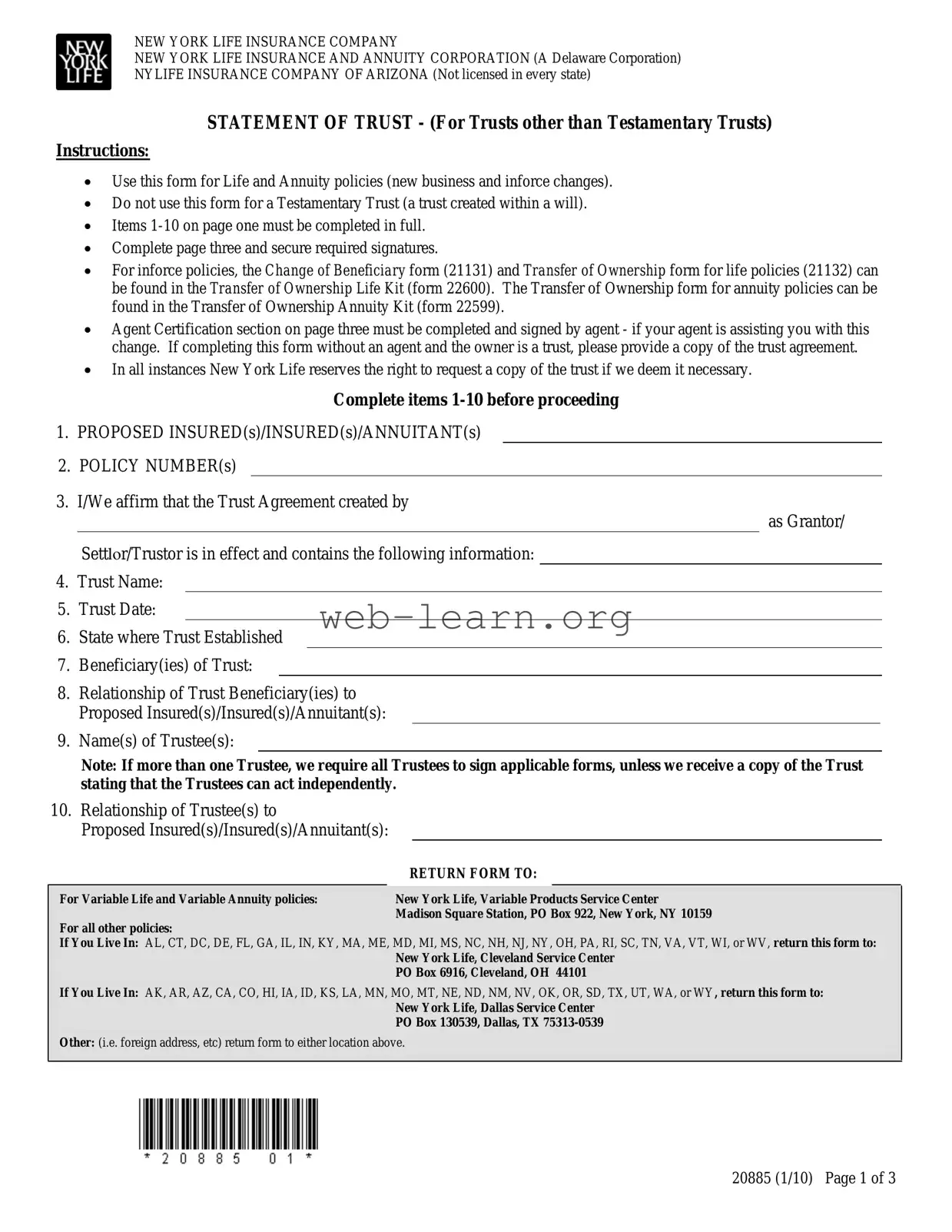
The New York 20885 form is a crucial document for individuals establishing or managing life insurance and annuity policies under a trust. This form is specifically designed for trusts that are not testamentary, meaning they are not created within a will. It requires the completion of ten essential items on the first page, including information about the proposed insured, policy numbers, and details about the trust itself, such as the trust name and date, as well as the names of the trustees. The form also includes sections that affirm the trust agreement is in effect and outlines the responsibilities and rights of the trustees regarding the policies. Importantly, it emphasizes the need for signatures from all trustees unless the trust document specifies otherwise. Additionally, the form provides instructions for submitting it to the appropriate New York Life service center based on the policy type and the state of residence. To ensure compliance with IRS regulations, it also requires the policy owner's taxpayer identification number and backup withholding certifications. Given the complexities involved in managing trusts and insurance policies, completing the 20885 form accurately and promptly is essential to avoid potential legal and financial complications.

NEW YORK LIFE INSURANCE COMPANY
NEW YORK LIFE INSURANCE AND ANNUITY CORPORATION (A Delaware Corporation)
NYLIFE INSURANCE COMPANY OF ARIZONA (Not licensed in every state)
STATEMENT OF TRUST - (For Trusts other than Testamentary Trusts)
Instructions:
•Use this form for Life and Annuity policies (new business and inforce changes).
•Do not use this form for a Testamentary Trust (a trust created within a will).
•Items
•Complete page three and secure required signatures.
•For inforce policies, the Change of Beneficiary form (21131) and Transfer of Ownership form for life policies (21132) can be found in the Transfer of Ownership Life Kit (form 22600). The Transfer of Ownership form for annuity policies can be found in the Transfer of Ownership Annuity Kit (form 22599).
•Agent Certification section on page three must be completed and signed by agent - if your agent is assisting you with this change. If completing this form without an agent and the owner is a trust, please provide a copy of the trust agreement.
•In all instances New York Life reserves the right to request a copy of the trust if we deem it necessary.
Complete items
1.PROPOSED INSURED(s)/INSURED(s)/ANNUITANT(s)
2.POLICY NUMBER(s)
3. I/We affirm that the Trust Agreement created by
as Grantor/
SettLOr/Trustor is in effect and contains the following information:
4.Trust Name:
5.Trust Date:
6.State where Trust Established
7.Beneficiary(ies) of Trust:
8.Relationship of Trust Beneficiary(ies) to Proposed Insured(s)/Insured(s)/Annuitant(s):
9. Name(s) of Trustee(s):
Note: If more than one Trustee, we require all Trustees to sign applicable forms, unless we receive a copy of the Trust stating that the Trustees can act independently.
10.Relationship of Trustee(s) to
Proposed Insured(s)/Insured(s)/Annuitant(s):
|
|
RETURN FORM TO: |
|
|
|
|
|
|
|
|
For Variable Life and Variable Annuity policies: |
New York Life, Variable Products Service Center |
|
|
|
|
Madison Square Station, PO Box 922, New York, NY 10159 |
|
|
For all other policies:
If You Live In: AL, CT, DC, DE, FL, GA, IL, IN, KY, MA, ME, MD, MI, MS, NC, NH, NJ, NY, OH, PA, RI, SC, TN, VA, VT, WI, or WV, return this form to:
New York Life, Cleveland Service Center
PO Box 6916, Cleveland, OH 44101
If You Live In: AK, AR, AZ, CA, CO, HI, IA, ID, KS, LA, MN, MO, MT, NE, ND, NM, NV, OK, OR, SD, TX, UT, WA, or WY, return this form to:
New York Life, Dallas Service Center
PO Box 130539, Dallas, TX
Other: (i.e. foreign address, etc) return form to either location above.
20885 (1/10) Page 1 of 3

Please read this page and secure required signatures on page three.
STATEMENT REGARDING TRUST AS POLICY BENEFICIARY
I/We affirm that the beneficiary designation for each policy listed agrees with a Trust Agreement created by the Grantor and dated as shown on page one.
For Life Insurance Policies:
If, before the proceeds are paid, the Insurer(s) receives proof that the Trust as policy beneficiary is not in effect at the Insured’s death, the proceeds shall be paid to the contingent beneficiary(ies), if any. Otherwise, the proceeds shall be paid in a single sum to the Owner, if the Owner is living at that time. If the Owner is not living at that time, the single sum shall be paid to the Owner’s Estate.
For Annuity Contracts:
Please see your Agent/Registered Representative for payment methods available upon death of the Owner/Annuitant.
For Life Insurance Policies and Annuity Contracts:
Before the Insurer(s) pays the proceeds at death, it may ask for proof that the Trust is in effect;
The Owner possesses all rights of ownership of each policy including the right to change the beneficiary designation at any time even if there is a contrary provision in the Trust Agreement. This applies to revocable and irrevocable trusts; The Insurer(s) will not have any liability after it pays the proceeds of each policy, as set forth in this Statement;
The Interest of the Trust(s) in each of these policies shall be subject to any assignment of that policy made before or after this Statement.
STATEMENT REGARDING TRUST AS OWNER
I/We affirm that the Trust Agreement created by the Grantor as shown on page one (and the trust date as shown on page one) agrees with the following:
1.The Trustee(s) have full authority to pay premiums.
2.The Trust Agreement contains no limitations on the ownership rights of the Trust(s) as owner(s) of the insurance/annuity policies.
20885 (1/10) Page 2 of 3

IMPORTANT: The Internal Revenue Service (IRS) requires that the named Owner complete the following:
(The IRS does not require your consent to any provision of this document other than the certifications required to avoid backup withholding).
Taxpayer Identification Number and Backup Withholding Certifications
Policyowner’s Taxpayer Identification Number is
Under penalties of perjury, I certify that the number shown above is my correct Taxpayer Identification Number. I further certify that I am a U.S. person (including a U.S. resident alien).
I also certify that (please check only one box):
I have been notified by the IRS that I am subject to backup withholding.
I am not subject to backup withholding because (a) I have not been notified that I am subject to backup withholding as a result of failure to report all interest or dividends, or (b) the IRS has notified me that I am no longer subject to backup withholding.
/ |
/ |
|
X |
|
X |
|
Date |
|
|
Grantor(s) signature |
|
Grantor(s) signature, if required |
|
/ |
/ |
|
X |
|
X |
|
|
|
|
|
|
|
|
Date |
|
|
Trustee(s) signature |
|
Trustee(s) signature, if required |
|
/ |
/ |
|
X |
|
X |
|
Date |
|
|
Proposed Insured(s)/Insured(s)/Annuitant(s) signature |
|
Additional Signature, if required |
|
/ |
/ |
|
X |
|
X |
|
Date |
|
|
Applicant(s)/Owner(s) signature, if other than above |
|
Additional Signature, if required |
|
\
\
If the indicated policy is
Print Name & Title of OfficerPrint Name & Title of Officer
/ |
/ |
|
X |
|
X |
Date |
|
|
Officer’s Signature |
|
Officer’s Signature |
AGENT CERTIFICATION
(if Agent assists with completion of form)
By signing below I attest that I have reviewed the identifying trust document(s) described on page one and that the document(s) appeared to be genuine and original.
Print Name of Agent/Registered Representative
X |
/ |
/ |
|
Agent/Registered Representative’s Signature |
|
Date |
|
20885 (1/10) Page 3 of 3
| Fact Name | Details |
|---|---|
| Form Purpose | This form is used for Life and Annuity policies, specifically for trusts other than testamentary trusts. |
| Exclusion of Testamentary Trusts | The form is not applicable for testamentary trusts, which are created within a will. |
| Completion Requirements | Items 1-10 on page one must be fully completed, and required signatures must be secured on page three. |
| Inforce Policies | For inforce policies, additional forms like the Change of Beneficiary form (21131) and Transfer of Ownership form (21132) are necessary. |
| Agent Certification | If an agent assists in completing the form, the Agent Certification section on page three must be signed by the agent. |
| Trust Agreement Requirement | A copy of the trust agreement is required if the owner is a trust and the form is completed without an agent. |
| Trustee Signatures | If there are multiple trustees, all must sign the applicable forms unless the trust allows independent action. |
| Return Addresses | The form must be returned to specific addresses based on the type of policy and the state of residence. |
| Governing Laws | This form is governed by New York state laws, specifically pertaining to trusts and insurance policies. |
Filling out the New York 20885 form requires careful attention to detail. After completing the form, it is essential to ensure that all necessary signatures are obtained before submission. This will help avoid delays in processing and ensure that the information is accurate and complete.
The New York 20885 form is designed for trusts other than testamentary trusts. It is used to designate a trust as the beneficiary of life insurance and annuity policies. This form ensures that the trust is properly recognized and that the insurance or annuity proceeds are directed according to the terms of the trust agreement.
The form should be completed by the grantor or trustee of the trust. If an agent is assisting with the process, they must also sign the form. It is important that all required information is filled out completely to avoid delays in processing.
Items 1-10 on page one must be filled out. This includes details such as:
Completing these items accurately is essential for the form to be valid.
The destination for the completed form depends on the type of policy and the state of residence. For variable life and annuity policies, send it to the Variable Products Service Center in New York. For all other policies, the address varies based on the state, with specific addresses for various regions outlined in the instructions.
If proof is received that the trust as a policy beneficiary is not in effect at the time of the insured's death, the proceeds will be paid to the contingent beneficiary, if one exists. If no contingent beneficiary is designated, the proceeds will be paid to the owner or the owner’s estate.
In cases where there is more than one trustee, all trustees must sign the applicable forms unless a copy of the trust document states that they can act independently. This requirement helps ensure that the trust is managed according to its terms and that all trustees are in agreement.
Filling out the New York 20885 form can be a straightforward process, but there are common mistakes that individuals often make. One significant error is failing to complete all required fields on the first page. Items 1 through 10 must be filled out in full. Incomplete forms may lead to delays in processing or even rejection. It's crucial to double-check that every section is addressed before submitting the form.
Another frequent mistake is not providing the correct trust information. When specifying the Trust Name and Trust Date, ensure that the details match exactly with the trust agreement. Any discrepancies can raise questions and complicate the approval process. Additionally, if the trust has multiple trustees, all must sign the necessary forms unless the trust document explicitly states otherwise. Omitting a signature could invalidate the form.
People often overlook the importance of the Agent Certification section. If an agent assists in completing the form, their signature is required on page three. This certification confirms that the agent has reviewed the relevant trust documents. Without this signature, the form may be considered incomplete, which can delay the processing of your request.
Lastly, many individuals neglect to provide the correct taxpayer identification information. The IRS mandates that the policyowner complete this section accurately. Failing to do so may result in backup withholding issues. It's essential to ensure that the Taxpayer Identification Number is correct and that you check the appropriate box regarding backup withholding status. This step is crucial for avoiding future complications with the IRS.
The New York 20885 form is essential for managing life insurance and annuity policies involving trusts. To ensure a smooth process, several other forms and documents are often used in conjunction with it. Each of these documents serves a specific purpose in the context of trust management and insurance policy administration.
Utilizing these forms and documents alongside the New York 20885 form can streamline the management of trust-related life insurance and annuity policies. Proper documentation ensures that all parties involved are informed and compliant with legal requirements.
The New York 20885 form serves a specific purpose in relation to trusts and insurance policies. There are several other documents that share similarities with this form, particularly in their function and the information they require. Here’s a breakdown of four such documents:
When filling out the New York 20885 form, it is essential to follow specific guidelines to ensure accuracy and compliance. Below is a list of things you should and shouldn't do during this process.
Following these guidelines will help ensure that the New York 20885 form is filled out correctly and submitted without issues. It is always beneficial to double-check your entries and consult with an agent if you have questions.
This form is specifically designed for trusts other than Testamentary Trusts. A Testamentary Trust is created within a will and is not applicable here.
It is crucial to complete items 1-10 on the first page in full. Incomplete forms may delay processing.
If the owner is a trust and you are completing the form without an agent, a copy of the trust agreement must be provided.
This section must be completed and signed by the agent if they assist in completing the form. It ensures that the agent has reviewed the necessary documents.
The form must be sent to the appropriate service center based on your state of residence. This ensures proper handling of your request.
Both revocable and irrevocable trusts can utilize this form. Ownership rights remain with the owner, regardless of the trust type.
The insurer may request proof that the trust is in effect before paying out any benefits. This is a protective measure.
The owner retains the right to change the beneficiary designation at any time, even if the trust agreement states otherwise.
Once the insurer pays the proceeds according to the trust agreement, they will not have any further liability. This protects the insurer from future claims.
If the trust document allows for independent action, not all trustees are required to sign. However, if multiple trustees are involved, signatures may be necessary.
Filling out the New York 20885 form is a crucial step for managing life insurance and annuity policies under a trust. Here are key takeaways to ensure you complete it correctly:
Following these guidelines will help ensure a smooth process in managing your trust-related insurance policies.