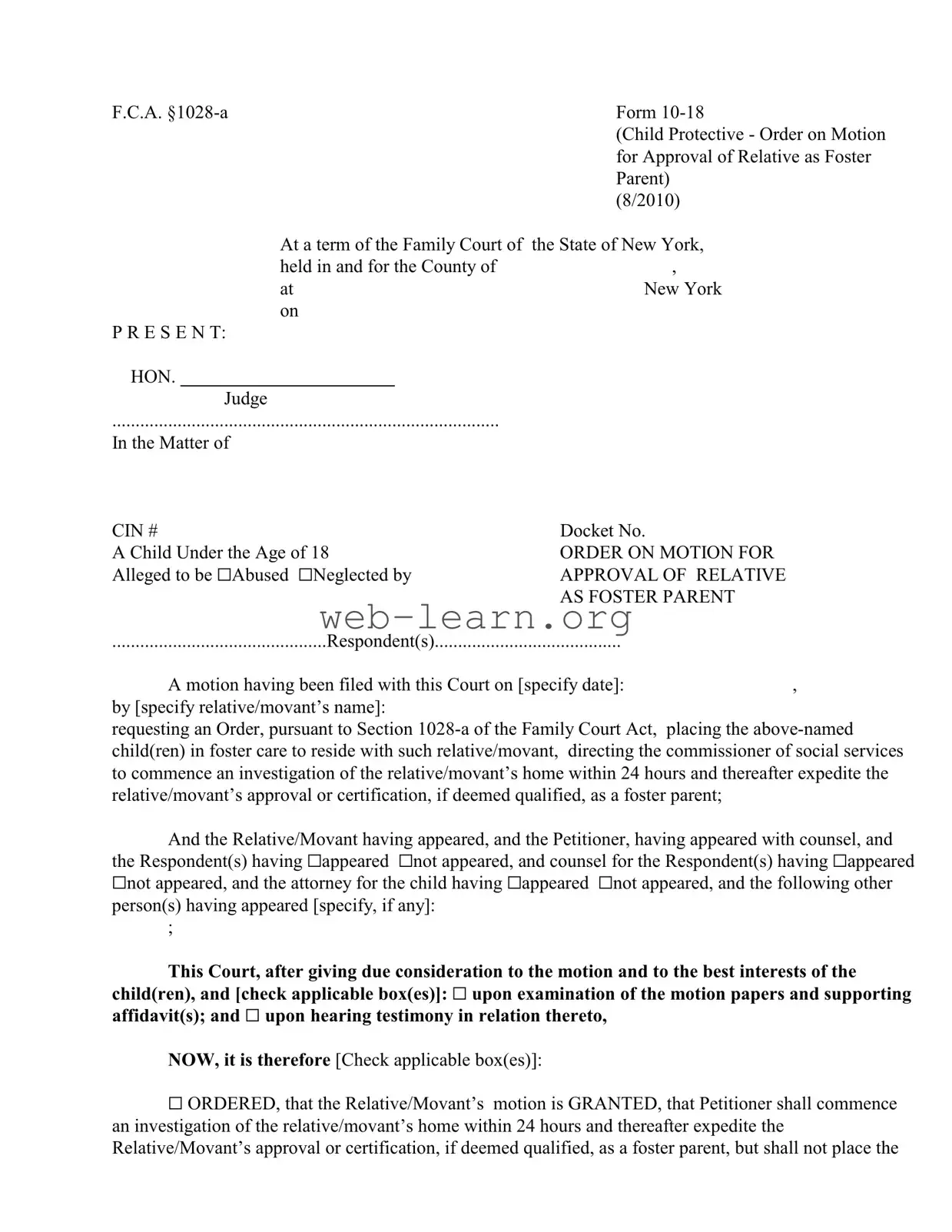
The New York 10 18 form plays a crucial role in the Family Court system, specifically when it comes to the welfare of children under the age of 18. This form is utilized to request approval for a relative to become a foster parent, particularly in cases where a child is alleged to be abused or neglected. When a motion is filed, it triggers a process that includes an immediate investigation by the commissioner of social services into the relative's home. This investigation must commence within 24 hours, ensuring that the child's safety and well-being are prioritized. The form also outlines the responsibilities of various parties involved, including the petitioner, the respondent, and the attorney for the child. Depending on the findings of the investigation, the court can either grant or deny the motion, determining whether the relative qualifies to provide a safe and nurturing environment for the child. The form is not just a procedural document; it embodies the court's commitment to acting in the best interests of children, while also establishing a clear timeline for appeals and further actions. Understanding the nuances of the 10 18 form is essential for anyone navigating the complexities of child welfare cases in New York.
F.C.A. |
Form |
||
|
|
|
(Child Protective - Order on Motion |
|
|
|
for Approval of Relative as Foster |
|
|
|
Parent) |
|
|
|
(8/2010) |
|
At a term of the Family Court of |
the State of New York, |
|
|
held in and for the County of |
, |
|
|
at |
New York |
|
|
on |
|
|
P R E S E N T: |
|
||
HON. |
|
|
|
|
Judge |
|
|
................................................................................... |
|
||
In the Matter of |
|
||
CIN # |
Docket No. |
A Child Under the Age of 18 |
ORDER ON MOTION FOR |
Alleged to be GAbused GNeglected by |
APPROVAL OF RELATIVE |
|
AS FOSTER PARENT |
..............................................Respondent(s) |
|
A motion having been filed with this Court on [specify date]: |
, |
by [specify relative/movant’s name]: |
|
requesting an Order, pursuant to Section |
placing the |
child(ren) in foster care to reside with such relative/movant, directing the commissioner of social services to commence an investigation of the relative/movant’s home within 24 hours and thereafter expedite the relative/movant’s approval or certification, if deemed qualified, as a foster parent;
And the Relative/Movant having appeared, and the Petitioner, having appeared with counsel, and the Respondent(s) having Gappeared Gnot appeared, and counsel for the Respondent(s) having Gappeared Gnot appeared, and the attorney for the child having Gappeared Gnot appeared, and the following other person(s) having appeared [specify, if any]:
;
This Court, after giving due consideration to the motion and to the best interests of the
child(ren), and [check applicable box(es)]: G upon examination of the motion papers and supporting affidavit(s); and G upon hearing testimony in relation thereto,
NOW, it is therefore [Check applicable box(es)]:
G ORDERED, that the Relative/Movant’s motion is GRANTED, that Petitioner shall commence an investigation of the relative/movant’s home within 24 hours and thereafter expedite the Relative/Movant’s approval or certification, if deemed qualified, as a foster parent, but shall not place the

Form |
Page 2 |
child(ren) with the Relative/Movant until and unless he or she is finally approved or certified as a foster parent, or, if the Relative/Movant is deemed upon investigation not to qualify as a foster parent, Petitioner shall report that determination to the Court, the parties and the attorney for the child forthwith;
OR
G ORDERED, that the Relative/Movant’s motion is DENIED; (and it is further) G ORDERED, that
ENTER
Judge of the Family Court
Dated:,
PURSUANT TO § 1113 OF THE FAMILY COURT ACT, AN APPEAL FROM THIS ORDER MUST BE TAKEN WITHIN 30 DAYS OF RECEIPT OF THE ORDER BY APPELLANT IN COURT, 30 DAYS AFTER SERVICE BY A PARTY OR THE ATTORNEY FOR THE CHILD UPON THE APPELLANT OR 35 DAYS FROM THE DATE OF MAILING OF THE ORDER TO THE APPELLANT BY THE CLERK OF THE COURT, WHICHEVER IS EARLIEST.
Check applicable box:
“Order mailed on [specify date(s) and to whom mailed]:
“Order received in court on [specify date(s) and to whom given]:
| Fact Name | Details |
|---|---|
| Governing Law | F.C.A. §1028-a governs the process for approving relatives as foster parents in New York. |
| Form Title | Form 10-18 is officially titled "Child Protective - Order on Motion for Approval of Relative as Foster Parent." |
| Purpose of the Form | This form is used to request the court's approval for a relative to become a foster parent. |
| Filing Requirements | A motion must be filed with the Family Court to initiate the approval process for a relative. |
| Investigation Timeline | The commissioner of social services is required to investigate the relative's home within 24 hours of the motion being filed. |
| Child's Best Interests | The court considers the best interests of the child when making a decision on the motion. |
| Outcome Possibilities | The court may either grant or deny the motion for approval of the relative as a foster parent. |
| Notification of Decision | If the relative is not approved, the petitioner must report this determination to the court and involved parties. |
| Appeal Process | An appeal from the order must be filed within 30 days of receipt, with specific conditions outlined for the timing. |
Completing the New York 10 18 form requires careful attention to detail. After filling it out, you will submit it to the Family Court, where it will be reviewed as part of the process concerning the approval of a relative as a foster parent. Follow these steps to ensure you fill out the form correctly.
What is the New York 10 18 form?
The New York 10 18 form, officially titled "Order on Motion for Approval of Relative as Foster Parent," is a legal document used in Family Court proceedings. It allows a relative to request approval to become a foster parent for a child who is alleged to be abused or neglected. The form facilitates the process of investigating and certifying the relative's home as suitable for fostering.
Who can file a New York 10 18 form?
A relative of the child can file the New York 10 18 form. This relative must be someone who wishes to take on the responsibility of fostering the child while the court addresses allegations of abuse or neglect. The relative must provide their name and details in the motion filed with the court.
What happens after the form is filed?
Once the form is filed, the Family Court will review the motion. The court may conduct a hearing where testimony can be presented. The judge will then decide whether to grant or deny the motion, based on the best interests of the child and the evidence provided.
What is the timeline for the investigation?
If the motion is granted, the commissioner of social services is required to start an investigation of the relative's home within 24 hours. This investigation assesses whether the relative meets the qualifications to be a foster parent.
Can a child be placed with the relative immediately?
No, a child cannot be placed with the relative until the relative has been officially approved or certified as a foster parent. If the investigation finds that the relative does not qualify, the court and other parties will be informed promptly.
What if the motion is denied?
If the court denies the motion, the relative will not be able to foster the child. The court will issue an order detailing the reasons for the denial, which may be important for any future motions or appeals.
How long does one have to appeal the court's order?
An appeal from the order must be filed within 30 days of receiving the order in court, or 30 days after service by a party or the attorney for the child, or 35 days from the mailing date of the order by the court clerk—whichever occurs first.
What information is required on the form?
The form requires specific details, including the name of the relative or movant, the child's information (CIN and docket number), and the date the motion is filed. Additionally, it may require information about other parties involved in the case.
Is legal representation necessary to file this form?
While it is not strictly required to have legal representation to file the New York 10 18 form, having an attorney can be beneficial. An attorney can help navigate the complexities of the Family Court system and ensure that the motion is properly presented.
Where can one obtain the New York 10 18 form?
The New York 10 18 form can typically be obtained from the Family Court in the relevant county. It may also be available online through the New York State Unified Court System's website, where forms for various legal proceedings are provided.
Completing the New York 10 18 form can be a complex process, and mistakes can lead to delays or denials of requests. One common error is failing to provide complete and accurate information about the child. The form requires specific details, including the child's name and docket number. Omitting any of this information can result in the court being unable to process the motion effectively.
Another frequent mistake involves incorrect dates. Applicants often miswrite the date of the motion or the date of the child’s birth. These discrepancies can create confusion and may even lead to the rejection of the application. It is essential to double-check all dates for accuracy before submission.
Many people also overlook the importance of signatures. The form requires signatures from various parties involved, including the relative/movant and the attorney for the child. Failing to secure all necessary signatures can halt the progress of the motion and necessitate resubmission.
In addition, individuals sometimes neglect to check the appropriate boxes on the form. The form includes several sections where boxes must be checked to indicate specific requests or circumstances. Not completing these sections can lead to misunderstandings regarding the nature of the request.
Another common error is not providing sufficient supporting documentation. The court may require additional evidence to support the motion, such as background checks or home assessments. Without these documents, the motion may be deemed incomplete.
Applicants may also fail to appear in court as required. If the relative/movant does not attend the hearing, the court may dismiss the motion. It is crucial to understand the importance of presence during the proceedings.
Additionally, some individuals do not follow the proper protocol for filing the form. Submitting the form to the wrong court or office can lead to significant delays. It is vital to ensure that the form is filed in the appropriate jurisdiction.
People often underestimate the timeline involved in the approval process. The form includes specific time frames for investigations and responses. Not adhering to these timelines can jeopardize the request and result in further complications.
Finally, some applicants do not seek legal assistance when needed. Navigating the Family Court system can be challenging, and having legal representation can help avoid many of these common pitfalls. Seeking guidance can lead to a smoother process and a higher likelihood of success.
The New York 10-18 form is an essential document in child protective proceedings, specifically related to the approval of relatives as foster parents. Alongside this form, several other documents are commonly utilized to ensure a thorough and efficient process. Below is a list of these forms and documents, each serving a distinct purpose in the legal framework.
Each of these documents plays a vital role in the child welfare system, ensuring that the process is thorough and that the best interests of the child are prioritized. Understanding these forms can help relatives navigate the complexities of becoming a foster parent in New York.
When filling out the New York 10-18 form, there are important guidelines to follow. Below is a list of ten things to do and not to do to ensure the process goes smoothly.
Following these guidelines will help facilitate a smoother process and ensure that the best interests of the child are prioritized.
Misconceptions about legal forms can lead to confusion and missteps in important processes. The New York 10 18 form, which deals with the approval of relatives as foster parents, is no exception. Here are four common misconceptions regarding this form:
Understanding these misconceptions can help relatives navigate the foster care system more effectively and ensure that the best interests of the child are prioritized.
When filling out and using the New York 10 18 form, there are several important points to keep in mind. This form is essential for requesting the approval of a relative as a foster parent under specific circumstances. Here are key takeaways to consider:
Understanding these aspects of the New York 10 18 form can help ensure that the process runs smoothly and that the best interests of the child are prioritized.