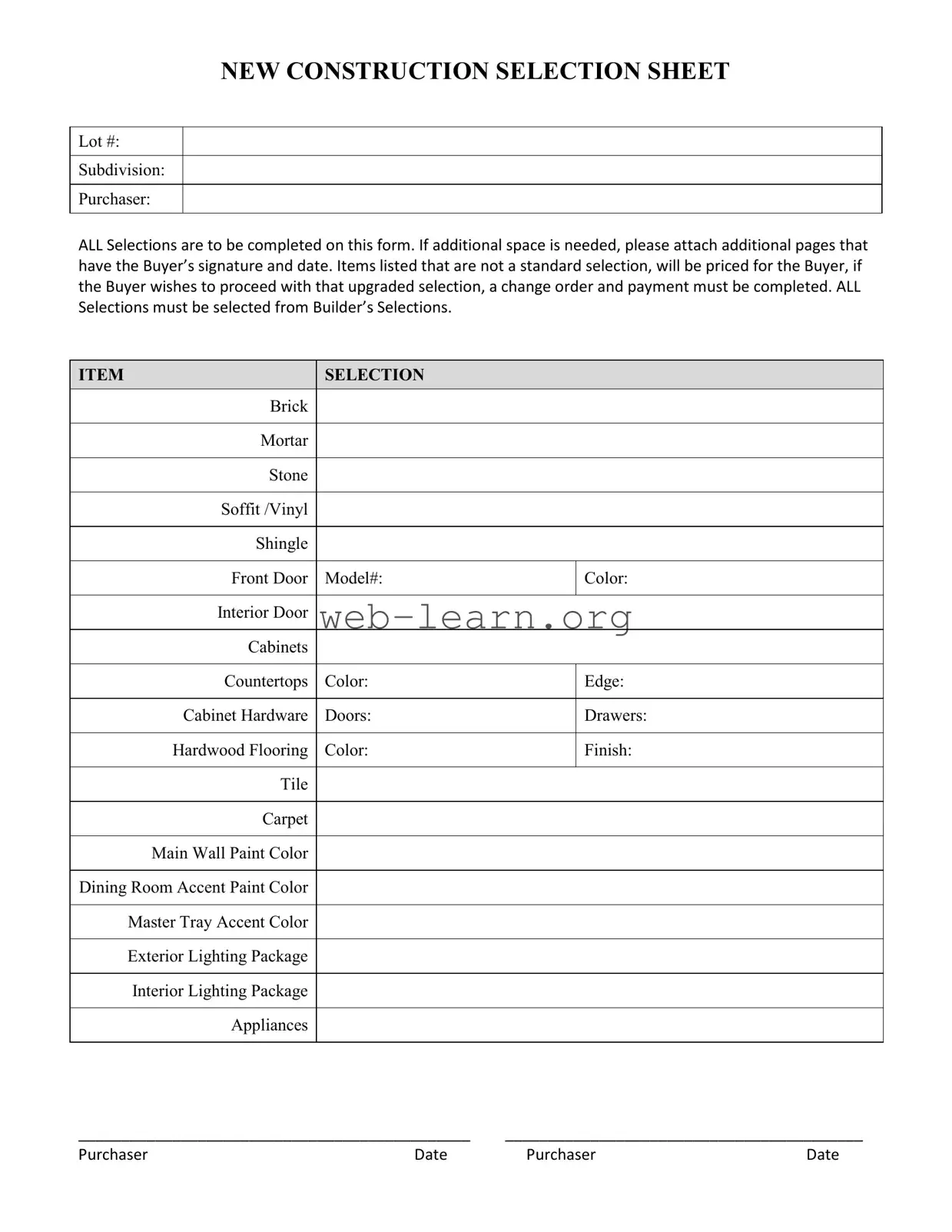
The New Construction Selection Sheet form is an essential tool for buyers embarking on the journey of building a new home. This form serves as a comprehensive checklist, ensuring that all necessary selections are documented and organized. It includes critical information such as the lot number, subdivision name, and purchaser details, making it easy to identify the specific project. Buyers must complete all selections listed on the form, which encompasses a range of choices from brick and mortar to flooring and paint colors. If a buyer desires an upgrade that isn't part of the standard selections, they must note that on the form. In such cases, the builder will provide pricing for the upgrade, and a change order along with payment will be required to proceed. Additionally, the form allows for extra pages to be attached if more space is needed, ensuring that every detail is captured accurately. The selections must come from the builder’s offerings, which helps maintain consistency and quality throughout the construction process. Ultimately, this form is designed to facilitate clear communication between the buyer and the builder, helping to create a home that reflects the buyer's unique style and preferences.

NEW CONSTRUCTION SELECTION SHEET
Lot #:
Subdivision:
Purchaser:
ALL Selections are to be completed on this form. If additional space is needed, please attach additional pages that have the Buyer’s signature and date. Items listed that are not a standard selection, will be priced for the Buyer, if the Buyer wishes to proceed with that upgraded selection, a change order and payment must be completed. ALL Selections must be selected from Builder’s Selections.
|
ITEM |
SELECTION |
|
|
|
||
|
|
|
|
|
Brick |
|
|
|
|
|
|
|
Mortar |
|
|
|
|
|
|
|
Stone |
|
|
|
|
|
|
|
Soffit /Vinyl |
|
|
|
|
|
|
|
Shingle |
|
|
|
|
|
|
|
Front Door |
Model#: |
Color: |
|
|
|
|
|
Interior Door |
|
|
|
|
|
|
|
Cabinets |
|
|
|
|
|
|
|
Countertops |
Color: |
Edge: |
|
|
|
|
|
Cabinet Hardware |
Doors: |
Drawers: |
|
|
|
|
|
Hardwood Flooring |
Color: |
Finish: |
|
|
|
|
|
Tile |
|
|
|
|
|
|
|
Carpet |
|
|
|
|
|
|
|
Main Wall Paint Color |
|
|
|
|
|
|
|
Dining Room Accent Paint Color |
|
|
|
|
|
|
|
Master Tray Accent Color |
|
|
|
|
|
|
|
Exterior Lighting Package |
|
|
|
|
|
|
|
Interior Lighting Package |
|
|
|
|
|
|
|
Appliances |
|
|
|
|
|
|
______________________________________________ |
__________________________________________ |
||
Purchaser |
Date |
Purchaser |
Date |
| Fact Name | Details |
|---|---|
| Form Purpose | The New Construction Selection Sheet is designed for buyers to select materials and finishes for their new home. |
| Lot Information | Buyers must provide the lot number and subdivision name to ensure accurate processing of selections. |
| Purchaser Identification | Each form requires the purchaser's name to clearly identify who is making the selections. |
| Selection Process | All selections must be made from the builder's pre-approved options, ensuring quality and consistency. |
| Additional Space | If more space is needed for selections, buyers can attach extra pages, which must include their signature and date. |
| Non-Standard Selections | Items not included in standard selections will require pricing and a change order for buyer approval. |
| Signature Requirement | Purchasers must sign and date the form to confirm their selections and acknowledge any additional costs. |
| Governing Laws | In states like California, the form is governed by the California Civil Code, which regulates construction contracts. |
| Itemized Selections | The form includes specific categories for selections, such as flooring, cabinetry, and paint colors. |
| Finalization of Selections | All selections must be finalized before construction begins to avoid delays and ensure timely project completion. |
After completing the New Construction Selection Sheet, you will submit it to the builder for review. If any selections are not standard, the builder will provide pricing for those options. Remember to sign and date the form where indicated.
What is the purpose of the New Construction Selection Sheet?
The New Construction Selection Sheet is designed to help buyers select various features and finishes for their new home. It organizes choices related to materials, colors, and styles, ensuring that all selections are documented clearly. This form is essential for guiding the construction process and aligning the buyer’s preferences with the builder’s offerings.
What information do I need to provide on the form?
You will need to fill out your lot number, subdivision, and your name as the purchaser. Additionally, you must make selections from the builder’s predefined options for various items such as brick, mortar, doors, cabinets, and flooring. If you require more space, feel free to attach additional pages, but remember to include your signature and date on those pages as well.
Can I choose items that are not listed on the selection sheet?
Yes, you can choose items that are not standard selections. However, these will be priced separately. If you decide to proceed with an upgraded selection, a change order must be completed, along with the necessary payment. It’s important to discuss these options with your builder to understand any implications for your overall budget and timeline.
What should I do if I need more selections than the form allows?
If you find that the form does not provide enough space for your selections, you can attach additional pages. Just ensure that you sign and date these pages. This will help maintain clarity and keep your selections organized.
How are selections confirmed once I complete the form?
Once you complete the New Construction Selection Sheet, it should be submitted to your builder. They will review your selections and confirm them with you. Make sure to keep a copy of the completed form for your records. This documentation will be important throughout the construction process.
What happens if I change my mind about a selection after submitting the form?
If you change your mind about any selections, you will need to communicate this to your builder as soon as possible. Depending on the stage of construction, changes may require a new change order and could incur additional costs. Always check with your builder to understand the implications of any changes.
Is there a deadline for completing the selections?
Yes, there is typically a deadline for completing your selections. This deadline is usually set by the builder and is important to ensure that construction stays on schedule. Be sure to ask your builder about the specific timeline for your project so that you can make your selections in a timely manner.
Filling out the New Construction Selection Sheet form can be straightforward, but mistakes often occur. One common error is not completing all required fields. Each section of the form is important, and leaving any item blank can lead to delays in the construction process. Always ensure that every selection is filled out before submitting the form.
Another frequent mistake is neglecting to sign and date the form. Both the purchaser's signature and date are essential for validating the selections made. Without these, the builder may not proceed with the orders, causing frustration and potential setbacks.
Some people fail to understand that selections must come from the builder’s approved list. Choosing items outside of this list can lead to complications, as those selections may require additional pricing and change orders. It's crucial to review the builder’s selections carefully to avoid this issue.
Additionally, individuals often overlook the importance of specifying details for each selection. For example, when selecting a front door, it’s not enough to just indicate “front door.” Providing the model number and color ensures that the builder knows exactly what you want. This attention to detail can prevent misunderstandings later on.
Another mistake is not considering the overall design and color scheme. People sometimes choose selections that do not complement each other, which can lead to a disjointed look in the finished home. Taking a moment to visualize how different elements will work together can save a lot of time and effort.
Some purchasers also forget to include additional pages if they need more space. The form mentions that extra pages can be attached, but failing to do so can result in incomplete selections. Always remember to attach any additional information, ensuring that it is signed and dated as well.
Another common oversight is not asking questions about the selections. If there is any uncertainty about what a particular item entails, it’s important to ask the builder for clarification. Ignoring this can lead to selecting something that doesn’t meet expectations.
People sometimes rush through the form, leading to careless mistakes. Taking the time to read through each section thoroughly can prevent errors that might require corrections later. A careful review can make a significant difference.
Lastly, forgetting to double-check for spelling errors or incorrect information is a common issue. Simple mistakes can cause delays in processing the selections. A quick review can help catch these errors before submission.
By being mindful of these common mistakes, purchasers can ensure a smoother process when filling out the New Construction Selection Sheet. Taking the time to complete the form accurately can lead to a more satisfying home-building experience.
The New Construction Selection Sheet is an essential document for anyone involved in a new home construction project. It outlines the various selections and upgrades a buyer can choose from, ensuring that all preferences are documented clearly. Alongside this form, several other documents may be required to facilitate a smooth construction process. Below are some of the common forms and documents that often accompany the New Construction Selection Sheet.
Understanding these documents can greatly enhance the home-buying experience. Each plays a vital role in ensuring that both the buyer and builder are on the same page throughout the construction process. Familiarity with these forms can help prevent misunderstandings and ensure a smoother transition into your new home.
The New Construction Selection Sheet form shares similarities with several other documents commonly used in the construction and real estate industries. Below are seven documents that exhibit comparable characteristics:
When filling out the New Construction Selection Sheet form, it's essential to follow certain guidelines to ensure a smooth process. Here are four important do's and don'ts to keep in mind:
When it comes to the New Construction Selection Sheet form, there are several misconceptions that can lead to confusion. Let’s clarify some of these common misunderstandings.
Understanding these misconceptions can help you navigate the New Construction Selection Sheet form more effectively. Being informed will lead to a smoother home-building experience!
When filling out the New Construction Selection Sheet form, keep the following key takeaways in mind: