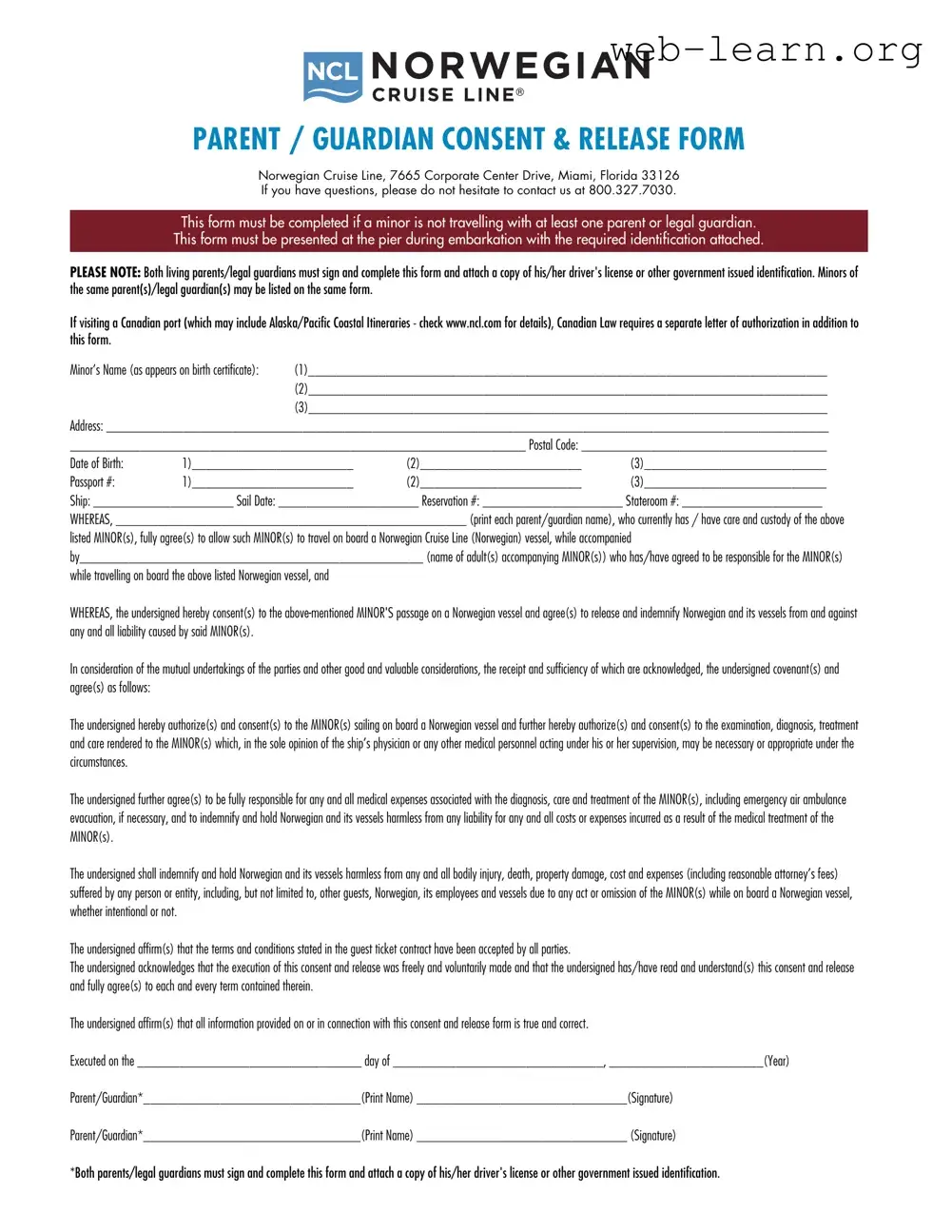
The NCL Parental Consent form serves as a crucial document in the context of educational programs and activities that involve minors. This form is designed to ensure that parents or guardians provide their approval for their child's participation in various initiatives that may include assessments, surveys, or other forms of data collection. Key components of the form typically include the identification of the student, the nature of the activity, and a clear statement regarding the rights of parents to withdraw consent at any time. Additionally, the form often outlines how the collected information will be used and the measures in place to protect the privacy of the child. By requiring parental consent, educational institutions aim to foster transparency and maintain a collaborative relationship with families, while also adhering to legal requirements that govern the protection of minors in educational settings.

PARENT / GUARDIAN CONSENT & RELEASE FORM
Norwegian Cruise Line, 7665 Corporate Center Drive, Miami, Florida 33126
If you have questions, please do not hesitate to contact us at 800.327.7030.
This form must be completed if a minor is not travelling with at least one parent or legal guardian.
This form must be presented at the pier during embarkation with the required identification attached.
PLEASE NOTE: Both living parents/legal guardians must sign and complete this form and attach a copy of his/her driver's license or other government issued identification. Minors of the same parent(s)/legal guardian(s) may be listed on the same form.
If visiting a Canadian port (which may include Alaska/Pacific Coastal Itineraries - check www.ncl.com for details), Canadian Law requires a separate letter of authorization in addition to this form.
Minor’s Name (as appears on birth certificate): |
(1)__________________________________________________________________________ |
|
(2)__________________________________________________________________________ |
|
(3)__________________________________________________________________________ |
Address: _______________________________________________________________________________________________________
_________________________________________________________________ Postal Code: ___________________________________
Date of Birth: |
1)_______________________ |
(2)_______________________ |
(3)__________________________ |
Passport #: |
1)_______________________ |
(2)_______________________ |
(3)__________________________ |
Ship: ____________________ Sail Date: ____________________ Reservation #: ____________________ Stateroom #: ____________________
WHEREAS, __________________________________________________ (print each parent/guardian name), who currently has / have care and custody of the above
listed MINOR(s), fully agree(s) to allow such MINOR(s) to travel on board a Norwegian Cruise Line (Norwegian) vessel, while accompanied
by_________________________________________________ (name of adult(s) accompanying MINOR(s)) who has/have agreed to be responsible for the MINOR(s)
while travelling on board the above listed Norwegian vessel, and
WHEREAS, the undersigned hereby consent(s) to the
In consideration of the mutual undertakings of the parties and other good and valuable considerations, the receipt and sufficiency of which are acknowledged, the undersigned covenant(s) and agree(s) as follows:
The undersigned hereby authorize(s) and consent(s) to the MINOR(s) sailing on board a Norwegian vessel and further hereby authorize(s) and consent(s) to the examination, diagnosis, treatment and care rendered to the MINOR(s) which, in the sole opinion of the ship’s physician or any other medical personnel acting under his or her supervision, may be necessary or appropriate under the circumstances.
The undersigned further agree(s) to be fully responsible for any and all medical expenses associated with the diagnosis, care and treatment of the MINOR(s), including emergency air ambulance evacuation, if necessary, and to indemnify and hold Norwegian and its vessels harmless from any liability for any and all costs or expenses incurred as a result of the medical treatment of the MINOR(s).
The undersigned shall indemnify and hold Norwegian and its vessels harmless from any and all bodily injury, death, property damage, cost and expenses (including reasonable attorney’s fees) suffered by any person or entity, including, but not limited to, other guests, Norwegian, its employees and vessels due to any act or omission of the MINOR(s) while on board a Norwegian vessel, whether intentional or not.
The undersigned affirm(s) that the terms and conditions stated in the guest ticket contract have been accepted by all parties.
The undersigned acknowledges that the execution of this consent and release was freely and voluntarily made and that the undersigned has/have read and understand(s) this consent and release and fully agree(s) to each and every term contained therein.
The undersigned affirm(s) that all information provided on or in connection with this consent and release form is true and correct.
Executed on the ________________________________ day of ______________________________, ______________________(Year)
Parent/Guardian*_______________________________(Print Name) ______________________________(Signature)
Parent/Guardian*_______________________________(Print Name) ______________________________ (Signature)
*Both parents/legal guardians must sign and complete this form and attach a copy of his/her driver's license or other government issued identification.
| Fact Name | Description |
|---|---|
| Purpose | The NCL Parental Consent form is designed to obtain permission from parents or guardians for children to participate in certain activities. |
| Legal Requirement | In many states, parental consent is required under laws governing minors' participation in activities, ensuring that parents are informed and involved. |
| State-Specific Forms | Different states may have their own versions of the consent form, reflecting local laws and requirements. |
| Governing Laws | For example, in California, the governing law is the Family Code Section 6700, which outlines parental rights regarding consent. |
| Information Included | The form typically includes details about the activity, potential risks, and emergency contact information. |
| Signature Requirement | A signature from a parent or guardian is mandatory, indicating their understanding and approval of the activity. |
Once you have the NCL Parental Consent form ready, you will need to complete it accurately. This will ensure that all necessary information is provided for processing. Follow these steps carefully to fill out the form correctly.
After filling out the form, make sure to review all the information for accuracy before submitting it. This will help avoid any delays in the process.
What is the NCL Parental Consent form?
The NCL Parental Consent form is a document designed to obtain permission from parents or guardians for their children to participate in certain activities or programs. This form ensures that parents are informed about the nature of the activity and any associated risks. It also serves to protect the rights and interests of both the child and the organization conducting the activity.
Who needs to sign the NCL Parental Consent form?
The form must be signed by a parent or legal guardian of the child. If the child is under the age of 18, their participation in activities typically requires explicit consent from a parent or guardian. This ensures that the adult responsible for the child is aware of and agrees to the child's involvement.
What information is required on the NCL Parental Consent form?
The form generally requests the following information:
Completing this information accurately helps ensure that the organization can communicate effectively with parents and respond appropriately in case of an emergency.
What happens if I do not sign the NCL Parental Consent form?
If the NCL Parental Consent form is not signed, the child may be unable to participate in the planned activity or program. The organization typically requires this consent to comply with legal and safety regulations, ensuring that all participants have parental approval.
Can I revoke my consent after signing the form?
Yes, parents or guardians can revoke their consent at any time. To do so, it is advisable to communicate directly with the organization managing the activity. This ensures that they are aware of the change in consent status and can take appropriate action regarding the child's participation.
Filling out the NCL Parental Consent form can be a straightforward process, but many individuals make common mistakes that can lead to delays or complications. One frequent error is not providing complete information. When parents or guardians leave sections blank or fail to provide necessary details, it can hinder the processing of the form.
Another mistake is using incorrect or outdated contact information. Parents should ensure that phone numbers and email addresses are current. This information is vital for communication and any follow-up that may be necessary.
Some individuals overlook the importance of signatures. Failing to sign the form or having an illegible signature can result in the form being rejected. It is crucial to double-check that all required signatures are present and clearly written.
In addition, not reading the instructions thoroughly can lead to misunderstandings. Each section of the form has specific requirements. Parents should take the time to understand what is needed before submitting the form.
Another common error is submitting the form without including the necessary supporting documents. If the form requires additional documentation, such as proof of identity or relationship to the child, parents must ensure these are attached. Omitting these documents can delay processing.
Some people also make the mistake of not keeping a copy of the completed form. Retaining a copy is important for personal records and can be useful if there are any questions or issues later on.
Misunderstanding the deadlines can lead to complications as well. Parents should be aware of any submission timelines to avoid missing important dates. Late submissions may not be accepted, which could impact the child’s participation.
Additionally, individuals sometimes fail to follow up after submission. It is advisable to check the status of the form to ensure it has been received and processed. This proactive approach can help address any issues promptly.
Lastly, overlooking the need for parental consent in certain situations can also be a mistake. Parents should be aware of when consent is required and ensure they are compliant with all necessary regulations.
The NCL Parental Consent form is a crucial document for obtaining permission from parents or guardians for their child's participation in specific programs. Along with this form, several other documents may be required to ensure compliance and clarity. Below is a list of commonly used forms that often accompany the NCL Parental Consent form.
Each of these documents plays a vital role in the overall process, ensuring that both the organization and the families involved are aligned and informed. Timely completion of these forms is essential to facilitate a smooth experience for everyone.
The NCL Parental Consent form is designed to ensure that parents or guardians provide permission for their children to participate in certain activities or programs. This document shares similarities with several other forms used in various contexts. Below is a list of eight documents that are comparable to the NCL Parental Consent form, along with explanations of how they are similar.
Each of these documents serves a specific purpose but shares the fundamental principle of requiring parental consent, ensuring that parents are informed and involved in decisions affecting their children.
When filling out the NCL Parental Consent form, it's important to follow specific guidelines to ensure the process goes smoothly. Here are some key dos and don'ts to keep in mind:
Many people have misunderstandings about the NCL Parental Consent form. Here’s a breakdown of nine common misconceptions:
While the form primarily addresses minors, it is also relevant for young adults who may still require parental consent for specific activities or decisions.
This is not true. Signing the consent form allows for specific permissions but does not relinquish overall parental rights.
Not all educational institutions use the NCL Parental Consent form. Requirements may vary by school or district.
Legal guardians can also sign the form. Anyone with legal authority over the child can provide consent.
Parents or guardians can revoke consent at any time, provided they follow the proper procedures outlined by the institution.
While it is often used in educational settings, it can also apply to extracurricular activities and medical decisions.
The NCL Parental Consent form is designed to be straightforward and easy to understand, ensuring parents can make informed decisions.
In some cases, both parents or guardians may need to sign the form, depending on the policies of the institution.
While the form provides consent for participation, it does not guarantee safety. Parents should always assess the risks involved.
Understanding these misconceptions can help parents and guardians navigate the consent process more effectively.
Filling out and using the NCL Parental Consent form is crucial for ensuring compliance with regulations regarding student participation. Here are some key takeaways to consider: