Homepage Attorney-Approved Bill of Sale Template Attorney-Approved Motorcycle Bill of Sale Template
Outline

When buying or selling a motorcycle, having a Motorcycle Bill of Sale form is essential. This document serves as a legal record of the transaction, protecting both the buyer and the seller. It typically includes important details such as the names and addresses of both parties, a description of the motorcycle, including its make, model, year, and Vehicle Identification Number (VIN). Additionally, the form outlines the sale price and the date of the transaction. By capturing this information, the Motorcycle Bill of Sale helps to clarify ownership and can be useful for future reference, especially in matters related to registration or title transfers. Furthermore, it may include any warranties or disclaimers regarding the motorcycle's condition, providing transparency in the sale. Ultimately, this simple yet vital document ensures a smoother transaction process and fosters trust between both parties involved.

Sample - Motorcycle Bill of Sale Form

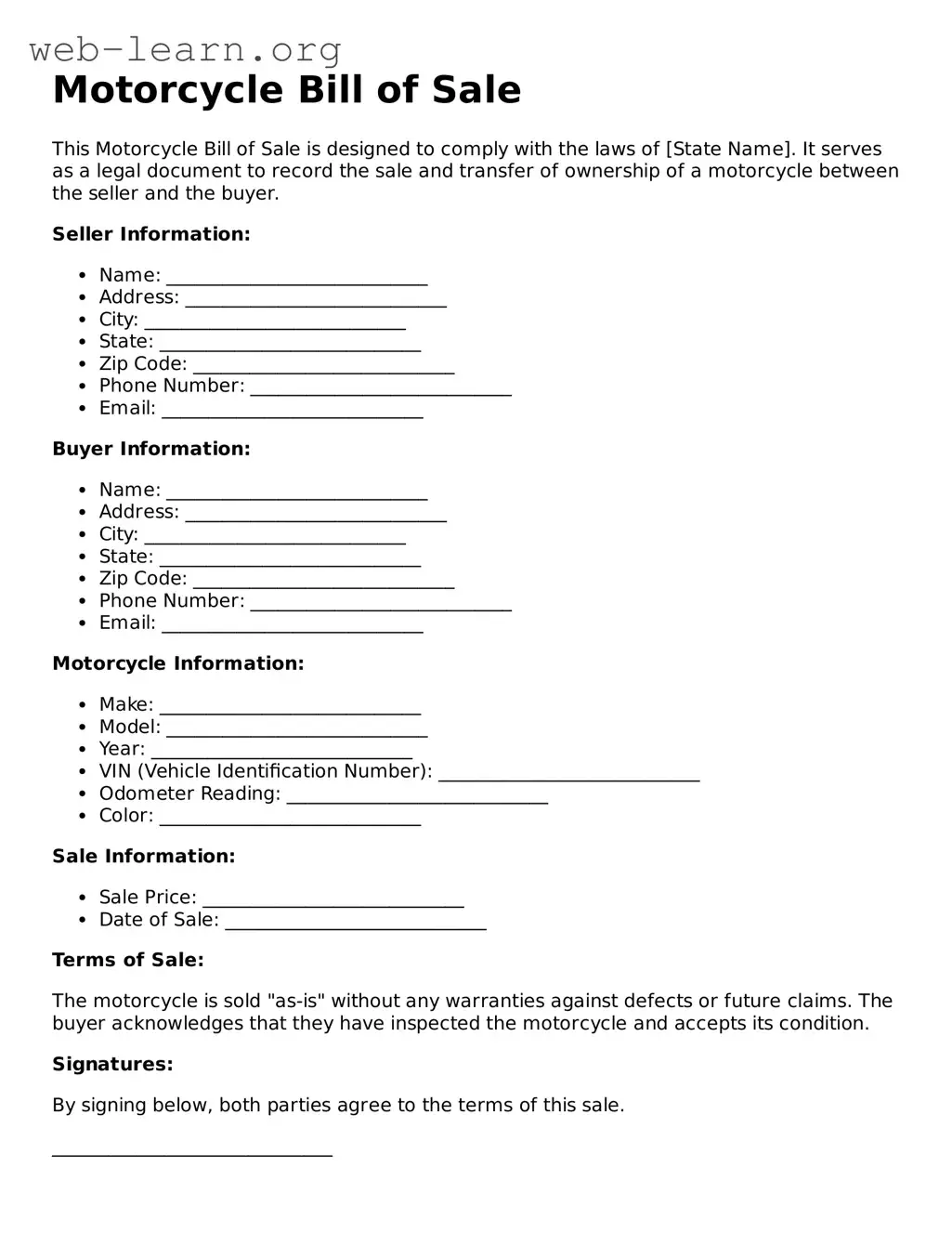
Motorcycle Bill of Sale

This Motorcycle Bill of Sale is designed to comply with the laws of [State Name]. It serves as a legal document to record the sale and transfer of ownership of a motorcycle between the seller and the buyer.

Seller Information:

  • Name: ____________________________
  • Address: ____________________________
  • City: ____________________________
  • State: ____________________________
  • Zip Code: ____________________________
  • Phone Number: ____________________________
  • Email: ____________________________

Buyer Information:

  • Name: ____________________________
  • Address: ____________________________
  • City: ____________________________
  • State: ____________________________
  • Zip Code: ____________________________
  • Phone Number: ____________________________
  • Email: ____________________________

Motorcycle Information:

  • Make: ____________________________
  • Model: ____________________________
  • Year: ____________________________
  • VIN (Vehicle Identification Number): ____________________________
  • Odometer Reading: ____________________________
  • Color: ____________________________

Sale Information:

  • Sale Price: ____________________________
  • Date of Sale: ____________________________

Terms of Sale:

The motorcycle is sold "as-is" without any warranties against defects or future claims. The buyer acknowledges that they have inspected the motorcycle and accepts its condition.

Signatures:

By signing below, both parties agree to the terms of this sale.

______________________________

Seller's Signature

______________________________

Date

______________________________

Buyer's Signature

______________________________

Date

This document should be retained by both parties for their records.

File Characteristics

Fact Name Details
Purpose The Motorcycle Bill of Sale serves as a legal document that records the transfer of ownership of a motorcycle from one party to another.
Identification The form typically requires details such as the motorcycle's make, model, year, VIN, and odometer reading.
Seller and Buyer Information Both the seller and buyer must provide their names, addresses, and signatures on the form.
State-Specific Forms Each state may have its own version of the Motorcycle Bill of Sale, which must comply with local laws.
Governing Laws In California, for example, the form must adhere to the California Vehicle Code, Section 5901.
Notarization Some states require the Bill of Sale to be notarized to be considered valid.
Tax Implications Sales tax may be applicable based on the purchase price and state regulations.
Record Keeping Both parties should keep a copy of the Bill of Sale for their records after the transaction.
Dispute Resolution The document can serve as evidence in case of disputes regarding the sale or ownership of the motorcycle.

Detailed Guide for Filling Out Motorcycle Bill of Sale

Filling out a Motorcycle Bill of Sale form is an essential step in the process of transferring ownership of a motorcycle. This document serves as proof of the transaction between the seller and the buyer, ensuring that both parties have a clear record of the sale. Once completed, the form will facilitate the registration of the motorcycle in the new owner's name and provide legal protection for both parties involved.

  1. Begin by entering the date of the sale at the top of the form. This should reflect the exact day the transaction takes place.
  2. Next, fill in the seller's information. Include the full name, address, and contact number of the seller. This identifies who is transferring ownership.
  3. Now, provide the buyer's information. Similar to the seller's details, include the full name, address, and contact number of the buyer.
  4. In the next section, describe the motorcycle. Include the make, model, year, color, and Vehicle Identification Number (VIN). This information is crucial for accurately identifying the motorcycle.
  5. Specify the purchase price of the motorcycle. Clearly state the amount agreed upon by both parties for the sale.
  6. Indicate the payment method used for the transaction. Whether it’s cash, check, or another form of payment, be specific.
  7. Both the seller and buyer should sign the form. This signature confirms that both parties agree to the terms outlined in the document.
  8. Lastly, provide the date of the signatures. This marks when the agreement was finalized.

Obtain Answers on Motorcycle Bill of Sale

  1. What is a Motorcycle Bill of Sale?

    A Motorcycle Bill of Sale is a legal document that serves as proof of the sale and transfer of ownership of a motorcycle from one party to another. This document typically includes important details such as the names and addresses of the buyer and seller, the motorcycle's make, model, year, Vehicle Identification Number (VIN), sale price, and the date of the transaction. Having a Bill of Sale is crucial for both parties as it protects their rights and provides a record of the transaction.

  2. Why do I need a Motorcycle Bill of Sale?

    There are several reasons why a Motorcycle Bill of Sale is important:

    • It serves as proof of ownership, which is essential for registering the motorcycle with the Department of Motor Vehicles (DMV).
    • It protects both the buyer and seller by documenting the terms of the sale and the condition of the motorcycle at the time of sale.
    • In the event of a dispute, this document can provide evidence of the agreed-upon terms and conditions.
  3. Is a Motorcycle Bill of Sale required in all states?

    The requirement for a Motorcycle Bill of Sale varies by state. While some states mandate that a Bill of Sale be completed for the transfer of ownership, others may not require it but still recommend having one for record-keeping purposes. It is advisable to check your state’s specific laws regarding motorcycle sales to ensure compliance.

  4. What should be included in a Motorcycle Bill of Sale?

    A comprehensive Motorcycle Bill of Sale should include the following information:

    • Full names and addresses of both the buyer and seller.
    • Details of the motorcycle, including make, model, year, color, and VIN.
    • The sale price and payment method.
    • The date of the sale.
    • Any warranties or conditions of the sale, if applicable.

    Including this information helps to ensure that the document is complete and legally binding.

  5. Can I create my own Motorcycle Bill of Sale?

    Yes, you can create your own Motorcycle Bill of Sale. Many templates are available online that can be customized to fit your specific needs. When drafting your own Bill of Sale, ensure that it includes all the necessary information and is signed by both parties. Alternatively, you may also choose to consult with a legal professional to ensure that your document meets all legal requirements.

Common mistakes

Filling out a Motorcycle Bill of Sale form can seem straightforward, but many individuals make common mistakes that can lead to complications down the line. One frequent error is failing to provide complete information about the motorcycle. Essential details such as the Vehicle Identification Number (VIN), make, model, year, and odometer reading must be included. Omitting any of this information can create confusion and may affect the transfer of ownership.

Another mistake often seen is not including the names and addresses of both the buyer and seller. This information is crucial for establishing the identities of the parties involved in the transaction. If either party’s information is missing or incorrect, it can lead to disputes or difficulties in registering the motorcycle in the buyer's name.

Additionally, people sometimes forget to sign and date the form. Both the buyer and seller should sign the Motorcycle Bill of Sale to validate the transaction. Without signatures, the document may not be legally binding, which can pose problems if either party later disputes the sale.

Finally, failing to keep a copy of the completed bill of sale is a common oversight. After filling out the form, both parties should retain a copy for their records. This document serves as proof of the transaction and can be important for future reference, especially if there are questions about ownership or if the motorcycle is involved in an accident.

Documents used along the form

When buying or selling a motorcycle, having the right documents is crucial. Along with the Motorcycle Bill of Sale form, several other forms can help ensure a smooth transaction. Here’s a list of important documents to consider:

  • Title Transfer Form: This document officially transfers ownership of the motorcycle from the seller to the buyer. It must be signed by both parties.
  • Odometer Disclosure Statement: This form records the motorcycle's mileage at the time of sale. It helps prevent fraud regarding the vehicle's condition.
  • Vehicle Registration Application: Buyers need this form to register the motorcycle in their name with the local Department of Motor Vehicles (DMV).
  • Insurance Certificate: Proof of insurance is often required before the motorcycle can be registered. This document shows that the buyer has coverage.
  • Release of Liability Form: This protects the seller by officially notifying the DMV that they are no longer responsible for the motorcycle after the sale.
  • Purchase Agreement: A detailed contract that outlines the terms of the sale, including price, condition, and any warranties provided by the seller.
  • VIN Verification Form: Some states require this document to confirm the motorcycle's Vehicle Identification Number matches the title and registration.
  • Emissions Compliance Certificate: In certain areas, this certificate proves that the motorcycle meets local emissions standards, which may be necessary for registration.
  • Power of Attorney: If the seller cannot be present for the sale, this document allows someone else to sign on their behalf, ensuring the transaction can proceed smoothly.

Having these documents ready can make the buying or selling process much easier. Ensure that all forms are completed accurately to avoid any complications down the road.

Similar forms

  • Vehicle Bill of Sale: Similar to the Motorcycle Bill of Sale, this document is used for the sale of any type of vehicle, including cars and trucks. It serves to transfer ownership from the seller to the buyer.
  • Boat Bill of Sale: This document is specifically for the sale of boats. Like the Motorcycle Bill of Sale, it provides proof of the transaction and details about the vessel.
  • ATV Bill of Sale: An ATV Bill of Sale is used for all-terrain vehicles. It includes information about the buyer, seller, and the ATV, ensuring a clear transfer of ownership.
  • Trailer Bill of Sale: When selling a trailer, this document is essential. It outlines the details of the trailer and serves as proof of the sale, similar to a Motorcycle Bill of Sale.
  • Personal Property Bill of Sale: This broader document can be used for various types of personal property. It functions similarly by documenting the sale and transfer of ownership.
  • Mobile Home Bill of Sale: When selling a mobile home, this document is necessary. It provides details about the home and ensures the transaction is recorded, much like the Motorcycle Bill of Sale.
  • Equipment Bill of Sale: This document is used for the sale of equipment, such as construction machinery. It includes pertinent information about the equipment and the parties involved.
  • Gun Bill of Sale: Similar in purpose, this document is used for the sale of firearms. It provides a record of the transaction and includes details about the firearm and the parties.
  • Pet Bill of Sale: When selling or adopting out pets, this document outlines the details of the transaction. It serves a similar purpose to the Motorcycle Bill of Sale by ensuring both parties are informed.
  • Business Bill of Sale: For the sale of a business or its assets, this document outlines the terms of the sale. Like the Motorcycle Bill of Sale, it provides legal protection for both parties involved.

Dos and Don'ts

When completing the Motorcycle Bill of Sale form, it's important to ensure accuracy and clarity. Here are some guidelines to follow:

  • Do: Provide accurate information about the motorcycle, including the make, model, year, and VIN (Vehicle Identification Number).
  • Do: Include the names and addresses of both the buyer and seller to establish clear ownership transfer.
  • Do: Specify the sale price clearly to avoid any misunderstandings later.
  • Do: Sign and date the form to make it legally binding.
  • Don't: Leave any sections blank, as this can lead to confusion or disputes.
  • Don't: Use abbreviations or shorthand that may not be understood by all parties involved.
  • Don't: Forget to check for any local requirements that may need to be included in the bill of sale.
  • Don't: Rush through the process; take your time to ensure everything is correct.

Misconceptions

Understanding the Motorcycle Bill of Sale form is essential for both buyers and sellers in the motorcycle market. However, several misconceptions can lead to confusion. Here are seven common misconceptions explained:

  • A Motorcycle Bill of Sale is not necessary. Many believe that a verbal agreement suffices. In reality, a written bill of sale serves as a legal document that protects both parties and provides proof of the transaction.
  • The bill of sale is only for new motorcycles. This is not true. A bill of sale is important for both new and used motorcycles, ensuring that ownership is clearly transferred.
  • Only the seller needs to sign the bill of sale. This misconception overlooks the fact that both the buyer and seller should sign the document to validate the transaction and acknowledge the terms.
  • A bill of sale is the same as a title. While both documents are important, they serve different purposes. The title proves ownership, while the bill of sale records the transaction details.
  • The bill of sale does not need to be notarized. While notarization is not always required, having the document notarized can add an extra layer of security and authenticity to the transaction.
  • It is only necessary in private sales. Some people think that bills of sale are only needed for private transactions. However, they are also beneficial in dealership sales to confirm the details of the purchase.
  • Once the bill of sale is signed, it cannot be changed. If both parties agree, modifications can be made to the bill of sale. It is crucial to document any changes and have both parties sign the updated version.

By addressing these misconceptions, individuals can navigate the motorcycle purchasing process with greater confidence and clarity.

Key takeaways

When filling out and using the Motorcycle Bill of Sale form, consider the following key points:

  1. Accurate Information: Ensure that all details about the motorcycle, including the make, model, year, and Vehicle Identification Number (VIN), are filled out correctly.
  2. Seller and Buyer Details: Include full names and addresses of both the seller and the buyer to establish clear ownership transfer.
  3. Purchase Price: Clearly state the agreed-upon purchase price to avoid any misunderstandings later on.
  4. Signatures: Both parties must sign the document. This signature confirms the agreement and the transfer of ownership.

Using this form properly can help facilitate a smooth transaction.