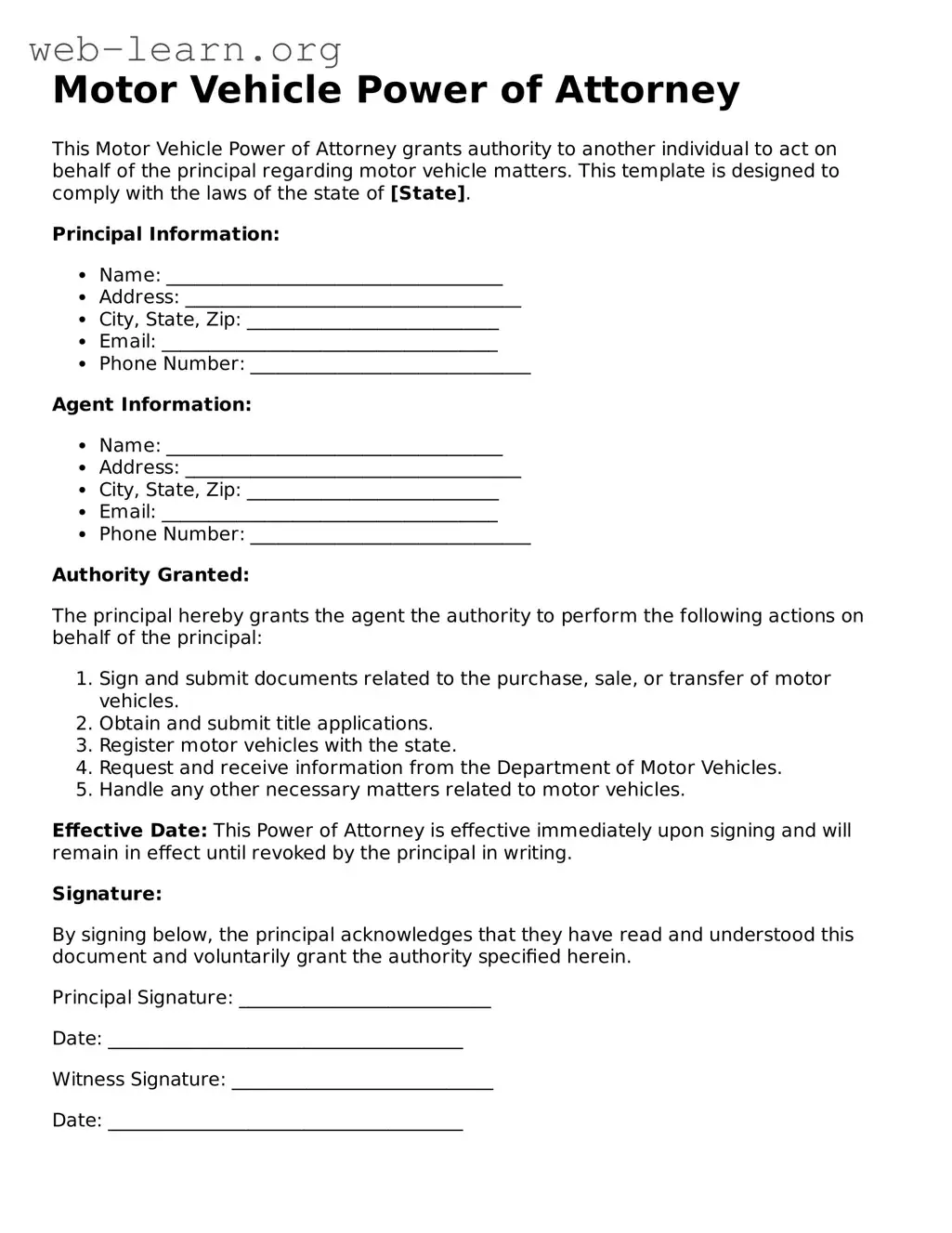
The Motor Vehicle Power of Attorney form serves as a vital tool for individuals who need to delegate authority regarding their vehicle-related matters. This document allows one person, known as the principal, to appoint another individual, referred to as the agent, to act on their behalf in various transactions involving motor vehicles. These transactions may include transferring ownership, registering a vehicle, or obtaining necessary documentation from the Department of Motor Vehicles. By utilizing this form, the principal can ensure that their interests are protected even when they are unable to personally attend to these tasks. It is essential for the principal to choose a trustworthy agent, as this person will have the authority to make decisions and sign documents related to the vehicle. The form typically requires the inclusion of specific details, such as the names and addresses of both the principal and the agent, as well as information about the vehicle in question. Additionally, the Motor Vehicle Power of Attorney may need to be notarized to ensure its validity, depending on state laws. Understanding the nuances of this form can help individuals navigate the complexities of vehicle ownership and management with greater ease and confidence.
Motor Vehicle Power of Attorney
This Motor Vehicle Power of Attorney grants authority to another individual to act on behalf of the principal regarding motor vehicle matters. This template is designed to comply with the laws of the state of [State].
Principal Information:
Agent Information:
Authority Granted:
The principal hereby grants the agent the authority to perform the following actions on behalf of the principal:
Effective Date: This Power of Attorney is effective immediately upon signing and will remain in effect until revoked by the principal in writing.
Signature:
By signing below, the principal acknowledges that they have read and understood this document and voluntarily grant the authority specified herein.
Principal Signature: ___________________________
Date: ______________________________________
Witness Signature: ____________________________
Date: ______________________________________
| Fact Name | Description |
|---|---|
| Definition | A Motor Vehicle Power of Attorney form allows an individual to designate another person to handle vehicle-related transactions on their behalf. |
| Purpose | This form is commonly used for tasks such as registering a vehicle, transferring ownership, or obtaining a duplicate title. |
| State-Specific Forms | Each state may have its own version of the form, tailored to meet local laws and regulations. |
| Governing Law | In most states, the use of this form is governed by the Uniform Power of Attorney Act, though specific provisions may vary. |
| Signature Requirement | The principal must sign the form, and in some states, a notary public may also need to witness the signature. |
| Durability | This power of attorney can be durable, meaning it remains effective even if the principal becomes incapacitated. |
| Revocation | The principal can revoke the power of attorney at any time, as long as they are mentally competent. |
| Limitations | Some states may impose limitations on the authority granted, so it’s essential to review local laws carefully. |
| Duration | The duration of the power of attorney can vary; it can be for a specific transaction or for an indefinite period. |
| Legal Advice | It’s advisable to seek legal advice before completing the form to ensure it meets all necessary legal requirements. |
Once you have the Motor Vehicle Power of Attorney form in hand, you are ready to begin the process of filling it out. This form allows you to designate someone to act on your behalf regarding motor vehicle transactions. Follow these steps carefully to ensure that all necessary information is completed accurately.
After you have completed these steps, your Motor Vehicle Power of Attorney form will be ready for processing. Make sure to keep a copy for your records and confirm that your agent is aware of their responsibilities.
What is a Motor Vehicle Power of Attorney form?
A Motor Vehicle Power of Attorney form is a legal document that allows an individual (the principal) to authorize another person (the agent) to act on their behalf in matters related to motor vehicles. This may include tasks such as signing documents, transferring titles, or registering vehicles.
Who can be designated as an agent?
Any adult can be designated as an agent in a Motor Vehicle Power of Attorney. This could be a family member, friend, or even a professional such as a lawyer. It is important to choose someone you trust, as they will have the authority to make decisions regarding your vehicle.
What powers does the agent have?
The agent can perform a variety of tasks related to your motor vehicle. These tasks typically include:
However, the specific powers granted can be customized based on your needs, so it is crucial to outline them clearly in the document.
Is the Motor Vehicle Power of Attorney form valid in all states?
While most states recognize a Motor Vehicle Power of Attorney, the specific requirements and validity may vary. It is essential to check the regulations in your state to ensure that the form meets all necessary criteria. Consulting with a local attorney can provide clarity and ensure compliance.
How long is the Motor Vehicle Power of Attorney valid?
The duration of the authority granted can vary. In some cases, the power may remain in effect until it is revoked or until a specific task is completed. In other situations, you may choose to set an expiration date. Clearly stating the duration in the document will help avoid confusion.
Can I revoke the Motor Vehicle Power of Attorney?
Yes, you can revoke the Motor Vehicle Power of Attorney at any time, as long as you are mentally competent. To do so, you should create a written revocation notice and provide it to your agent. It is also advisable to notify any relevant institutions, such as the Department of Motor Vehicles, to prevent any unauthorized actions.
Do I need to have the form notarized?
Many states require the Motor Vehicle Power of Attorney form to be notarized for it to be considered valid. Notarization helps to ensure that the document is authentic and that you were not coerced into signing it. Check your state’s requirements to determine if notarization is necessary.
Filling out a Motor Vehicle Power of Attorney form can seem straightforward, but many people make common mistakes that can lead to complications down the line. One frequent error is failing to provide all necessary information. This includes not only the names and addresses of both the principal and the agent but also the vehicle details. Omitting any critical information can render the document invalid.
Another mistake is not signing the form correctly. The principal must sign the document, and in some states, a witness or notary may also be required. Neglecting to have the form notarized when necessary can lead to issues when trying to use the power of attorney.
People often forget to specify the powers granted to the agent. A vague description can create confusion. It’s essential to clearly outline what actions the agent is authorized to take regarding the vehicle. Without this clarity, the agent may not be able to perform the intended tasks.
Additionally, failing to date the document is a common oversight. A date provides context and can be crucial if questions arise about the timing of the authority granted. Without a date, it can be difficult to determine when the powers were conferred.
Some individuals mistakenly believe they can use an outdated version of the form. Laws and requirements can change, so always ensure you are using the most current version of the Motor Vehicle Power of Attorney form. Using an obsolete form can lead to rejection by the Department of Motor Vehicles.
Another frequent error is neglecting to keep copies of the completed form. Once the document is signed and submitted, it’s vital to have a copy for your records. This can help resolve any disputes or questions about the authority granted in the future.
People sometimes overlook the importance of discussing the arrangement with the agent beforehand. It's crucial that the person you are granting authority to understands their responsibilities and is willing to accept them. Miscommunication can lead to misunderstandings and potential legal issues.
In some cases, individuals fail to consider the implications of granting power of attorney. It’s important to understand the extent of the authority being given and the trust involved. This decision should not be taken lightly, as it can affect ownership and control over the vehicle.
Lastly, many forget to revoke the power of attorney when it is no longer needed. If circumstances change, such as selling the vehicle or no longer needing the agent’s assistance, it’s important to formally revoke the power of attorney. Failing to do so can lead to unauthorized actions taken by the agent.
When dealing with motor vehicle transactions, a Motor Vehicle Power of Attorney form is often accompanied by other important documents. These forms help ensure that all legal requirements are met and that the process runs smoothly. Below is a list of commonly used forms and documents.
Having these documents ready can simplify the process of buying, selling, or transferring a motor vehicle. Each form plays a specific role in ensuring that all legal aspects are covered, making the transaction smoother for everyone involved.
The Motor Vehicle Power of Attorney form is a specific document that allows one person to authorize another to act on their behalf regarding motor vehicle matters. There are several other documents that serve similar purposes in different contexts. Here are nine documents that share similarities with the Motor Vehicle Power of Attorney:
Understanding these documents can help you navigate the complexities of granting authority to others in various situations. Each serves a unique purpose but shares the common goal of allowing someone to act on your behalf.
When filling out the Motor Vehicle Power of Attorney form, it’s important to follow certain guidelines to ensure everything is completed correctly. Here’s a list of dos and don’ts:
When it comes to the Motor Vehicle Power of Attorney form, many misunderstandings can lead to confusion. Here are ten common misconceptions that people often have:
Understanding these misconceptions can help you navigate the process more effectively and ensure you make informed decisions regarding your motor vehicle transactions.
Filling out a Motor Vehicle Power of Attorney form can seem daunting, but it doesn't have to be. Here are some key takeaways to keep in mind:
By keeping these points in mind, you can confidently fill out and use the Motor Vehicle Power of Attorney form.
Poa Document - Ensures that all legal obligations related to real estate can be met by the agent.
Types of Power of Attorney California - This document can be used to appoint a family member, friend, or professional as your agent.
Temporary Power of Attorney for Child - It’s a simple way to provide clear authority in specific situations.