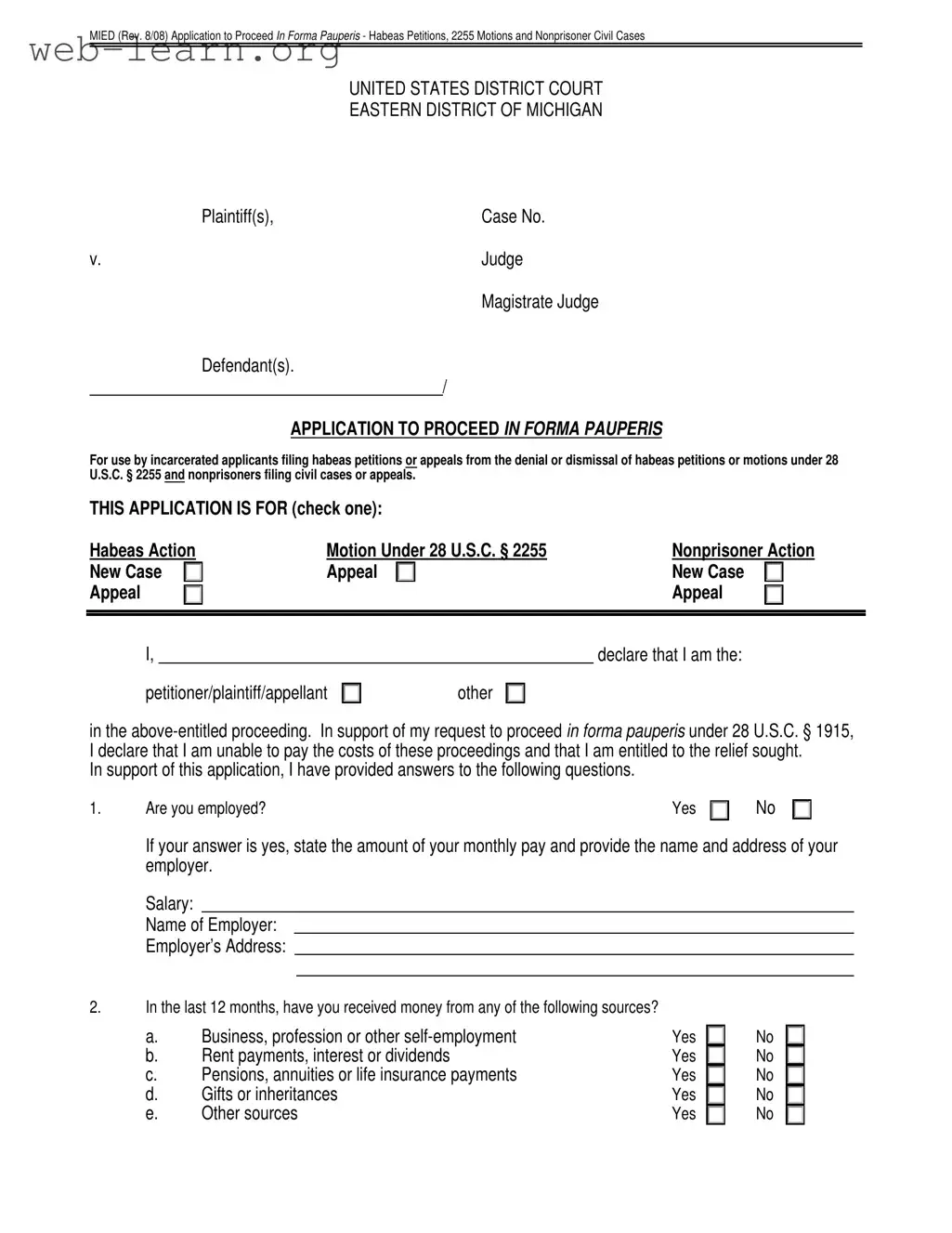
The Motion Onforma Paupris Michigan form is a crucial document designed for individuals seeking to proceed without the financial burden of court fees in specific legal proceedings. This form is primarily utilized by incarcerated individuals filing habeas petitions or appeals related to the denial or dismissal of such petitions, as well as those submitting motions under 28 U.S.C. § 2255. Additionally, nonprisoners can also use this form for civil cases or appeals. When completing the application, applicants must declare their financial situation, providing detailed information about their employment status, income sources, and any assets they may possess. Questions regarding monthly earnings, bank account balances, and property ownership are included to assess eligibility for fee waivers. The form also allows applicants to request service by a U.S. Marshal for nonprisoner civil cases, ensuring that legal documents are delivered appropriately. A section dedicated to certification by a prison official is also present, confirming the applicant's financial status within the institution. This comprehensive application aims to facilitate access to justice for those who may otherwise be unable to afford the associated costs.
MIED (Rev. 8/08) Application to Proceed In Forma Pauperis - Habeas Petitions, 2255 Motions and Nonprisoner Civil Cases
UNITED STATES DISTRICT COURT
EASTERN DISTRICT OF MICHIGAN
Plaintiff(s), |
Case No. |
v. |
Judge |
|
Magistrate Judge |
Defendant(s). |
|
|
/ |
APPLICATION TO PROCEED IN FORMA PAUPERIS
For use by incarcerated applicants filing habeas petitions or appeals from the denial or dismissal of habeas petitions or motions under 28 U.S.C. § 2255 and nonprisoners filing civil cases or appeals.
THIS APPLICATION IS FOR (check one):
Habeas Action |
Motion Under 28 U.S.C. § 2255 |
Nonprisoner Action |
New Case |
Appeal |
New Case |
Appeal |
|
Appeal |
|
|
|
I,
petitioner/plaintiff/appellant
declare that I am the:
other
in the
In support of this application, I have provided answers to the following questions.
1. |
Are you employed? |
Yes |
No
If your answer is yes, state the amount of your monthly pay and provide the name and address of your employer.
Salary:
Name of Employer:
Employer’s Address:
2.In the last 12 months, have you received money from any of the following sources?
a. |
Business, profession or other |
Yes |
b. |
Rent payments, interest or dividends |
Yes |
c. |
Pensions, annuities or life insurance payments |
Yes |
d. |
Gifts or inheritances |
Yes |
e. |
Other sources |
Yes |
No
No
No
No
No

MIED (Rev. 8/08) Application to Proceed In Forma Pauperis - Habeas Petitions, 2255 Motions and Nonprisoner Civil Cases
If you answered yes to any of these questions, state the source of the money and the amount that you received.
Source:
Amount:
3.Do you have any money in a:
a. |
Prison or jail account |
Yes |
b. |
Checking account |
Yes |
c. |
Savings account |
Yes |
If you answered yes, state the total amount. Amount:
No
No
No
4.Do you own or have any interest in real estate, stocks, bonds, notes, vehicles, or other valuable property or assets
(excluding ordinary household furnishings and clothing)? |
Yes |
No
If you answered yes, describe the property and state its approximate value. |
|
|
Property description: |
|
Value: |
Property description: |
|
Value: |
5.List the people who are dependent on you for support, state your relationship to each person and how much you contribute to their support.
Relationship: |
|
Amount: |
Relationship: |
|
Amount: |
Relationship: |
|
Amount: |
Relationship: |
|
Amount: |
I declare under penalty of perjury that the foregoing is true and correct.
Date:
Signature of Applicant and Prisoner No. if applicable
Address (including name of Institution)
City, State, Zip Code
Telephone Number
REQUEST FOR SERVICE BY U.S. MARSHAL
For use only by nonprisoners filing new civil cases.
If my application to proceed In Forma Pauperis is granted:
a. I request service of the summons and complaint by a U.S. Marshal. Yes
No
Date:
Signature of Applicant

MIED (Rev. 8/08) Application to Proceed In Forma Pauperis - Habeas Petitions, 2255 Motions and Nonprisoner Civil Cases
CERTIFICATE
This section only applies to incarcerated applicants filing habeas petitions or appeals from the denial or dismissal of habeas petitions or
motions under 28 U.S.C. § 2255. (To be completed by an authorized prison official.)
I certify that the applicant named herein has the sum of $ |
|
on account to his/her |
||
credit at (name of institution) |
|
|
. |
|
I further certify that the applicant has the following securities to his/her credit at this institution:
.
Date:
Signature and Title of Authorized Official
Name of Institution
| Fact Name | Details |
|---|---|
| Form Title | Application to Proceed In Forma Pauperis - Habeas Petitions, 2255 Motions and Nonprisoner Civil Cases |
| Governing Law | This form is governed by 28 U.S.C. § 1915, which allows individuals to file without prepayment of fees if they cannot afford them. |
| Jurisdiction | The form is specifically for use in the United States District Court for the Eastern District of Michigan. |
| Eligibility | It is designed for incarcerated applicants filing habeas petitions or appeals, as well as nonprisoners filing civil cases or appeals. |
| Application Sections | The application includes sections to declare employment status, sources of income, and financial assets. |
| Dependent Support | Applicants must list individuals who depend on them for support, including the relationship and amount contributed. |
| Service Request | Nonprisoners may request service by a U.S. Marshal if their application is granted. |
Completing the Motion Onforma Paupris Michigan form requires careful attention to detail. This form is essential for individuals seeking to waive court fees due to financial hardship. Follow the steps below to ensure accurate completion.
What is the Motion Onforma Paupris Michigan form?
The Motion Onforma Paupris Michigan form is an application used by individuals who are unable to pay court fees. This form is specifically for those filing habeas petitions, motions under 28 U.S.C. § 2255, or nonprisoner civil cases in the United States District Court for the Eastern District of Michigan. By completing this form, applicants can request permission to proceed without the financial burden of court costs.
Who can use this form?
This form can be used by two main categories of applicants:
What information do I need to provide on the form?
The form requires various details to assess your financial situation. Key information includes:
What if I do not have any income or assets?
If you do not have any income or assets, you can still complete the form. Indicate "No" for the relevant questions. Providing accurate information is crucial, as it helps the court determine your eligibility for fee waivers.
How do I submit the form?
You can submit the completed form to the court where your case is being heard. Make sure to follow any specific submission guidelines provided by the court. If you are incarcerated, you may need to have the form signed by an authorized prison official.
What happens after I submit the form?
Once submitted, the court will review your application. If approved, you will be allowed to proceed without paying the standard court fees. You will receive notification of the court's decision, which may take some time depending on the court's workload.
Can I request a U.S. Marshal to serve my documents?
If you are a nonprisoner and your application is granted, you can request that the U.S. Marshal serve your summons and complaint. This request is included in the form, and you must indicate your preference for this service.
What if I provide false information on the form?
Providing false information on the application can lead to serious consequences, including legal penalties. It is important to be truthful and accurate when filling out the form. Misrepresentation can affect your case and may result in your application being denied.
Filling out the Motion Onforma Paupris Michigan form can be a daunting task, especially for those unfamiliar with legal processes. One common mistake is failing to check the appropriate box for the type of application being submitted. Whether it’s for a habeas action, a motion under 28 U.S.C. § 2255, or a nonprisoner action, selecting the right option is crucial. An incorrect choice can lead to delays or even rejection of the application.
Another frequent error involves incomplete financial disclosures. Applicants must answer questions about their employment status and any income received in the past year. Omitting details about sources of income, such as gifts or inheritances, can undermine the credibility of the application. It’s essential to be thorough and transparent in this section to avoid complications.
Many applicants also overlook the importance of accurately reporting their financial assets. When asked about money in checking or savings accounts, individuals might mistakenly claim they have none when, in fact, they do. Providing accurate figures is vital, as discrepancies can raise red flags and lead to further scrutiny.
Additionally, failing to list dependents can be a significant oversight. The form requires applicants to identify individuals who rely on them for support. Neglecting to mention dependents or not providing sufficient details about the financial contributions made to their support can impact the outcome of the application.
Another common mistake is neglecting to sign and date the application. A missing signature can render the entire form invalid. It’s a simple step, but one that can easily be overlooked in the rush to submit paperwork.
Moreover, applicants sometimes forget to include their contact information. Providing a phone number or address is essential for the court to reach out for any follow-up questions or clarifications. Without this information, the application process may stall.
Lastly, some individuals fail to seek assistance or clarification when needed. Legal processes can be confusing, and it’s perfectly acceptable to ask for help. Whether it’s from a legal aid organization or a trusted friend, getting guidance can prevent many of these common mistakes and ensure that the application is completed correctly.
The Motion In Forma Pauperis form is often accompanied by several other documents that support the application process in the U.S. District Court for the Eastern District of Michigan. Each of these documents serves a specific purpose and is essential for ensuring that the court has all necessary information to process the request. Below is a list of commonly used forms and documents.
These documents collectively support the Motion In Forma Pauperis and are critical for ensuring that the court can make an informed decision regarding the applicant's financial ability to proceed with their case. Properly completing and submitting these forms can significantly impact the outcome of the application process.
The Motion Onforma Paupris Michigan form shares similarities with several other legal documents used in various court proceedings. Each of these documents serves a specific purpose related to financial eligibility and procedural requests. Below is a list of nine documents that are comparable to the Motion Onforma Paupris Michigan form:
When filling out the Motion Onforma Paupris Michigan form, it is crucial to approach the task with care and attention to detail. Below is a list of essential dos and don'ts to ensure a smooth application process.
By following these guidelines, applicants can enhance their chances of successfully proceeding in forma pauperis in the Eastern District of Michigan.
Here are ten common misconceptions about the Motion Onforma Paupris Michigan form, along with clarifications for each.
When filling out the Motion Onforma Paupris Michigan form, keep the following key takeaways in mind: