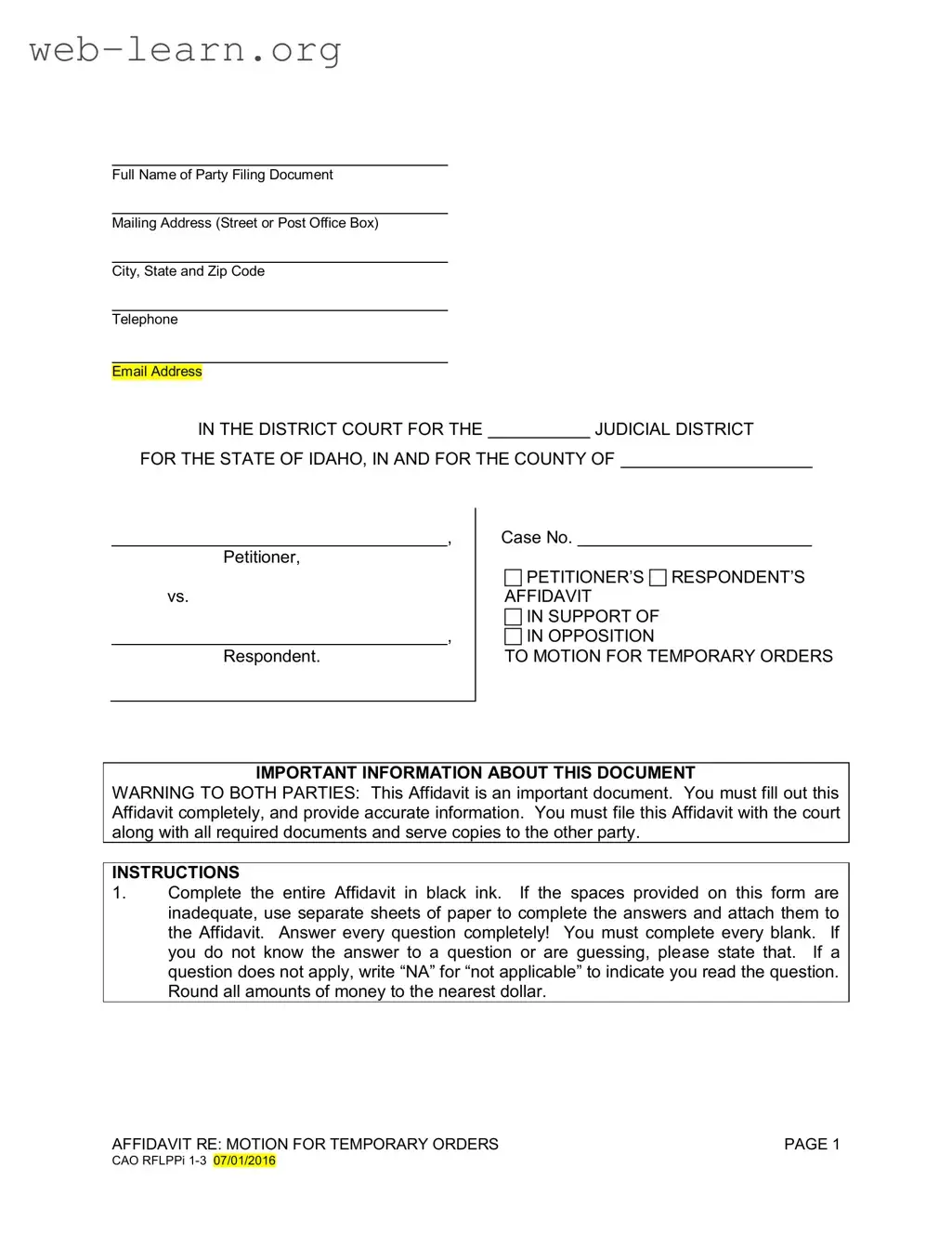
The Motion for Temporary Orders form in Idaho serves as a crucial tool for individuals navigating family law disputes, particularly during the often tumultuous period before a final court decision is reached. This form allows a petitioner or respondent to request immediate relief regarding various issues, including child custody, support, and visitation rights. It requires detailed personal information, such as the full names, addresses, and contact details of both parties involved. Additionally, the form necessitates the completion of an affidavit, which is a sworn statement that provides the court with essential facts about the case. The affidavit must be filled out thoroughly, ensuring that all questions are answered accurately, and any relevant financial information is disclosed. This includes income sources, employment details, and monthly expenses, particularly those related to children common to the parties. The document emphasizes the importance of transparency, instructing individuals to provide supporting documentation, such as pay stubs and tax forms, to substantiate their claims. Moreover, the form addresses the Uniform Child Custody Jurisdiction and Enforcement Act provisions, which help to clarify jurisdictional issues that may affect custody decisions. Overall, the Motion for Temporary Orders form is designed to facilitate a fair and efficient resolution of urgent matters while ensuring that both parties adhere to the legal requirements set forth by the Idaho courts.

Full Name of Party Filing Document
Mailing Address (Street or Post Office Box)
City, State and Zip Code
Telephone
Email Address
IN THE DISTRICT COURT FOR THE |
|
JUDICIAL DISTRICT |
FOR THE STATE OF IDAHO, IN AND FOR THE COUNTY OF
,
Petitioner,
vs.
,
Respondent.
Case No.
PETITIONER’S RESPONDENT’S
AFFIDAVIT
IN SUPPORT OF
IN OPPOSITION
TO MOTION FOR TEMPORARY ORDERS
IMPORTANT INFORMATION ABOUT THIS DOCUMENT
WARNING TO BOTH PARTIES: This Affidavit is an important document. You must fill out this Affidavit completely, and provide accurate information. You must file this Affidavit with the court along with all required documents and serve copies to the other party.
INSTRUCTIONS
1.Complete the entire Affidavit in black ink. If the spaces provided on this form are inadequate, use separate sheets of paper to complete the answers and attach them to the Affidavit. Answer every question completely! You must complete every blank. If
you do not know the answer to a question or are guessing, please state that. If a question does not apply, write “NA” for “not applicable” to indicate you read the question.
Round all amounts of money to the nearest dollar.
AFFIDAVIT RE: MOTION FOR TEMPORARY ORDERS |
PAGE 1 |
CAO RFLPPi

2.Answer the following statements YES or NO. If you mark NO, explain your answer on a separate piece of paper and attach the explanation to the Affidavit.
YES NO
YES NO
YES NO
1.I listed all sources of my income.
2.I attached copies of my two (2) most recent pay stubs.
3.I attached copies of my
1.GENERAL INFORMATION:
A. Name: |
|
Date of Birth: |
|
|
|
|
|
B.Social Security Number:
C.Current Address:
D. Date of Marriage: |
|
Date of Divorce: |
E.Last date when you and the other party lived together:
F.Names of children common to the parties in this case, their dates of birth, and Social Security Number(s):
Full Name of Child |
|
Date of Birth |
|
Social Security Number |
|
|
|
|
|
|
|
|
|
|
|
|
|
|
|
|
|
|
|
|
|
|
|
|
|
G.The present address for each child identified above is
H.For the past five years, the children have resided with Petitioner and/or Respondent as follows: [PUT IN ADDRESSES, BEGINNING AND ENDING DATES].
Address |
Dates |
Resided With |
Relationship |
1
2
3
4
AFFIDAVIT RE: MOTION FOR TEMPORARY ORDERS |
PAGE 2 |
CAO RFLPPi

The name, date of birth, relationship to you, and gross monthly income for each individual who lives in your household:
Name |
Date of Birth |
Relationship to You Income |
|
|
|
|
|
|
I.Any other person for whom you contribute support:
Name |
Age Relationship |
Reside with |
Court Order to |
|
to You |
You (Y/N) |
Support (Y/N) |
|
|
|
|
|
|
|
|
2.UNIFORM CHILD CUSTODY JURISDICTION AND ENFORCEMENT ACT PROVISIONS: Answer the following:
A. I have not participated as a party or witness or in any other capacity, in any other proceeding concerning the custody of or visitation with the child/ren identified above.
or
I have participated as a party or witness or in another capacity in the following proceedings concerning the custody or visitation with the child/ren identified above:
[INPUT INFORMATION INCLUDING COURT CASE NUMBER AND TYPE OF PROCEEDING]
B. I do not know of any proceeding that could affect the current proceeding, including proceedings for enforcement and proceedings related to domestic violence, protective orders, termination of parental rights, and adoptions.
I know of the following proceedings that could affect the current proceeding: (identify
each proceeding by court, case number, and the nature of the proceeding)
.
C. There is not a child protection proceeding pending involving any of the children identified above.
or
There is a child protection proceeding pending involving the children identified above.
(identify the court and case number)
AFFIDAVIT RE: MOTION FOR TEMPORARY ORDERS |
PAGE 3 |
CAO RFLPPi

3.YOUR EMPLOYMENT INFORMATION:
A.Your job/occupation/profession/title: Name and address of current employer:
Date employment began:
How often are you paid: Weekly Every other week Monthly Twice a month
Other
B.If you are not working, why not?
C.Previous employer name and address:
Previous job/occupation/profession/title:
Date previous job began:Date previous job ended:
Reason you left job:
Gross monthly pay at previous job: $
D. Total gross income for the last two years: |
|
||
Year |
$ |
Year |
$ |
E.Your total gross income from January 1 of this year to the date of this Affidavit
4.YOUR EDUCATION/TRAINING: List name of school, length of time there, a year of last attendance, and degree earned:
A.High School:
B.College:
C.
D.Occupational Training:
5.YOUR CURRENT GROSS MONTHLY INCOME:
List below all income you receive from any source, whether private or governmental,
taxable or not.
List all income payable to you individually or payable jointly to you and your spouse. Use a monthly average for items that vary from month to month.
Multiply weekly income and deductions by 4.33. Multiply biweekly income by 2.165 to
arrive at the total amount for the month. |
|
A. Gross Salary/wages per month |
$ |
Attach copies of your two most recent pay stubs.
Rate of Pay $ |
|
per hour week month year |
|
|
|||
B. Expenses paid for by your employer: |
|
|
|||||
1. |
Automobile |
|
|
$ |
|
||
2. |
Auto expenses, such as gas, repairs, insurance |
$ |
|
||||
3. |
Lodging |
|
|
$ |
|
||
4. |
Other (explain) |
|
|
|
$ |
|
|
|
|
|
|
|
|
|
|
C. Commissions/Bonuses |
$ |
|
|||
D. Tips |
$ |
|
|||
AFFIDAVIT RE: MOTION FOR TEMPORARY ORDERS |
|
|
PAGE 4 |
||
CAO RFLPPi |
07/01/2016 |
|
|
|
|

E. |
$ |
|
||
F. |
Social Security Benefits |
$ |
|
|
G. |
Worker’s Compensation and/or disability income |
$ |
|
|
H. |
Unemployment compensation |
$ |
|
|
I. |
Gifts/Prizes |
$ |
|
|
J. |
Payments from prior spouse |
$ |
|
|
K. |
Rental income (net after expenses) |
$ |
|
|
L. |
Contributions to household living expenses by others |
$ |
|
|
M. Other (explain): |
|
$ |
|
|
|
|
|
|
|
|
(include dividends, pensions, interest, trust income, |
|
|
|
|
annuities, or royalties.) |
|
|
|
|
|
TOTAL: |
$ |
0 |
6.
If self employed, provide the following information: Name, address and telephone number of business:
Type of business entity:
State and Date of incorporation: Nature of your interest:
Nature of business: Percent ownership: Number of shares of stock:
Total issued and outstanding shares: Gross sales/revenue last 12 months:
INSTRUCTIONS
Both parties must answer item 7 if either party asks for child support. These expenses include only those expenses for children who are common to the parties, which means one party is the birth/adoptive mother and the other is the birth/adoptive father of the children.
7.SCHEDULE OF ALL MONTHLY EXPENSES FOR CHILDREN:
DO NOT LIST any expenses for the other party, or children who live with the other party, unless you are paying those expenses.
Use a monthly average for items that vary from month to month.
If you are listing anticipated expenses, indicate this by putting an asterisk (*) next to the estimated amount.
A. HEALTH INSURANCE: |
|
|
|
1. |
Total monthly cost: |
$ |
|
2. |
Premium cost to insure you alone: |
$ |
|
3. |
Premium cost to insure children common to the parties |
$ |
|
4.List all people covered by your insurance coverage
5.Name of insurance company and Policy/Group Number:
B. DENTAL/VISION INSURANCE:
AFFIDAVIT RE: MOTION FOR TEMPORARY ORDERS |
PAGE 5 |
CAO RFLPPi

1. |
Total monthly cost: |
$ |
|
2. |
Premium Cost to insure you alone: |
$ |
|
3. |
Premium cost to insure children common to the parties: |
$ |
|
4.List all people covered by your insurance coverage:
5.Name of insurance company and Policy/Group Number:
C. UNREIMBURSED MEDICAL AND DENTAL EXPENSES:
(Cost to you after, or in addition to, any insurance reimbursement)
1. |
Prescriptions and medical supplies: |
$ |
|
||
2. |
Other: |
$ |
|
||
|
|
|
|
|
|
|
|
TOTAL: |
$ |
0 |
|
D. CHILD CARE COSTS: |
|
|
|
||
1. |
Total monthly child care costs: |
$ |
|
||
|
(do not include amounts paid by H&W or other State |
|
|
|
|
|
Assistance programs) |
|
|
|
|
2. |
Names of children cared for and amount per child: |
|
|
|
|
|
|
|
|
$ |
|
|
|
|
|
|
|
$
$
$
3.Name(s) and address(es) of child care provider(s):
E.EMPLOYER PRETAX PROGRAM:
Do you participate in an employer program for pretax payment of child care expenses (cafeteria plan)? YES NO
F.COURT ORDERED CHILD SUPPORT:
1.Court ordered current child support for children
|
Not common to the parties |
$ |
|
2. |
Amount of any arrears payment |
$ |
|
3. |
Amount per month actually paid in last 12 months: |
$ |
|
Attach proof that you are paying
4.Names and relationship of minor children who
you support or who live with you, but are not common to the parties:
G. COURT ORDERED SPOUSAL MAINTENANCE/SUPPORT (Alimony):
1.Court ordered spousal maintenance/support you
actually pay to previous spouse: |
$ |
|||
H. EXTRAORDINARY EXPENSES: |
|
|
||
AFFIDAVIT RE: MOTION FOR TEMPORARY ORDERS |
|
PAGE 6 |
||
CAO RFLPPi |
07/01/2016 |
|
|
|

1.For Children (Educational Expense/Special Needs/Other): $ Explain:
2. For Self: |
$ |
||
Explain: |
|
|
|
INSTRUCTIONS
Both parties must answer items 8 and 9 if either party is requesting:
Spousal maintenance
Division of expenses
Attorneys’ fees and costs
Adjustment or deviation from the child support amount
Enforcement
8.SCHEDULE OF ALL MONTHLY EXPENSES:
Do NOT list any expenses for the other party, or children who live with the other party unless you are paying those expenses.
Use a monthly average for items that vary from month to month.
If you are listing anticipated expenses, indicate this by putting an asterisk (*) next to the estimated amount.
A. HOUSING EXPENSES: |
|
|
||||
1. |
House payment: |
|
|
|||
|
a. |
First Mortgage: |
$ |
|
||
|
b. |
Second Mortgage: |
$ |
|
||
|
c. |
Homeowners Association Fee: |
$ |
|
||
|
d. |
Rent: |
$ |
|
||
2. |
Repair & Upkeep: |
$ |
|
|||
3. |
Yard work/Pool/Pest control |
$ |
|
|||
4. |
Insurance & Taxes not included in house payment: |
$ |
|
|||
5. |
Other (explain) |
$ |
|
|||
|
|
|
|
TOTAL: |
$ |
0 |
B. UTILITIES: |
|
|
||||
1. |
Water, sewer, and garbage: |
$ |
|
|||
2. |
Electricity: |
$ |
|
|||
3. |
Gas: |
$ |
|
|||
4. |
Telephone: |
$ |
|
|||
5. |
Mobile Phone/Pager: |
$ |
|
|||
6. |
Internet Provider: |
$ |
|
|||
7. |
Cable/Satellite Television: |
$ |
|
|||
8. |
Other (explain): |
$ |
|
|||
|
|
|
|
|
|
|
|
|
|
|
TOTAL: |
$ |
0 |
AFFIDAVIT RE: MOTION FOR TEMPORARY ORDERS |
PAGE 7 |
CAO RFLPPi

C. FOOD: |
|
|
|
|
1. |
Food: |
$ |
|
|
2. |
School lunches: |
$ |
|
|
3. |
Meals outside home |
$ |
|
|
|
TOTAL: |
$ |
0 |
|
D. CLOTHING: |
|
|
|
|
1. |
Clothing for you: |
$ |
|
|
2. |
Uniforms or special work clothes: |
$ |
|
|
3. |
Clothing for children living with you: |
$ |
|
|
|
TOTAL: |
$ |
0 |
|
E. TRANSPORTATION OR AUTOMOBILE EXPENSES:
1. |
Car insurance |
$ |
2. |
List all cars and individuals covered: |
|
|
|
|
|
|
|
|
|
|
3. |
Car payment, if any: |
$ |
|
4. |
Car repair and maintenance: |
$ |
|
5. |
Gas and oil: |
$ |
|
6. |
Bus fare/parking fees: |
$ |
|
7. |
Other (explain): |
$ |
|
|
|
TOTAL: |
$ |
F. MISCELLANEOUS:
1. |
School and school supplies: |
$ |
||
2. |
School activities or fees: |
$ |
||
3. |
Extracurricular activities of children: |
$ |
||
4. |
Church/Contributions: |
$ |
||
5. |
Newspapers, magazines and books: |
$ |
||
6. |
Barber and Beauty Shop: |
$ |
||
7. |
Life insurance (beneficiary: |
|
) $ |
|
8. |
Disability insurance: |
|
|
$ |
9. |
Recreation/Entertainment: |
$ |
||
10. Children’s allowance: |
$ |
|||
11. Union/Professional dues: |
$ |
|||
12. Voluntary retirement contributions and savings deductions: $
13. Pet Expenses: |
$ |
14. Cigarettes: |
$ |
15. Alcohol: |
$ |
16. Other (explain): |
$ |
TOTAL: |
$ |
0
0
AFFIDAVIT RE: MOTION FOR TEMPORARY ORDERS |
PAGE 8 |
CAO RFLPPi

9.OUTSTANDING DEBTS AND ACCOUNTS: List all debts and installment payments you currently owe, but do not include items listed in Item 8 “monthly schedule of expenses”.
Follow the format below. Use additional paper if necessary:
Credit Name
Purpose of Debt
Unpaid Balance
Min.
Monthly
Payment
Date of |
Amount |
Your Last |
of Your |
Payment |
Payment |
|
|
AFFIDAVIT RE: MOTION FOR TEMPORARY ORDERS |
PAGE 9 |
CAO RFLPPi

INSTRUCTIONS
Both parties must answer item 10 and 11 if either party asks for temporary custody. The requested information applies only to the children common to the parties, which means one party is the birth/adoptive mother and the other is the birth/adoptive father of the children.
10.CUSTODY:
A. The opposing party and I were unable to reach an agreement in mediation regarding the temporary custody of our child.
or
I have asked the opposing party to participate in mediation and he/she has refused.
Attach copy of letter requesting mediation.
B.A temporary custody schedule is necessary for the
.
C. During our marriage, we cared for the child in the following manner: (input care given i.e. I have been the primary caretaker and my spouse has been the primary breadwinner.)
D.Since our separation (or since entry of the last custody order), our child has been with each of us according the following schedule:
E.My work schedule is as follows:
F.To the best of my knowledge, the opposing party’s work schedules is as follows:
G.The child has been with the following care providers when we are unable to care for him/her/them because of work:
.
H. Our child attends school at (name of school) |
|
|
|
||
which is located |
|
miles away from my residence and |
|
miles from the |
|
opposing party’s |
residence. |
|
|
|
|
I.Our child is involved in the following extracurricular activities (describe the activity and
schedule of time requirement for practices, games, etc.)
J.I participate in the child’s activities by (give examples)
K.The opposing party participates OR does not participate by (give examples)
AFFIDAVIT RE: MOTION FOR TEMPORARY ORDERS |
PAGE 10 |
CAO RFLPPi
| Fact Name | Details |
|---|---|
| Governing Law | The Motion for Temporary Orders in Idaho is governed by the Idaho Rules of Family Law Procedure (IRFLP). |
| Filing Requirements | The affidavit must be filed with the court, along with all required documents, and served to the other party. |
| Completeness Requirement | All sections of the affidavit must be completed fully. If a section does not apply, "NA" should be written. |
| Income Disclosure | Petitioners must list all sources of income and provide recent pay stubs and tax forms. |
| Child Information | Details about children, including names, dates of birth, and Social Security Numbers, must be provided. |
| Employment Details | Current and previous employment information, including job titles and income, must be disclosed. |
| Monthly Expenses | Petitioners must provide a schedule of all monthly expenses for children common to the parties. |
| Self-Employment Information | If self-employed, detailed business information, including gross sales, must be included. |
| Affidavit Importance | The affidavit is a crucial document that requires accuracy and completeness; errors can lead to delays. |
| Submission Format | The affidavit must be completed in black ink, and if more space is needed, additional sheets can be attached. |
Filling out the Motion for Temporary Orders form in Idaho is a crucial step in your legal process. It requires careful attention to detail and accurate information. Once you have completed the form, you will need to file it with the court and serve copies to the other party involved. Below are the steps to guide you through the process.
After completing the form, review it for accuracy and completeness. Once satisfied, file it with the appropriate court and ensure that copies are served to the other party. This process is essential for moving forward with your case.
What is a Motion for Temporary Orders in Idaho?
A Motion for Temporary Orders is a request made to the court to establish temporary arrangements while a case is ongoing. This could involve issues like child custody, support, or visitation. It helps provide immediate relief or structure until a final decision is made.
Who can file a Motion for Temporary Orders?
Either party involved in a family law case can file a Motion for Temporary Orders. This includes both the petitioner and the respondent. It’s important to ensure that the motion is relevant to the ongoing case and addresses specific needs.
What information do I need to provide in the affidavit?
You will need to provide detailed information about your income, employment, and living situation. This includes:
What happens if I don’t fill out the affidavit completely?
If the affidavit is not filled out completely, it may delay the process or result in the court rejecting your motion. It is crucial to answer every question thoroughly. If a question does not apply to you, indicate that by writing “NA.”
Do I need to provide proof of income?
Yes, you must attach copies of your two most recent pay stubs and any relevant tax documents, such as W-2 and 1099 forms. This documentation helps the court understand your financial situation and make informed decisions.
How do I serve the documents to the other party?
You must provide copies of the filed motion and affidavit to the other party. This can typically be done through personal delivery, mail, or, in some cases, through electronic means. Ensure you follow the rules of service as outlined by the court.
Can I request a hearing for my Motion for Temporary Orders?
Yes, you can request a hearing. After filing your motion, you may need to schedule a hearing date with the court. This allows both parties to present their arguments regarding the temporary orders before a judge.
What if I need to make changes to my Motion for Temporary Orders?
If you need to make changes, you can file an amended motion. It’s essential to notify the court and the other party of any changes you wish to make. Always keep copies of all documents for your records.
Filling out the Motion For Temporary Orders Idaho form can be a complex process. Many individuals make common mistakes that can lead to delays or complications in their case. One frequent error is failing to complete all sections of the form. Each blank must be filled out, even if the answer is "not applicable." Leaving sections incomplete may result in the court rejecting the submission or requesting additional information.
Another common mistake is not providing accurate or updated information. For instance, listing outdated addresses or incorrect income figures can mislead the court and affect the outcome. It's essential to ensure that all details, such as names, dates, and financial information, are current and correct. This attention to detail helps maintain credibility in the eyes of the court.
Some individuals neglect to attach the required documentation, such as recent pay stubs or tax forms. The form specifically requests copies of the two most recent pay stubs and W-2 or 1099 forms for the last two years. Failing to include these documents can lead to unnecessary delays in processing the motion.
Additionally, not providing explanations for negative responses can be problematic. When a question is answered with "NO," an explanation must be attached. Omitting this step can raise questions about the completeness of the application and may lead to further inquiries from the court.
Another mistake is not rounding financial figures to the nearest dollar as instructed. This may seem minor, but it can create inconsistencies in the financial information presented. Following instructions regarding financial reporting is crucial for clarity and accuracy.
Some people also overlook the importance of answering questions about other legal proceedings. If there are ongoing cases that might affect the current motion, these must be disclosed. Failing to mention such proceedings can result in complications or even legal repercussions.
Moreover, individuals sometimes forget to sign and date the affidavit. An unsigned document is not valid and will be rejected by the court. It's vital to double-check that all required signatures are present before submission.
Finally, individuals may not serve copies of the motion to the other party as required. Proper service is a legal obligation that ensures both parties are informed of the proceedings. Neglecting this step can lead to additional legal complications and may impact the case's progress.
When filing a Motion for Temporary Orders in Idaho, there are several other documents that may be necessary to support your case. Each of these documents serves a specific purpose and helps provide the court with the information it needs to make informed decisions. Below are five commonly used forms and documents that often accompany the Motion for Temporary Orders.
Understanding these documents can help streamline the process of filing a Motion for Temporary Orders. Each plays a vital role in presenting a comprehensive case to the court, ensuring that all necessary information is available for consideration.
The Motion For Temporary Orders Idaho form is similar to several other legal documents that serve various purposes in family law proceedings. Each document has its own specific focus but shares some common elements regarding information collection and procedural requirements. Below is a list of documents that are comparable to the Motion For Temporary Orders Idaho form:
When filling out the Motion For Temporary Orders Idaho form, there are several important things to keep in mind. Here’s a list of what to do and what to avoid:
By following these guidelines, you can help ensure that your form is completed correctly and efficiently.
This form can address various temporary matters, including child support, visitation, and spousal support. It is not limited to custody alone.
Completing the form accurately is crucial. Missing information can delay the process or lead to complications in your case.
This form is often necessary for obtaining temporary orders. Ignoring it may result in a lack of legal protection during proceedings.
It is essential to serve the other party with copies of the filed documents. This ensures both parties are informed and can respond appropriately.
While individuals can file the form on their own, having legal representation can provide guidance and improve the chances of a favorable outcome.
Filing the motion does not guarantee that the court will grant your requests. The court will consider all evidence and arguments before making a decision.