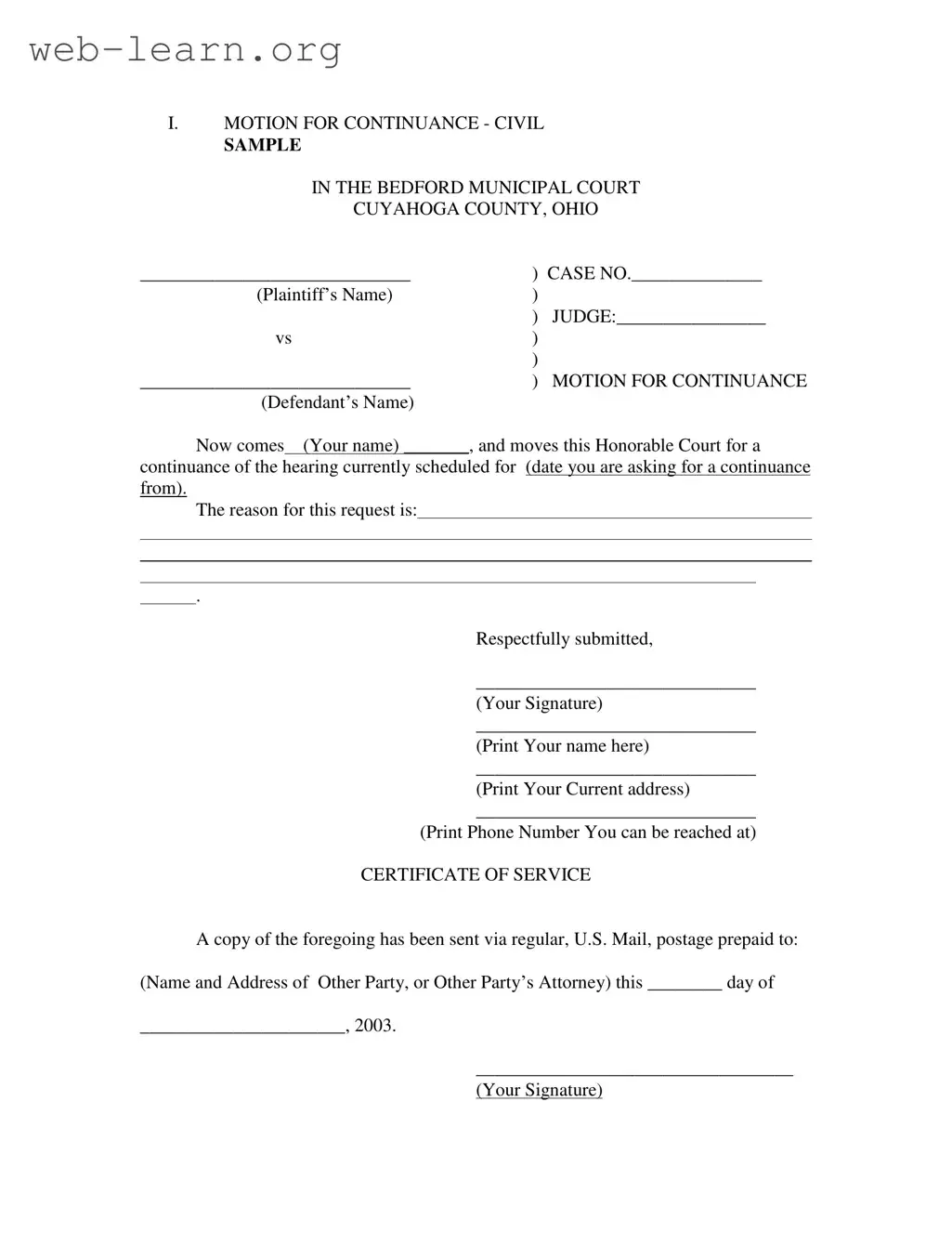
The Motion For Continuance form serves as a crucial tool in civil court proceedings, particularly within the Bedford Municipal Court in Cuyahoga County, Ohio. This form allows a party involved in a case to request a delay in a scheduled hearing. The process begins with the party submitting their name and the case number, followed by a clear statement of the request for continuance. It is essential to specify the date from which the continuance is sought and provide a valid reason for the request. The form requires the signature of the requesting party, along with their printed name, current address, and a reachable phone number. Additionally, the Certificate of Service section ensures that a copy of the motion is sent to the other party or their attorney, confirming that all involved parties are informed of the request. Completing this form accurately is vital to ensure that the court considers the motion appropriately.
I.MOTION FOR CONTINUANCE - CIVIL
SAMPLE
IN THE BEDFORD MUNICIPAL COURT
CUYAHOGA COUNTY, OHIO
_____________________________ |
) CASE NO.______________ |
|
(Plaintiffís Name) |
) |
|
|
) |
JUDGE:________________ |
vs |
) |
|
|
) |
|
_____________________________ |
) |
MOTION FOR CONTINUANCE |
(Defendantís Name)
Now comes (Your name) _______, and moves this Honorable Court for a
continuance of the hearing currently scheduled for (date you are asking for a continuance from).
The reason for this request is:
.
Respectfully submitted,
______________________________
(Your Signature)
______________________________
(Print Your name here)
______________________________
(Print Your Current address)
______________________________
(Print Phone Number You can be reached at)
CERTIFICATE OF SERVICE
A copy of the foregoing has been sent via regular, U.S. Mail, postage prepaid to:
(Name and Address of Other Party, or Other Partyís Attorney) this ________ day of
______________________, 2003.
__________________________________
(Your Signature)
| Fact Name | Description |
|---|---|
| Purpose | The Motion for Continuance is used to request a delay in a scheduled court hearing. |
| Governing Law | In Ohio, the relevant law governing continuances can be found in Ohio Rules of Civil Procedure, Rule 53. |
| Filing Requirements | The motion must be filed with the court and served to all parties involved in the case. |
| Signature Requirement | The individual requesting the continuance must sign the motion, indicating their agreement with the request. |
| Service of Motion | A certificate of service must accompany the motion, confirming that all parties have been notified. |
| Reason for Request | The motion must include a valid reason for the request, such as scheduling conflicts or the need for additional time to prepare. |
| Deadline for Filing | It is advisable to file the motion as soon as the need for a continuance is known, ideally well before the scheduled hearing date. |
| Judicial Discretion | The granting of a continuance is at the discretion of the judge, who will consider the reasons provided. |
Once you have gathered all necessary information, it's time to fill out the Motion For Continuance form. This form is essential for requesting a delay in your scheduled hearing. Completing it accurately will help ensure that your request is properly considered by the court.
What is a Motion for Continuance?
A Motion for Continuance is a formal request made to a court to postpone a scheduled hearing or trial. This motion is typically submitted when a party involved in the case cannot attend the hearing on the scheduled date due to valid reasons, such as illness, scheduling conflicts, or the need for more time to prepare.
How do I fill out the Motion for Continuance form?
To complete the Motion for Continuance form, start by providing your name and the case number at the top. Next, indicate the date of the hearing you wish to postpone. In the section where you state your reasons for requesting the continuance, be clear and concise. Finally, ensure you sign the document, print your name, and include your current address and phone number for contact purposes.
What reasons are acceptable for requesting a continuance?
Acceptable reasons for requesting a continuance can vary, but they generally include:
It's important to provide a clear explanation for your request, as the court will consider the validity of your reasons.
How far in advance should I file the Motion for Continuance?
It is best to file the Motion for Continuance as soon as you become aware that you will not be able to attend the scheduled hearing. Ideally, this should be done at least a few days before the hearing date. However, if an unexpected situation arises, you can file the motion even on short notice. The court will review the circumstances and decide whether to grant the request.
What happens after I file the Motion for Continuance?
Once you file the Motion for Continuance, the court will review your request. If the motion is granted, you will receive a new date for the hearing. If the motion is denied, you are still required to attend the hearing on the original date. It is advisable to keep track of any communication from the court regarding your motion.
Do I need to notify the other party about my Motion for Continuance?
Yes, you must notify the other party involved in the case. The Motion for Continuance form includes a section for a Certificate of Service, where you confirm that you have sent a copy of the motion to the other party or their attorney. This is an essential step to ensure that everyone involved is aware of the request for postponement.
Filling out the Motion For Continuance form can be a straightforward task, but there are several common mistakes that people often make. One prevalent error is failing to provide a clear and valid reason for the request. The court needs to understand why a continuance is necessary. A vague statement or a generic excuse may not suffice and could lead to the denial of the motion.
Another frequent mistake involves neglecting to include the correct date of the hearing from which the continuance is being requested. This date is crucial for the court to process the motion effectively. If the date is incorrect, it can create confusion and potentially delay the proceedings further.
Additionally, many individuals overlook the importance of proper signatures. The form requires not only the signature of the person filing the motion but also the printed name, address, and contact information. Omitting any of these details can lead to complications. The court must have accurate information to reach out if necessary.
Some people forget to send a copy of the motion to the other party involved in the case. This step is essential as it ensures that all parties are informed about the request for a continuance. Failing to serve the other party can result in the motion being dismissed due to lack of proper procedure.
Another common oversight is not adhering to the required timeline for submitting the motion. Courts often have specific deadlines for filing such requests. If the motion is submitted too late, it may not be considered, which could have significant consequences for the case.
Moreover, individuals sometimes fail to proofread their motion before submission. Typos or grammatical errors can undermine the professionalism of the request. A well-prepared motion reflects respect for the court and the legal process.
Lastly, many do not include the certificate of service section correctly. This part confirms that the other party has been notified. If this section is incomplete or inaccurate, it can lead to further complications. Ensuring that all parts of the form are filled out correctly is essential for a smooth process.
The Motion for Continuance form is a key document used in legal proceedings to request a delay in a scheduled hearing. In addition to this form, several other documents may be required or helpful in the process. Below is a list of commonly used forms and documents that often accompany the Motion for Continuance.
These forms and documents play an important role in the legal process surrounding a Motion for Continuance. Each serves a distinct purpose and contributes to the overall clarity and effectiveness of the motion being presented to the court.
The Motion for Continuance form shares similarities with several other legal documents. Each serves a specific purpose in legal proceedings, often related to scheduling and procedural requests. Below are four documents that are comparable to the Motion for Continuance:
When filling out the Motion For Continuance form, it's important to approach the task carefully. Here are some dos and don'ts to guide you:
Misconceptions about the Motion for Continuance form can lead to confusion for those involved in legal proceedings. Below is a list of common misconceptions, along with clarifications for each.
This is not true. The court has discretion in deciding whether to grant a continuance based on the circumstances presented.
While motions can be filed at various stages, submitting them too close to the hearing date may be viewed unfavorably by the court.
A valid reason must be included in the motion. Courts typically require justification for postponing a hearing.
Both plaintiffs and defendants have the right to file such motions if they believe a continuance is necessary.
These are distinct motions. A continuance postpones a hearing, while a motion to dismiss seeks to terminate the case entirely.
Notification is essential. The certificate of service included in the motion ensures that the other party is aware of the request.
Adhering to the proper format is crucial. Courts expect motions to follow specific guidelines to be considered.
A motion must be properly scheduled for a hearing. It does not receive automatic judicial review without this step.
When filling out and using the Motion For Continuance form, consider the following key points:
Following these steps can help ensure your motion is properly considered by the court.