The Motion Florida form serves as a vital tool for individuals seeking judicial action in family law cases within the Thirteenth Judicial Circuit in Tampa, Florida. This blank motion is specifically designed for use during an ongoing lawsuit or after a final judgment has been entered. Before utilizing this form, it is crucial to ensure that no more appropriate court-approved form exists for your situation, as the Florida Supreme Court has established specific forms for various requests, including motions for civil contempt and emergency child pick-up orders. Understanding the distinction between a petition and a motion is essential; a petition initiates a lawsuit or modifies an existing order, while a motion requests specific actions during a case that has already been filed. When completing the form, clearly outline your legal issue and the remedy you seek, as the court can only act on what you specifically request. Additionally, proper service of the motion on all parties involved is mandatory, ensuring transparency and fairness in the legal process. Filing can be done either in person or by mail, and scheduling a hearing is a necessary step following the submission of the motion. Always provide adequate notice to the other party, allowing them sufficient time to prepare. Overall, the Motion Florida form is a structured means to articulate legal requests and navigate the complexities of family law proceedings.
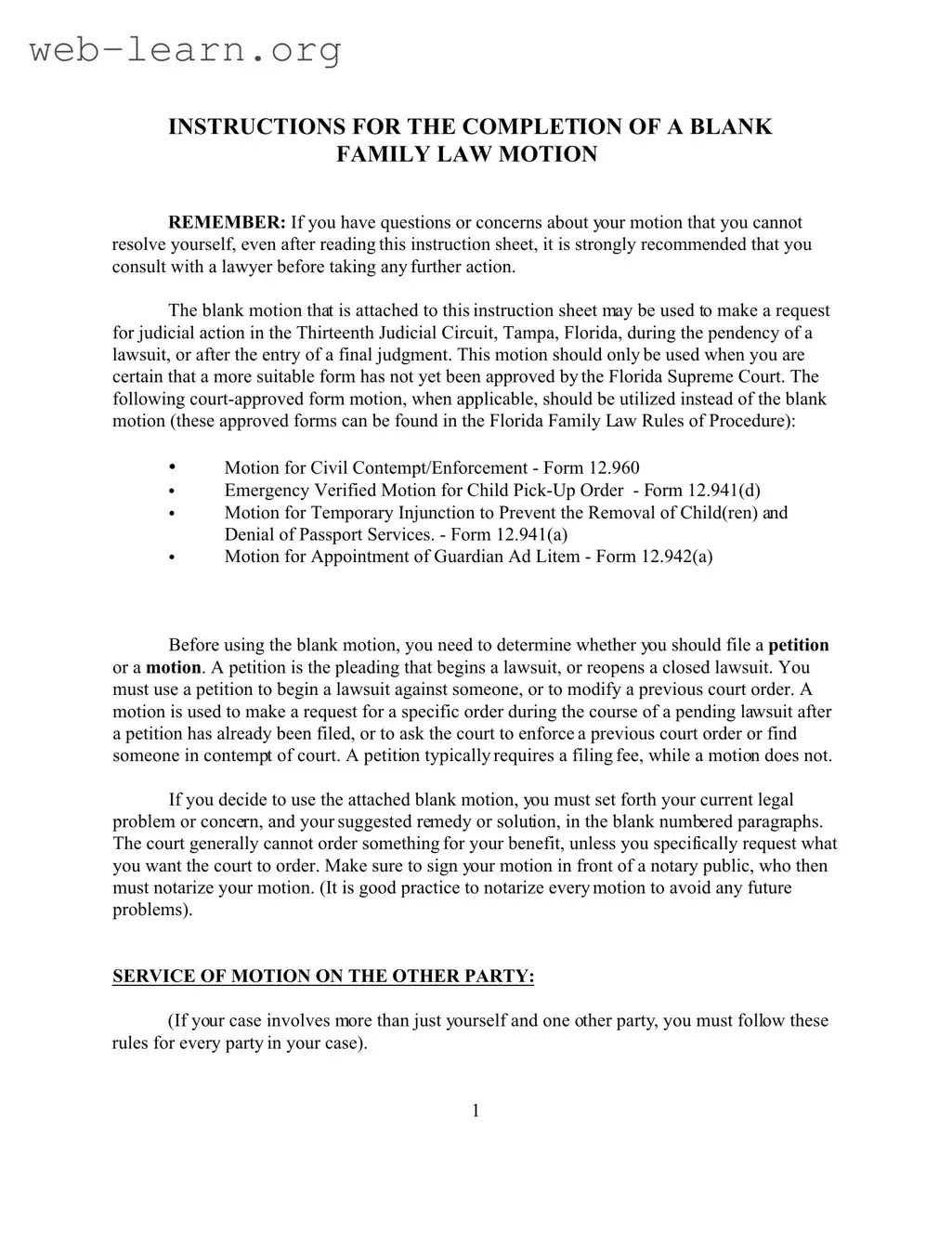
INSTRUCTIONS FOR THE COMPLETION OF A BLANK
FAMILY LAW MOTION
REMEMBER: If you have questions or concerns about your motion that you cannot resolve yourself, even after reading this instruction sheet, it is strongly recommended that you consult with a lawyer before taking any further action.
The blank motion that is attached to this instruction sheet may be used to make a request for judicial action in the Thirteenth Judicial Circuit, Tampa, Florida, during the pendency of a lawsuit, or after the entry of a final judgment. This motion should only be used when you are certain that a more suitable form has not yet been approved by the Florida Supreme Court. The following courtapproved form motion, when applicable, should be utilized instead of the blank motion (these approved forms can be found in the Florida Family Law Rules of Procedure):
•Motion for Civil Contempt/Enforcement Form 12.960
•Emergency Verified Motion for Child PickUp Order Form 12.941(d)
•Motion for Temporary Injunction to Prevent the Removal of Child(ren) and Denial of Passport Services. Form 12.941(a)
•Motion for Appointment of Guardian Ad Litem Form 12.942(a)
Before using the blank motion, you need to determine whether you should file a petition or a motion. A petition is the pleading that begins a lawsuit, or reopens a closed lawsuit. You must use a petition to begin a lawsuit against someone, or to modify a previous court order. A motion is used to make a request for a specific order during the course of a pending lawsuit after a petition has already been filed, or to ask the court to enforce a previous court order or find someone in contempt of court. A petition typically requires a filing fee, while a motion does not.
If you decide to use the attached blank motion, you must set forth your current legal problem or concern, and your suggested remedy or solution, in the blank numbered paragraphs. The court generally cannot order something for your benefit, unless you specifically request what you want the court to order. Make sure to sign your motion in front of a notary public, who then must notarize your motion. (It is good practice to notarize every motion to avoid any future problems).
SERVICE OF MOTION ON THE OTHER PARTY:
(If your case involves more than just yourself and one other party, you must follow these rules for every party in your case).
1
Except in very limited instances discussed below, you will need to simultaneously provide a copy of your motion to the other party when you file your motion with the court. Therefore, you need to either mail, telefax, or hand deliver a copy of the motion to the other party. Once you decide which method of service to use, you then must fill out the “Certificate of Service” section by indicating the method of service you plan to use to provide a copy of your motion to the other party.
In most cases, it is essential that you provide the other party with a copy of your motion. When a party files a motion with the court without notifying the other party about the motion, the motion is considered an ex parte motion. Your judge can only rule on an ex parte motion without a hearing when there is a wellfounded reason to not have a hearing (for instance, when one party believes the other party will destroy or hide property if given notice of an impending court hearing).
FILING:
If you choose to file your motion in person, you may file it at the following location: 800 East Twiggs Street, room 101. If you choose to file by mail, you should send your documents to: Clerk of the Court, P.O. Box 3450, Tampa, Florida 33601. The phone number for the Clerk of Court is 2768100 x 4358.
NOTICE OF HEARING:
When a party files a motion with the court, the party must also schedule that motion for a hearing on that motion with the judge or general master. After you obtain a hearing date, you must attempt to contact the other party for the purpose of mutually agreeing on the most convenient time for the hearing. If your attempts at coordinating a suitable time and date for the hearing are unsuccessful, or if the other party is uncooperative, you have satisfied your obligation, and you may schedule the hearing for the time and date you deem appropriate. However, unless your motion is an emergency motion, you must provide the other party with a copy of your motion at least five (5) business days before the date of the hearing, unless the other party agrees to an earlier hearing date. Failure to provide the other party at least five (5) business days to prepare may result in the court denying or striking your motion.
Once you obtain the time and date of your hearing, you must complete a “Notice of Hearing” form (12.923). After you complete the “Notice of Hearing,” you must file it with the court, and also serve a copy on the other party.
2

IN THE CIRCUIT COURT OF THE THIRTEENTH JUDICIAL CIRCUIT, IN AND FOR HILLSBOROUGH COUNTY, STATE OF FLORIDA
IN RE: |
(1) |
|
|
|
|
List the petitioner’s name in |
|
|
|
the original case |
|
|
||
____________________________________, |
(3) |
|
||
|
|
Petitioner, |
Case No. _________ |
|
|
|
|
(4) |
|
AND |
(2) |
|
Division ________ |
|
|
List the Respondent s Name |
|
|
|
_____________________________________. |
|
|
||
|
|
Respondent. |
|
|
________________________________________/ |
|
|
||
|
|
(5) State what you want to file a motion for |
||
|
MOTION TO/FOR: |
|
|
|
|
|
(6) Your Name |
|
|
COMES NOW, |
, and moves that the court grant the |
|||
|
|
(7) State same as number (5) |
||
relief sought herein in the Motion to/for |
, and as |
|||
grounds therefore would show: |
|
|
||
(8) On the lines below list exactly what you want to ask from the court
1.___________________________________________________________________________________
____________________________________________________________________________________
____________________________________________________________________________________
____________________________________________________________________________________
2.___________________________________________________________________________________
____________________________________________________________________________________
____________________________________________________________________________________
____________________________________________________________________________________
3.___________________________________________________________________________________
____________________________________________________________________________________
____________________________________________________________________________________
WHEREFORE, the undersigned prays that this court will grant the relief sought herein.
1

I HEREBY C ERTIFY that a cop y of the fo regoing has been furnished by [ �check one only] ( ) mail ( ) faxed and mailed ( )hand delivered to the person(s) listed below on
(9)Date you file your motion
{DATE} ________________________________
Other party or his/her attorney:
(10)List the name and address of the other party in your case Name:_________________________________________________________
Address________________________________________________________
City, State, Zip
(11)Your signature in front of a notary
__________________________________________
Signature of party
__________________________________________
Address
__________________________________________
City, State, Zip
__________________________________________
Telephone
STATE OF FLORIDA |
|
|
COUNTY OF |
) |
|
Sworn to (or affirmed) and subscribed befo re me on (dat e) |
20____ by |
|
(name) |
. |
|
____________________________________
NOTARY
____ Personally known
____ Produced Identification
Type of Identification ________________________________
2

IN THE CIRCUIT COURT OF THE THIRTEENTH JUDICIAL CIRCUIT, IN AND FOR HILLSBOROUGH COUNTY, STATE OF FLORIDA
IN RE: |
|
____________________________________, |
|
Petitioner, |
Case No. _________ |
AND |
Division _________ |
_____________________________________. |
|
Respondent. |
|
________________________________________/ |
|
MOTION TO/FOR:
COMES NOW, _______________________________, and moves that the court grant the
relief sought herein in the Motion to/for ________________________________, and as grounds
therefore would show:
1.___________________________________________________________________________________
____________________________________________________________________________________
____________________________________________________________________________________
____________________________________________________________________________________
2.___________________________________________________________________________________
____________________________________________________________________________________
____________________________________________________________________________________
____________________________________________________________________________________
3.___________________________________________________________________________________
____________________________________________________________________________________
____________________________________________________________________________________
____________________________________________________________________________________
WHEREFORE, the undersigned prays that this court will grant the relief sought herein.
1
I HEREBY CERTIFY that a copy of the foregoing has been furnished by [ �check one only]
() mail ( ) faxed and mailed ( )hand delivered to the person(s) listed below on {DATE} ________________________________
Other party or his/her attorney:
Name:_________________________________________________________
Address________________________________________________________
City, State, Zip__________________________________________________
__________________________________________
Signature of party
__________________________________________
Address
__________________________________________
City, State, Zip
__________________________________________
Telephone
STATE OF FLORIDA
COUNTY OF ______________________________)
Sworn to (or affirmed) and subscribed befo re me on (dat e)__ ____________ 20 ____ by
{NAME}________________________________________.
____________________________________
NOTARY
____ Personally known
____ Produced identification
Type of identification produced
__________________________________
2
| Fact Name | Details |
|---|---|
| Purpose | The Motion Florida form is used to request judicial action during a lawsuit or after a final judgment in the Thirteenth Judicial Circuit, Tampa, Florida. |
| Usage Conditions | This form should only be utilized if no more suitable court-approved form exists, as specified by the Florida Supreme Court. |
| Filing Requirements | When filing, you must provide a copy of the motion to the other party, unless it qualifies as an ex parte motion. |
| Notarization | It is advisable to have the motion notarized to prevent future issues, ensuring all signatures are valid. |
| Governing Laws | This form is governed by the Florida Family Law Rules of Procedure, specifically applicable in Hillsborough County. |
Filling out the Motion Florida form is a crucial step in seeking judicial action. It is important to ensure that all sections are completed accurately to avoid delays in the court process. Below are the steps to guide you through the completion of the form.
After completing the form, you will need to file it with the court and serve a copy to the other party. Be sure to schedule a hearing date and provide the other party with notice of the hearing, as outlined in the instructions. Following these steps will help ensure that your motion is properly submitted and considered by the court.
What is the Motion Florida form used for?
The Motion Florida form is designed to request judicial action in family law cases within the Thirteenth Judicial Circuit in Tampa, Florida. It can be used during an ongoing lawsuit or after a final judgment has been issued. This form is appropriate when there isn't a more suitable court-approved form available for your specific situation.
When should I use a motion instead of a petition?
A petition is used to initiate a lawsuit or modify a previous court order. In contrast, a motion is used to request a specific order during an ongoing lawsuit or to enforce an existing court order. If you are looking to modify or start a case, you will need a petition. For requests during a case, use a motion.
What should I include in my motion?
In your motion, clearly outline your current legal issue and the remedy you seek. Use the blank numbered paragraphs to specify your requests. It is essential to be explicit about what you want the court to order, as the court cannot act unless you make a clear request.
Do I need to notify the other party when I file a motion?
Yes, you must provide a copy of your motion to the other party simultaneously when you file it with the court. This can be done via mail, fax, or hand delivery. Not notifying the other party may result in your motion being considered ex parte, which limits the court's ability to rule on it without a hearing.
How do I file my motion?
You can file your motion in person at the Clerk of Court's office located at 800 East Twiggs Street, room 101. If you prefer to file by mail, send your documents to the Clerk of the Court, P.O. Box 3450, Tampa, Florida 33601. Make sure to include all necessary information and documentation.
What is the process for scheduling a hearing?
After filing your motion, you must schedule a hearing with the judge or general master. Contact the other party to agree on a convenient date and time. If you cannot coordinate with them, you may set the hearing for a time you find suitable. However, you must give at least five business days' notice to the other party before the hearing, unless it's an emergency motion.
What happens if I don’t provide sufficient notice for the hearing?
If you fail to provide at least five business days' notice to the other party, the court may deny or strike your motion. It is crucial to adhere to this requirement to ensure that the other party has adequate time to prepare.
Is notarization required for the motion?
Yes, it is important to sign your motion in front of a notary public. Notarizing your motion helps to avoid potential issues in the future. This practice is highly recommended for all motions filed.
Filling out the Motion Florida form can be a straightforward process, but there are common mistakes that can lead to delays or complications. One frequent error is not clearly stating the purpose of the motion. It's essential to articulate exactly what you are asking the court to do. If the motion lacks clarity, the judge may not fully understand your request, which can result in a denial.
Another common mistake is failing to provide proper service to the other party. When filing a motion, you must simultaneously provide a copy to the other party involved in the case. Neglecting this step can lead to your motion being classified as ex parte, which may limit the court's ability to rule in your favor. Always ensure that you fill out the "Certificate of Service" section accurately to confirm that the other party has received the motion.
Many people also forget to notarize their motion. Notarization is a crucial step that adds legitimacy to your document. Without a notary's signature, the court may not accept your motion. It’s advisable to have every motion notarized to avoid any potential issues down the line.
Additionally, some individuals do not schedule a hearing after filing their motion. A motion is not complete until a hearing date is set. It’s important to reach out to the other party to agree on a suitable time for the hearing. If you cannot coordinate a time, you may proceed with scheduling the hearing on your own, but be sure to notify the other party at least five business days in advance.
Lastly, many people overlook the requirement to specify their legal problem and the desired remedy in the numbered paragraphs of the motion. If these sections are vague or incomplete, the court cannot provide the relief you seek. It’s crucial to be specific and detailed in your requests to ensure the court understands your needs.
When navigating family law matters in Florida, various forms and documents may accompany the Motion Florida form. Understanding these related documents can help streamline the process and ensure that all necessary steps are taken.
Familiarizing oneself with these documents can greatly enhance the effectiveness of legal proceedings in family law. Each form serves a specific purpose and can help ensure that the rights and interests of all parties involved are adequately represented and protected.
The Motion Florida form is similar to several other legal documents used in family law. Each of these documents serves a specific purpose, but they share common characteristics with the Motion Florida form. Here’s a list of those documents and how they relate:
When filling out the Motion Florida form, it is essential to follow specific guidelines to ensure your submission is correct and effective. Below is a list of things you should and shouldn't do during this process.
Following these guidelines will help you navigate the process more smoothly and increase the likelihood of a favorable outcome in your case.
Here are ten common misconceptions about the Motion Florida form, along with clarifications to help you understand its proper use:
This form is specifically designed for family law matters within the Thirteenth Judicial Circuit. It should not be used for unrelated legal issues.
In most cases, you must provide a copy of your motion to the other party. Failing to do so may result in your motion being considered ex parte, which limits the court's ability to rule on it.
Before using this blank motion, check if there’s a more suitable court-approved form for your situation. Using the correct form can streamline the process.
The court needs clear requests. If you don’t specify what you want, the judge may not grant your request.
While it may seem like a minor detail, notarizing your motion is good practice and can help avoid issues later.
After filing a motion, you must schedule a hearing. This is a crucial step in the process.
Typically, you must serve the motion at least five business days before the hearing, unless it’s an emergency motion.
A petition initiates a lawsuit, while a motion requests specific orders within an ongoing case. Understanding this difference is vital.
It’s important to attempt to agree on a hearing date with the other party. If unsuccessful, you can set the date yourself.
You are responsible for serving the other party with a copy of the motion and the notice of hearing. The Clerk does not handle this for you.
When filling out and using the Motion Florida form, keep these key takeaways in mind: