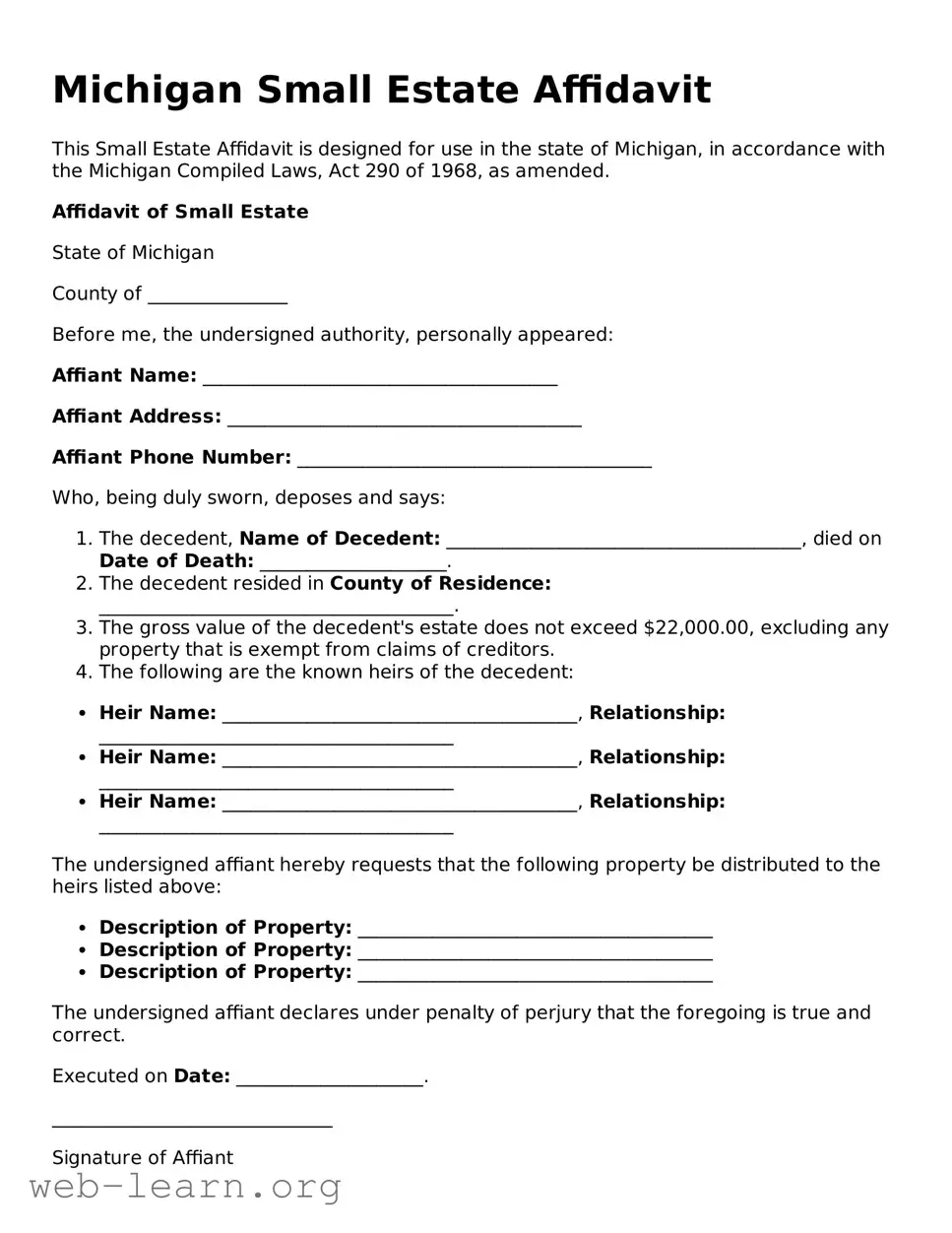
Navigating the complexities of estate matters can often be daunting, especially when dealing with the loss of a loved one. In Michigan, the Small Estate Affidavit serves as a valuable tool for simplifying the process of transferring assets when the total value of an estate falls below a certain threshold. This form allows heirs to bypass the lengthy probate process, streamlining the distribution of personal property, bank accounts, and other assets. By completing the Small Estate Affidavit, individuals can assert their rights to inherit property without the need for formal probate proceedings, provided they meet specific criteria set forth by state law. The form requires essential information, including the names of the deceased, the heirs, and a detailed account of the estate’s assets. Moreover, it necessitates the signatures of those claiming the inheritance, ensuring a level of accountability and transparency in the process. Understanding the nuances of this affidavit can empower individuals to efficiently manage their loved one's estate while minimizing stress during an already challenging time.
Michigan Small Estate Affidavit
This Small Estate Affidavit is designed for use in the state of Michigan, in accordance with the Michigan Compiled Laws, Act 290 of 1968, as amended.
Affidavit of Small Estate
State of Michigan
County of _______________
Before me, the undersigned authority, personally appeared:
Affiant Name: ______________________________________
Affiant Address: ______________________________________
Affiant Phone Number: ______________________________________
Who, being duly sworn, deposes and says:
The undersigned affiant hereby requests that the following property be distributed to the heirs listed above:
The undersigned affiant declares under penalty of perjury that the foregoing is true and correct.
Executed on Date: ____________________.
______________________________
Signature of Affiant
______________________________
Printed Name of Affiant
Notary Public:
______________________________
Signature of Notary Public
______________________________
Printed Name of Notary Public
My commission expires: ________________
| Fact Name | Description |
|---|---|
| Purpose | The Michigan Small Estate Affidavit allows individuals to claim assets of a deceased person without going through formal probate, simplifying the process for small estates. |
| Eligibility | This affidavit can be used when the total value of the deceased's assets does not exceed $24,000, excluding certain types of property. |
| Governing Law | The form is governed by Michigan Compiled Laws, specifically MCL 700.3981 to MCL 700.3988, which outline the requirements and procedures for small estate claims. |
| Required Information | To complete the affidavit, you must provide details such as the deceased's name, date of death, and a list of assets being claimed. |
| Signature Requirement | The affidavit must be signed by the claimant, who is typically an heir or a personal representative, and may need to be notarized to be valid. |
After gathering the necessary information and documents, you can begin filling out the Michigan Small Estate Affidavit form. This process is straightforward but requires attention to detail to ensure accuracy. Follow the steps below to complete the form correctly.
Once you have submitted the form, the court will review it. If everything is in order, you will receive confirmation that the estate can be distributed according to the information provided. Keep a copy of the form for your records.
What is a Small Estate Affidavit in Michigan?
The Small Estate Affidavit is a legal document that allows individuals to claim assets of a deceased person without going through the formal probate process. In Michigan, this option is available when the total value of the estate is below a certain threshold, making it a more accessible and efficient way to settle smaller estates.
Who is eligible to use the Small Estate Affidavit?
Typically, the person eligible to use the Small Estate Affidavit is an heir or a beneficiary of the deceased. To qualify, the total value of the estate must be less than $66,000, excluding certain assets like real estate. This process is designed for individuals who are directly related to the deceased and have a legitimate claim to the estate.
What assets can be claimed using the Small Estate Affidavit?
Assets that can be claimed include bank accounts, personal property, and other financial accounts. However, real estate cannot be transferred using this affidavit. The affidavit serves as a means to collect and distribute these smaller assets without the need for a full probate proceeding.
How does one complete the Small Estate Affidavit?
To complete the Small Estate Affidavit, the eligible individual must fill out the form with accurate information about the deceased, the assets, and the heirs. It is important to provide all necessary details to avoid delays. Once completed, the affidavit must be signed in front of a notary public.
What is the process after submitting the Small Estate Affidavit?
After submitting the Small Estate Affidavit, the individual can present it to financial institutions or other entities holding the deceased's assets. The affidavit serves as proof of the individual's right to claim those assets. It is advisable to keep copies of the affidavit and any supporting documents for personal records.
Are there any fees associated with filing a Small Estate Affidavit?
While there are no court fees for filing a Small Estate Affidavit in Michigan, there may be fees charged by financial institutions when transferring assets. Additionally, if legal assistance is sought, attorney fees may apply. It is wise to inquire about any potential costs ahead of time.
Can the Small Estate Affidavit be contested?
Yes, the Small Estate Affidavit can be contested by other heirs or beneficiaries who believe they have a claim to the estate. If a dispute arises, it may require further legal action to resolve the matter. It is crucial to ensure that all heirs are aware of the process to minimize the likelihood of disputes.
What should I do if the estate exceeds the Small Estate threshold?
If the estate exceeds the Small Estate threshold, the formal probate process will be necessary. This involves filing a petition with the probate court and may require the appointment of a personal representative. Seeking legal advice can help navigate the complexities of probate and ensure compliance with state laws.
Filling out the Michigan Small Estate Affidavit form can be straightforward, but many individuals make common mistakes that can lead to delays or complications. One frequent error is failing to accurately list all assets. The form requires a comprehensive inventory of the deceased's assets, including bank accounts, real estate, and personal property. Omitting even a small asset can create issues later, as it may be deemed invalid if not properly accounted for.
Another common mistake involves incorrect signatures. The form must be signed by the appropriate parties, including the affiant and any other individuals who are required to sign. If signatures are missing or not properly executed, the affidavit may be rejected. Ensuring that all required signatures are present and correctly dated is crucial for the document's validity.
People often overlook the importance of notarization. The Michigan Small Estate Affidavit must be notarized to be considered legally binding. Failing to have the document notarized can render it ineffective. It is essential to ensure that a notary public is present at the time of signing to avoid this pitfall.
Inaccurate information can also pose significant problems. Individuals may mistakenly provide incorrect dates of death or misstate the relationship to the deceased. Such inaccuracies can lead to confusion and may require additional documentation to rectify. Double-checking all personal details before submission can help mitigate this risk.
Another mistake involves not following the specific instructions for filing. Each county may have different requirements for submission, including where to file the affidavit and any additional forms that may be needed. Ignoring these instructions can result in delays or the need for resubmission.
Lastly, people sometimes fail to keep copies of the completed affidavit. Having a personal copy is essential for record-keeping and can be helpful if any questions arise in the future. Without a copy, tracking the status of the estate can become challenging. It is wise to retain a copy for personal records and future reference.
The Michigan Small Estate Affidavit is a useful tool for individuals managing the estate of a deceased person when the estate's value is below a certain threshold. However, several other forms and documents may accompany this affidavit to ensure a smooth process. Below is a list of these essential documents, each serving a specific purpose in the estate administration process.
These documents play a crucial role in the administration of a small estate in Michigan. Collectively, they help streamline the process and ensure that all legal requirements are met, allowing heirs to receive their rightful inheritance efficiently.
The Small Estate Affidavit form shares similarities with several other legal documents. Each serves a specific purpose in the management of estates and assets. Here’s a list of seven documents that are comparable to the Small Estate Affidavit:
When filling out the Michigan Small Estate Affidavit form, it's important to follow certain guidelines to ensure everything goes smoothly. Here are some do's and don'ts to keep in mind:
Following these tips can help you navigate the process more easily and avoid potential pitfalls.
The Michigan Small Estate Affidavit is a useful tool for settling estates that do not exceed a certain value. However, several misconceptions can lead to confusion. Here are eight common misunderstandings about the Small Estate Affidavit form:
Only heirs can use the Small Estate Affidavit. Many believe that only heirs are eligible to file this affidavit. In reality, anyone with a legitimate interest in the estate can use it, including creditors and other beneficiaries.
The Small Estate Affidavit can be used for any estate. Some think this affidavit is applicable for all estates. However, it is specifically designed for estates valued at $24,000 or less, excluding certain assets.
Filing the affidavit avoids all taxes. There is a misconception that using the Small Estate Affidavit eliminates tax obligations. While it simplifies the process, it does not exempt the estate from taxes that may still be due.
All debts must be paid before filing. Many believe they must settle all debts before submitting the affidavit. In fact, the affidavit allows for the payment of debts after its approval, using the estate’s assets.
Using the Small Estate Affidavit is a quick process. Some assume that the process is always quick and easy. While it can be simpler than probate, delays can occur depending on the specific circumstances of the estate.
Once filed, the affidavit cannot be challenged. There is a belief that filing the affidavit makes it immune to challenges. However, interested parties can still contest the validity of the affidavit if they have valid reasons.
The form is the same for all counties in Michigan. Some think that the Small Estate Affidavit form is uniform across the state. In fact, different counties may have variations in their forms or requirements.
Legal assistance is unnecessary. Many believe they can handle the Small Estate Affidavit on their own without help. While it is possible, consulting a legal professional can provide valuable guidance and ensure all requirements are met.
Understanding these misconceptions can help individuals navigate the process more effectively and avoid potential pitfalls when dealing with small estates in Michigan.
When dealing with the Michigan Small Estate Affidavit form, it is important to understand the key aspects of the process. Here are ten essential takeaways:
Understanding these points can help streamline the process of handling a small estate in Michigan.