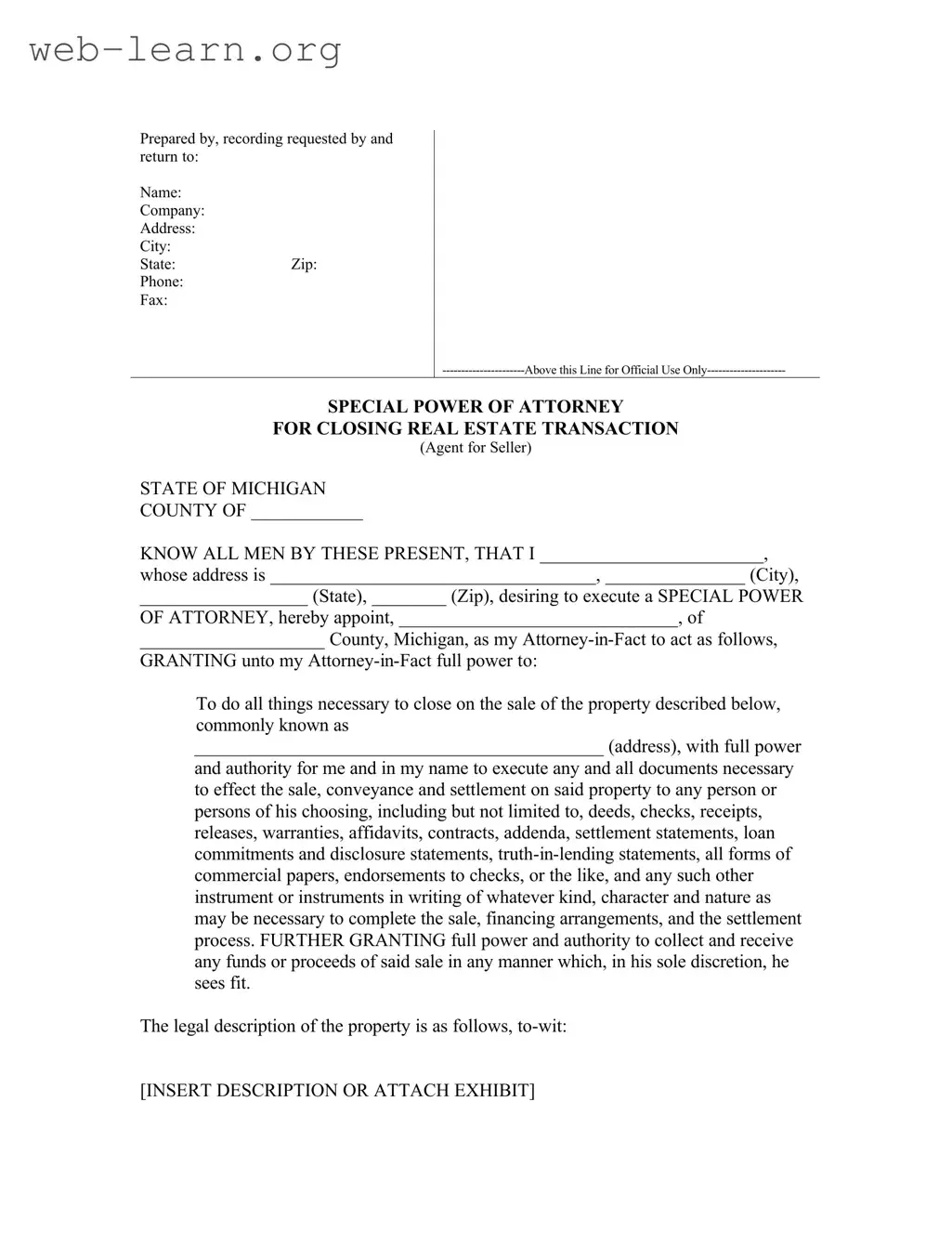
The Michigan Sales form is an essential document used in real estate transactions within the state. It facilitates the appointment of an agent who can act on behalf of the seller, ensuring that the sale process runs smoothly. This form includes sections for personal details such as names, addresses, and contact information for both the seller and the appointed attorney-in-fact. The primary purpose of the form is to grant the attorney-in-fact the authority to execute necessary documents related to the sale of the property, which can include deeds, contracts, and settlement statements. Additionally, the form allows the agent to collect any proceeds from the sale, providing them with comprehensive power to manage the transaction effectively. It also outlines the legal description of the property being sold, ensuring clarity and specificity. Notably, the form requires signatures from the seller and witnesses, as well as notarization, to validate the authority granted. This process helps protect all parties involved by ensuring that the agent's actions are legally recognized and binding until any revocation is officially recorded.

Prepared by, recording requested by and return to:
Name:
Company:
Address:
City:
State:Zip:
Phone:
Fax:
SPECIAL POWER OF ATTORNEY
FOR CLOSING REAL ESTATE TRANSACTION
(Agent for Seller)
STATE OF MICHIGAN
COUNTY OF ____________
KNOW ALL MEN BY THESE PRESENT, THAT I ________________________,
whose address is ___________________________________, _______________ (City),
__________________ (State), ________ (Zip), desiring to execute a SPECIAL POWER
OF ATTORNEY, hereby appoint, ______________________________, of
____________________ County, Michigan, as my
GRANTING unto my
To do all things necessary to close on the sale of the property described below, commonly known as
____________________________________________ (address), with full power
and authority for me and in my name to execute any and all documents necessary to effect the sale, conveyance and settlement on said property to any person or persons of his choosing, including but not limited to, deeds, checks, receipts, releases, warranties, affidavits, contracts, addenda, settlement statements, loan commitments and disclosure statements,
The legal description of the property is as follows,
[INSERT DESCRIPTION OR ATTACH EXHIBIT]
I hereby ratify and confirm all that said
All acts done by means of this power shall be done in my name, and all instruments and documents executed by my Attorney hereunder shall contain my name, followed by that of my attorney and the description
DATED this the ________ day of ___________________, 20____.
________________________________
Signature
Print Name: ______________________
_______________________________
Witness
Print Name: _____________________
_______________________________
Witness
Print Name: _____________________
STATE OF MICHIGAN
COUNTY OF _________________
The foregoing instrument was acknowledged before me this
_____________________ (date) by
___________________________________________ (name of person acknowledged).
_____________________________
Notary Public
Printed Name: _________________
My Commission Expires:
____________________
Principal Name and Address |
|||
Name: |
|
Name: |
|
|
|
|
|
Address: |
|
Address: |
|
|
|
|
|
City: |
|
City: |
|
|
|
|
|
State: |
Zip: |
State: |
Zip: |
|
|
|
|
Phone: |
|
Phone: |
|
|
|
|
|
|
|
|
|
Witness Name and Address |
Witness Name and Address |
|
|
Name: |
|
Name: |
|
|
|
|
|
Address: |
|
Address: |
|
|
|
|
|
City: |
|
City: |
|
|
|
|
|
State: |
Zip: |
State: |
Zip: |
|
|
|
|
Phone: |
|
Phone: |
|
|
|
|
|
| Fact Name | Details |
|---|---|
| Purpose | The Michigan Sales form serves as a Special Power of Attorney for closing real estate transactions, allowing an appointed agent to act on behalf of the seller. |
| Governing Law | This form is governed by the Michigan Compiled Laws, specifically under the Michigan Power of Attorney Act (MCL 700.5501 et seq.). |
| Required Information | Essential details include the names, addresses, and contact information of the principal and attorney-in-fact, as well as the property description. |
| Execution Validity | The power of attorney remains valid until a revocation is recorded in the county recorder's office where the property is located. |
| Notarization | The form requires notarization to ensure the authenticity of the signatures and the acknowledgment of the principal's identity. |
Filling out the Michigan Sales form requires careful attention to detail. Each section must be completed accurately to ensure the document serves its intended purpose. Follow these steps to complete the form correctly.
Once you have filled out the form completely, review it for accuracy before submitting it. Ensure all required signatures are present and that any attached exhibits are included. Proper completion of the form is essential for a smooth transaction process.
The Michigan Sales form is a legal document used to appoint an Attorney-in-Fact for closing real estate transactions in Michigan. This form grants the appointed individual the authority to handle various aspects of the sale, including signing documents and receiving funds on behalf of the seller.
This form is typically used by individuals selling real estate in Michigan who may not be able to attend the closing in person. It allows them to designate someone else to act on their behalf, ensuring that the sale can proceed smoothly.
To complete the Michigan Sales form, you will need to provide:
The form remains valid until a revocation is recorded in the recorder's office of the county where the property is located. This means that the powers granted to the Attorney-in-Fact can be relied upon by third parties until the seller takes formal steps to revoke them.
Yes, you can revoke the power of attorney at any time. However, to ensure that third parties are aware of the revocation, it must be formally recorded in the appropriate county office. Until that happens, the Attorney-in-Fact retains the authority granted by the form.
If you have questions about completing the Michigan Sales form, consider consulting a legal professional. They can provide guidance specific to your situation and ensure that the form is filled out correctly.
Filling out the Michigan Sales form can be straightforward, but mistakes can lead to complications. One common error is failing to provide complete information in the "Prepared by, recording requested by and return to" section. All fields, including name, company, address, city, state, and zip code, should be filled out accurately. Incomplete information may delay processing or cause the form to be rejected.
Another mistake is neglecting to include the legal description of the property. This section is crucial, as it identifies the property involved in the transaction. Omitting this information can lead to confusion or disputes about which property the power of attorney pertains to.
Many individuals also forget to sign the form. The signature of the principal is essential for the document to be valid. Without it, the power of attorney cannot be enforced. Additionally, some may overlook the requirement for witnesses. Two witnesses must sign the form, and their information should be clearly printed to ensure compliance with legal standards.
Another frequent error is not having the document notarized. The acknowledgment by a notary public is necessary to validate the power of attorney. Failing to include this step can result in the document being deemed invalid by third parties.
People sometimes misinterpret the authority granted to the Attorney-in-Fact. It is important to understand that the powers given are broad and should be clearly stated. If the language is vague or unclear, it may lead to issues in executing the powers intended.
Additionally, individuals may forget to include their contact information. Providing a phone number and email address can facilitate communication should any questions arise during the transaction process. This oversight can lead to delays if the involved parties cannot reach one another.
Some may also neglect to check for local practices that differ from the procedures outlined in the form. If local customs vary, it is important to follow those to ensure compliance. Ignoring this can create unnecessary complications.
Lastly, failing to keep a copy of the completed form for personal records can be a mistake. Having a copy ensures that all parties involved have access to the information and can refer back to it if needed. This practice can prevent misunderstandings or disputes later on.
When engaging in real estate transactions in Michigan, several forms and documents may accompany the Michigan Sales form. Each of these documents serves a specific purpose in facilitating the sale and ensuring that all parties involved are protected and informed. Below is a list of commonly used documents in conjunction with the Michigan Sales form.
Understanding these documents can help streamline the real estate transaction process. Each form plays a crucial role in protecting the interests of both buyers and sellers, ensuring that all legal requirements are met throughout the sale.
When filling out the Michigan Sales form, attention to detail is crucial. Here are some important do's and don'ts to consider:
Misconceptions about the Michigan Sales form can lead to confusion during real estate transactions. Here are six common misconceptions:
When filling out and using the Michigan Sales form, consider these key takeaways: