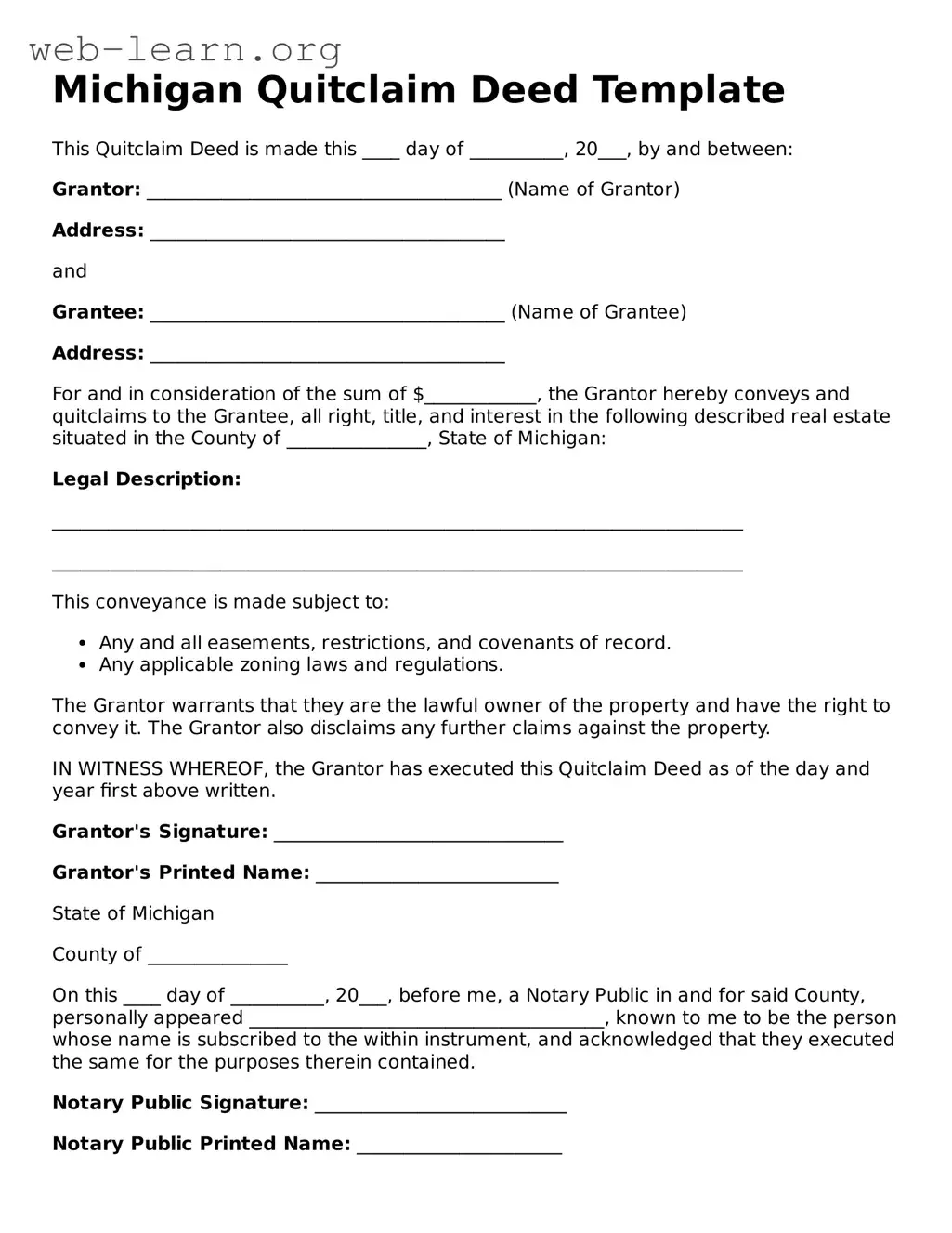
The Michigan Quitclaim Deed form serves as a vital instrument in the transfer of property ownership, allowing individuals to convey their interest in real estate without providing any warranties regarding the title. This form is particularly useful in situations where the granter may not have a clear title to the property or when the parties involved have a pre-existing relationship, such as family members or business partners. The form typically includes essential information such as the names of the granter and grantee, a legal description of the property, and the date of execution. Additionally, it requires the signature of the granter, and in some cases, a notary public may need to witness this signature to ensure the document's validity. Understanding the nuances of the Quitclaim Deed is crucial for anyone looking to navigate property transfers in Michigan, as it can simplify transactions while also carrying specific implications for the parties involved.
Michigan Quitclaim Deed Template
This Quitclaim Deed is made this ____ day of __________, 20___, by and between:
Grantor: ______________________________________ (Name of Grantor)
Address: ______________________________________
and
Grantee: ______________________________________ (Name of Grantee)
Address: ______________________________________
For and in consideration of the sum of $____________, the Grantor hereby conveys and quitclaims to the Grantee, all right, title, and interest in the following described real estate situated in the County of _______________, State of Michigan:
Legal Description:
__________________________________________________________________________
__________________________________________________________________________
This conveyance is made subject to:
The Grantor warrants that they are the lawful owner of the property and have the right to convey it. The Grantor also disclaims any further claims against the property.
IN WITNESS WHEREOF, the Grantor has executed this Quitclaim Deed as of the day and year first above written.
Grantor's Signature: _______________________________
Grantor's Printed Name: __________________________
State of Michigan
County of _______________
On this ____ day of __________, 20___, before me, a Notary Public in and for said County, personally appeared ______________________________________, known to me to be the person whose name is subscribed to the within instrument, and acknowledged that they executed the same for the purposes therein contained.
Notary Public Signature: ___________________________
Notary Public Printed Name: ______________________
My Commission Expires: ___________________________
| Fact Name | Description |
|---|---|
| Definition | A quitclaim deed is a legal document used to transfer ownership of real property from one party to another without any warranties. |
| Governing Law | The Michigan Quitclaim Deed is governed by the Michigan Compiled Laws, specifically MCL 565.25. |
| Usage | This form is commonly used in situations such as transferring property between family members or clearing up title issues. |
| No Warranty | The grantor makes no guarantees about the title or any claims against the property. |
| Consideration | While a quitclaim deed can be executed for little or no consideration, it is often accompanied by a nominal payment. |
| Signature Requirement | The grantor must sign the deed in the presence of a notary public for it to be valid. |
| Recording | To provide public notice of the transfer, the deed should be recorded with the local county register of deeds. |
| Tax Implications | Transferring property via a quitclaim deed may have tax implications, including potential transfer taxes. |
| Revocation | A quitclaim deed cannot be revoked once executed and delivered, unless the parties agree otherwise. |
| Limitations | It does not provide any protection against future claims or disputes regarding the property title. |
After completing the Michigan Quitclaim Deed form, the next step involves filing it with the appropriate county register of deeds. This process ensures that the transfer of property is officially recorded, making it a matter of public record. Following these steps will help you fill out the form accurately.
A Quitclaim Deed is a legal document used to transfer ownership of real estate in Michigan. It allows the current owner, known as the grantor, to convey their interest in a property to another person, known as the grantee. Unlike other types of deeds, a Quitclaim Deed does not guarantee that the grantor has clear title to the property. It simply transfers whatever interest the grantor has, if any.
Use a Quitclaim Deed when you want to transfer property between family members, in divorce settlements, or when clearing up title issues. It is often used in situations where the parties know each other and trust that the transfer is valid. However, it is not advisable for transactions involving strangers or when the property’s title is unclear.
To complete a Quitclaim Deed, follow these steps:
After completing the deed, file it with the local county register of deeds to ensure the transfer is officially recorded.
Yes, there are fees for filing a Quitclaim Deed in Michigan. These fees vary by county. You may also need to pay for notarization and any additional documents required for the transfer. Check with your local county register of deeds for the exact amounts.
While it is not legally required to have an attorney, it is highly recommended. An attorney can help ensure that the deed is correctly drafted and that all necessary legal considerations are addressed. This is especially important if there are complexities related to the property or the parties involved.
Once you file the Quitclaim Deed with the county register of deeds, the transfer is officially recorded. The grantee will then have legal ownership of the property as specified in the deed. It is advisable for the grantee to keep a copy of the recorded deed for their records, as it serves as proof of ownership.
Filling out the Michigan Quitclaim Deed form can be a straightforward process, but mistakes can lead to complications. One common error is failing to include the correct names of the grantor and grantee. It is essential to ensure that the names match exactly as they appear on legal documents. Inaccuracies can result in delays or even disputes regarding ownership.
Another frequent mistake involves not providing a complete legal description of the property. A vague or incomplete description can cause confusion about the property being transferred. It is crucial to include the full address and any relevant parcel numbers to avoid any ambiguity.
Many individuals overlook the need for signatures. Both the grantor and the grantee must sign the document for it to be valid. If either party neglects to sign, the deed may be considered invalid, leading to potential legal challenges.
Additionally, some people fail to have the deed notarized. In Michigan, a Quitclaim Deed must be notarized to be effective. Without this step, the deed may not be accepted by the county register of deeds, which can hinder the transfer process.
Another mistake is not checking the recording requirements for the county where the property is located. Each county may have specific rules regarding the format and additional documentation needed when filing the Quitclaim Deed. Ignoring these requirements can lead to rejection of the filing.
People often forget to pay the appropriate transfer tax. Michigan requires a transfer tax to be paid when a property changes hands. Failing to include this payment can result in fines or additional fees.
Some individuals may also neglect to include a statement of consideration, which is the amount paid for the property. This information is important for tax purposes and should be clearly stated on the form.
Another common oversight is not providing a copy of the deed to all parties involved. It is good practice to ensure that everyone has a copy for their records. This helps prevent misunderstandings or disputes in the future.
Lastly, individuals sometimes do not keep a copy of the filed deed for their own records. Retaining a copy is essential for future reference and can assist in resolving any issues that may arise regarding property ownership.
A Quitclaim Deed is a legal document used to transfer ownership of real estate from one party to another without guaranteeing that the title is clear. When completing a property transfer in Michigan, several other forms and documents may also be necessary to ensure a smooth transaction. Below is a list of commonly used documents that accompany a Quitclaim Deed.
Understanding these additional documents can help streamline the property transfer process in Michigan. It is advisable to consult with a professional to ensure all necessary forms are completed accurately and submitted on time.
A Quitclaim Deed is a legal document used to transfer ownership of property. Several other documents serve similar purposes in property transactions. Here are six documents that are similar to a Quitclaim Deed:
When filling out the Michigan Quitclaim Deed form, it is important to follow certain guidelines to ensure accuracy and compliance. Here’s a list of things you should and shouldn’t do:
By adhering to these guidelines, you can help ensure that your Quitclaim Deed is processed smoothly and correctly.
Many people have misunderstandings about the Michigan Quitclaim Deed form. Here are eight common misconceptions, along with clarifications for each:
This is true. A quitclaim deed does not guarantee that the property is free of liens or claims. It simply transfers whatever interest the grantor has in the property, if any.
While quitclaim deeds are often used in family transactions, they can be used in any situation where the parties agree to transfer property. This includes sales and transfers between strangers.
This is a misconception. A warranty deed provides guarantees about the title, while a quitclaim deed does not. The two serve different purposes and offer different levels of protection.
While having an attorney can be helpful, it is not legally required to complete a quitclaim deed in Michigan. Individuals can fill out the form themselves, but they should ensure all information is accurate.
A quitclaim deed does not resolve disputes. It merely transfers the grantor's interest. Legal disputes must be settled separately, often through mediation or court.
This is incorrect. A quitclaim deed can be revoked if the grantor is still alive and has not transferred their interest to someone else. Revocation must follow legal procedures.
While quitclaim deeds are primarily used for real estate, they can also be used to transfer other types of property, such as vehicles or personal items, depending on state laws.
In Michigan, a quitclaim deed must be signed by the grantor but does not necessarily need to be notarized to be valid. However, notarization can help prevent future disputes regarding authenticity.
Filling out and using the Michigan Quitclaim Deed form can be straightforward if you keep a few key points in mind. Here are some essential takeaways to consider:
By keeping these points in mind, you can navigate the process of filling out and using the Michigan Quitclaim Deed form more effectively.
Quick Claim Deed Form Connecticut - It can help in transferring property to a trust.
Quick Claim Deed Florida - Quitclaim Deeds are often used to clear up title issues or disputes.
Arizona Quit Claim Deed - A Quitclaim Deed can be an efficient way to transfer property ownership without a lengthy process.