Homepage Blank Michigan Probate Form
Outline

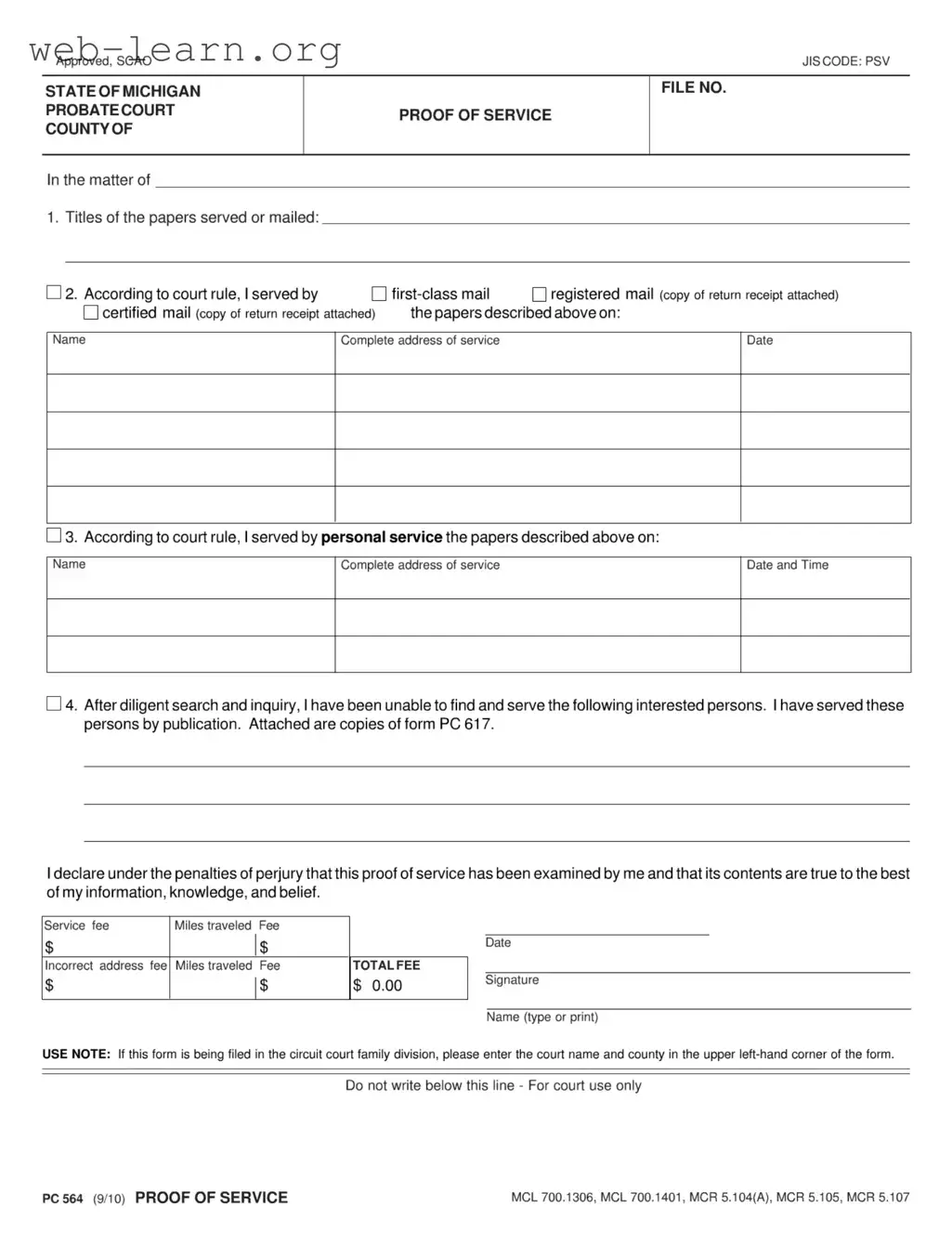
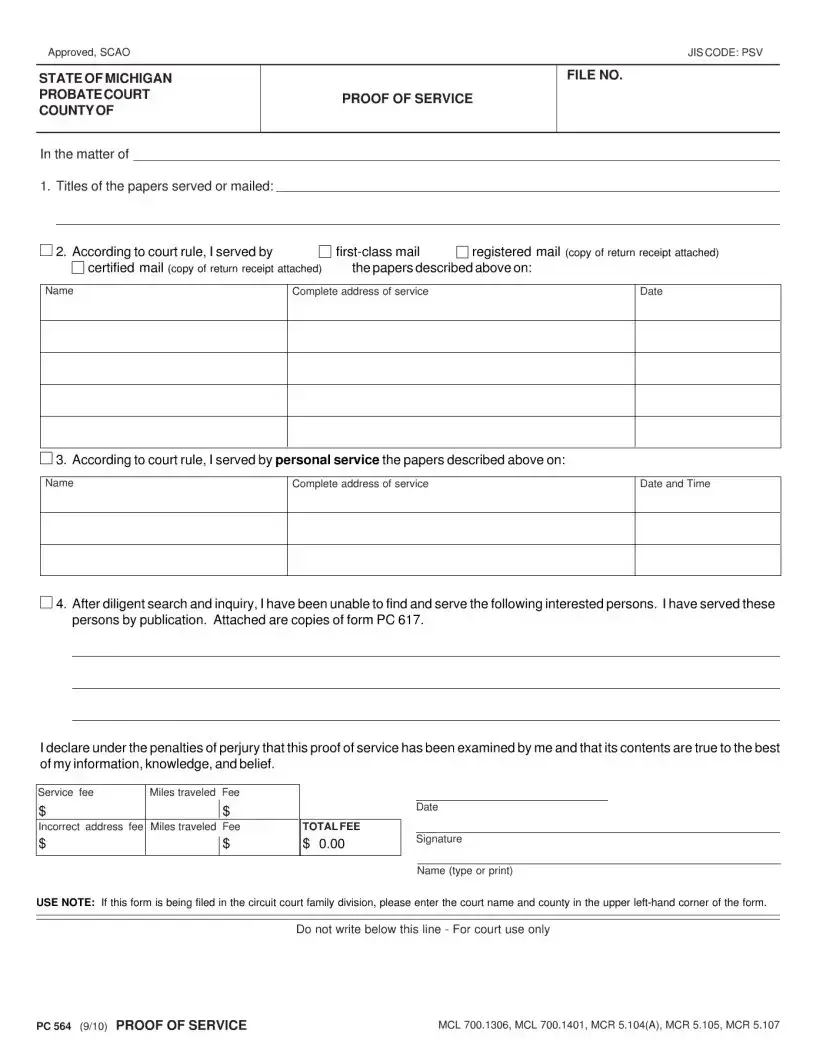
Navigating the complexities of probate law can be daunting, especially when it comes to understanding the various forms involved in the process. One essential document in Michigan's probate proceedings is the Probate Court Proof of Service form. This form serves as a crucial record, confirming that interested parties have been properly notified about court actions regarding a deceased person's estate. It requires detailed information, such as the titles of the papers served, the method of service—whether by mail or personal delivery—and the names and addresses of those served. Additionally, if certain interested persons cannot be located after diligent search efforts, the form allows for service by publication. This ensures that all potential heirs or beneficiaries are given notice, even if they are not easily reachable. The form also includes sections for declaring service fees and distances traveled, emphasizing the importance of accuracy and transparency in the probate process. By understanding the significance of the Proof of Service form, individuals can better navigate the probate landscape and ensure that all legal requirements are met.
Sample - Michigan Probate Form

Form Information

Fact Name Description
Form Purpose The Michigan Probate form serves as a proof of service document, verifying that certain legal papers have been delivered to interested parties as required by law.
Governing Laws This form is governed by Michigan Compiled Laws (MCL) 700.1306 and 700.1401, as well as Michigan Court Rules (MCR) 5.104(A), 5.105, and 5.107.
Service Methods The form allows for service via first-class mail, registered mail, certified mail, and personal service. It also accommodates service by publication if interested persons cannot be located.
Filing Instructions If filed in the circuit court family division, the court name and county must be entered in the upper left-hand corner of the form.

Detailed Guide for Filling Out Michigan Probate

Filling out the Michigan Probate form requires careful attention to detail. This form serves as a formal declaration of service, ensuring that all interested parties have been properly notified. It is important to provide accurate information to avoid any delays in the probate process.

  1. Begin by entering the court name and county in the upper left-hand corner of the form if this is being filed in the circuit court family division.
  2. In the section labeled "Titles of the papers served or mailed," clearly write the titles of the documents you are submitting.
  3. Next, indicate the method of service by checking the appropriate box: first-class mail, registered mail, or certified mail. If you choose registered or certified mail, attach a copy of the return receipt.
  4. Provide the name and complete address of the person served, along with the date of service.
  5. If you used personal service, complete the next section by entering the name, complete address, and the date and time of service.
  6. If you were unable to find and serve certain interested persons, list their names in the designated area. You must also indicate that these persons were served by publication and attach copies of form PC 617.
  7. In the fee section, record any service fees, miles traveled, and the total fee incurred.
  8. Sign and date the form at the bottom. Ensure that you type or print your name clearly.
  9. Finally, review the completed form to ensure all information is accurate and complete before submission.

Obtain Answers on Michigan Probate

  1. What is the purpose of the Michigan Probate form?

    The Michigan Probate form is used to provide proof that legal documents related to a probate case have been served to interested parties. This is an essential step in the probate process, ensuring that all relevant individuals are notified and have the opportunity to respond or participate in the proceedings.

  2. Who needs to be served with this form?

    Generally, interested persons include heirs, beneficiaries, and any other parties who may have a legal interest in the estate. It is crucial to serve these individuals to comply with court rules and ensure a fair process.

  3. How can I serve the documents?

    You can serve the documents in a few ways:

    • By first-class mail
    • By registered mail
    • By certified mail
    • By personal service

    Each method has specific requirements, such as obtaining a return receipt for registered or certified mail, which must be attached to the proof of service.

  4. What should I do if I cannot locate an interested person?

    If you are unable to find and serve an interested person after a diligent search, you may serve them by publication. This involves publishing a notice in a local newspaper to inform them of the proceedings. You will need to attach copies of the publication to your proof of service.

  5. What information is required on the form?

    The form requires several key pieces of information, including:

    • The titles of the papers served
    • The method of service
    • The names and addresses of the individuals served
    • The date of service
    • Details of any individuals served by publication

    Accurate and complete information is vital for the form to be accepted by the court.

  6. What are the fees associated with serving documents?

    When completing the form, you will need to include any service fees and mileage traveled. It is important to keep a record of these expenses, as they may be reimbursable from the estate.

  7. What happens if the form is not completed correctly?

    If the proof of service is not filled out correctly, the court may reject it. This could delay the probate process. Therefore, double-checking all entries and ensuring compliance with court rules is essential.

  8. Is there a specific court rule I should be aware of?

    Yes, several court rules govern the proof of service in Michigan probate cases. Key rules include MCL 700.1306, MCL 700.1401, and MCR 5.104(A), among others. Familiarizing yourself with these rules can help ensure compliance and avoid potential issues.

  9. What should I do after completing the form?

    Once you have completed the proof of service form, you must file it with the probate court. Ensure that you keep a copy for your records. This document serves as evidence that you have fulfilled your obligation to notify interested parties.

Common mistakes

Completing the Michigan Probate form can be a straightforward process, but several common mistakes can lead to delays or complications. One frequent error is failing to provide complete information in the sections requiring names and addresses. Each interested party must be clearly identified. Incomplete or incorrect information can hinder the court's ability to process the form effectively.

Another mistake involves misunderstanding the service methods. The form allows for various methods of service, including first-class mail, registered mail, and personal service. Some individuals mistakenly select a method without ensuring it aligns with the requirements of their specific case. It is crucial to understand which method is appropriate to avoid issues with the validity of the service.

Many people overlook the importance of attaching necessary documentation. For instance, if service is conducted by mail, copies of the return receipts must be included. Failing to attach these documents can result in the court not recognizing the service as valid, potentially prolonging the probate process.

Additionally, individuals often miscalculate the service fees and mileage. It is essential to accurately record these figures to ensure proper compensation and avoid discrepancies. Inaccurate calculations can lead to confusion and may require additional steps to rectify.

Lastly, individuals sometimes forget to sign the form or include the date. A missing signature or date can render the form incomplete. To prevent delays, always ensure that the form is signed and dated before submission. Paying attention to these details can significantly streamline the probate process.

Documents used along the form

When navigating the Michigan probate process, several forms and documents may accompany the Michigan Probate form. Each document plays a unique role in ensuring that the probate proceedings are conducted smoothly and in accordance with the law. Here is a list of commonly used forms in conjunction with the Michigan Probate form.

  • Petition for Probate: This document initiates the probate process. It requests the court to validate a will and appoint a personal representative to manage the estate.
  • Letters of Authority: Once the court approves the will and appoints a personal representative, this document grants them the legal authority to act on behalf of the estate.
  • Inventory of Estate: This form lists all the assets of the deceased person. It helps the court understand what is included in the estate and is often required to be filed within a specific timeframe.
  • Notice of Hearing: This document informs interested parties about upcoming hearings related to the probate case. It ensures that everyone has the opportunity to participate in the proceedings.
  • Proof of Claim: Creditors may use this form to formally present their claims against the estate. It provides a way for debts to be addressed during the probate process.
  • Final Account: At the conclusion of the probate process, this document summarizes all financial transactions made by the personal representative. It details income, expenses, and distributions to beneficiaries.
  • Waiver of Notice: Interested parties may sign this document to waive their right to receive formal notice of certain proceedings. It can help streamline the process if all parties agree.
  • Order for Distribution: This court order directs how the remaining assets of the estate should be distributed to the beneficiaries after all debts and expenses have been settled.
  • Affidavit of Heirship: In cases where there is no will, this form can help establish the rightful heirs of the deceased. It provides the court with information about the family lineage.

Understanding these documents can make the probate process more manageable. Each form serves a distinct purpose and helps ensure that the wishes of the deceased are honored while protecting the rights of all parties involved. Familiarity with these forms can empower individuals as they navigate through the complexities of probate in Michigan.

Similar forms

The Michigan Probate form is an important document used in the probate court system. It serves as a proof of service, indicating that certain papers have been delivered to interested parties. Several other documents share similarities with this form in terms of purpose and structure. Below is a list of eight documents that are comparable to the Michigan Probate form, along with explanations of their similarities.

  • Proof of Service (California) - Like the Michigan Probate form, this document verifies that legal documents have been properly served to involved parties. It includes details such as names, addresses, and methods of service.
  • Notice of Hearing (New York) - This document informs interested parties about a scheduled court hearing. Similar to the Michigan Probate form, it requires details about the service method and the individuals notified.
  • Affidavit of Service (Texas) - This affidavit serves as a sworn statement confirming that legal documents were delivered. It parallels the Michigan Probate form in its requirement for a signature and a declaration of truthfulness.
  • Summons (Florida) - A summons notifies a defendant of a legal action. The similarities lie in the need for service verification and the inclusion of recipient details, much like the Michigan Probate form.
  • Service of Process (Illinois) - This document outlines how legal papers are served to defendants. It shares the same purpose of confirming service and includes similar information about the individuals involved.
  • Certificate of Service (Virginia) - This certificate confirms that documents have been served to all necessary parties. It is akin to the Michigan Probate form in that it requires detailed information about the service process.
  • Notice of Intent (Ohio) - This notice informs parties of an impending legal action. It has similar requirements for detailing how and when service was completed, reflecting the structure of the Michigan Probate form.
  • Return of Service (Georgia) - This document is used to confirm that service has been completed. It is similar to the Michigan Probate form in its format and the necessity of providing proof of service to the court.

Dos and Don'ts

When filling out the Michigan Probate form, there are important guidelines to follow to ensure that your submission is accurate and complete. Here’s a list of things you should and shouldn’t do:

  • Do read the instructions carefully before starting. Understanding the requirements can save you time and effort.
  • Do provide complete names and addresses for all individuals involved. This information is crucial for proper service.
  • Do double-check your dates and signatures. An incorrect date or missing signature can delay the process.
  • Do attach any required documents, such as proof of service receipts. These are essential for the court's records.
  • Don’t leave any sections blank unless specifically instructed. Incomplete forms may be rejected by the court.
  • Don’t use abbreviations for names or addresses. Clarity is key to ensuring that the information is understood.
  • Don’t forget to keep a copy of the completed form for your records. This can be helpful for future reference.

By following these guidelines, you can help ensure that your Michigan Probate form is filled out correctly and efficiently.

Misconceptions

Understanding the Michigan Probate form is essential for anyone involved in the probate process. However, several misconceptions can lead to confusion. Here are six common misconceptions:

  • All probate cases require the same form. Many people believe that a single form suffices for all probate cases. In reality, different situations may require different forms depending on the specifics of the case.
  • Proof of service is optional. Some individuals think that providing proof of service is not necessary. This is incorrect; proof of service is a critical component of the probate process, ensuring that all interested parties are notified.
  • Only attorneys can file probate forms. While attorneys often assist with probate cases, individuals can file forms themselves. Self-representation is allowed, provided one understands the requirements and procedures.
  • Filing the form guarantees a quick resolution. Many assume that submitting the form will expedite the probate process. However, the court's timeline can vary significantly based on various factors, including the complexity of the case.
  • Once filed, the form cannot be changed. Some believe that once a form is submitted, it cannot be altered. In truth, if errors are discovered, individuals may be able to amend their filings, but this often requires additional steps.
  • All interested parties must be served in person. It is a common misconception that personal service is the only method of serving interested parties. In certain circumstances, service by mail or publication may be acceptable, especially if individuals cannot be located.

Being aware of these misconceptions can help individuals navigate the probate process more effectively and avoid potential pitfalls.

Key takeaways

Here are key takeaways regarding the Michigan Probate form:

  • The form is titled "Proof of Service" and is used to document the delivery of legal papers.
  • It is important to accurately fill in the file number and the county at the top of the form.
  • There are multiple methods for serving documents, including first-class mail, registered mail, certified mail, and personal service.
  • When using personal service, include the date and time of service, along with the recipient's complete address.
  • If unable to locate interested persons, service by publication is an option. Copies of form PC 617 should be attached.
  • Ensure to declare the truthfulness of the information provided by signing and dating the form.