In the realm of marriage planning, a prenuptial agreement serves as a vital tool for couples in Michigan, providing clarity and protection for both parties. This legally binding document outlines the financial and property rights of each spouse in the event of a divorce or separation. By addressing issues such as asset division, debt responsibility, and spousal support, the Michigan Prenuptial Agreement form helps to foster open communication about financial matters before tying the knot. It is essential for couples to understand that this agreement not only safeguards individual interests but also promotes transparency and trust within the relationship. Additionally, the form must adhere to specific legal requirements to be enforceable, including the necessity for both parties to fully disclose their financial situations and to enter into the agreement voluntarily, without coercion. Through thoughtful consideration and mutual agreement, couples can craft a prenuptial agreement that reflects their unique circumstances and intentions, ultimately setting a strong foundation for their future together.
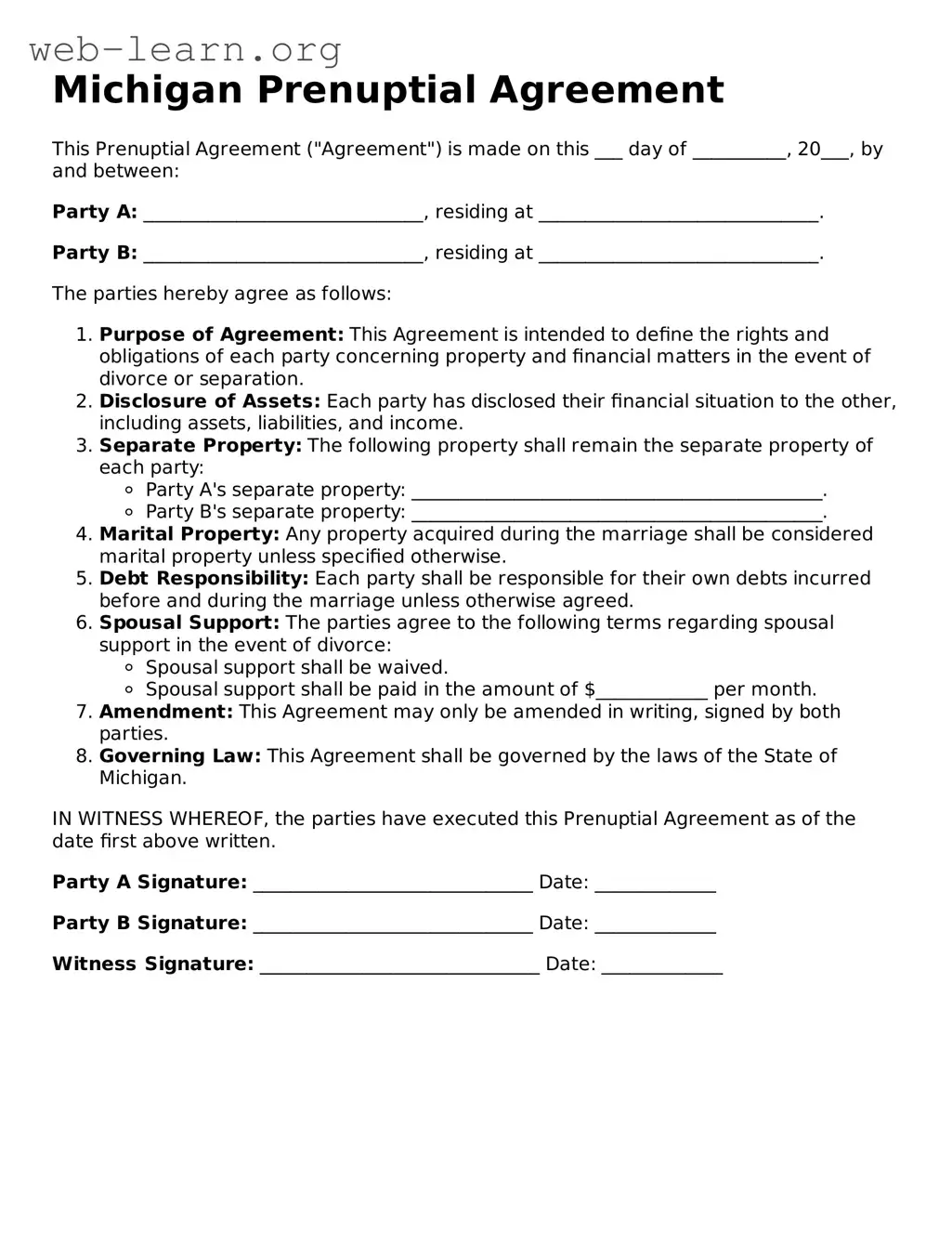
Michigan Prenuptial Agreement
This Prenuptial Agreement ("Agreement") is made on this ___ day of __________, 20___, by and between:
Party A: ______________________________, residing at ______________________________.
Party B: ______________________________, residing at ______________________________.
The parties hereby agree as follows:
IN WITNESS WHEREOF, the parties have executed this Prenuptial Agreement as of the date first above written.
Party A Signature: ______________________________ Date: _____________
Party B Signature: ______________________________ Date: _____________
Witness Signature: ______________________________ Date: _____________
| Fact Name | Description |
|---|---|
| Governing Law | The Michigan Prenuptial Agreement is governed by the Michigan Compiled Laws, specifically under MCL 557.101 et seq. |
| Purpose | This agreement outlines how assets and debts will be handled in the event of divorce or death. |
| Written Requirement | In Michigan, a prenuptial agreement must be in writing to be enforceable. |
| Voluntary Agreement | Both parties must enter into the agreement voluntarily without any coercion. |
| Full Disclosure | Each party should provide a full and fair disclosure of their financial situation before signing. |
| Legal Representation | While not required, it is advisable for both parties to seek independent legal counsel. |
| Modification | Agreements can be modified or revoked after marriage, but this must also be in writing. |
| Enforceability | The agreement can be challenged in court if it is deemed unconscionable or if proper procedures were not followed. |
Filling out the Michigan Prenuptial Agreement form is an important step in preparing for your upcoming marriage. This process involves providing essential information about both parties and their assets. Ensuring that all details are accurate and complete will help facilitate a smooth agreement.
What is a prenuptial agreement?
A prenuptial agreement, often called a "prenup," is a legal document created by two individuals before they marry. This agreement outlines the division of assets and responsibilities in the event of a divorce or separation. It can also address issues such as spousal support and debt management.
Is a prenuptial agreement enforceable in Michigan?
Yes, prenuptial agreements are generally enforceable in Michigan, provided they meet certain legal requirements. Both parties must voluntarily enter into the agreement, and it must be in writing and signed by both individuals. Additionally, the terms should be fair and not unconscionable at the time of enforcement.
What should be included in a Michigan prenuptial agreement?
A comprehensive prenuptial agreement may include:
Do both parties need a lawyer to create a prenuptial agreement?
While it is not legally required for both parties to have legal representation, it is highly advisable. Having separate attorneys ensures that both individuals understand their rights and obligations. This can help prevent future disputes about the agreement's validity.
Can a prenuptial agreement be changed after marriage?
Yes, a prenuptial agreement can be amended or revoked after marriage. Both parties must agree to the changes, and the revised agreement must be in writing and signed by both individuals. This ensures that any modifications are legally binding.
What happens if a prenuptial agreement is not in place?
If a couple does not have a prenuptial agreement and later divorces, Michigan law will govern the division of assets and debts. This means that the court will apply state laws to determine how property is divided, which may not align with the couple's wishes.
How can one ensure that a prenuptial agreement is fair?
To ensure fairness, both parties should fully disclose their financial situations, including assets, debts, and income. Each party should also have independent legal counsel to review the agreement. Fairness is crucial, as an agreement perceived as one-sided may be challenged in court.
When should a prenuptial agreement be created?
It is best to create a prenuptial agreement well in advance of the wedding. This allows ample time for negotiation and ensures that both parties are not under pressure. Ideally, it should be finalized at least a few weeks before the wedding date.
Are there any limitations to what can be included in a prenuptial agreement?
Yes, certain provisions cannot be included in a prenuptial agreement. For example, agreements regarding child custody or child support are typically not enforceable within a prenup, as these matters are determined based on the best interests of the child at the time of divorce.
Filling out a prenuptial agreement in Michigan can be a straightforward process, but many individuals make common mistakes that can lead to complications later. Understanding these pitfalls can help ensure that the agreement is valid and enforceable. Here are nine mistakes to avoid.
One frequent error is not fully disclosing all assets and debts. Transparency is crucial in a prenuptial agreement. If one party fails to reveal significant financial information, the agreement may be challenged in court. Both parties should provide a complete list of their assets, liabilities, and income.
Another mistake involves using vague or ambiguous language. Clarity is essential. If the terms of the agreement are not specific, it can lead to misunderstandings or disputes in the future. Each provision should be clear and detailed to avoid misinterpretation.
Failing to consider changes in circumstances is also a common oversight. Life events such as job changes, inheritance, or the birth of children can affect financial situations. It’s wise to include provisions that address how the agreement will adapt to these changes.
Some individuals neglect to consult with legal professionals. While it is possible to draft a prenuptial agreement without legal assistance, doing so can lead to significant mistakes. Having a lawyer review the agreement ensures that it complies with Michigan law and protects both parties' interests.
Another mistake is not allowing enough time for negotiation. Rushing through the process can lead to pressure and misunderstandings. Both parties should have ample time to discuss the terms, ask questions, and make informed decisions.
Additionally, failing to sign the agreement in front of witnesses or a notary can invalidate it. Michigan law requires that prenuptial agreements be executed properly. Ensuring that the document is signed and notarized can prevent future disputes about its validity.
Ignoring the need for periodic reviews is another error. As life evolves, so should the agreement. Regularly reviewing and updating the prenuptial agreement can help both parties stay aligned with their current circumstances and intentions.
Some people mistakenly believe that a prenuptial agreement can address child custody or child support issues. In Michigan, these matters are determined by the court based on the best interests of the child. Attempting to include such provisions in a prenuptial agreement may render those clauses unenforceable.
Finally, overlooking the importance of understanding state laws can lead to significant issues. Each state has its own rules governing prenuptial agreements. Familiarity with Michigan's specific requirements can help ensure that the agreement is legally sound and enforceable.
A prenuptial agreement is an important document for couples planning to marry, as it outlines the division of assets and responsibilities in the event of a divorce. Alongside this agreement, several other forms and documents may be necessary to ensure a comprehensive understanding of both parties' financial situations and legal rights. Below is a list of some commonly used forms that complement the Michigan Prenuptial Agreement.
These documents work together to provide a clearer picture of the couple's financial and legal landscape. Understanding each form's purpose can help couples navigate their relationship with greater clarity and security.
When filling out the Michigan Prenuptial Agreement form, it's important to keep a few key points in mind. Here are some things you should and shouldn't do:
When considering a prenuptial agreement in Michigan, several misconceptions can lead to confusion. Understanding these myths is crucial for anyone contemplating this important legal document.
By addressing these misconceptions, individuals can make more informed decisions about prenuptial agreements and their role in marriage planning.
When considering a prenuptial agreement in Michigan, it is essential to understand the implications and requirements associated with the process. Below are key takeaways regarding the Michigan Prenuptial Agreement form.
Understanding these key elements can help individuals navigate the process of creating a prenuptial agreement effectively and ensure that it meets their needs and legal standards.
Louisiana Prenup - This agreement can help ensure that both parties understand their rights and obligations.
Florida Prenup - This form can help couples discuss sensitive financial topics openly.
Hawaii Prenup - This document helps clarify asset ownership and financial responsibilities in case of divorce.