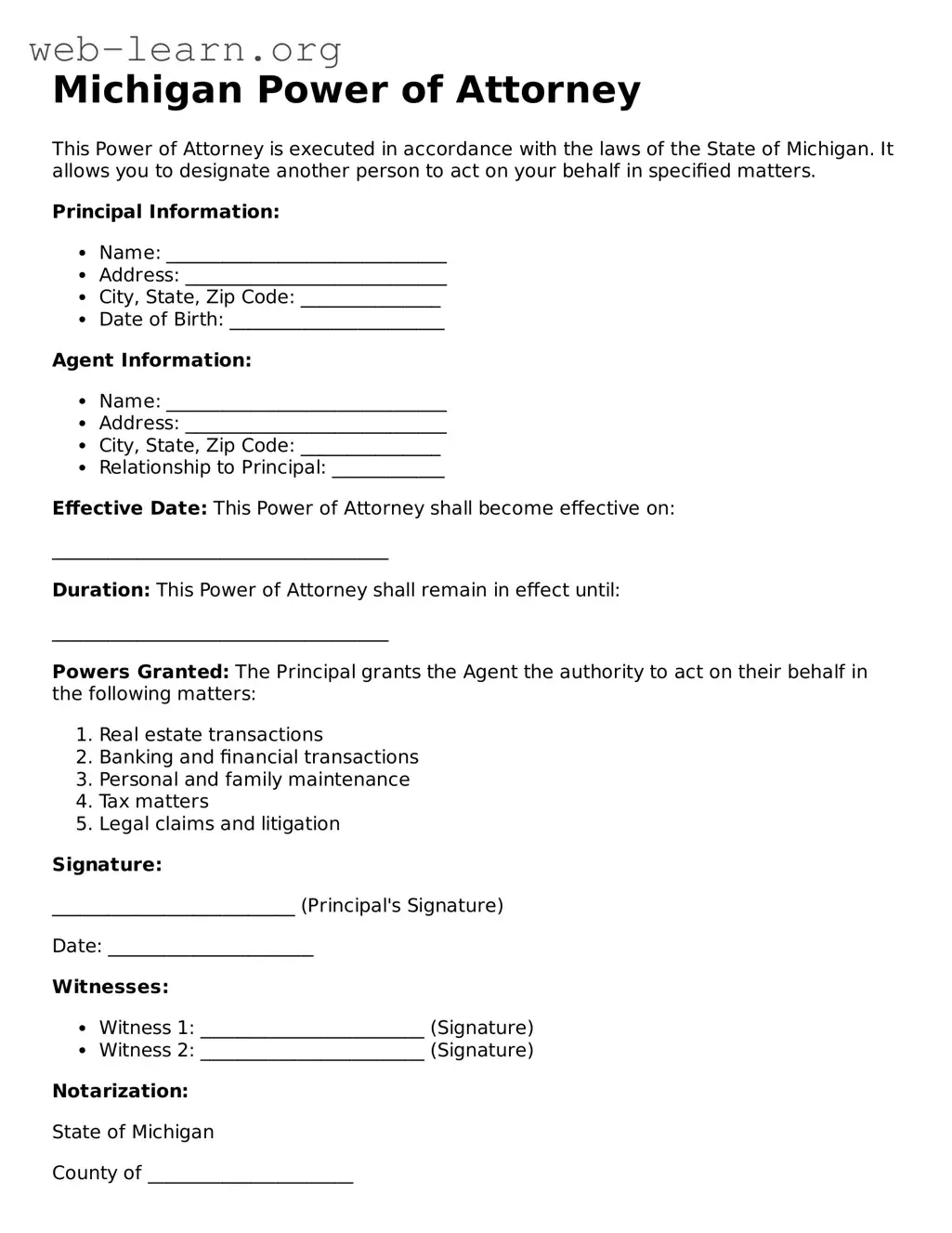
The Michigan Power of Attorney form is an important legal document that allows individuals to designate someone they trust to make decisions on their behalf. This arrangement can be particularly useful in situations where a person becomes unable to handle their own affairs due to illness, injury, or other circumstances. The form covers various aspects, including financial matters, healthcare decisions, and property management. By completing this document, a principal grants authority to an agent, who can act in their best interest. It is essential for the principal to choose someone reliable, as this person will have significant control over important decisions. Furthermore, the Michigan Power of Attorney can be tailored to meet specific needs, whether it is for a limited duration or for broader, ongoing authority. Understanding the nuances of this form can help individuals ensure that their wishes are respected and that their affairs are managed according to their preferences.
Michigan Power of Attorney
This Power of Attorney is executed in accordance with the laws of the State of Michigan. It allows you to designate another person to act on your behalf in specified matters.
Principal Information:
Agent Information:
Effective Date: This Power of Attorney shall become effective on:
____________________________________
Duration: This Power of Attorney shall remain in effect until:
____________________________________
Powers Granted: The Principal grants the Agent the authority to act on their behalf in the following matters:
Signature:
__________________________ (Principal's Signature)
Date: ______________________
Witnesses:
Notarization:
State of Michigan
County of ______________________
Subscribed and sworn before me on this _____ day of ____________, 20__.
______________________________
Notary Public
My Commission Expires: ______________
| Fact Name | Details |
|---|---|
| Definition | A Power of Attorney (POA) in Michigan allows one person to make decisions on behalf of another person. |
| Types | Michigan recognizes several types of POAs, including durable, medical, and limited POAs. |
| Durable POA | This type remains effective even if the principal becomes incapacitated. |
| Medical POA | It specifically allows an agent to make healthcare decisions for the principal. |
| Signing Requirements | The form must be signed by the principal and witnessed by at least one person or notarized. |
| Revocation | The principal can revoke the POA at any time as long as they are competent. |
| Governing Laws | The Michigan Power of Attorney Act (MCL 700.5501 et seq.) governs these forms. |
| Agent's Responsibilities | The agent must act in the best interest of the principal and follow their wishes. |
| Filing Requirements | Generally, a POA does not need to be filed with the court, but it may be required by some institutions. |
After obtaining the Michigan Power of Attorney form, the next step is to accurately complete it to ensure that it reflects your intentions. This document allows you to designate someone to make decisions on your behalf in specific situations. Follow these steps carefully to fill out the form correctly.
What is a Power of Attorney in Michigan?
A Power of Attorney (POA) in Michigan is a legal document that allows one person, known as the principal, to grant another person, called the agent or attorney-in-fact, the authority to make decisions on their behalf. This can include financial matters, medical decisions, or other personal affairs. The principal can specify the extent of the agent's powers and the duration of the authority granted.
What types of Power of Attorney are available in Michigan?
How do I create a Power of Attorney in Michigan?
To create a Power of Attorney in Michigan, the principal must complete a form that outlines the powers granted to the agent. The form must be signed by the principal and witnessed by at least one individual or notarized. It is advisable to keep the document in a safe place and provide copies to the agent and any relevant institutions.
Can I revoke a Power of Attorney in Michigan?
Yes, a Power of Attorney can be revoked at any time as long as the principal is competent. To revoke the document, the principal should create a written revocation and notify the agent and any institutions that were given a copy of the original POA. It is also wise to destroy any copies of the original document to prevent confusion.
What happens if the principal becomes incapacitated?
If the principal becomes incapacitated and has executed a Durable Power of Attorney, the agent can begin making decisions on their behalf without interruption. However, if a Springing Power of Attorney was created, the agent's authority will only activate once the specific event of incapacity is confirmed.
Are there any limitations on what an agent can do?
Yes, the principal can set limitations within the Power of Attorney document. For example, the principal may restrict the agent from making gifts or selling property without prior consent. It is important to clearly outline these limitations in the POA to ensure that the agent acts within the principal’s wishes.
Do I need a lawyer to create a Power of Attorney?
While it is not legally required to have a lawyer to create a Power of Attorney in Michigan, consulting one can be beneficial. A lawyer can help ensure that the document meets legal requirements and accurately reflects the principal's intentions. This can help avoid potential disputes or issues in the future.
Filling out a Power of Attorney form in Michigan can be a straightforward process, but many individuals make common mistakes that can lead to complications. One frequent error is not specifying the powers granted to the agent clearly. Without precise language, the agent may not have the authority to act in certain situations. It is essential to detail the specific powers you wish to grant, ensuring that your agent understands their responsibilities and limitations.
Another mistake often seen is failing to date the document. A Power of Attorney is only valid if it is properly dated. Without a date, there may be confusion regarding when the authority was granted. This oversight can lead to disputes or challenges regarding the validity of the document. Always remember to include the date when signing the form.
Some individuals overlook the requirement for witnesses or notarization. In Michigan, a Power of Attorney must be signed in the presence of a notary public or two witnesses. Neglecting this step can render the document invalid. Ensure that you understand the specific witnessing requirements and complete this step diligently to avoid any issues.
Another common error is not discussing the decision with the chosen agent beforehand. It is crucial to have an open conversation with the person you wish to designate as your agent. This discussion ensures they are willing to take on the responsibility and understand your wishes. Failing to communicate can lead to misunderstandings and potential conflicts later on.
Lastly, many people forget to keep copies of the completed Power of Attorney form. After signing and executing the document, it is vital to provide copies to your agent, relevant family members, and any institutions that may need it. Retaining copies for your records ensures that everyone involved has access to the necessary information when it is needed most.
When creating a Power of Attorney in Michigan, it's often beneficial to consider additional documents that can complement your planning. Each of these forms serves a unique purpose, helping to ensure that your wishes are respected and that your affairs are managed according to your preferences.
Considering these documents alongside your Michigan Power of Attorney can provide a comprehensive approach to your legal and financial planning. Each serves a specific purpose and can help ensure your wishes are followed, offering peace of mind for you and your loved ones.
When filling out the Michigan Power of Attorney form, it’s important to understand the best practices to ensure the document is valid and meets your needs. Here are some key do's and don'ts to consider:
By following these guidelines, you can help ensure that your Power of Attorney is properly executed and effective when needed.
Many people have misunderstandings about the Michigan Power of Attorney form. Here are five common misconceptions, along with explanations to clarify them.
This is not true. Power of Attorney forms can vary significantly by state and the specific powers granted. In Michigan, the form must meet certain state requirements to be valid.
While many use it for financial decisions, a Power of Attorney can also be used for healthcare decisions. It's important to specify the types of authority granted in the document.
This is a misconception. You can revoke or change your Power of Attorney at any time, as long as you are mentally competent. Just be sure to follow the proper procedures.
This isn't accurate. The authority granted can be limited to specific tasks or decisions. You have control over what powers you give to your agent.
This is a common myth. Anyone can benefit from having a Power of Attorney, regardless of age. Life can be unpredictable, and having this document can help ensure your wishes are followed.
When considering the Michigan Power of Attorney form, it is essential to understand its implications and how to use it effectively. Below are key takeaways to keep in mind:
Does Oregon Power of Attorney Need to Be Notarized - Use this form to ensure your financial matters are managed as you wish.
How to Get Power of Attorney for Elderly Parent in Georgia - It can facilitate smoother transitions during significant life events.
Alabama Power of Attorney Form - This document can facilitate the management of your assets and liabilities.
Hawaii Poa - This form can be used to designate someone for specific legal transactions.