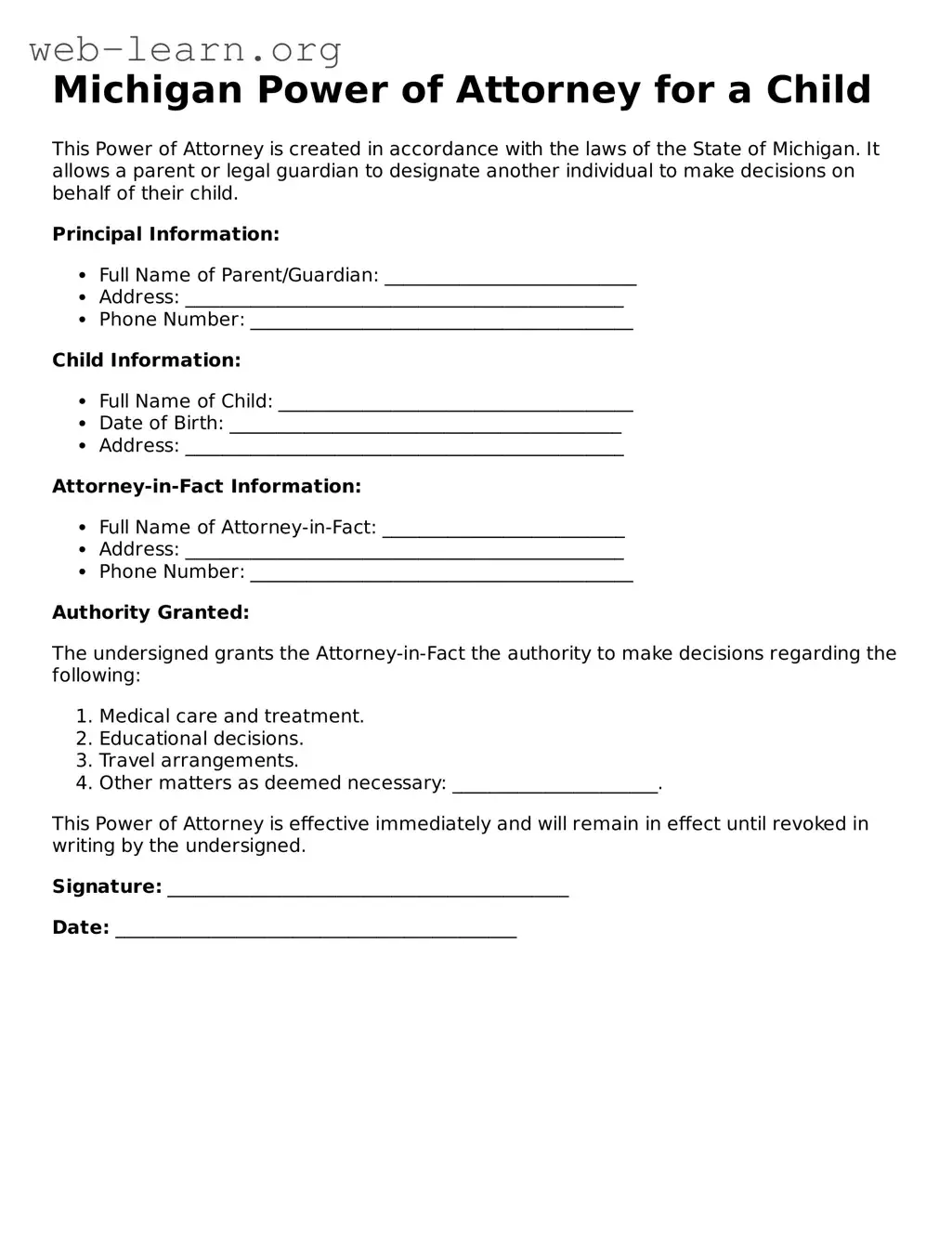
The Michigan Power of Attorney for a Child form serves as a vital legal tool for parents and guardians who wish to designate another adult to make decisions on behalf of their minor child. This form allows for the appointment of a trusted individual to manage various aspects of a child's care, including medical decisions, educational matters, and general welfare. By completing this form, parents can ensure that their child receives appropriate care in their absence, whether due to travel, illness, or other circumstances. The document typically includes essential information such as the names and addresses of both the parent and the designated agent, as well as the specific powers granted to the agent. Importantly, the form must be signed and dated to be legally binding, and it can be revoked at any time by the parent or guardian. Understanding the implications and requirements of this form is crucial for parents seeking peace of mind while ensuring their child's needs are met when they cannot be present.
Michigan Power of Attorney for a Child
This Power of Attorney is created in accordance with the laws of the State of Michigan. It allows a parent or legal guardian to designate another individual to make decisions on behalf of their child.
Principal Information:
Child Information:
Attorney-in-Fact Information:
Authority Granted:
The undersigned grants the Attorney-in-Fact the authority to make decisions regarding the following:
This Power of Attorney is effective immediately and will remain in effect until revoked in writing by the undersigned.
Signature: ___________________________________________
Date: ___________________________________________
| Fact Name | Description |
|---|---|
| Definition | The Michigan Power of Attorney for a Child form allows a parent or legal guardian to designate another adult to make decisions on behalf of their child. |
| Governing Law | This form is governed by the Michigan Compiled Laws, specifically MCL 700.5201 et seq., which outlines the powers and limitations of a power of attorney for minors. |
| Duration | The authority granted through this form remains in effect until a specified date, the child reaches the age of majority, or until it is revoked by the parent or guardian. |
| Required Signatures | The form must be signed by the parent or legal guardian, and it is advisable to have it notarized to enhance its validity. |
| Scope of Authority | The designated adult can make decisions regarding the child's education, healthcare, and general welfare, but cannot make decisions that require parental consent under Michigan law. |
Filling out the Michigan Power of Attorney for a Child form can feel overwhelming, but taking it step by step can simplify the process. After you complete the form, it will be ready for submission, allowing you to designate someone to make decisions on behalf of your child when necessary.
What is a Power of Attorney for a Child in Michigan?
A Power of Attorney for a Child is a legal document that allows a parent or legal guardian to grant another adult the authority to make decisions on behalf of their child. This can include decisions related to education, health care, and general welfare. The form is particularly useful when parents are unable to care for their child temporarily due to travel, illness, or other circumstances.
Who can be appointed as an attorney-in-fact for my child?
The attorney-in-fact can be any adult that the parent or guardian trusts. This person could be a relative, family friend, or neighbor. It is essential that the appointed individual understands the responsibilities involved in caring for the child and is willing to take on this role.
What decisions can the attorney-in-fact make?
The attorney-in-fact can make a variety of decisions, including:
However, the document can specify limitations on these powers if desired.
Is the Power of Attorney for a Child form permanent?
No, the Power of Attorney for a Child is not permanent. It is typically intended for a specific period or until the parent or guardian is able to resume their responsibilities. The document can also be revoked at any time by the parent or guardian, as long as they provide proper notice to the attorney-in-fact.
Do I need to have the Power of Attorney for a Child form notarized?
Yes, the form must be signed in the presence of a notary public to be legally valid in Michigan. Notarization helps to ensure that the document is authentic and that the parent or guardian is willingly granting these powers.
Can I use a Power of Attorney for a Child form from another state?
While some states may recognize Power of Attorney documents from other jurisdictions, it is advisable to use the Michigan-specific form to avoid any potential legal complications. Each state has its own laws and requirements, so using the correct form ensures compliance with Michigan law.
What should I do if I have further questions about the Power of Attorney for a Child?
If you have additional questions or concerns, consider consulting with a family law attorney who is familiar with Michigan law. They can provide tailored advice and help you understand the implications of granting power of attorney for your child.
Filling out the Michigan Power of Attorney for a Child form can be a straightforward process, yet many individuals encounter pitfalls that can complicate matters. One common mistake is failing to provide accurate personal information. It is essential to ensure that names, addresses, and contact details for both the parent and the designated agent are correct. Any discrepancies can lead to confusion or delays in critical situations.
Another frequent error involves neglecting to specify the duration of the power of attorney. Without clearly stating how long the authority is granted, there may be misunderstandings about when the agent's powers begin and end. This can create uncertainty for both the parent and the designated agent, potentially leading to legal complications.
Many people also overlook the importance of signing the document in the presence of a witness or notary. Michigan law requires that the Power of Attorney for a Child form be properly executed to be valid. Failing to meet this requirement can render the document ineffective, leaving the child without the necessary legal protections.
In addition, some individuals forget to outline the specific powers being granted to the agent. It is crucial to be explicit about what decisions the agent can make on behalf of the child. Vague language may lead to misunderstandings, causing the agent to act outside their intended authority.
Another mistake often made is not reviewing the form for completeness. Each section of the document should be filled out thoroughly. Leaving any part of the form blank can raise questions about the intent and validity of the power of attorney.
Moreover, individuals sometimes fail to communicate with the child about the arrangement. It is beneficial for the child to understand who will be responsible for their care and what that entails. Open communication can help alleviate any anxiety the child may feel regarding the situation.
People also occasionally forget to update the form when circumstances change. Life events such as a change in the designated agent’s availability or a shift in the child's needs can necessitate a revision of the power of attorney. Keeping the document current is vital to ensure that it reflects the current situation accurately.
Furthermore, some individuals do not seek legal advice when needed. While it is possible to complete the form independently, consulting with a legal professional can provide clarity and assurance that all requirements are met. This step can prevent potential issues down the line.
Finally, a lack of understanding regarding the implications of granting power of attorney can lead to hesitance or mistakes. It is important to fully grasp what responsibilities and rights are being transferred. Taking the time to educate oneself about the process can foster confidence and accuracy in completing the form.
When establishing a Power of Attorney for a Child in Michigan, several other forms and documents may be beneficial to ensure comprehensive legal coverage. Each of these documents serves a unique purpose and can help clarify responsibilities and rights. Below is a list of common documents that may accompany the Power of Attorney for a Child.
Having these documents prepared alongside the Power of Attorney for a Child can help ensure that all necessary permissions and responsibilities are clearly defined. This proactive approach can prevent misunderstandings and provide peace of mind for all parties involved.
The Power of Attorney for a Child form allows a parent or guardian to designate another individual to make decisions on behalf of their child. This document is similar to several other legal forms that grant authority or make decisions for someone else. Here are seven documents that share similarities:
Understanding these documents can help parents and guardians make informed decisions about the care and welfare of their children. Each form serves a unique purpose but shares the common goal of ensuring that someone trusted can act on behalf of another.
When filling out the Michigan Power of Attorney for a Child form, it’s important to be careful and thorough. Here are some essential do's and don'ts to keep in mind:
Many people have misconceptions about the Michigan Power of Attorney for a Child form. Understanding these misconceptions can help parents and guardians make informed decisions. Here are seven common misunderstandings:
While both documents allow someone to care for a child, a power of attorney is temporary and does not transfer legal custody. Guardianship is a more permanent arrangement.
This form can be used for various situations, not just emergencies. It allows the designated individual to make decisions about the child’s education, healthcare, and general welfare.
While parents typically initiate this process, legal guardians or others with parental rights can also establish a power of attorney.
In Michigan, the power of attorney form does not necessarily require notarization, but having it notarized can add an extra layer of legitimacy.
The power of attorney is not permanent. It can be revoked at any time by the parent or guardian who created it.
This form specifically pertains to the care and custody of the child. It does not grant authority over financial or legal matters unrelated to the child's welfare.
The process is relatively straightforward. Parents can often find templates online and fill them out with minimal legal assistance.
By clarifying these misconceptions, individuals can better navigate the responsibilities and implications of the Michigan Power of Attorney for a Child form.
Filling out and using the Michigan Power of Attorney for a Child form is an important step for parents and guardians who wish to designate someone else to make decisions for their child. Here are some key takeaways to consider:
How to Get Power of Attorney in Florida - The Power of Attorney for a Child is a flexible tool for modern families.
Power of Attorney Illinois Cost - The Power of Attorney for a Child is an important planning tool for responsible parents.