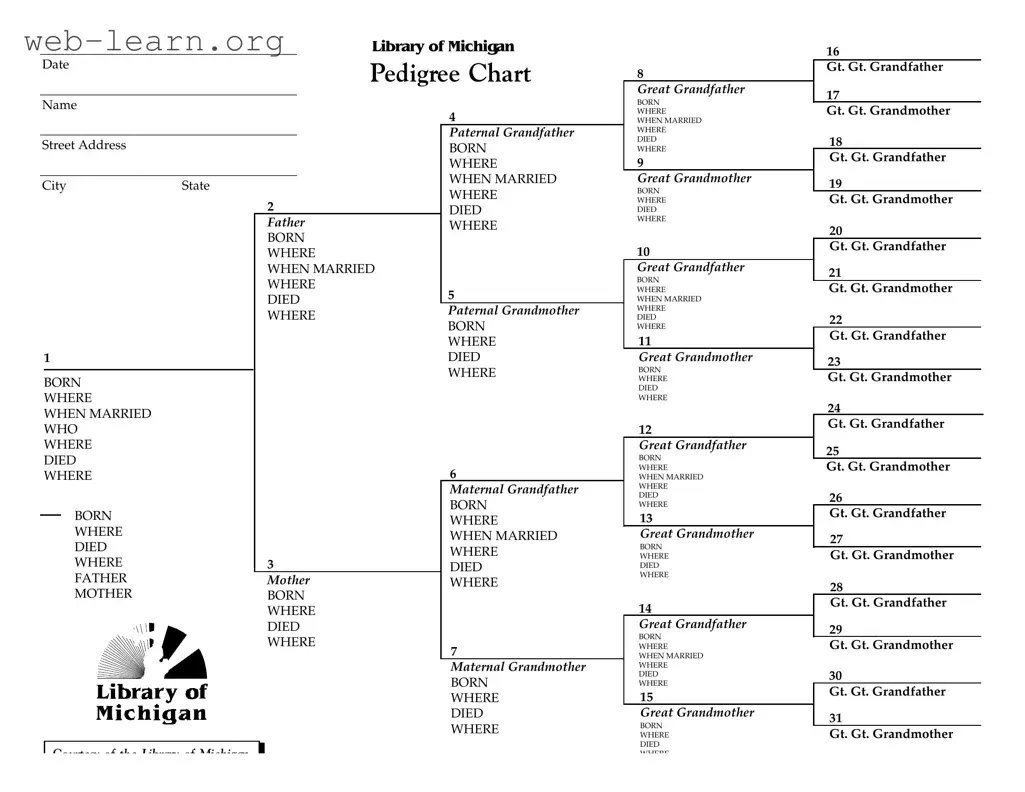
The Michigan Pedigree form serves as a vital tool for individuals seeking to trace their family lineage and document their ancestry. This form is designed to collect essential information about multiple generations of a family, beginning with the individual and extending to great-great-grandparents. Each section prompts users to provide details such as names, birthplaces, marriage dates, and death locations for each ancestor. The structured layout facilitates a clear understanding of familial connections, making it easier to visualize one's heritage. By filling out this form, individuals can preserve their family's history and contribute to genealogical research. The form is not only a practical resource for personal exploration but also serves a broader purpose in the preservation of cultural and historical narratives. As users engage with this form, they embark on a journey that connects them to their roots, offering insights into their family's past and the stories that shaped their present.

________________________________________ |
Library of Michigan |
|
Date |
Pedigree Chart |
|
________________________________________ |
||
|
||
Name |
|
8
GREAT GRANDFATHER
BORN
WHERE
16
GT. GT. GRANDFATHER
17
GT. GT. GRANDMOTHER
________________________________________
Street Address
________________________________________
City |
State |
4
PATERNAL GRANDFATHER
BORN WHERE
WHEN MARRIED WHERE
WHEN MARRIED
WHERE
DIED
WHERE
9
GREAT GRANDMOTHER
BORN
WHERE
18
GT. GT. GRANDFATHER
19
GT. GT. GRANDMOTHER
1
BORN WHERE
WHEN MARRIED WHO
WHERE DIED WHERE
BORN
WHERE
DIED
WHERE
FATHER
MOTHER
2
FATHER
BORN WHERE
WHEN MARRIED WHERE
DIED WHERE
3
MOTHER
BORN
WHERE
DIED
WHERE
DIED
WHERE
5
PATERNAL GRANDMOTHER
BORN
WHERE
DIED
WHERE
6
MATERNAL GRANDFATHER
BORN WHERE
WHEN MARRIED WHERE
DIED WHERE
7
MATERNAL GRANDMOTHER
BORN
WHERE
DIED
WHERE
DIED
WHERE
10
GREAT GRANDFATHER
BORN
WHERE
WHEN MARRIED
WHERE
DIED
WHERE
11
GREAT GRANDMOTHER
BORN
WHERE
DIED
WHERE
12
GREAT GRANDFATHER
BORN
WHERE
WHEN MARRIED
WHERE
DIED
WHERE
13
GREAT GRANDMOTHER
BORN
WHERE
DIED
WHERE
14
GREAT GRANDFATHER
BORN
WHERE
WHEN MARRIED
WHERE
DIED
WHERE
15
GREAT GRANDMOTHER
BORN
WHERE
DIED
20
GT. GT. GRANDFATHER
21
GT. GT. GRANDMOTHER
22
GT. GT. GRANDFATHER
23
GT. GT. GRANDMOTHER
24
GT. GT. GRANDFATHER
25
GT. GT. GRANDMOTHER
26
GT. GT. GRANDFATHER
27
GT. GT. GRANDMOTHER
28
GT. GT. GRANDFATHER
29
GT. GT. GRANDMOTHER
30
GT. GT. GRANDFATHER
31
GT. GT. GRANDMOTHER
Courtesy of the Library of Michigan
WHERE
| Fact Name | Description |
|---|---|
| Governing Law | The Michigan Pedigree form is governed by Michigan law, specifically the Michigan Compiled Laws § 333.2832. |
| Purpose | This form is used to document the lineage of an individual for various legal and genealogical purposes. |
| Required Information | The form requires details about ancestors, including names, birthplaces, and dates of significant life events. |
| Format | The form is structured to capture information across multiple generations, specifically up to eight great-grandparents. |
| Submission | Completed forms can be submitted to relevant state agencies or used for personal records. |
| Accessibility | The form is available through the Library of Michigan and can often be found online. |
| Legal Importance | Accurate completion of the form may be necessary for inheritance claims and other legal matters. |
| Support Resources | Assistance is available through genealogical societies and legal consultants familiar with Michigan law. |
| Updates | It is advisable to check for any changes to the form or related laws periodically to ensure compliance. |
Filling out the Michigan Pedigree form is an important step in documenting your family history. This form requires detailed information about your ancestors, including their names, birthplaces, and significant life events. By following these steps, you can ensure that you accurately complete the form.
The Michigan Pedigree form is a document used to record family history and lineage. It helps individuals trace their ancestry by collecting information about their ancestors, including names, birthplaces, marriage details, and death locations. This form is particularly useful for genealogical research and can assist in building a family tree.
To fill out the Michigan Pedigree form, start with your information at the top. Include your name, birth details, and the names of your parents. Then, work backward through your family tree, adding details about each ancestor. For each person, provide:
Be as thorough as possible. If you don’t have certain information, leave those sections blank or note it as unknown.
The Michigan Pedigree form can be obtained from the Library of Michigan. It may also be available online through various genealogy websites or local historical societies. Make sure to check for the most current version of the form to ensure you have all the necessary sections.
While the primary purpose of the Michigan Pedigree form is for genealogical research, it can also be useful for legal matters, such as estate planning or verifying family relationships. However, it is important to note that this form is not a legal document on its own. Always consult with a legal professional if you need the information for legal purposes.
Filling out the Michigan Pedigree form can be a straightforward process, but many individuals encounter common pitfalls that may lead to inaccuracies. One frequent mistake is neglecting to provide complete information for each ancestor. Each section of the form requests specific details, such as birthplaces and dates. Omitting even one piece of information can hinder the accuracy of the entire pedigree.
Another common error is inconsistent naming conventions. Many people may use nicknames or variations of names that differ from official records. This inconsistency can create confusion when verifying information. It is essential to use full legal names to ensure clarity and accuracy in genealogical research.
Additionally, individuals often fail to verify the accuracy of the dates they provide. Inaccurate dates can lead to significant discrepancies in family trees. Cross-referencing with official documents, such as birth certificates or marriage licenses, can help ensure that the information recorded is correct.
Many people also overlook the importance of including all relevant ancestors. The form requires information about great-grandparents and beyond. Failing to include these individuals can result in an incomplete family history. Taking the time to gather information about all ancestors ensures a more comprehensive pedigree.
Another mistake is not paying attention to the order of information. The form has a specific structure, and deviating from this structure can lead to confusion. Filling out the form in the correct sequence helps maintain clarity and organization.
Individuals often underestimate the significance of providing accurate locations. Simply stating "Michigan" or "USA" without specifying the city or county can lead to ambiguity. Precise locations enhance the quality of genealogical research and help others trace family histories more effectively.
Moreover, some may fail to include the maiden names of female ancestors. This omission can complicate research, especially when tracing lineage through women. Including maiden names provides crucial links to previous generations.
Another oversight occurs when individuals do not review their completed forms for errors. Simple typographical mistakes can lead to misunderstandings or misinterpretations of the data. Taking a moment to proofread can save time and effort in the long run.
Lastly, many people do not keep copies of their completed forms. In the event of loss or damage, having a backup can be invaluable. It is wise to maintain a digital or physical copy for personal records and future reference.
The Michigan Pedigree form is an essential document for recording family lineage. It provides a structured way to capture vital information about ancestors. In addition to this form, several other documents may be used to support genealogical research. Below are some commonly associated forms and documents.
Using these documents in conjunction with the Michigan Pedigree form can enhance the accuracy and depth of genealogical research. Each form plays a unique role in piecing together the puzzle of family history.
The Michigan Pedigree form is a useful tool for documenting family history and lineage. Several other documents serve similar purposes, helping individuals trace their ancestry and gather vital information about their relatives. Here are seven documents that share similarities with the Michigan Pedigree form:
When filling out the Michigan Pedigree form, it is important to follow specific guidelines to ensure accuracy and completeness. Below is a list of things you should and shouldn't do.
The Michigan Pedigree form is a valuable tool for documenting family history, yet several misconceptions surround its use and purpose. Understanding these misconceptions can help individuals navigate the process more effectively. Below are six common misunderstandings about the Michigan Pedigree form:
By addressing these misconceptions, individuals can approach the Michigan Pedigree form with clarity and confidence, making the process of documenting their family history more accessible and meaningful.
Here are key takeaways for filling out and using the Michigan Pedigree form: