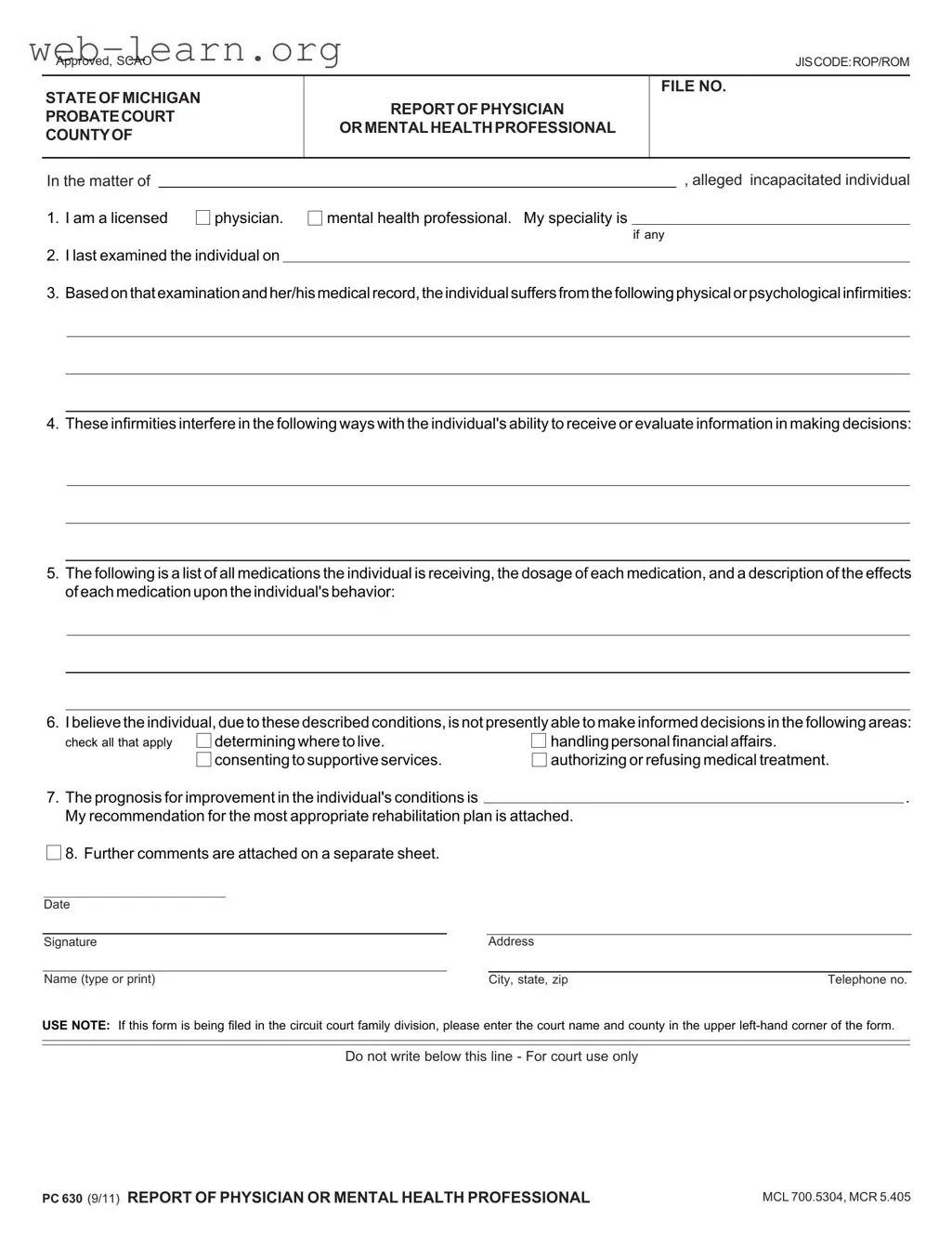
The Michigan PC 630 form plays a crucial role in the assessment of an individual's capacity to make informed decisions regarding their personal and medical affairs. This form is completed by a licensed physician or mental health professional who has evaluated the individual in question. It contains essential information, including the professional's specialty, the date of the last examination, and a detailed account of any physical or psychological conditions affecting the individual. The form outlines how these conditions impact the person's ability to process information and make decisions. Additionally, it lists any medications the individual is taking, along with their dosages and effects on behavior. The professional must also indicate whether the individual can make informed choices in specific areas, such as living arrangements, financial matters, and medical treatment. A prognosis for improvement and recommendations for rehabilitation are included as well. This comprehensive report is vital for the court's understanding of the individual's situation and aids in determining the appropriate legal actions moving forward.
Approved, SCAO |
JISCODE:ROP/ROM |
STATEOFMICHIGAN PROBATECOURT COUNTYOF
REPORTOFPHYSICIAN
ORMENTALHEALTHPROFESSIONAL
FILE NO.
In the matter of
1. I am a licensed
physician.
, alleged incapacitated individual
mental health professional. My speciality is
if any
2.I last examined the individual on
3.Basedonthatexaminationandher/hismedicalrecord,theindividualsuffersfromthefollowingphysicalorpsychologicalinfirmities:
4. These infirmities interfere in the following ways with the individual's ability to receive or evaluate information in making decisions:
5.The following is a list of all medications the individual is receiving, the dosage of each medication, and a description of the effects ofeachmedicationupontheindividual'sbehavior:
6. |
I believe the individual, due to these described conditions, is not presently able to make informed decisions in the following areas: |
|||
|
check all that apply |
determiningwheretolive. |
handlingpersonalfinancialaffairs. |
|
|
|
consentingtosupportiveservices. |
authorizing or refusing medical treatment. |
|
7. |
The prognosis for improvement in the individual's conditions is |
|
. |
|
My recommendation for the most appropriate rehabilitation plan is attached.
8. Further comments are attached on a separate sheet.
Date |
|
|
|
|
|
|
|
Signature |
Address |
|
|
|
|
|
|
Name (type or print) |
City, state, zip |
Telephone no. |
|
USE NOTE: If this form is being filed in the circuit court family division, please enter the court name and county in the upper
Do not write below this line - For court use only
PC 630 (9/11) REPORT OF PHYSICIAN OR MENTAL HEALTH PROFESSIONAL |
MCL 700.5304, MCR 5.405 |
| Fact Name | Description |
|---|---|
| Form Title | The form is titled "Report of Physician or Mental Health Professional." It is used in probate court proceedings. |
| Governing Laws | This form is governed by Michigan Compiled Laws (MCL) 700.5304 and Michigan Court Rules (MCR) 5.405. |
| Purpose | The purpose of the form is to provide a professional assessment of an individual's mental or physical capacity. |
| Examiner's Credentials | The individual completing the form must be a licensed physician or a mental health professional. |
| Examination Date | The form requires the date of the last examination of the alleged incapacitated individual. |
| Infirmities | It asks for a description of physical or psychological infirmities that affect decision-making ability. |
| Medications | The form includes a section for listing medications, dosages, and their effects on the individual's behavior. |
| Decision-Making Capacity | The form assesses the individual's ability to make informed decisions in various areas, such as financial matters and medical treatment. |
| Prognosis and Recommendations | It requires the examiner to provide a prognosis for improvement and recommendations for a rehabilitation plan. |
To complete the Michigan PC 630 form, follow these detailed steps. Ensure all information is accurate and complete, as this form is crucial for the individual's case. Once filled out, the form must be submitted to the appropriate court for processing.
What is the purpose of the Michigan PC 630 form?
The Michigan PC 630 form is used to report the findings of a licensed physician or mental health professional regarding an individual's capacity to make informed decisions. This form is crucial in cases where a person may be deemed incapacitated, as it outlines the individual's mental and physical health status, medication effects, and their ability to manage personal affairs.
Who can complete the PC 630 form?
Only licensed physicians or mental health professionals can complete the PC 630 form. These professionals must have examined the individual in question and possess the necessary expertise to evaluate their mental and physical health conditions.
What information is required on the PC 630 form?
The form requires several key pieces of information, including:
How does the PC 630 form impact legal proceedings?
The information provided in the PC 630 form can significantly influence legal decisions regarding guardianship or conservatorship. Courts rely on this report to determine the level of support an individual may need and whether a guardian should be appointed to manage their affairs.
What happens after the PC 630 form is submitted?
Once the PC 630 form is submitted to the court, it becomes part of the legal record. The court will review the findings and may schedule a hearing to discuss the individual's capacity and the need for a guardian. Additional documentation or testimony may be required during this process.
Can the information in the PC 630 form be contested?
Yes, the findings in the PC 630 form can be contested. Interested parties, such as family members or legal representatives, may present evidence or testimony to challenge the conclusions drawn by the physician or mental health professional. The court will consider all relevant information before making a final decision.
Filling out the Michigan PC 630 form is a critical step in legal proceedings related to the determination of an individual's capacity. However, several common mistakes can occur during this process. Understanding these errors can help ensure that the form is completed accurately and effectively.
One frequent mistake is failing to provide complete information about the alleged incapacitated individual. The form requires specific details, such as the individual's name and the date of the last examination. Omitting this information can lead to delays in processing the form and may affect the overall outcome of the case.
Another common error involves the description of the individual's physical or psychological infirmities. Individuals often provide vague or insufficient details. It is essential to clearly articulate how these infirmities impact the person's ability to make informed decisions. A lack of clarity can result in misunderstandings regarding the individual's condition.
In addition, some people neglect to list all medications the individual is taking. This section is crucial, as it outlines the effects of each medication on the individual's behavior. Incomplete or inaccurate medication information can mislead the court regarding the individual's capacity and needs.
Additionally, individuals may fail to check all relevant areas where the incapacitated person cannot make informed decisions. The form includes several options, such as handling personal financial affairs and consenting to medical treatment. Omitting any of these areas can provide an incomplete picture of the individual's capabilities.
Another mistake involves the prognosis for improvement. Some may leave this section blank or provide overly optimistic assessments without sufficient basis. A realistic prognosis is vital for understanding the individual's potential for recovery and the appropriateness of proposed rehabilitation plans.
Moreover, individuals sometimes forget to attach necessary documents, such as the rehabilitation plan or further comments. These attachments can provide critical context and support for the information presented in the form. Failure to include them can weaken the case.
Lastly, people often overlook the importance of the signature and contact information. It is essential to ensure that the form is signed and that the physician or mental health professional's contact details are accurate. Incomplete signatures can render the form invalid and lead to additional complications.
By being aware of these common mistakes, individuals can improve their chances of successfully completing the Michigan PC 630 form, thereby facilitating a smoother legal process.
The Michigan PC 630 form is a critical document used in the probate court to report on an individual's mental and physical health. It provides essential information regarding a person's capacity to make informed decisions. Several other forms and documents often accompany this form to ensure a comprehensive understanding of the individual's situation. Below is a list of these documents.
Each of these forms plays a vital role in the probate process, ensuring that individuals receive the necessary support and protection based on their health status. Properly completing and submitting these documents helps streamline the legal proceedings and safeguard the interests of those involved.
The Michigan PC 630 form, which is a report from a physician or mental health professional regarding an individual's capacity to make informed decisions, shares similarities with several other legal and medical documents. Below is a list of eight documents that have comparable functions or purposes:
When filling out the Michigan PC 630 form, it is essential to follow specific guidelines to ensure accuracy and compliance. Below are some recommended actions and things to avoid:
By adhering to these guidelines, the form will be more effective in communicating the necessary information to the court.
Understanding the Michigan PC 630 form can be challenging, and several misconceptions often arise. Here are eight common misunderstandings:
Clarifying these misconceptions can help individuals navigate the process more effectively and ensure that the needs of those who may be incapacitated are met appropriately.
When filling out and using the Michigan PC 630 form, there are several important points to keep in mind. This form is designed to provide crucial information about an individual's mental and physical health in the context of legal proceedings.
Completing the Michigan PC 630 form thoroughly and accurately is essential for ensuring that the individual's needs are met within the legal framework. Proper documentation can significantly impact the outcomes of any related proceedings.