Homepage Blank Michigan Pc 584 Form
Outline

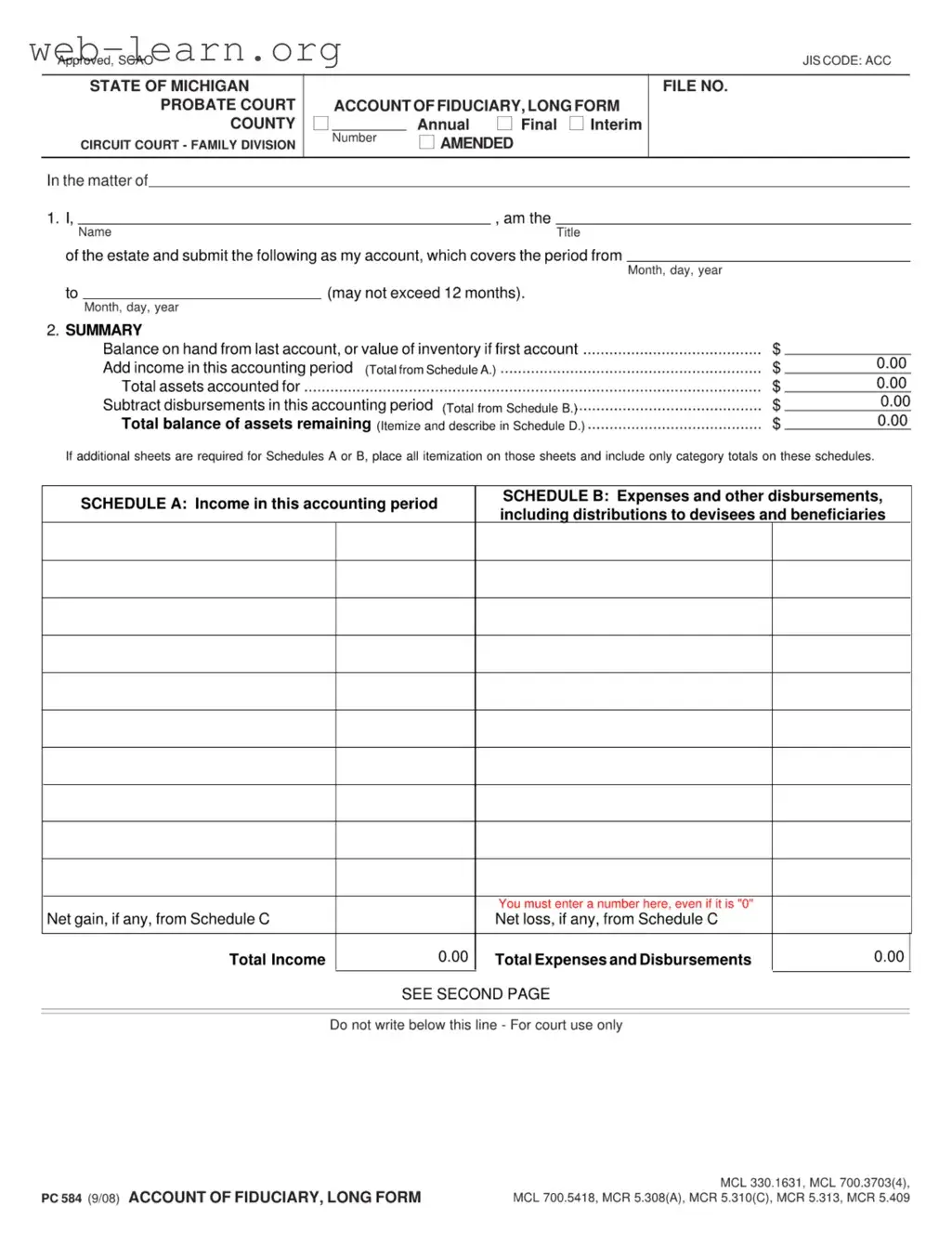
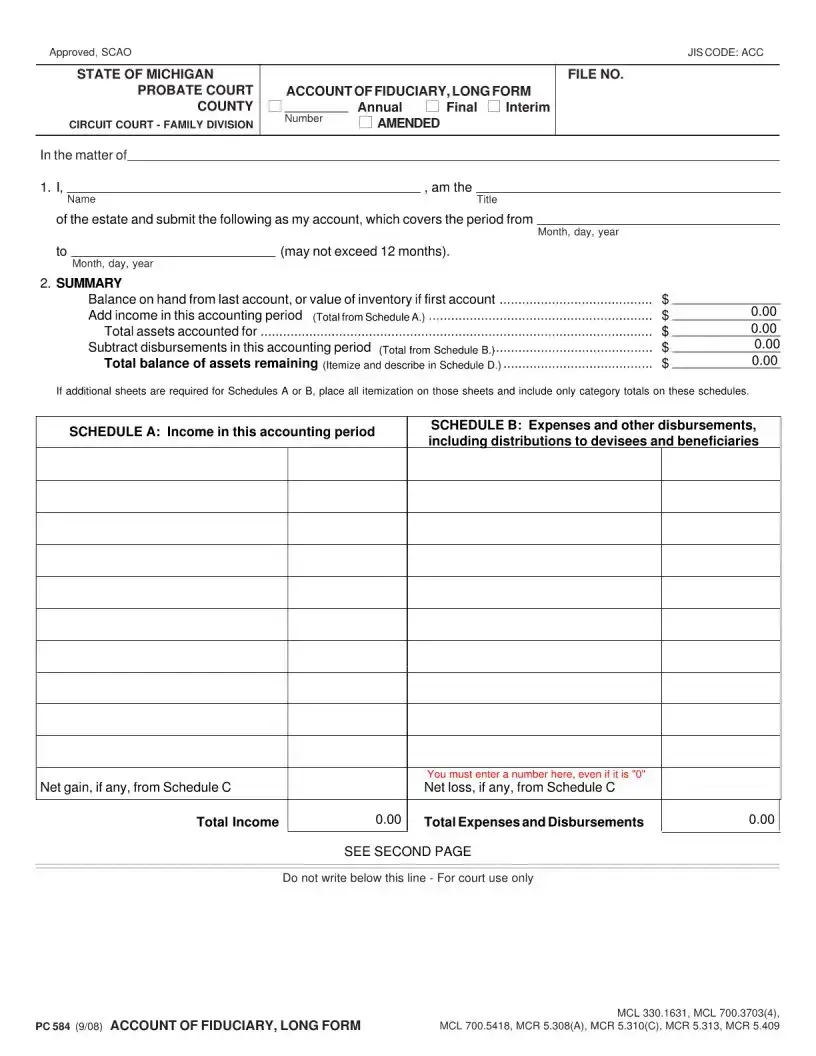
The Michigan PC 584 form, known as the Account of Fiduciary, Long Form, plays a crucial role in the management of estates and trusts. This form is primarily used by fiduciaries to provide a detailed account of financial activities related to the estate over a specified period, typically not exceeding 12 months. It includes essential sections such as a summary of assets, income, and disbursements, allowing for a clear overview of the estate’s financial status. The form requires fiduciaries to list all income received and expenses incurred, ensuring transparency and accountability. Additionally, it mandates the itemization of remaining assets at the end of the accounting period, which helps in tracking the estate's value. Notably, the form also includes provisions for reporting gains and losses from asset dispositions. To maintain the integrity of the accounting process, fiduciaries must attach supporting documents, such as financial institution statements, and provide detailed descriptions of services rendered by attorneys and fiduciaries. Understanding the requirements of the PC 584 form is essential for anyone involved in estate management in Michigan, as it facilitates effective communication with the probate court and interested parties.
Sample - Michigan Pc 584 Form

Form Information

Fact Name Fact Description
Form Purpose The Michigan PC 584 form is used to account for the financial activities of a fiduciary over a specified period.
Governing Laws This form is governed by MCL 330.1631, MCL 700.3703(4), MCL 700.5418, MCR 5.308(A), MCR 5.310(C), MCR 5.313, and MCR 5.409.
Fiduciary Responsibilities The fiduciary must report all income, expenses, and disbursements related to the estate or trust.
Filing Requirements In certain cases, the account must be filed with the probate court, and a filing fee may apply.
Account Period The accounting period cannot exceed 12 months and must be clearly stated on the form.
Verification of Funds For guardianships and conservatorships, proof of liquid assets must be submitted within 30 days after the accounting period ends.
Objection Process Interested persons can file objections to the account with the court, subject to a filing fee.
Perjury Declaration The fiduciary must declare under penalty of perjury that the account is accurate to the best of their knowledge.
Tax Requirements Proof of inheritance or estate tax paid must be attached based on the date of the decedent's death.

Detailed Guide for Filling Out Michigan Pc 584

Filling out the Michigan PC 584 form is a straightforward process that requires attention to detail. This form serves as a comprehensive account of the fiduciary's financial activities during a specified period. It is essential to ensure accuracy and completeness, as this document will be submitted to the court for review.

  1. Begin by entering your name in the designated space for the fiduciary's name.
  2. Indicate your title related to the estate in the appropriate field.
  3. Fill in the accounting period by entering the starting and ending dates (month, day, year).
  4. In the summary section, report the balance on hand from the last account or the value of the inventory if this is the first account.
  5. Add the income received during this accounting period, as detailed in Schedule A.
  6. Calculate the total assets accounted for by summing the balance from the last account and the income reported.
  7. Subtract total disbursements from this accounting period, which should be detailed in Schedule B.
  8. Determine the total balance of assets remaining and itemize them in Schedule D.
  9. If additional sheets are necessary for Schedules A or B, ensure that you include all itemizations on those sheets and only report category totals on the main schedules.
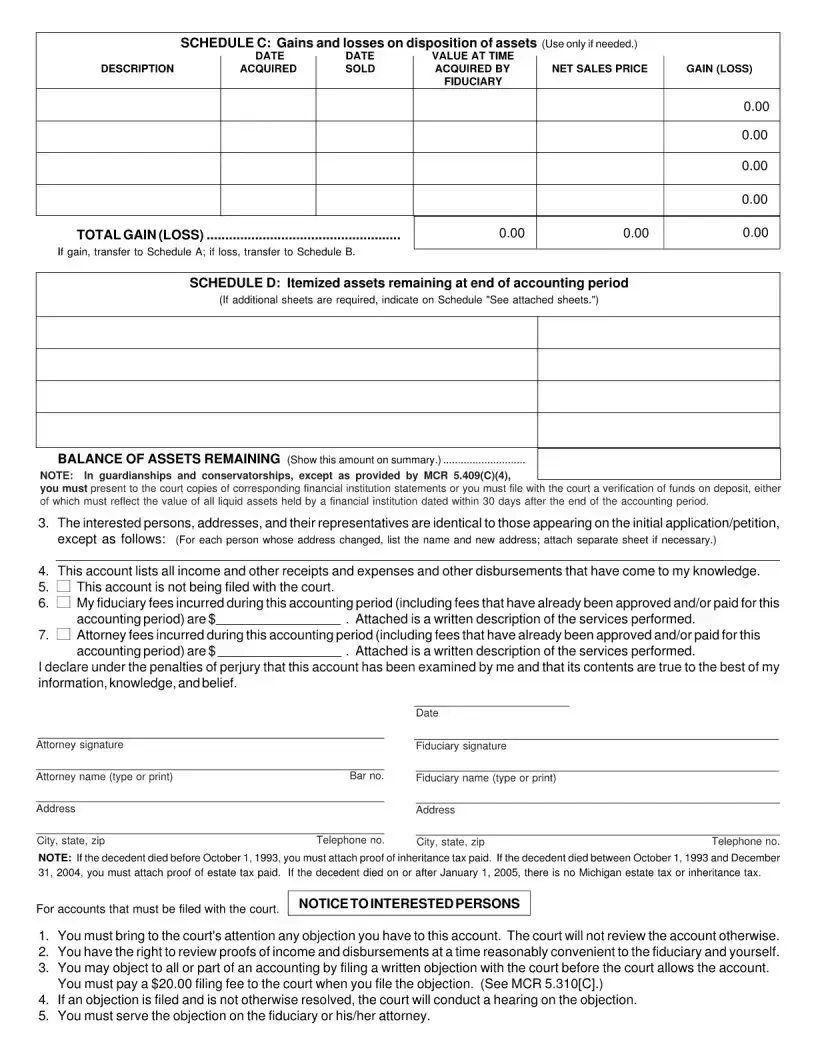
  10. Complete Schedule C if there are any gains or losses from the disposition of assets.
  11. List any interested persons and their addresses, noting any changes from the initial application or petition.
  12. Confirm that all income and expenses are accurately reflected in the account.
  13. Document any fiduciary fees incurred during the accounting period, attaching a description of services performed.
  14. Record any attorney fees incurred, also attaching a description of services performed.
  15. Sign and date the form, ensuring that both the fiduciary and the attorney provide their signatures and printed names.
  16. Include the addresses and telephone numbers for both the fiduciary and the attorney.
  17. Attach any necessary proof of inheritance or estate tax paid, if applicable.

Obtain Answers on Michigan Pc 584

  1. What is the Michigan PC 584 form?

    The Michigan PC 584 form is a legal document used to report the financial activities of a fiduciary, such as an executor or guardian, for a specific accounting period. It includes details about income, expenses, and the remaining assets of the estate or guardianship.

  2. Who needs to file the PC 584 form?

    The form must be completed by fiduciaries managing estates or guardianships. This includes executors of wills, guardians for minors or incapacitated individuals, and conservators managing financial affairs. It ensures that all financial transactions are documented and transparent.

  3. What information is required on the form?

    The form requires several key pieces of information:

    • Name and title of the fiduciary
    • Accounting period dates
    • Summary of the estate's financial status, including income, expenses, and remaining assets
    • Details of any gains or losses from asset dispositions
    • Fiduciary and attorney fees incurred during the accounting period
  4. Are there any attachments needed with the form?

    Yes, attachments may be required. If the accounting period involves guardianships or conservatorships, you must provide financial institution statements or a verification of funds. Additionally, if the decedent died before October 1, 1993, proof of inheritance tax paid is necessary. For deaths between October 1, 1993, and December 31, 2004, proof of estate tax paid must be included.

  5. What happens if someone objects to the accounting?

    If an interested person has an objection, they must bring it to the court's attention. The court will not review the account unless notified. The objecting party must file a written objection with the court and pay a $20.00 filing fee. If unresolved, the court will hold a hearing to address the objection.

  6. Is there a deadline for filing the PC 584 form?

    While the form must be submitted regularly, specific deadlines can vary based on the court's requirements and the estate's circumstances. It’s essential to check with the local probate court for any specific timelines that apply to your situation.

Common mistakes

Filling out the Michigan PC 584 form can be a daunting task, and mistakes can lead to delays or complications in the probate process. One common error is failing to provide complete and accurate information. When listing the balance on hand from the last account or the value of the inventory, it’s crucial to ensure that these figures are correct. Inaccurate totals can raise red flags and may require additional explanations or corrections.

Another frequent mistake involves not including all necessary schedules. The form requires detailed reporting of income and expenses through Schedules A and B. If you forget to attach these schedules or fail to provide itemized details, it could lead to complications. Remember, it’s essential to document every aspect of the accounting period accurately.

People often overlook the importance of updating addresses for interested persons. If any addresses have changed since the initial application or petition, it’s vital to list the new information. Omitting this can cause confusion and may hinder the process of notifying all parties involved.

Additionally, some individuals neglect to attach the required financial statements or verification of funds. For guardianships and conservatorships, this step is not just a formality; it’s a legal requirement. Failing to provide proof of liquid assets can result in the court rejecting the account.

Finally, a common oversight is not including the fiduciary and attorney fees accurately. It’s important to disclose all fees incurred during the accounting period. If you don’t provide a written description of the services performed, it may raise questions about the legitimacy of those fees. Always ensure that you have documented everything thoroughly to avoid any issues.

Documents used along the form

When dealing with the Michigan PC 584 form, which is the Account of Fiduciary, Long Form, several other documents often accompany it. Each of these documents plays a crucial role in ensuring transparency and accountability in the management of an estate or trust. Below is a list of these forms, along with a brief description of their purpose.

  • PC 583 - Account of Fiduciary, Short Form: This form serves as a simplified version of the PC 584, designed for situations where the accounting period is shorter or the financial activity is less complex.
  • PC 580 - Inventory of Estate: This document provides a detailed list of all assets within the estate, including their values at the time of the decedent's passing, helping to establish a clear picture of the estate's worth.
  • PC 581 - Petition for Appointment of Personal Representative: This form initiates the probate process by requesting the court to appoint someone to manage the estate, ensuring that the fiduciary has the legal authority to act on behalf of the estate.
  • PC 582 - Order Appointing Personal Representative: Once the petition is approved, this document formally appoints the personal representative, granting them the authority to handle the estate's affairs.
  • PC 584a - Statement of Account: This is a supplementary document that provides a detailed breakdown of the fiduciary's financial activities, including income and disbursements, which can be attached to the PC 584 for clarity.
  • PC 585 - Waiver of Accounting: In some cases, beneficiaries may agree to waive the formal accounting process, allowing the fiduciary to manage the estate without the need for detailed reporting to the court.
  • PC 586 - Notice to Interested Persons: This document informs all parties with a stake in the estate about the accounting and any actions taken by the fiduciary, ensuring that everyone is kept in the loop regarding the estate's management.

Each of these forms is integral to the probate process in Michigan. They help maintain accountability and protect the interests of all parties involved. Understanding these documents can empower individuals to navigate the complexities of estate management with greater confidence.

Similar forms

The Michigan PC 584 form is used for reporting the account of a fiduciary. Similar documents serve comparable purposes in managing financial accounts for estates or trusts. Here are five documents that share similarities with the Michigan PC 584 form:

  • Michigan PC 583 - Account of Fiduciary, Short Form: This document is also used to report the financial activities of a fiduciary but is designed for simpler estates or accounts. It requires less detail than the long form, making it easier to complete for smaller estates.
  • California Form DE-154 - Final Distribution Account: This form is utilized in California for final accounting in probate cases. It details the distribution of assets to beneficiaries, similar to how the Michigan PC 584 outlines disbursements and remaining assets.
  • Florida Form 706 - Estate Tax Return: While primarily a tax document, this form requires an accounting of the estate's assets and liabilities. Like the Michigan PC 584, it necessitates detailed reporting of financial information related to the estate.
  • New York Form C-1 - Account of a Fiduciary: This form serves a similar purpose in New York, detailing the financial transactions of a fiduciary over a specified period. It includes sections for income, expenses, and remaining assets, paralleling the structure of the Michigan PC 584.
  • Texas Form 104 - Annual Account of a Guardian: This document is for guardians managing the finances of a ward. It outlines income, expenses, and remaining assets, akin to the reporting requirements in the Michigan PC 584.

Dos and Don'ts

When filling out the Michigan PC 584 form, it is important to follow specific guidelines to ensure accuracy and compliance. Below is a list of things you should and shouldn't do.

  • Do provide accurate information regarding the estate and accounting period.
  • Do include all income and disbursements for the specified accounting period.
  • Do attach necessary documentation, such as financial institution statements, if applicable.
  • Do sign and date the form to confirm the accuracy of the information provided.
  • Do ensure that all totals are clearly calculated and correctly entered.
  • Don't leave any sections blank; if something does not apply, indicate that clearly.
  • Don't submit the form without reviewing it for errors or omissions.
  • Don't forget to notify the court of any objections to the account.
  • Don't file the form without including the required attachments, if applicable.

Following these guidelines can help streamline the process and avoid potential issues. Make sure to take your time and double-check your work before submission.

Misconceptions

Misconceptions about the Michigan PC 584 form can lead to confusion for fiduciaries and interested parties. Here are six common misunderstandings:

  • The form is only for final accounts. Many believe that the Michigan PC 584 form is exclusively for final accounts. In reality, it can also be used for annual and interim accounts.
  • All assets must be liquidated before filing. Some think that all assets need to be converted to cash before filing the form. However, the form allows for itemized reporting of remaining assets, including those that are not liquid.
  • Filing is optional for fiduciaries. A common misconception is that fiduciaries can choose whether or not to file the account. In fact, filing is often required, especially in guardianships and conservatorships.
  • Objections can be filed anytime. Many assume that objections to the account can be submitted at any time. However, objections must be filed before the court allows the account, and there is a specific procedure to follow.
  • Fiduciaries do not need to provide supporting documents. Some believe that the form alone suffices. In truth, fiduciaries must attach relevant documents, such as financial institution statements or descriptions of services performed.
  • There are no fees associated with filing objections. It is a misconception that filing an objection is free. In fact, there is a $20.00 filing fee that must be paid when submitting an objection to the court.

Understanding these misconceptions can help ensure compliance with the requirements of the Michigan PC 584 form and facilitate a smoother process for all parties involved.

Key takeaways

Filling out the Michigan PC 584 form is an important process for fiduciaries managing estates. Here are key takeaways to consider:

  • The form is used to provide a detailed account of financial activities related to an estate over a specific period.
  • It is essential to include a summary that outlines the balance on hand, income received, and disbursements made during the accounting period.
  • Fiduciaries must itemize assets remaining at the end of the accounting period in Schedule D.
  • Any gains or losses from the disposition of assets should be reported in Schedule C, if applicable.
  • Verification of liquid assets held by financial institutions must be submitted if the accounting involves guardianships or conservatorships.
  • Fiduciaries should include all relevant financial information, including fiduciary and attorney fees incurred during the accounting period.
  • Interested persons have the right to object to the account, but they must do so in writing and pay a filing fee.
  • Objections must be served to the fiduciary or their attorney to be considered by the court.
  • It is crucial to declare the accuracy of the account under penalties of perjury, ensuring that the information is true to the best of the fiduciary's knowledge.

Understanding these points can help ensure compliance with the requirements of the Michigan PC 584 form and facilitate a smoother process in managing estate accounts.