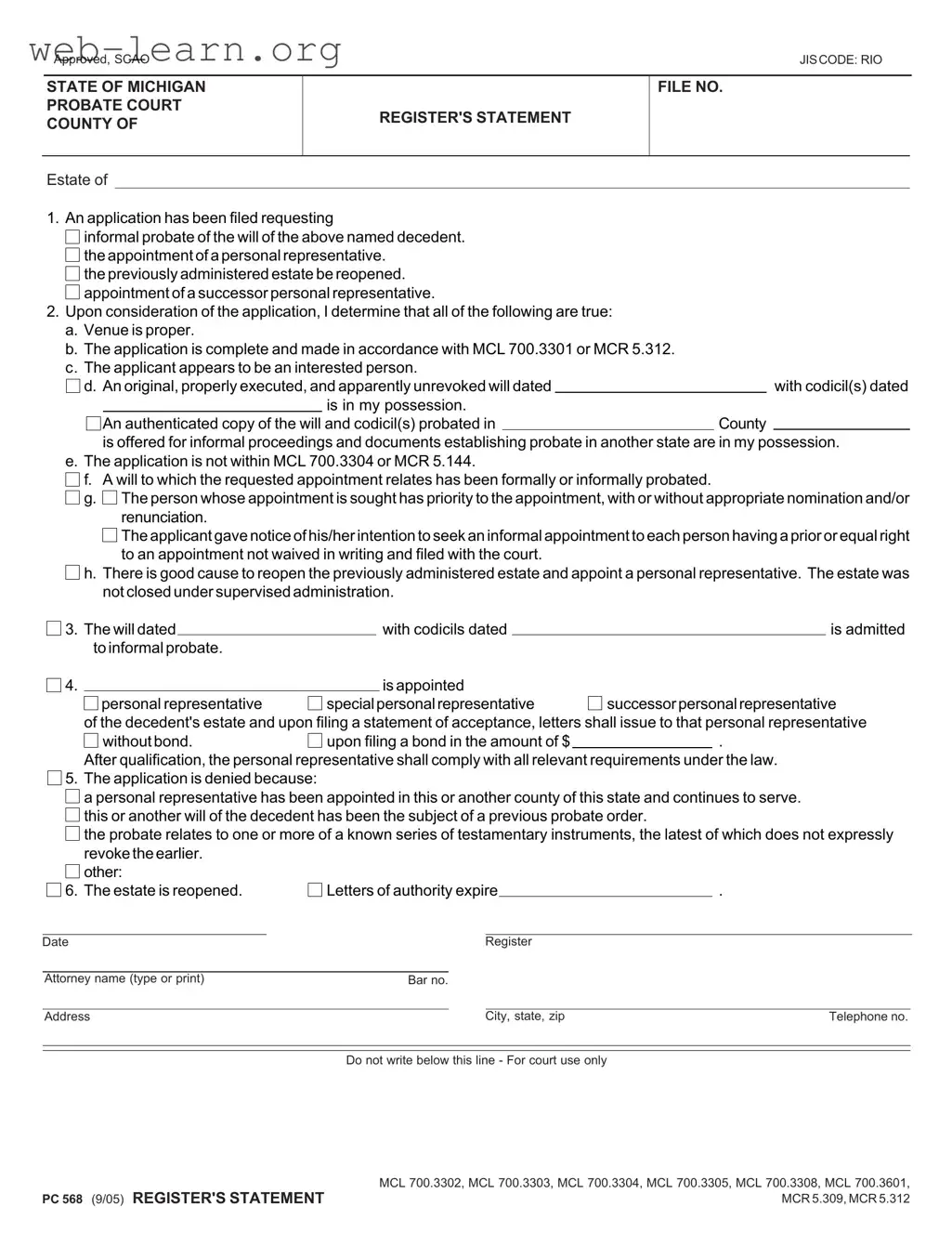
The Michigan PC 568 form plays a crucial role in the probate process, specifically for informal probate proceedings. It is used when someone applies to the probate court for various reasons related to a decedent's estate. This includes requests for the informal probate of a will, the appointment of a personal representative, or even the reopening of a previously administered estate. The form ensures that the court has all necessary information to make informed decisions. It confirms that the application meets legal requirements and that the applicant has the right to seek probate. Additionally, the form addresses the status of the will, including whether it has been formally or informally probated before. It also outlines the responsibilities of the appointed personal representative and the conditions under which the application may be denied. By following the guidelines set forth in this form, individuals can navigate the complexities of estate management with greater ease and confidence.

Approved, SCAO |
JISCODE: RIO |
STATE OF MICHIGAN PROBATE COURT COUNTY OF
REGISTER'S STATEMENT
FILE NO.
Estate of
1. An application has been filed requesting |
|
informal probate of the will of the above named decedent. |
|
theappointment ofa personal representative. |
|
the previously administered estate be reopened. |
|
appointment of a successor personal representative. |
|
2. Upon consideration of the application, I determine that all of the following are true: |
|
a. Venue is proper. |
|
b. The application is complete and made in accordance with MCL 700.3301 or MCR 5.312. |
|
c. The applicant appears to be an interested person. |
|
d. An original, properly executed, and apparently unrevoked will dated |
with codicil(s) dated |
is in my possession. |
|
An authenticated copy of the will and codicil(s) probated in |
County |
is offered for informal proceedings and documents establishing probate in another state are in my possession. e. The application is not within MCL 700.3304 or MCR 5.144.
f. A will to which the requested appointment relates has been formally or informally probated.
g. The person whose appointment is sought has priority to the appointment, with or without appropriate nomination and/or renunciation.
Theapplicantgavenoticeofhis/herintentiontoseekaninformalappointmenttoeachpersonhavingapriororequalright to an appointment not waived in writing and filed with the court.
h. There is good cause to reopen the previously administered estate and appoint a personal representative. The estate was
|
not closed under supervised administration. |
|
|
|
||||||||||
3. |
The will dated |
|
|
|
with codicils dated |
|
|
|
is admitted |
|||||
|
to informal probate. |
|
|
|
|
|
|
|
|
|
|
|
||
4. |
|
|
|
|
|
is appointed |
|
|
|
|||||
|
personal representative |
specialpersonalrepresentative |
successorpersonalrepresentative |
|||||||||||
|
of the decedent's estate and upon filing a statement of acceptance, letters shall issue to that personal representative |
|||||||||||||
|
withoutbond. |
upon filing a bond in the amount of $ |
|
|
. |
|
||||||||
|
After qualification, the personal representative shall comply with all relevant requirements under the law. |
|||||||||||||
5. |
The application is denied because: |
|
|
|
|
|
|
|
|
|
|
|
||
|
a personal representative has been appointed in this or another county of this state and continues to serve. |
|||||||||||||
|
this or another will of the decedent has been the subject of a previous probate order. |
|||||||||||||
|
the probate relates to one or more of a known series of testamentary instruments, the latest of which does not expressly |
|||||||||||||
|
revoketheearlier. |
|
|
|
|
|
|
|
|
|
|
|
||
|
other: |
|
|
|
|
|
|
|
|
|
|
|
||
6. |
The estate is reopened. |
Letters of authority expire |
|
|
|
. |
|
|||||||
|
|
|
|
|
|
|
|
|
|
|
|
|
||
Date |
|
|
|
|
|
|
|
Register |
|
|
|
|||
|
|
|
|
|
|
|
|
|
|
|
|
|||
Attorney name (type or print) |
|
|
Bar no. |
|
|
|
||||||||
|
|
|
|
|
|
|
|
|
|
|
|
|||
Address |
|
|
|
|
City, state, zip |
|
|
Telephone no. |
||||||
|
|
|
|
|
|
|
|
|
|
|
|
|||
|
|
|
|
|
|
|
|
|
|
|
|
|||
|
|
|
|
Do not write below this line - For court use only |
|
|
|
|||||||
|
MCL 700.3302, MCL 700.3303, MCL 700.3304, MCL 700.3305, MCL 700.3308, MCL 700.3601, |
PC 568 (9/05) REGISTER'S STATEMENT |
MCR 5.309, MCR 5.312 |
| Fact Name | Details |
|---|---|
| Purpose of the Form | The Michigan PC 568 form is used to request informal probate of a will, the appointment of a personal representative, or the reopening of a previously administered estate. |
| Governing Laws | The form is governed by several laws, including MCL 700.3301, MCL 700.3302, MCL 700.3303, MCL 700.3304, MCL 700.3305, MCL 700.3308, MCL 700.3601, and MCR 5.309, MCR 5.312. |
| Application Requirements | The applicant must provide a complete application, demonstrate proper venue, and present an original will that appears valid. |
| Personal Representative Appointment | A personal representative may be appointed without bond, or with bond, depending on the circumstances outlined in the application. |
Completing the Michigan PC 568 form is an important step in managing the probate process. This form helps facilitate various requests related to the estate of a deceased person. Following the steps outlined below will assist you in filling out the form accurately and efficiently.
After filling out the form, you will need to submit it to the appropriate probate court in Michigan. Make sure to keep a copy for your records. Following submission, you may receive further instructions or updates regarding your application.
What is the Michigan PC 568 form?
The Michigan PC 568 form is a legal document used in probate court. It serves as a register's statement that accompanies applications for informal probate of a will, appointment of a personal representative, or reopening of a previously administered estate. The form ensures that the court has the necessary information to process these requests.
Who can file the Michigan PC 568 form?
Any interested person, such as a beneficiary or heir of the decedent, can file the Michigan PC 568 form. It is important that the applicant has a legitimate interest in the estate and meets the requirements outlined in Michigan law.
What information is required on the form?
The form requires various pieces of information, including:
Providing complete and accurate information is crucial for the application to be processed effectively.
What happens after the form is filed?
Once the Michigan PC 568 form is filed, the probate court will review the application. If all conditions are met, the court may admit the will to informal probate and appoint a personal representative. If the application is denied, the court will provide reasons for the denial.
Can the estate be reopened using this form?
Yes, the Michigan PC 568 form can be used to reopen a previously administered estate. The applicant must demonstrate good cause for reopening the estate, and the estate must not have been closed under supervised administration.
What is the role of the personal representative?
The personal representative is responsible for managing the decedent's estate. This includes settling debts, distributing assets to beneficiaries, and ensuring compliance with legal requirements. The representative must file a statement of acceptance and may need to post a bond, depending on the court's requirements.
What if the application is denied?
If the application is denied, the court will specify the reasons. Common reasons for denial include the appointment of another personal representative or the existence of a previous probate order for the will in question. The applicant may seek legal advice to understand the next steps.
Where can I obtain the Michigan PC 568 form?
The Michigan PC 568 form can typically be obtained from the local probate court or downloaded from the Michigan Courts website. It is advisable to ensure that you are using the most current version of the form.
Filling out the Michigan PC 568 form is an important step in the probate process, but many individuals make mistakes that can lead to delays or complications. One common error occurs when applicants fail to provide complete information. Each section of the form requires specific details, and leaving out any information can result in the application being deemed incomplete. It is crucial to double-check that all fields are filled out accurately and thoroughly.
Another frequent mistake is neglecting to include the proper documentation. The form requires an original will and any codicils that are relevant to the case. If these documents are not submitted, the court may not be able to process the application. Ensure that you have all necessary documents ready and that they are properly executed and dated.
People often overlook the importance of verifying their relationship to the decedent. The form requires that the applicant be an "interested person," which means they have a legitimate stake in the estate. Failing to demonstrate this connection can lead to the rejection of the application. It’s advisable to clearly state your relationship to the decedent in the application.
Additionally, some applicants forget to provide notice to individuals who have prior or equal rights to the appointment of a personal representative. This notice is essential, as it shows that all interested parties have been informed of the proceedings. If notice has not been properly given, it can complicate or even derail the probate process.
Another common error is misinterpreting the requirements for reopening a previously administered estate. The form specifies that there must be good cause for reopening, and applicants often fail to provide sufficient justification. Clear and compelling reasons should be included in the application to support the request for reopening the estate.
Lastly, applicants sometimes neglect to sign the form or provide the necessary contact information. A missing signature can render the application invalid, while incomplete contact details can lead to communication issues with the court. Always ensure that you sign the form and provide a current address and phone number to avoid unnecessary complications.
The Michigan PC 568 form is an essential document in the probate process, particularly when dealing with the informal probate of a will. However, there are several other forms and documents that often accompany it, each serving a specific purpose in the overall procedure. Below is a list of these documents, along with brief descriptions of their roles.
Understanding these forms and their purposes can make navigating the probate process smoother. Each document plays a vital role in ensuring that the wishes of the deceased are honored and that the estate is managed properly. Being informed helps everyone involved to be better prepared for what lies ahead.
The Michigan PC 568 form is a critical document used in the probate process, particularly for informal probate. It shares similarities with several other legal documents that serve various purposes in estate management and probate proceedings. Here are ten documents that are similar to the Michigan PC 568 form, along with explanations of how they relate:
When filling out the Michigan PC 568 form, it’s essential to approach the task with care and attention to detail. Here’s a helpful list of things you should and shouldn’t do to ensure a smooth process.
By following these guidelines, you can navigate the process of completing the Michigan PC 568 form with confidence and ease.
Understanding the Michigan PC 568 form is essential for anyone involved in the probate process. However, several misconceptions can lead to confusion. Here are four common misunderstandings:
This form can also be used to reopen previously administered estates. If circumstances change or new information arises, this form allows for the reopening of an estate.
While attorneys often handle probate matters, interested individuals can also file the form. Anyone with a legitimate interest in the estate may submit the application.
Filing the form does not ensure that the will is accepted for probate. The court will evaluate the application and determine whether all requirements are met before proceeding.
Additional documents may be required depending on the specifics of the estate. It is important to review all necessary paperwork to ensure compliance with probate laws.
When filling out and using the Michigan PC 568 form, it’s essential to understand the key components involved in the process. Here are some important takeaways: