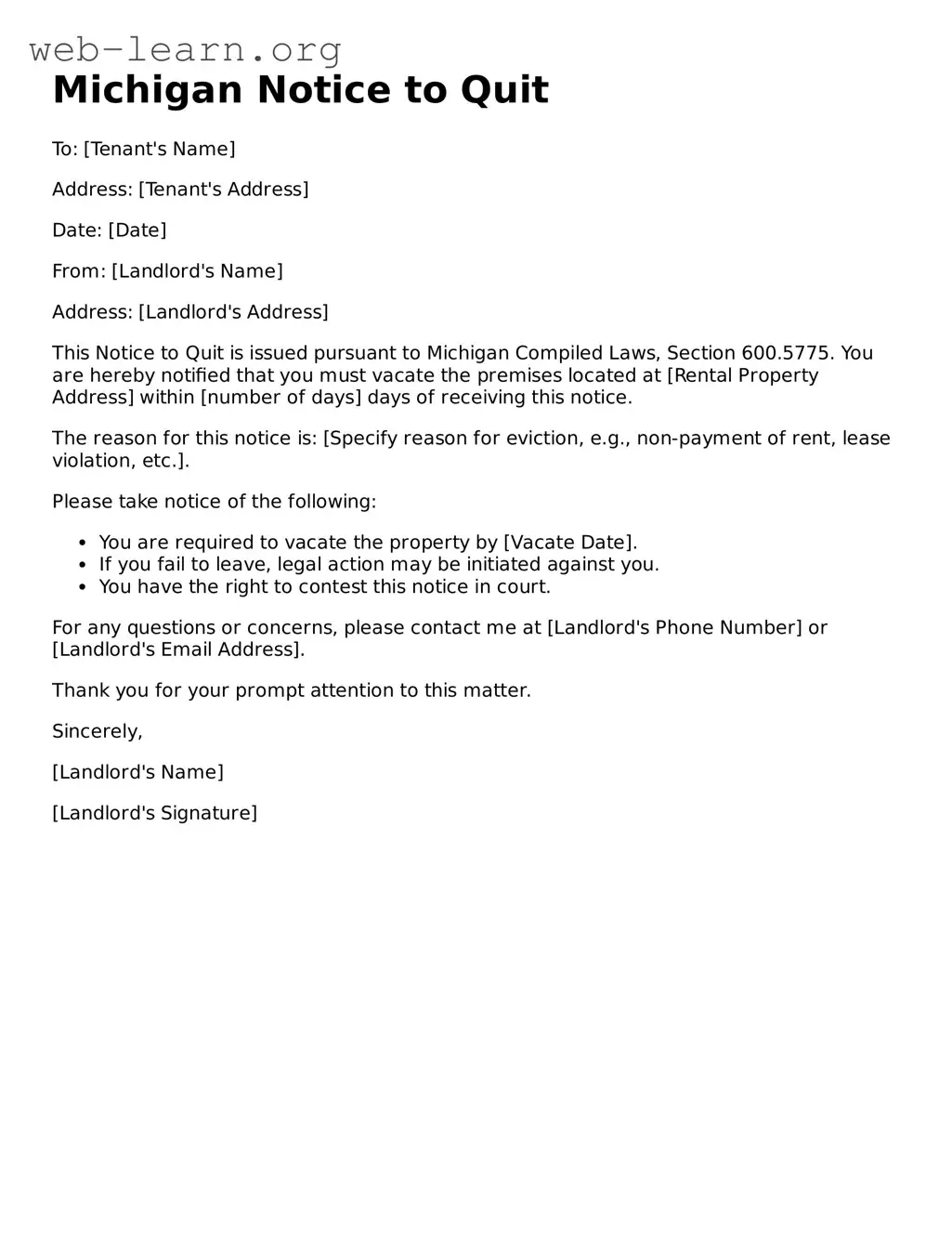
The Michigan Notice to Quit form plays a crucial role in the landlord-tenant relationship, serving as an official notification that a tenant must vacate the rental property. This form is often the first step in the eviction process, signaling to the tenant that they are in violation of their lease agreement, whether due to non-payment of rent, lease violations, or other reasons. The document outlines the specific grounds for termination, providing essential details such as the date by which the tenant must leave and any pertinent information regarding the lease terms. Additionally, the Notice to Quit must comply with state laws, ensuring that it is delivered in a manner that is legally recognized, which may include personal delivery, certified mail, or posting on the property. Understanding the nuances of this form is vital for both landlords seeking to enforce their rights and tenants who wish to protect their interests. By clearly communicating the need for a tenant to vacate, the Notice to Quit serves not only as a legal requirement but also as a tool for facilitating a smoother transition for all parties involved.
Michigan Notice to Quit
To: [Tenant's Name]
Address: [Tenant's Address]
Date: [Date]
From: [Landlord's Name]
Address: [Landlord's Address]
This Notice to Quit is issued pursuant to Michigan Compiled Laws, Section 600.5775. You are hereby notified that you must vacate the premises located at [Rental Property Address] within [number of days] days of receiving this notice.
The reason for this notice is: [Specify reason for eviction, e.g., non-payment of rent, lease violation, etc.].
Please take notice of the following:
For any questions or concerns, please contact me at [Landlord's Phone Number] or [Landlord's Email Address].
Thank you for your prompt attention to this matter.
Sincerely,
[Landlord's Name]
[Landlord's Signature]
| Fact Name | Description |
|---|---|
| Purpose | The Michigan Notice to Quit form is used to inform a tenant that they must vacate the rental property. |
| Governing Law | This form is governed by the Michigan Compiled Laws, specifically MCL 600.5775. |
| Delivery Methods | The notice can be delivered in person, by mail, or by posting it on the property. |
| Notice Period | The required notice period can vary based on the reason for eviction; typically, it is 7 days for non-payment of rent. |
| Tenant Rights | Tenants have the right to contest the eviction in court after receiving the notice. |
| Form Requirements | The notice must include specific information such as the tenant's name, address, and the reason for the eviction. |
| Signature Requirement | The form should be signed by the landlord or their authorized agent to be valid. |
| Legal Consequences | Failure to comply with the notice can lead to a formal eviction process initiated by the landlord. |
| Record Keeping | Landlords should keep a copy of the notice for their records as proof of the eviction process. |
After obtaining the Michigan Notice to Quit form, it's important to fill it out correctly to ensure it meets legal requirements. Once completed, the form will be served to the tenant, and this step is crucial for moving forward with any potential eviction process.
What is a Michigan Notice to Quit form?
The Michigan Notice to Quit form is a legal document used by landlords to inform tenants that they must vacate the rental property. This notice serves as a formal request for the tenant to leave, typically due to lease violations, non-payment of rent, or other reasons specified by law.
When should a landlord use a Notice to Quit?
A landlord should issue a Notice to Quit when a tenant fails to comply with the terms of the lease agreement. Common reasons include not paying rent on time, causing damage to the property, or engaging in illegal activities. The notice provides the tenant with a specific timeframe to remedy the situation or vacate the premises.
How much notice must be given to the tenant?
The notice period varies depending on the reason for eviction. For non-payment of rent, a landlord typically must provide a 7-day notice. For lease violations, a 30-day notice is usually required. It is essential to follow the appropriate timeframes as outlined by Michigan law.
Can a tenant contest a Notice to Quit?
Yes, a tenant has the right to contest a Notice to Quit. If the tenant believes the notice is unjust, they can respond to the landlord and may choose to take legal action. A court will ultimately decide whether the eviction is warranted based on the evidence presented.
What happens if the tenant does not leave after receiving a Notice to Quit?
If the tenant does not vacate the property by the deadline specified in the Notice to Quit, the landlord can proceed with legal eviction proceedings. This typically involves filing a complaint in the local district court to seek a judgment for eviction.
Is a Notice to Quit the same as an eviction notice?
No, a Notice to Quit is not the same as an eviction notice. The Notice to Quit is the first step in the eviction process, serving as a warning to the tenant. If the tenant fails to comply, the landlord may then file for eviction, which is a legal action that requires court involvement.
Do I need to provide a reason for the Notice to Quit?
Yes, it is important to include a clear reason for issuing the Notice to Quit. This helps the tenant understand why they are being asked to leave and provides a basis for any potential legal proceedings if the matter escalates.
Can a Notice to Quit be delivered electronically?
In Michigan, a Notice to Quit can be delivered in person, by mail, or through other means, including electronic delivery, if the tenant has agreed to receive notices in that manner. However, it is advisable to keep a record of how the notice was delivered.
What should I do if I receive a Notice to Quit?
If you receive a Notice to Quit, it is crucial to read it carefully and understand your rights. You may want to address the issue stated in the notice, such as paying overdue rent or resolving lease violations. If you believe the notice is unjust, consider seeking legal advice to explore your options.
Where can I find a Michigan Notice to Quit form?
A Michigan Notice to Quit form can be obtained from various sources, including online legal document providers, local court websites, or legal aid organizations. Ensure that the form you choose complies with Michigan laws and includes all necessary information.
Completing the Michigan Notice to Quit form can be a straightforward process, but many individuals make common mistakes that can lead to delays or complications. Awareness of these pitfalls can help ensure that the form is filled out correctly and serves its intended purpose.
One frequent mistake is failing to provide accurate tenant information. It is crucial to include the full name of the tenant as it appears in the lease agreement. Omitting or misspelling the name can create confusion and may render the notice invalid. Additionally, including the correct address of the rental property is equally important.
Another common error involves not specifying the reason for the notice. Michigan law requires that the reason for the eviction be clearly stated. Whether it is for non-payment of rent or a lease violation, clarity is key. A vague or incomplete explanation can lead to challenges in court.
Many people also overlook the requirement for proper dates. The notice must include the date it is issued and the date by which the tenant must vacate the property. Failing to provide these dates can result in legal complications and may extend the eviction process unnecessarily.
In some cases, individuals forget to sign the form. A signature is essential as it verifies that the notice is legitimate and that the landlord has taken the necessary steps to initiate the eviction process. Without a signature, the document may be considered incomplete.
Another mistake involves not providing the tenant with a copy of the notice. It is important to deliver the notice in accordance with Michigan law, which may include personal delivery or sending it via certified mail. Failure to do so can lead to disputes over whether the tenant was properly informed.
Additionally, some landlords neglect to keep a record of the notice. Documenting the issuance of the Notice to Quit can serve as important evidence should the matter proceed to court. A simple record of the delivery method and date can make a significant difference in legal proceedings.
Lastly, individuals may not be aware of the specific notice periods required by Michigan law. Depending on the reason for eviction, the notice period can vary. Understanding these requirements is essential to ensure compliance with legal standards and to avoid further complications.
In Michigan, the Notice to Quit form is a critical document in the eviction process. However, several other forms and documents are often utilized in conjunction with it to ensure compliance with legal requirements and to facilitate communication between landlords and tenants. Below is a list of these forms, each serving a specific purpose in the eviction process.
Understanding these documents is essential for both landlords and tenants navigating the eviction process in Michigan. Each form plays a vital role in ensuring that the rights of both parties are respected and that the process adheres to legal standards.
When filling out the Michigan Notice to Quit form, it's essential to approach the task with care. This document serves as a formal notice to a tenant regarding the termination of their lease. Here are seven important dos and don’ts to keep in mind:
Taking these steps can help ensure that the process is smooth and legally sound. Properly completing the Notice to Quit form is crucial for both landlords and tenants in Michigan.
Misconception 1: A Notice to Quit is an eviction notice.
Many people believe that a Notice to Quit is the same as an eviction notice. However, this is not accurate. A Notice to Quit is a formal request for a tenant to vacate the property, but it does not initiate the eviction process. Eviction requires a court order, while a Notice to Quit is simply a preliminary step.
Misconception 2: A Notice to Quit can be issued for any reason.
Some individuals think that landlords can issue a Notice to Quit for any reason. In reality, the reasons must align with state law. Common reasons include non-payment of rent or lease violations. Landlords must follow specific legal guidelines when serving this notice.
Misconception 3: Tenants have no rights after receiving a Notice to Quit.
It is a common belief that receiving a Notice to Quit means tenants must leave immediately. This is misleading. Tenants have rights and can respond to the notice. They may dispute the reasons or seek legal advice before vacating the premises.
Misconception 4: A Notice to Quit must be served in person.
Some assume that a Notice to Quit must always be delivered in person. In Michigan, this is not the case. The notice can be served by mail or posted on the property, as long as it complies with the legal requirements. Understanding the methods of service is crucial for both landlords and tenants.
When dealing with the Michigan Notice to Quit form, it's important to understand its purpose and the process involved. Here are some key takeaways:
House Quit Notice Letter - Understanding the Notice to Quit can help tenants negotiate or resolve issues with their landlord.
Arizona Eviction Process for Non Payment of Rent - This document serves as a warning to tenants regarding lease violations.