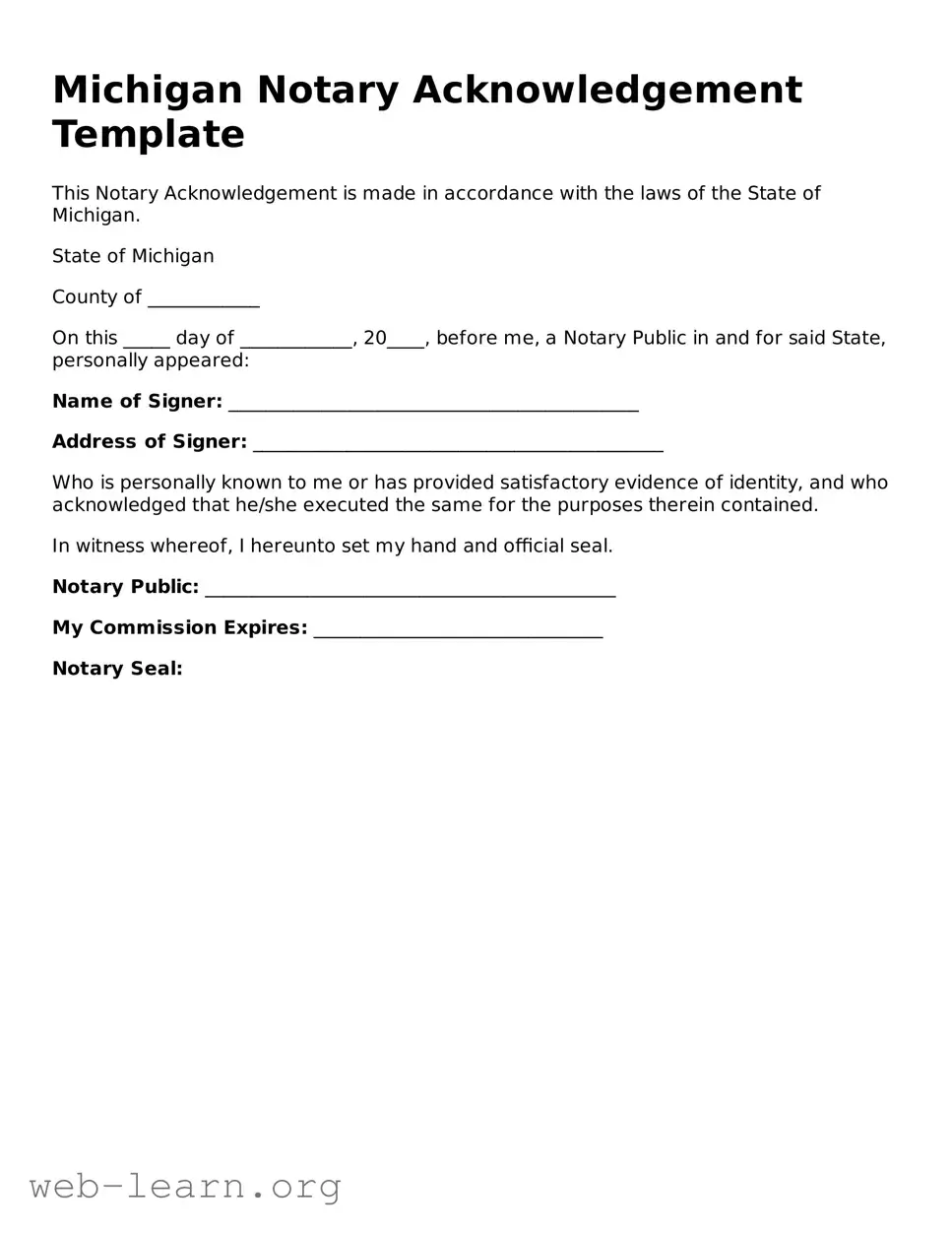
The Michigan Notary Acknowledgement form plays a crucial role in the notarization process, ensuring that signatures on important documents are verified and authenticated. This form serves as a declaration by the signer, confirming their identity and willingness to sign the document in question. By completing this form, individuals can protect themselves and others from fraud and ensure that legal documents hold up in court. The notary public, an impartial witness, verifies the identity of the signer and affixes their seal to the form, adding an extra layer of credibility. This process not only enhances the trustworthiness of the document but also complies with state laws governing notarization. Understanding the key components of the Michigan Notary Acknowledgement form is essential for anyone involved in transactions that require notarized signatures, whether for real estate, legal agreements, or financial documents.
Michigan Notary Acknowledgement Template
This Notary Acknowledgement is made in accordance with the laws of the State of Michigan.
State of Michigan
County of ____________
On this _____ day of ____________, 20____, before me, a Notary Public in and for said State, personally appeared:
Name of Signer: ____________________________________________
Address of Signer: ____________________________________________
Who is personally known to me or has provided satisfactory evidence of identity, and who acknowledged that he/she executed the same for the purposes therein contained.
In witness whereof, I hereunto set my hand and official seal.
Notary Public: ____________________________________________
My Commission Expires: _______________________________
Notary Seal:
| Fact Name | Description |
|---|---|
| Purpose | The Michigan Notary Acknowledgment form is used to verify the identity of a signer and confirm that they willingly signed a document. |
| Governing Law | This form is governed by the Michigan Notary Public Act, specifically MCL 55.261 to 55.309. |
| Signer's Presence | The signer must be present before the notary at the time of acknowledgment. |
| Identification Requirement | The notary is required to verify the identity of the signer through an acceptable form of identification. |
| Signature Requirement | The signer must provide their signature on the document in the notary's presence. |
| Notary's Role | The notary public certifies that the signer appeared before them and acknowledged signing the document. |
| Record Keeping | Notaries are advised to keep a record of all acknowledgments performed in their notary journal. |
| Expiration | The acknowledgment does not expire, but the notary's commission must be valid at the time of acknowledgment. |
After obtaining the Michigan Notary Acknowledgement form, you will need to fill it out accurately to ensure it is valid. Follow these steps carefully to complete the form correctly.
Once you have filled out the form, it is ready for use. Keep it in a safe place or submit it as required for your specific needs.
What is a Michigan Notary Acknowledgement form?
The Michigan Notary Acknowledgement form is a legal document that verifies the identity of a signer and confirms that they willingly signed a document. This form is crucial for ensuring the authenticity of signatures on important documents, such as contracts and deeds.
Who can act as a notary in Michigan?
In Michigan, a notary public must be at least 18 years old, a resident of Michigan or a resident of a bordering state who is employed in Michigan, and must have no felony convictions. They are appointed by the state and are responsible for witnessing the signing of documents and administering oaths.
What is the purpose of the notary's acknowledgment?
The purpose of the notary's acknowledgment is to provide a formal declaration that the signer personally appeared before the notary and acknowledged that they signed the document. This adds a layer of protection against fraud and ensures that the document can be trusted by third parties.
How do I complete a Michigan Notary Acknowledgement form?
To complete the form, follow these steps:
Is there a fee for notary services in Michigan?
Yes, notaries in Michigan are allowed to charge a fee for their services. As of the latest guidelines, the maximum fee for a notarial act is $10. However, notaries may choose to charge less, and some may offer their services for free, especially for charitable purposes.
Do I need to use a specific format for the acknowledgment?
While there is no strictly mandated format, the acknowledgment must contain specific elements to be valid. This includes the notary’s name, the date of the acknowledgment, a statement confirming the signer’s identity, and the notary’s signature and seal. Following the standard format helps ensure compliance with Michigan law.
Can I use a Michigan Notary Acknowledgement form for documents from other states?
Yes, a Michigan Notary Acknowledgement form can be used for documents originating from other states, provided that the notary's acknowledgment meets the requirements of Michigan law. However, it is advisable to check if the receiving state has specific requirements for notarization to ensure that the document will be accepted.
When completing the Michigan Notary Acknowledgment form, many individuals make mistakes that can lead to delays or complications. One common error is forgetting to include the date of the acknowledgment. This date is crucial as it indicates when the notary's signature was applied. Without it, the document may not be valid.
Another frequent mistake is not having the signer present at the time of the acknowledgment. The notary must witness the signing of the document to ensure authenticity. If the signer is absent, the notary cannot properly complete the form.
Some people fail to provide the correct name of the signer. The name must match the identification presented to the notary. Discrepancies can result in the document being questioned or rejected.
Additionally, individuals sometimes overlook the requirement for a signature from the notary. The notary must sign the form to validate it. Without this signature, the acknowledgment is incomplete.
Another mistake is neglecting to fill in the notary's commission expiration date. This date is important as it confirms the notary's authority to perform the acknowledgment. An expired commission can invalidate the document.
People also often forget to include their address on the form. The notary's address is necessary for record-keeping and verification purposes. Omitting this information can lead to issues down the line.
Not providing the appropriate identification for the signer is another common error. The notary must verify the identity of the signer through valid ID. If proper identification is not presented, the acknowledgment cannot be completed.
Some individuals fail to check for any additional requirements specific to their situation. Different types of documents may have unique requirements. Not being aware of these can lead to incomplete or incorrect forms.
Another mistake is not keeping a copy of the completed acknowledgment. It is essential to maintain records for future reference. Without a copy, it may be challenging to verify the acknowledgment later.
Lastly, rushing through the process can lead to multiple errors. Taking the time to carefully review the form before submission can prevent many of these common mistakes. Attention to detail is key in ensuring a valid acknowledgment.
When utilizing the Michigan Notary Acknowledgment form, several other documents may also be required to ensure proper legal procedures are followed. Each of these documents serves a specific purpose in the notarization process.
Understanding these documents can help streamline the notarization process and ensure that all necessary steps are taken for legal compliance. Always consult with a professional if you have questions about specific requirements.
The Notary Acknowledgment form serves an important purpose in the legal world, confirming that a signature is genuine and that the signer acted voluntarily. Several other documents share similarities with this form. Here’s a look at eight of them:
Each of these documents plays a role in ensuring that transactions are legitimate and that the intentions of the parties involved are clear. Notarization adds an important layer of security and trust in these processes.
When filling out the Michigan Notary Acknowledgment form, it's important to be thorough and precise. Here are some guidelines to help ensure the process goes smoothly.
By following these simple guidelines, you can help ensure that the notary process is efficient and effective. Remember, attention to detail is key in legal documentation.
Understanding the Michigan Notary Acknowledgement form can be challenging, and several misconceptions often arise. Here are seven common misunderstandings:
By understanding these misconceptions, individuals can better navigate the notary process and ensure their documents are properly executed.
When filling out and using the Michigan Notary Acknowledgment form, there are several important points to keep in mind. Here are some key takeaways:
By following these guidelines, individuals can effectively navigate the process of using the Michigan Notary Acknowledgment form.