In the realm of business, the protection of sensitive information is paramount. The Michigan Non-disclosure Agreement (NDA) form serves as a crucial tool for safeguarding proprietary data, trade secrets, and confidential discussions between parties. This legal document outlines the obligations of those involved, ensuring that shared information remains secure and is not disclosed to unauthorized individuals. The NDA typically includes key components such as the definition of what constitutes confidential information, the duration of confidentiality, and the specific responsibilities of each party. By establishing clear guidelines, this agreement fosters trust and encourages open communication, which is essential for collaboration and innovation. Whether you are a startup seeking to protect your ideas or an established company entering into a partnership, understanding the nuances of the Michigan NDA form is vital for maintaining a competitive edge in today's fast-paced business environment.
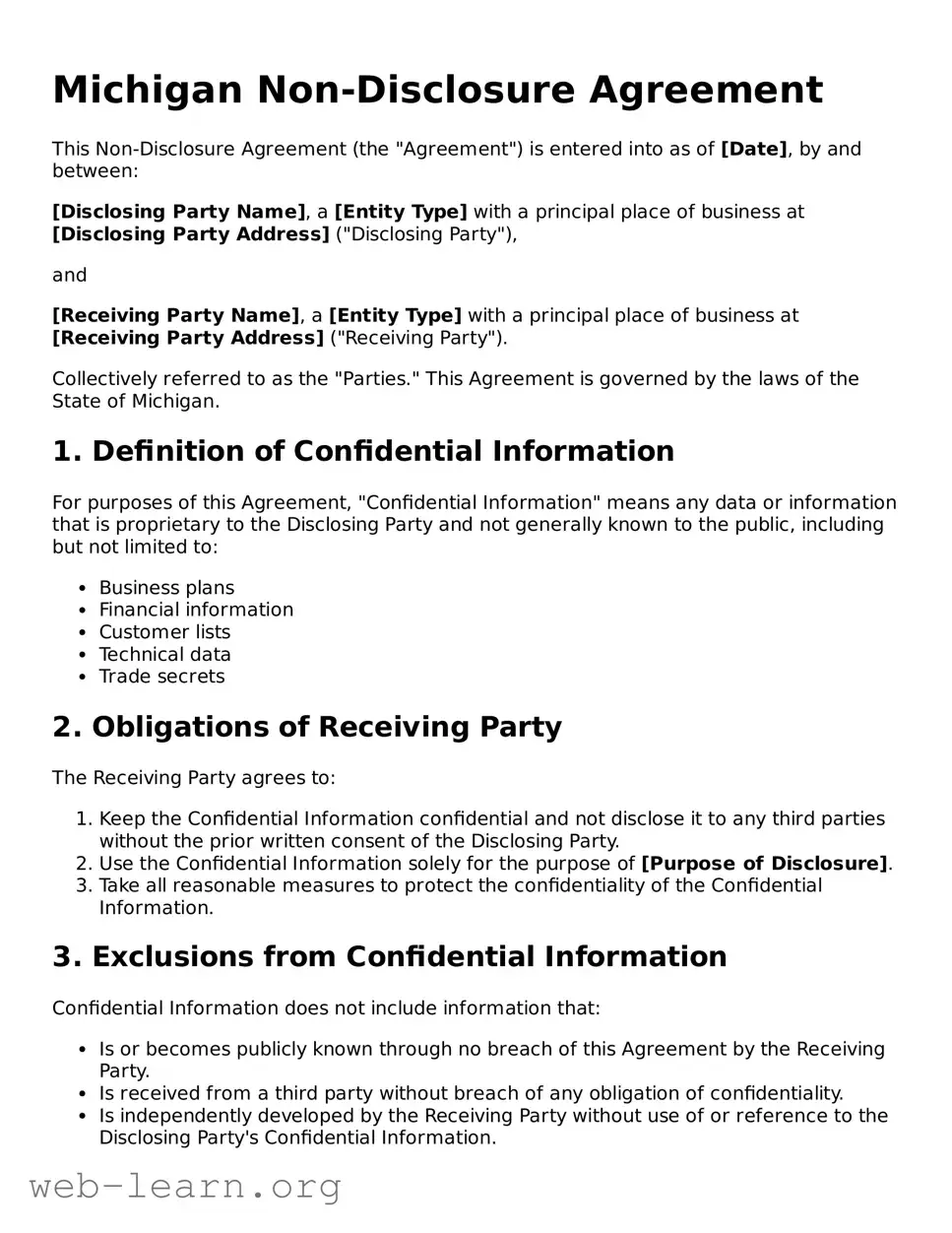
Michigan Non-Disclosure Agreement
This Non-Disclosure Agreement (the "Agreement") is entered into as of [Date], by and between:
[Disclosing Party Name], a [Entity Type] with a principal place of business at [Disclosing Party Address] ("Disclosing Party"),
and
[Receiving Party Name], a [Entity Type] with a principal place of business at [Receiving Party Address] ("Receiving Party").
Collectively referred to as the "Parties." This Agreement is governed by the laws of the State of Michigan.
1. Definition of Confidential Information
For purposes of this Agreement, "Confidential Information" means any data or information that is proprietary to the Disclosing Party and not generally known to the public, including but not limited to:
2. Obligations of Receiving Party
The Receiving Party agrees to:
3. Exclusions from Confidential Information
Confidential Information does not include information that:
4. Term
This Agreement shall commence on the date first written above and shall continue in effect until [Termination Date] or until terminated by either party with [Number of Days] days written notice to the other party.
5. Governing Law
This Agreement shall be governed by and construed in accordance with the laws of the State of Michigan.
6. Miscellaneous
This Agreement constitutes the entire understanding between the Parties regarding the subject matter hereof and supersedes all prior agreements and understandings, whether written or oral.
IN WITNESS WHEREOF, the Parties have executed this Non-Disclosure Agreement as of the date first above written.
Disclosing Party:
______________________________
[Disclosing Party Name]
Receiving Party:
______________________________
[Receiving Party Name]
| Fact Name | Details |
|---|---|
| Definition | A Michigan Non-disclosure Agreement (NDA) is a legal contract that protects confidential information shared between parties. |
| Governing Law | The NDA is governed by Michigan state law, specifically the Michigan Uniform Trade Secrets Act. |
| Purpose | It prevents the unauthorized disclosure of sensitive information, such as trade secrets or proprietary data. |
| Enforceability | The agreement is enforceable in Michigan courts, provided it meets the necessary legal requirements. |
| Duration | The duration of confidentiality obligations can vary, but it is typically defined within the agreement itself. |
After obtaining the Michigan Non-disclosure Agreement form, you will need to complete it accurately to ensure that all necessary information is provided. Follow these steps to fill out the form correctly.
Once you have completed the form, ensure that both parties retain a copy for their records. This will help in maintaining clarity regarding the terms outlined in the agreement.
What is a Non-disclosure Agreement (NDA)?
A Non-disclosure Agreement, commonly referred to as an NDA, is a legal contract designed to protect confidential information. It establishes a relationship between parties where one or both agree not to disclose certain information to third parties. This is particularly important in business settings where sensitive information is shared.
Why is an NDA important in Michigan?
In Michigan, as in other states, an NDA is crucial for safeguarding trade secrets and proprietary information. It helps businesses maintain their competitive edge by ensuring that sensitive data, such as client lists, business strategies, or financial information, remains confidential. By having an NDA in place, parties can confidently share information without fear of it being misused.
Who should use a Michigan NDA?
Any individual or organization that plans to share confidential information should consider using an NDA. This includes:
What information is typically covered in an NDA?
An NDA generally covers a wide range of confidential information, including but not limited to:
It is essential to clearly define what constitutes confidential information in the agreement to avoid any ambiguity.
How long does the confidentiality obligation last?
The duration of the confidentiality obligation can vary based on the terms set in the NDA. Typically, it lasts for a specified period, which could range from a few years to indefinitely, depending on the nature of the information. It is advisable to discuss and agree upon this duration before signing the agreement.
What happens if someone breaches the NDA?
If a party breaches the NDA, the injured party may seek legal remedies. This could include monetary damages, injunctive relief, or other legal actions to prevent further disclosure. It is crucial to have a clear understanding of the consequences outlined in the NDA to ensure that all parties are aware of their responsibilities.
Can an NDA be modified after it is signed?
Yes, an NDA can be modified, but this typically requires the consent of all parties involved. Any changes should be documented in writing and signed by all parties to ensure that the modifications are legally binding. Always keep a copy of the original agreement and any amendments for your records.
Is it necessary to have a lawyer review the NDA?
While it is not mandatory to have a lawyer review an NDA, it is highly recommended. A legal professional can help ensure that the agreement is comprehensive, clear, and enforceable. They can also provide guidance on specific terms that may need to be included based on the unique circumstances of your situation.
When individuals fill out the Michigan Non-disclosure Agreement (NDA) form, several common mistakes can lead to complications or misunderstandings. One frequent error is failing to clearly define the confidential information. A vague description can create confusion about what is protected under the agreement. It is essential to specify the types of information considered confidential to avoid disputes later on.
Another mistake involves not identifying the parties involved. The NDA should clearly state who is bound by the agreement. Omitting a party or incorrectly naming them can render the agreement ineffective. Ensuring that all parties are properly identified helps establish accountability and clarity.
People often neglect to include the duration of the confidentiality obligation. An NDA should specify how long the information must remain confidential. Without a defined time frame, the agreement may lack enforceability. This oversight can lead to uncertainty about the expectations and responsibilities of the parties involved.
Inadequate consideration of exceptions to confidentiality is another common pitfall. Many individuals overlook the need to outline situations where disclosure is permissible. For example, if the information becomes public knowledge or is required by law to be disclosed, those exceptions should be clearly articulated. Failing to include these details can limit the effectiveness of the NDA.
Additionally, people sometimes forget to review the agreement for completeness. An incomplete NDA may lead to misunderstandings or legal challenges. All relevant sections should be filled out thoroughly, and any necessary signatures should be obtained. Neglecting this step can undermine the agreement's validity.
Lastly, individuals may not seek legal advice before finalizing the NDA. While it may seem straightforward, consulting with a legal professional can provide insights that help avoid pitfalls. Legal experts can offer guidance on language, enforceability, and specific state laws that may affect the NDA. Skipping this step can lead to significant issues down the line.
A Michigan Non-disclosure Agreement (NDA) is a crucial document that protects confidential information shared between parties. When entering into an NDA, several other forms and documents may also be relevant to ensure comprehensive legal protection and clarity. Below is a list of commonly used documents that often accompany an NDA in Michigan.
These documents can work together with the Michigan Non-disclosure Agreement to create a robust framework for protecting confidential information. Understanding each document's purpose and how they complement one another is essential for effective legal preparation.
When filling out the Michigan Non-disclosure Agreement form, it’s important to follow certain guidelines to ensure the document is completed correctly. Here are some dos and don’ts to keep in mind:
Understanding the Michigan Non-disclosure Agreement (NDA) form can be challenging, especially with common misconceptions surrounding it. Here are four prevalent myths and the truths behind them:
This is not true. Non-disclosure agreements can be beneficial for businesses of any size, including small startups and individual entrepreneurs. They help protect sensitive information regardless of the scale of the operation.
While NDAs are often associated with trade secrets, they can also protect other types of confidential information, such as client lists, marketing strategies, and proprietary processes. Any sensitive information that a party wishes to keep private can be covered by an NDA.
This is misleading. An NDA restricts sharing specific confidential information, but it does not prohibit all communication. Parties can still discuss general ideas or information that is not covered by the agreement.
While NDAs are generally enforceable, they must meet certain legal standards to be valid. If an NDA is overly broad or vague, a court may not uphold it. It’s essential for the terms to be clear and reasonable.
When filling out and using the Michigan Non-disclosure Agreement (NDA) form, consider the following key takeaways: