In the competitive landscape of Michigan's job market, employers often seek to protect their business interests through non-compete agreements. These legal documents serve as a safeguard, preventing employees from engaging in similar work with competitors for a specified period after leaving their current position. The Michigan Non-compete Agreement form outlines essential elements such as the duration of the restriction, the geographical area it covers, and the specific activities that are limited. It also emphasizes the need for mutual consideration, ensuring that both parties understand their rights and obligations. By clearly defining the terms of the agreement, this form aims to balance the interests of employers in safeguarding trade secrets and proprietary information while allowing employees the freedom to pursue their careers. Understanding the nuances of this form is crucial for both employers and employees, as it can significantly impact future employment opportunities and business operations.
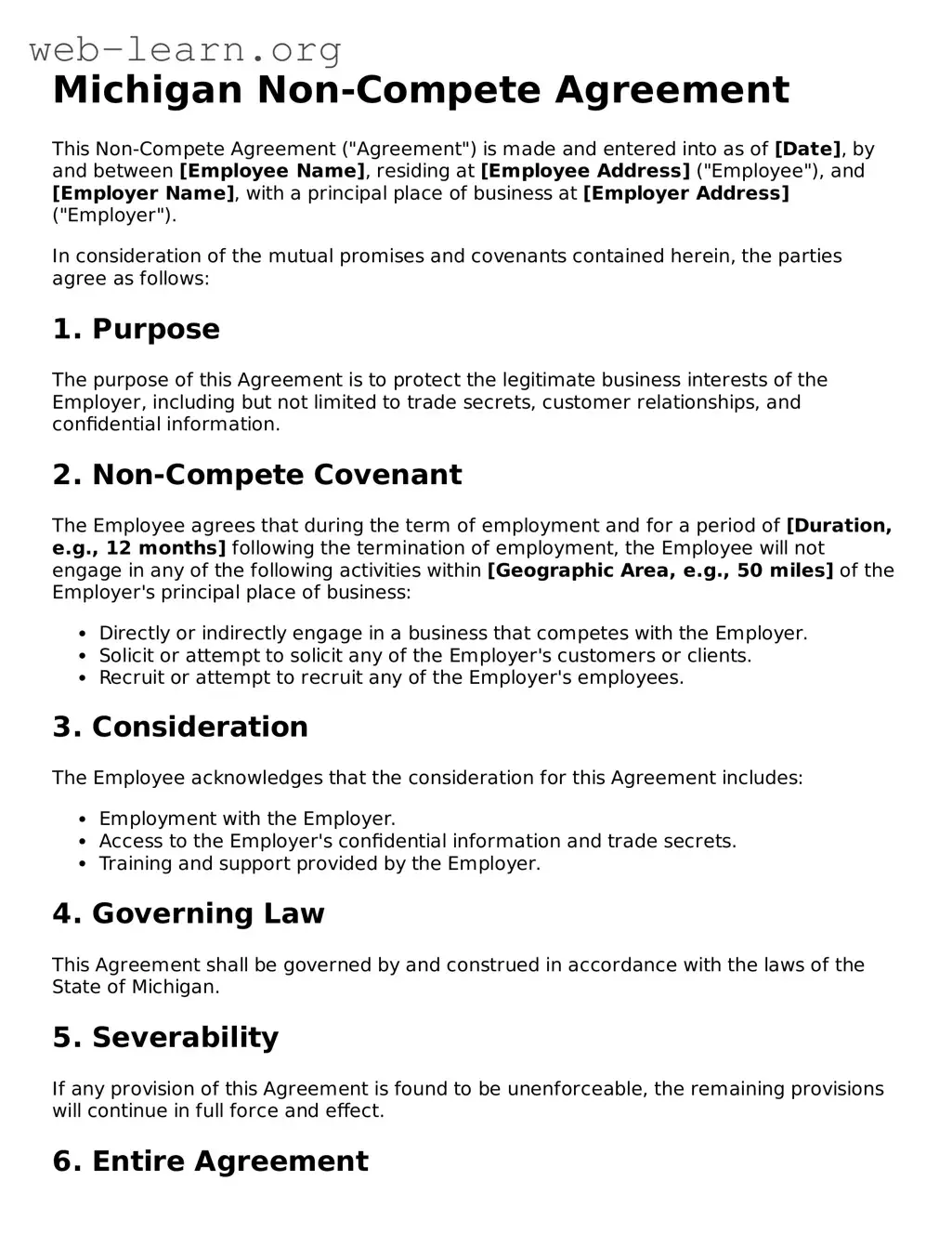
Michigan Non-Compete Agreement
This Non-Compete Agreement ("Agreement") is made and entered into as of [Date], by and between [Employee Name], residing at [Employee Address] ("Employee"), and [Employer Name], with a principal place of business at [Employer Address] ("Employer").
In consideration of the mutual promises and covenants contained herein, the parties agree as follows:
1. Purpose
The purpose of this Agreement is to protect the legitimate business interests of the Employer, including but not limited to trade secrets, customer relationships, and confidential information.
2. Non-Compete Covenant
The Employee agrees that during the term of employment and for a period of [Duration, e.g., 12 months] following the termination of employment, the Employee will not engage in any of the following activities within [Geographic Area, e.g., 50 miles] of the Employer's principal place of business:
3. Consideration
The Employee acknowledges that the consideration for this Agreement includes:
4. Governing Law
This Agreement shall be governed by and construed in accordance with the laws of the State of Michigan.
5. Severability
If any provision of this Agreement is found to be unenforceable, the remaining provisions will continue in full force and effect.
6. Entire Agreement
This Agreement constitutes the entire understanding between the parties regarding the subject matter hereof and supersedes all prior discussions and agreements.
IN WITNESS WHEREOF, the parties have executed this Non-Compete Agreement as of the date first above written.
Employer: _______________________________ Date: _______________
Employee: _______________________________ Date: _______________
| Fact Name | Description |
|---|---|
| Definition | A non-compete agreement restricts an employee from working for competitors after leaving a job. |
| Governing Law | The Michigan Non-Compete Agreement is governed by Michigan law, specifically MCL 445.774a. |
| Enforceability | In Michigan, non-compete agreements must be reasonable in scope, duration, and geographic area to be enforceable. |
| Consideration | For a non-compete agreement to be valid, there must be consideration, such as a job offer or a promotion. |
| Duration | Agreements that last for one to two years are often considered reasonable in Michigan. |
| Employee Rights | Employees have the right to challenge non-compete agreements in court if they believe the terms are unfair. |
Completing the Michigan Non-compete Agreement form is a straightforward process that requires attention to detail. Once filled out correctly, the form will serve as a formal document outlining the terms of the agreement between the parties involved.
What is a Non-compete Agreement in Michigan?
A Non-compete Agreement is a contract between an employer and an employee that restricts the employee from working for competitors or starting a competing business for a specified period after leaving the company. In Michigan, these agreements are enforceable but must meet certain criteria to be valid.
What are the key components of a valid Non-compete Agreement?
For a Non-compete Agreement to be enforceable in Michigan, it should include:
How long can a Non-compete Agreement last?
The duration of a Non-compete Agreement in Michigan can vary, but it typically ranges from six months to two years. Courts often assess whether the time frame is reasonable based on the specific industry and circumstances.
Are there any geographical restrictions in a Non-compete Agreement?
Yes, a Non-compete Agreement should specify a geographical area where the restrictions apply. The area must be reasonable and related to the employer's business interests. For example, it could cover a specific city, county, or state.
Can an employee negotiate the terms of a Non-compete Agreement?
Absolutely. Employees have the right to negotiate the terms of a Non-compete Agreement before signing. It's advisable to discuss any concerns with the employer and seek modifications that make the agreement more acceptable.
What happens if I violate a Non-compete Agreement?
If an employee violates a Non-compete Agreement, the employer may take legal action. This can include seeking an injunction to prevent the employee from working for a competitor or pursuing damages for any losses incurred due to the violation.
Are there any exceptions to Non-compete Agreements in Michigan?
Yes, certain exceptions exist. For instance, Non-compete Agreements may not be enforceable against employees in specific professions, such as low-wage workers. Additionally, if the agreement is deemed overly broad or unreasonable, a court may refuse to enforce it.
How can I ensure my Non-compete Agreement is enforceable?
To enhance the enforceability of a Non-compete Agreement, it should be clear, reasonable, and tailored to protect legitimate business interests. Consulting with a legal professional can help ensure that the agreement meets all necessary criteria and complies with Michigan law.
When filling out the Michigan Non-compete Agreement form, many individuals make critical mistakes that can jeopardize their rights and future employment opportunities. Understanding these pitfalls is essential for anyone entering into such agreements.
One common mistake is failing to clearly define the scope of the agreement. A non-compete should specify the type of work that is restricted after leaving a job. Vague language can lead to confusion and potential legal disputes. Always ensure that the terms are precise and understandable.
Another frequent error involves overlooking the geographic limitations. Non-compete agreements should outline the specific areas where the restrictions apply. If this aspect is not clearly articulated, it may lead to enforcement issues down the line. Always double-check that the geographic scope is reasonable and justifiable.
Many individuals also neglect to consider the duration of the restrictions. Non-compete agreements must have a defined time frame. An overly lengthy duration may render the agreement unenforceable in Michigan. Be sure to strike a balance between protecting the employer’s interests and allowing for future employment opportunities.
Additionally, failing to review the consideration offered in exchange for signing the agreement is another mistake. In Michigan, there must be something of value provided to the employee, such as a job offer or a promotion. Without adequate consideration, the agreement may not hold up in court.
Another critical oversight is not seeking legal advice before signing. Many individuals assume they understand the implications of the agreement, but the nuances can be complex. Consulting with a legal expert can provide clarity and help avoid potential pitfalls.
Moreover, some people mistakenly believe that non-compete agreements are universally enforceable. In Michigan, the enforceability of these agreements depends on various factors, including reasonableness and the specific circumstances of the employment. Always verify that the terms align with Michigan law to avoid unexpected consequences.
Finally, failing to keep a copy of the signed agreement can lead to complications later. It’s vital to retain a copy for your records, as it serves as a reference point for understanding your obligations. This simple step can save you from confusion and potential legal issues in the future.
The Michigan Non-compete Agreement is a vital tool for employers seeking to protect their business interests. However, several other documents often accompany this agreement to ensure comprehensive legal protection and clarity for both parties involved. Below is a list of related forms and documents that are commonly used alongside the Michigan Non-compete Agreement.
Utilizing these documents in conjunction with the Michigan Non-compete Agreement can help establish a clearer understanding between employers and employees. By ensuring all parties are on the same page, these forms provide a robust framework for managing expectations and protecting business interests.
The Non-compete Agreement is a crucial document in the business world, primarily aimed at protecting a company's interests. However, it shares similarities with several other legal documents. Here’s a look at eight documents that resemble a Non-compete Agreement:
Understanding these documents can help individuals and businesses navigate the complexities of contractual relationships. Each serves a specific purpose, but they all share a common goal: to protect interests and maintain fairness in business dealings.
When filling out the Michigan Non-compete Agreement form, it’s crucial to approach the process with care. Here are some important dos and don’ts to keep in mind:
Many people have misunderstandings about the Michigan Non-compete Agreement form. Here are four common misconceptions, along with clarifications to help you navigate this important legal document.
When it comes to filling out and using the Michigan Non-compete Agreement form, there are several important points to keep in mind. Understanding these key takeaways can help ensure that the agreement is effective and enforceable.
By keeping these takeaways in mind, both employers and employees can navigate the complexities of non-compete agreements more effectively.
Nys Non Compete - Non-compete Agreements may require careful consideration and negotiation.
Non Compete Agreement Indiana - This form helps to clarify expectations between employer and employee regarding future employment.
Are Non Competes Enforceable in Florida - It is advisable to document any discussions regarding the agreement.