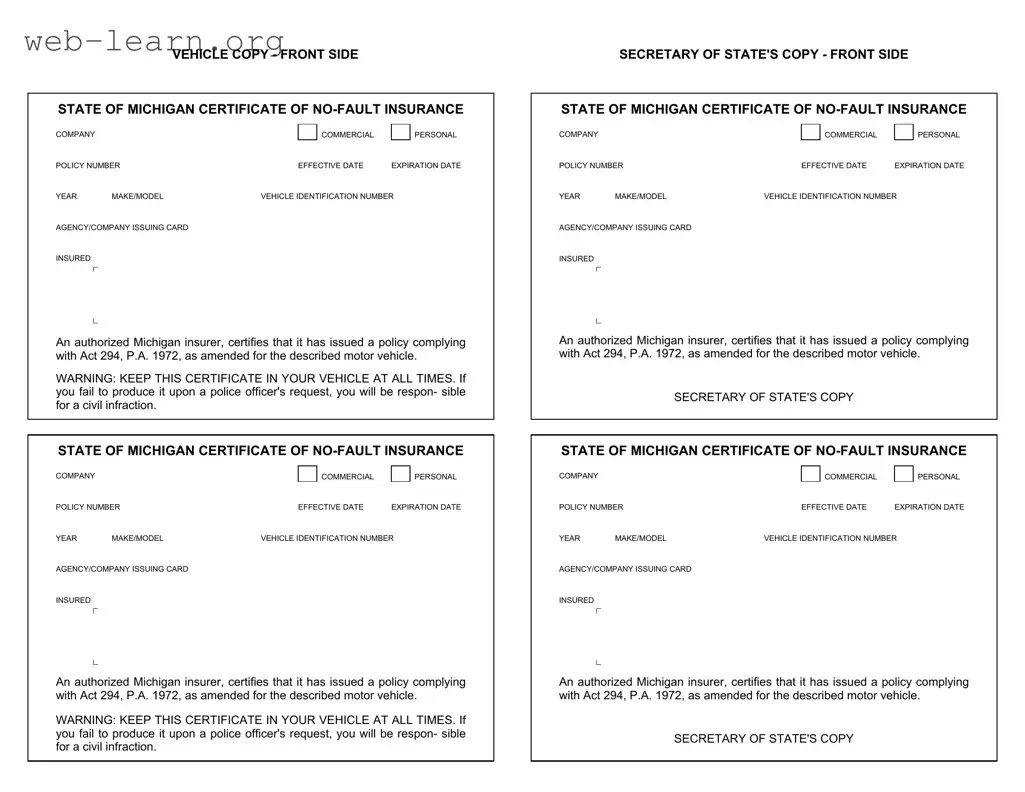
In Michigan, the No Fault Insurance form serves as a vital document for vehicle owners, ensuring compliance with state insurance laws. This form includes essential details such as the policy number, effective and expiration dates, and the vehicle's make, model, and identification number. It is issued by an authorized Michigan insurer, confirming that the vehicle is covered under a policy that meets the requirements of Act 294, P.A. 1972. The form must be kept in the vehicle at all times, as failure to produce it upon a police officer's request can lead to a civil infraction. Additionally, the form is necessary when applying for license plates, reinforcing the importance of having valid insurance coverage. It also outlines the legal responsibilities of vehicle owners, including the consequences of operating a vehicle without proper insurance. Notably, the form warns that if a named excluded person drives the vehicle, all liability coverage becomes void, leaving the vehicle uninsured. Understanding the implications of this form is crucial for all Michigan drivers, as it not only protects them legally but also ensures their peace of mind on the road.

VEHICLE COPY - FRONT SIDE
STATE OF MICHIGAN CERTIFICATE OF
COMPANY |
|
|
|
COMMERCIAL |
|
PERSONAL |
POLICY NUMBER |
|
EFFECTIVE DATE |
EXPIRATION DATE |
|||
YEAR |
MAKE/MODEL |
VEHICLE IDENTIFICATION NUMBER |
||||
AGENCY/COMPANY ISSUING CARD
INSURED
An authorized Michigan insurer, certifies that it has issued a policy complying with Act 294, P.A. 1972, as amended for the described motor vehicle.
WARNING: KEEP THIS CERTIFICATE IN YOUR VEHICLE AT ALL TIMES. If you fail to produce it upon a police officer's request, you will be respon- sible for a civil infraction.
STATE OF MICHIGAN CERTIFICATE OF
COMPANY |
|
|
|
COMMERCIAL |
|
PERSONAL |
POLICY NUMBER |
|
EFFECTIVE DATE |
EXPIRATION DATE |
|||
YEAR |
MAKE/MODEL |
VEHICLE IDENTIFICATION NUMBER |
||||
AGENCY/COMPANY ISSUING CARD
INSURED
An authorized Michigan insurer, certifies that it has issued a policy complying with Act 294, P.A. 1972, as amended for the described motor vehicle.
WARNING: KEEP THIS CERTIFICATE IN YOUR VEHICLE AT ALL TIMES. If you fail to produce it upon a police officer's request, you will be respon- sible for a civil infraction.
SECRETARY OF STATE'S COPY - FRONT SIDE
STATE OF MICHIGAN CERTIFICATE OF
COMPANY |
|
|
|
COMMERCIAL |
|
PERSONAL |
POLICY NUMBER |
|
EFFECTIVE DATE |
EXPIRATION DATE |
|||
YEAR |
MAKE/MODEL |
VEHICLE IDENTIFICATION NUMBER |
||||
AGENCY/COMPANY ISSUING CARD
INSURED
An authorized Michigan insurer, certifies that it has issued a policy complying with Act 294, P.A. 1972, as amended for the described motor vehicle.
SECRETARY OF STATE'S COPY
STATE OF MICHIGAN CERTIFICATE OF
COMPANY |
|
|
|
COMMERCIAL |
|
PERSONAL |
POLICY NUMBER |
|
EFFECTIVE DATE |
EXPIRATION DATE |
|||
YEAR |
MAKE/MODEL |
VEHICLE IDENTIFICATION NUMBER |
||||
AGENCY/COMPANY ISSUING CARD
INSURED
An authorized Michigan insurer, certifies that it has issued a policy complying with Act 294, P.A. 1972, as amended for the described motor vehicle.
SECRETARY OF STATE'S COPY

SECRETARY OF STATE'S COPY - REVERSE SIDE |
VEHICLE COPY - REVERSE SIDE |
Michigan Law (MCLA 500.3101) requires that the owner or registrant of a motor vehicle regis- tered in this state must have insurance or other approved security for the payment of
An owner or registrant convicted of such a misdemeanor shall be fined not less than $200.00 nor more than $500.00, or imprisoned for not more than 1 year, or both.
THIS FORM MUST BE PRESENTED AS EVIDENCE OF INSURANCE WITH YOUR APPLICA- TION FOR LICENSE PLATES, EITHER BY MAIL OR AT ANY SECRETARY OF STATE LICENSE PLATE BRANCH OFFICE. A PERSON WHO ISSUES OR WHO SUPPLIES FALSE INFORMA- TION TO THE SECRETARY OF STATE OR USES AN INVALID CERTIFICATE OF INSURANCE IS GUILTY OF A MISDEMEANOR PUNISHABLE BY IMPRISONMENT FOR NOT MORE THAN 1 YEAR, OR A FINE OF NOT MORE THAN $1,000.00, OR BOTH.
If this vehicle is driven by the person(s) named below, residual liability insurance does not apply and the vehicle will be considered uninsured:
WARNING - when a named excluded person operates a vehicle, all liability coverage is void - no one is insured. Owners of the vehicle and others legally responsible for the acts of the named excluded person remain fully responsible.
ACORD 50 MI (2007/12) |
© 1993, 2007 ACORD CORPORATION. All rights reserved. |
Michigan Law (MCLA 500.3101) requires that the owner or registrant of a motor vehicle regis- tered in this state must have insurance or other approved security for the payment of
An owner or registrant convicted of such a misdemeanor shall be fined not less than $200.00 nor more than $500.00, or imprisoned for not more than 1 year, or both.
THIS FORM MUST BE PRESENTED AS EVIDENCE OF INSURANCE WITH YOUR APPLICA- TION FOR LICENSE PLATES, EITHER BY MAIL OR AT ANY SECRETARY OF STATE LICENSE PLATE BRANCH OFFICE. A PERSON WHO ISSUES OR WHO SUPPLIES FALSE INFORMA- TION TO THE SECRETARY OF STATE OR USES AN INVALID CERTIFICATE OF INSURANCE IS GUILTY OF A MISDEMEANOR PUNISHABLE BY IMPRISONMENT FOR NOT MORE THAN 1 YEAR, OR A FINE OF NOT MORE THAN $1,000.00, OR BOTH.
If this vehicle is driven by the person(s) named below, residual liability insurance does not apply and the vehicle will be considered uninsured:
WARNING - when a named excluded person operates a vehicle, all liability coverage is void - no one is insured. Owners of the vehicle and others legally responsible for the acts of the named excluded person remain fully responsible.
ACORD 50 MI (2007/12) |
© 1993, 2007 ACORD CORPORATION. All rights reserved. |
Michigan Law (MCLA 500.3101) requires that the owner or registrant of a motor vehicle regis- tered in this state must have insurance or other approved security for the payment of
An owner or registrant convicted of such a misdemeanor shall be fined not less than $200.00 nor more than $500.00, or imprisoned for not more than 1 year, or both.
A PERSON WHO SUPPLIES FALSE INFORMATION TO THE SECRETARY OF STATE OR WHO ISSUES OR USES AN INVALID CERTIFICATE OF INSURANCE IS GUILTY OF A MISDEMEAN- OR PUNISHABLE BY IMPRISONMENT FOR NOT MORE THAN 1 YEAR, OR A FINE OF NOT MORE THAN $1,000.00, OR BOTH.
If this vehicle is driven by the person(s) named below, residual liability insurance does not apply and the vehicle will be considered uninsured:
WARNING - when a named excluded person operates a vehicle, all liability coverage is void - no one is insured. Owners of the vehicle and others legally responsible for the acts of the named excluded person remain fully responsible.
ACORD 50 MI (2007/12) |
© 1993, 2007 ACORD CORPORATION. All rights reserved. |
Michigan Law (MCLA 500.3101) requires that the owner or registrant of a motor vehicle regis- tered in this state must have insurance or other approved security for the payment of
An owner or registrant convicted of such a misdemeanor shall be fined not less than $200.00 nor more than $500.00, or imprisoned for not more than 1 year, or both.
A PERSON WHO SUPPLIES FALSE INFORMATION TO THE SECRETARY OF STATE OR WHO ISSUES OR USES AN INVALID CERTIFICATE OF INSURANCE IS GUILTY OF A MISDEMEAN- OR PUNISHABLE BY IMPRISONMENT FOR NOT MORE THAN 1 YEAR, OR A FINE OF NOT MORE THAN $1,000.00, OR BOTH.
If this vehicle is driven by the person(s) named below, residual liability insurance does not apply and the vehicle will be considered uninsured:
WARNING - when a named excluded person operates a vehicle, all liability coverage is void - no one is insured. Owners of the vehicle and others legally responsible for the acts of the named excluded person remain fully responsible.
ACORD 50 MI (2007/12) |
© 1993, 2007 ACORD CORPORATION. All rights reserved. |
| Fact Name | Fact Description |
|---|---|
| Governing Law | The Michigan No Fault Insurance form is governed by Act 294, P.A. 1972, as amended. |
| Insurance Requirement | Michigan law mandates that all registered motor vehicles must have no-fault insurance or approved security at all times. |
| Failure to Produce | If a driver fails to present the certificate upon request by a police officer, it results in a civil infraction. |
| Misdemeanor Penalty | Driving without proper insurance can lead to a misdemeanor charge, with fines ranging from $200 to $500, or imprisonment for up to one year. |
| Evidence of Insurance | This form must be submitted as proof of insurance when applying for license plates in Michigan. |
| False Information | Providing false information to the Secretary of State regarding insurance is a misdemeanor, punishable by a fine of up to $1,000 or imprisonment for up to one year. |
| Exclusion Clause | If a named excluded person operates the vehicle, all liability coverage becomes void, and the vehicle is deemed uninsured. |
| Agency Information | The form includes details about the issuing agency or company, ensuring transparency in the insurance process. |
Completing the Michigan No Fault Insurance form is essential for ensuring compliance with state law. This form must be submitted with your application for license plates. Follow these steps carefully to fill out the form accurately.
What is the Michigan No Fault Insurance form?
The Michigan No Fault Insurance form is a document that certifies a motor vehicle is covered by a no-fault insurance policy, as required by Michigan law. This form must be issued by an authorized Michigan insurer and contains essential information such as the policy number, effective dates, and vehicle details.
Why do I need to keep the No Fault Insurance form in my vehicle?
It is crucial to keep this form in your vehicle at all times. If a police officer requests to see proof of insurance and you cannot provide it, you may be held responsible for a civil infraction. This could result in fines or other penalties.
What happens if I drive without the No Fault Insurance form?
Driving without the No Fault Insurance form can lead to serious consequences. Under Michigan law, operating a vehicle without proper insurance is considered a misdemeanor. Penalties may include fines ranging from $200 to $500, imprisonment for up to one year, or both.
How do I obtain the Michigan No Fault Insurance form?
You can obtain the No Fault Insurance form from your insurance provider. When you purchase a no-fault insurance policy, your insurer will provide you with this certificate. Ensure that the information is accurate and up-to-date.
What information is included on the No Fault Insurance form?
The form includes several key pieces of information, such as:
What are the consequences of providing false information on the form?
Providing false information or using an invalid certificate of insurance is a serious offense. If convicted, you may face a misdemeanor charge, which can result in imprisonment for up to one year, a fine of up to $1,000, or both.
What should I do if my No Fault Insurance form is lost or damaged?
If your No Fault Insurance form is lost or damaged, contact your insurance provider immediately. They can issue a replacement certificate. It is important to have a valid form on hand to avoid potential legal issues.
Filling out the Michigan No Fault Insurance form can be straightforward, but many make common mistakes that can lead to complications. One frequent error is failing to provide accurate information about the vehicle. This includes the vehicle identification number (VIN), make, model, and year. Inaccuracies in these details can result in delays or even denial of insurance coverage.
Another mistake people often make is neglecting to check the effective and expiration dates of their insurance policy. If the dates are incorrect, it could suggest that the policy is not valid. This oversight can lead to significant legal and financial repercussions, especially if an accident occurs.
Many individuals also forget to include the policy number. This number is crucial for identifying the specific insurance coverage associated with the vehicle. Without it, insurance claims may be difficult to process, and authorities may question the validity of the insurance.
Some applicants fail to sign the form. A signature is not just a formality; it indicates that the information provided is true and that the applicant understands the terms of the insurance. Without a signature, the form may be considered incomplete, causing further delays.
Additionally, people sometimes overlook the importance of keeping the certificate in the vehicle at all times. Michigan law requires this certificate to be readily available. If a police officer requests it and it cannot be produced, the driver may face civil infractions.
Lastly, providing false information on the form is a serious mistake. This can lead to criminal charges, including fines or imprisonment. Honesty is essential when filling out the No Fault Insurance form to avoid severe consequences.
When dealing with Michigan's No Fault Insurance, several other forms and documents are often necessary to ensure compliance and proper documentation. These documents serve different purposes, from verifying coverage to providing proof of registration. Below is a list of common forms that accompany the No Fault Insurance form.
Understanding these documents can help ensure that all requirements are met and that you are protected while driving in Michigan. Keeping these forms organized and accessible is a smart practice for any vehicle owner.
The Michigan No Fault Insurance form shares similarities with several other important documents related to vehicle insurance and registration. Below is a list of seven such documents, each with a brief explanation of its relationship to the Michigan No Fault Insurance form.
When filling out the Michigan No Fault Insurance form, it is crucial to ensure accuracy and compliance with the state's requirements. Here are some essential dos and don’ts to keep in mind:
By following these guidelines, you can help ensure that your insurance documentation is processed smoothly and that you remain compliant with Michigan law.
There are several misconceptions regarding the Michigan No Fault Insurance form. Understanding these misconceptions can help vehicle owners comply with state laws and avoid penalties.
Filling out and using the Michigan No Fault Insurance form correctly is essential for compliance with state laws. Here are some key takeaways to keep in mind:
By following these guidelines, you can navigate the Michigan No Fault Insurance requirements with confidence and stay compliant with state laws.