In Michigan, the Motor Vehicle Power of Attorney form serves as a crucial tool for individuals who need to delegate authority regarding their vehicle to another person. This legal document allows one person, known as the principal, to appoint an agent to handle specific tasks related to their motor vehicle, such as signing documents for title transfers, registration, or even selling the vehicle. It is particularly useful in situations where the principal cannot be present to complete these transactions, whether due to time constraints, distance, or other obligations. The form ensures that the agent has the necessary authority to act on behalf of the principal, thus streamlining processes that might otherwise be complicated or delayed. Additionally, the document requires signatures from both the principal and the agent, ensuring clarity and mutual agreement on the powers being granted. Understanding the significance and proper use of this form can help individuals navigate vehicle-related transactions more efficiently and with greater peace of mind.
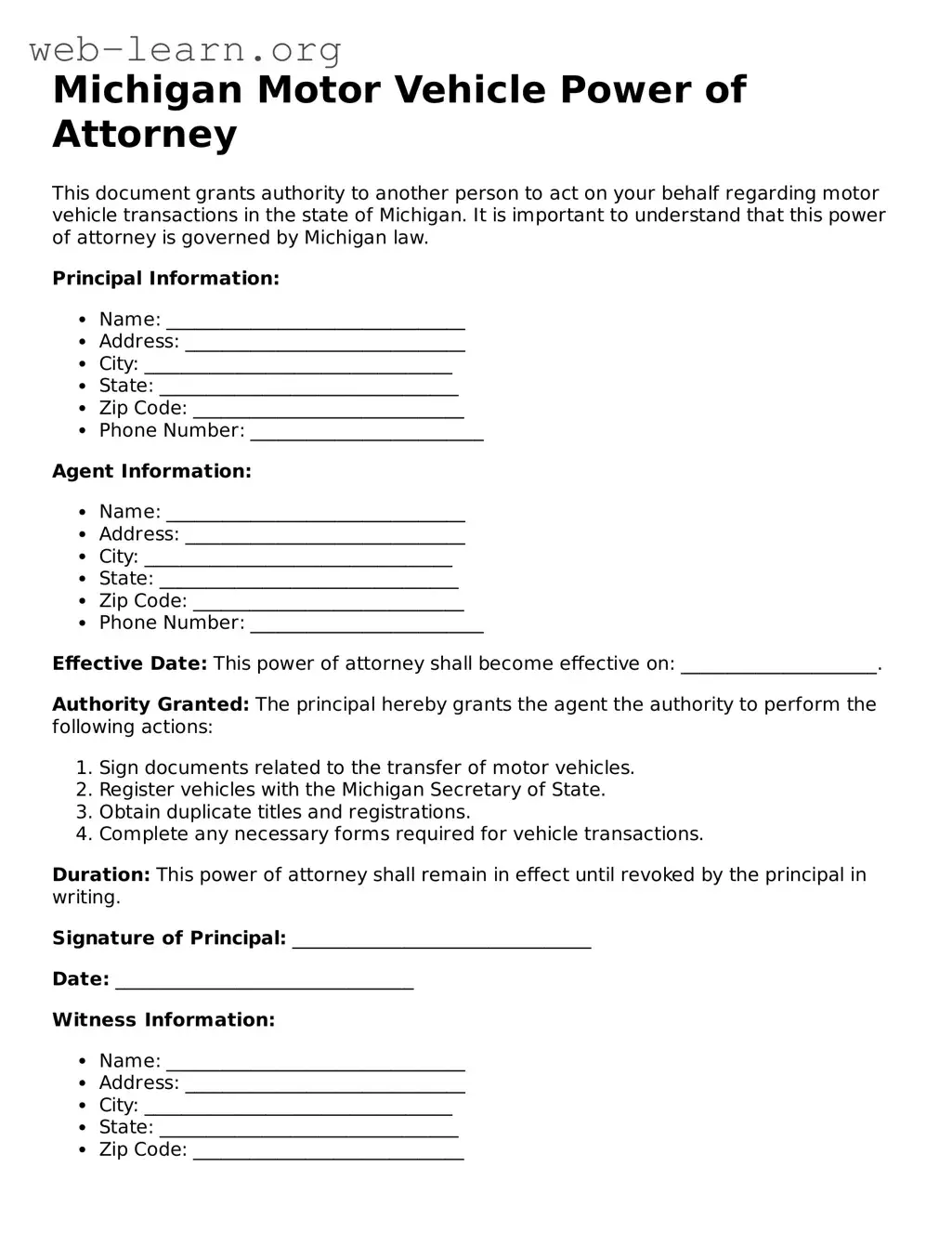
Michigan Motor Vehicle Power of Attorney
This document grants authority to another person to act on your behalf regarding motor vehicle transactions in the state of Michigan. It is important to understand that this power of attorney is governed by Michigan law.
Principal Information:
Agent Information:
Effective Date: This power of attorney shall become effective on: _____________________.
Authority Granted: The principal hereby grants the agent the authority to perform the following actions:
Duration: This power of attorney shall remain in effect until revoked by the principal in writing.
Signature of Principal: ________________________________
Date: ________________________________
Witness Information:
Signature of Witness: ________________________________
Date: ________________________________
| Fact Name | Details |
|---|---|
| Purpose | The Michigan Motor Vehicle Power of Attorney form allows an individual to appoint another person to handle motor vehicle transactions on their behalf. |
| Governing Law | This form is governed by the Michigan Compiled Laws, specifically MCL 700.5501. |
| Eligibility | Any adult resident of Michigan can create a Power of Attorney for motor vehicle transactions. |
| Principal and Agent | The person granting authority is called the principal, while the person receiving authority is known as the agent. |
| Scope of Authority | The agent can perform various tasks, including signing titles, transferring ownership, and registering vehicles. |
| Revocation | The principal can revoke the Power of Attorney at any time, provided they notify the agent and relevant parties. |
| Signature Requirement | The form must be signed by the principal and may require notarization to be valid. |
| Expiration | Unless specified otherwise, the Power of Attorney remains effective until revoked by the principal. |
Filling out the Michigan Motor Vehicle Power of Attorney form is a straightforward process. This form allows you to designate someone to handle specific vehicle-related transactions on your behalf. Once you have completed the form, it is important to ensure that it is signed and dated properly to be considered valid.
After completing these steps, you can provide the signed form to your attorney-in-fact. They can then proceed with the necessary vehicle-related transactions on your behalf.
What is a Michigan Motor Vehicle Power of Attorney form?
The Michigan Motor Vehicle Power of Attorney form is a legal document that allows one person (the principal) to authorize another person (the agent) to act on their behalf regarding motor vehicle transactions. This can include tasks such as registering a vehicle, transferring ownership, or obtaining a title.
Who can be designated as an agent?
Any competent adult can be designated as an agent. This could be a family member, friend, or trusted individual. It’s important to choose someone you trust, as they will have the authority to make decisions regarding your vehicle.
What transactions can the agent perform?
The agent can perform various transactions related to motor vehicles, including:
Do I need to have the form notarized?
Yes, the Michigan Motor Vehicle Power of Attorney form must be notarized to be valid. This means that you will need to sign the document in front of a notary public, who will then verify your identity and witness the signing.
How long is the power of attorney valid?
The power of attorney remains in effect until you revoke it or until the specific task is completed. If you want to terminate the authority granted to the agent, you will need to provide a written notice of revocation.
Can I use this form for multiple vehicles?
Yes, you can use the Michigan Motor Vehicle Power of Attorney form for multiple vehicles. However, it is advisable to clearly specify each vehicle in the document to avoid any confusion regarding which vehicles the agent is authorized to act upon.
What if I change my mind after signing?
If you change your mind after signing the form, you can revoke the power of attorney at any time. To do this, you should create a written revocation notice and provide it to your agent and any relevant parties, such as the Secretary of State.
Is there a fee associated with using this form?
While there is no fee specifically for completing the Motor Vehicle Power of Attorney form itself, there may be fees associated with notary services or any vehicle transactions that your agent undertakes on your behalf. It’s wise to inquire about any potential costs beforehand.
Where can I obtain the Michigan Motor Vehicle Power of Attorney form?
You can obtain the Michigan Motor Vehicle Power of Attorney form from the Michigan Secretary of State's website or at any local Secretary of State office. It’s important to ensure that you are using the most current version of the form.
Filling out the Michigan Motor Vehicle Power of Attorney form can be straightforward, but many individuals make common mistakes that can lead to complications down the road. One frequent error is failing to provide complete and accurate information about the vehicle. This includes the vehicle identification number (VIN), make, model, and year. Omitting any of these details can result in delays or even invalidate the document.
Another mistake is not signing the form correctly. The Power of Attorney must be signed by the principal, which is the person granting authority. If the signature is missing or does not match the name printed on the form, it can create issues when trying to execute the powers granted.
Additionally, many people overlook the importance of having the form notarized. In Michigan, notarization is often required for the Power of Attorney to be considered valid. Without this step, the document may not hold up in legal situations, leaving the designated agent without authority.
Some individuals also fail to specify the powers being granted clearly. The form allows for various powers related to vehicle transactions, but vague language can lead to misunderstandings. It's essential to outline exactly what the agent is authorized to do, whether it’s transferring ownership, signing documents, or handling registration.
Another common oversight involves the date of the signing. Leaving the date blank or entering an incorrect date can lead to confusion regarding the validity of the Power of Attorney. This date is crucial, as it establishes when the authority begins and can affect the timing of any transactions.
Finally, neglecting to keep a copy of the completed form is a mistake that can have significant consequences. The principal should retain a copy for their records, and it’s wise for the agent to have one as well. This ensures that both parties are on the same page regarding the powers granted and can refer back to the document if any questions arise.
The Michigan Motor Vehicle Power of Attorney form is a crucial document that allows one person to authorize another to act on their behalf regarding motor vehicle transactions. When dealing with motor vehicle matters, several other forms and documents may be necessary to ensure a smooth process. Below is a list of commonly used forms that complement the Michigan Motor Vehicle Power of Attorney.
Each of these forms plays a vital role in the management and transfer of vehicle ownership. Understanding and utilizing the appropriate documents can help ensure compliance with Michigan's motor vehicle laws and facilitate smoother transactions.
The Motor Vehicle Power of Attorney form allows someone to act on another person's behalf regarding vehicle-related matters. Several other documents serve similar purposes in different contexts. Here’s a list of documents that share similarities:
When filling out the Michigan Motor Vehicle Power of Attorney form, it is important to follow specific guidelines to ensure the document is valid and effective. Here are seven things you should and shouldn't do:
The Michigan Motor Vehicle Power of Attorney (POA) form allows individuals to appoint someone else to handle specific vehicle-related matters on their behalf. However, several misconceptions often arise regarding its use and implications. Below is a list of common misunderstandings.
Many believe that the POA is limited to transactions like buying or selling a vehicle. In reality, it can also cover tasks such as title transfers, registration renewals, and more.
While legal advice can be beneficial, individuals can complete the form themselves without needing a lawyer. The form is designed for easy use by the general public.
This is not true. You can appoint any trusted individual, whether they are a family member or a friend, as your agent to act on your behalf.
Some people think that once a POA is established, it remains in effect indefinitely. However, you can revoke it at any time as long as you follow the proper procedures.
The Michigan Motor Vehicle POA is specific to Michigan. Other states have their own requirements and forms, which may differ significantly.
This is a misconception. The agent must act in your best interest and cannot use the authority granted for their personal benefit.
While notarization can add an extra layer of authenticity, it is not a strict requirement for the Michigan Motor Vehicle POA to be valid.
Many believe that the POA must be submitted to a government office. In fact, you simply need to keep it on hand for the agent to present when necessary.
This is incorrect. If the POA is durable, it remains effective even if the principal becomes incapacitated, allowing the agent to continue acting on their behalf.
Understanding these misconceptions can help individuals make informed decisions about using the Michigan Motor Vehicle Power of Attorney form effectively.
Here are some key takeaways regarding the Michigan Motor Vehicle Power of Attorney form:
Indiana Vehicle Power of Attorney - It provides a legal framework for someone else to act on your behalf, ensuring compliance with state laws.
How to Get Power of Attorney in Arizona - This form can be a crucial part of your overall estate planning strategy, especially for vehicle assets.
Poa Dmv - A Motor Vehicle Power of Attorney can prevent delays in important vehicle transactions.